How to Improve Operational Efficiency (Without the Corporate Nonsense)
Tired of jargon? Learn how to improve operational efficiency with a simple, honest framework for fixing what’s broken and building what actually works.
Dan Robin
Improving how a business runs isn't about some massive, overnight transformation. It’s more like untangling the hundreds of tiny knots that slow everyone down, day after day.
It all starts with an honest look at how things actually get done, not how they’re supposed to get done. The goal is to build sustainable workflows, not just apply another quick fix. This is the shift that turns chaotic, stressful days into calmer, more productive ones.
The Real Cost of 'Good Enough'
It starts small. A little workaround here, a disconnected spreadsheet there. A manager pulls someone aside to explain a process that isn't written down anywhere. None of these things feel like a big deal on their own.
But they pile up. Before you know it, your entire operation is a patchwork of band-aids held together by a few heroic employees who know all the "tricks." This is what we call operational debt, and it's quietly costing you a fortune.
The Tell-Tale Signs of Operational Drag
Let’s be honest. This isn’t about pointing fingers; it’s about seeing how broken systems force good people into bad habits. The symptoms are everywhere if you know where to look.
Think about the retail associate who has to type the same customer info into two different systems because they don't talk to each other. Or the garbled handoff between nursing shifts that turns patient care into a risky game of telephone. It’s the delayed shipment because the picklist was pulled from an inventory count that was a day old.
These moments aren't just minor annoyances. They are the daily grind for your teams, and they come with a steep price.
The real cost isn’t just in wasted minutes. It’s in the compounded frustration, the risk of burnout, and the slow erosion of your team's ability to do great work. Efficiency isn't about squeezing more out of people; it's about removing the obstacles that hold them back.
Digging Up the Hidden Costs
The most obvious cost is wasted time, which is just another way of saying wasted money. One study found that the average office worker is truly productive for less than three hours a day. Inefficient processes are a huge part of the problem.
But the real damage goes deeper.
To understand the true impact of "good enough," you have to spot the hidden costs. A restaurant that doesn't track inventory meticulously is literally throwing money in the bin every day. Learning about effective methods for reducing food waste in restaurants shows how even small process tweaks can directly pad the bottom line.
These hidden costs show up in a few key ways:
Employee Frustration: Constantly battling broken systems is mentally draining. When talented people spend their energy on workarounds instead of their actual jobs, morale tanks. Good employees start looking for the exit.
Missed Opportunities: Your team can't be proactive or deliver that "wow" customer experience when they're buried under manual tasks. They just don't have the time or the mental bandwidth.
Increased Risk: Every manual data entry, every verbal handoff, is a chance for something to go wrong. These small errors can snowball into major quality problems, safety incidents, or compliance breaches.
The point isn't to make you feel bad about where things are today. It's to build a solid case for why things need to change. Recognizing these real-world pains is the first step toward building something much, much better.
How to Find the Real Bottlenecks
You can’t fix a problem you don’t truly understand. Most advice on improving operational efficiency stays frustratingly vague. The real answers aren’t found in a boardroom. They’re on the floor, in the warehouse, and behind the counter.
To get to the heart of what’s slowing you down, you have to see how work actually gets done. Shadow a nurse during a chaotic shift change. Walk the floor with your warehouse team during peak hours. Follow a support ticket from creation to resolution. The goal is simple: observe and listen.
This isn’t about commissioning some massive analysis. It's about focused, empathetic observation and talking to the people who live your processes every day.
Start by Asking Better Questions
Believe me, your frontline team knows exactly where the problems are. They're the ones inventing clever workarounds and dealing with the fallout from broken processes. Your job is to make it safe enough for them to tell you the truth.
So, ditch the corporate surveys. Grab a coffee and ask simple, direct questions.
“What’s the most frustrating part of your day?”
“If you had a magic wand, what’s the one thing you’d fix about how we do things?”
“Can you show me the step in this process that makes you want to pull your hair out?”
The goal isn't to solve the problem on the spot. It’s to listen. The honest, unfiltered feedback you get is pure gold, revealing the friction points that formal process maps almost always miss.
I've learned that we often assume processes work the way they were designed. The reality? People find ways to get the job done despite the process, not because of it. Finding the real bottlenecks means finding where their energy is spent fighting the system.
You’ll quickly start to notice a pattern. Most of this "operational drag" comes from a few common culprits: workarounds that become the unofficial standard, disconnected tools, and fuzzy instructions that just create confusion.
This is how those small issues compound, turning quick fixes into genuine operational drag.
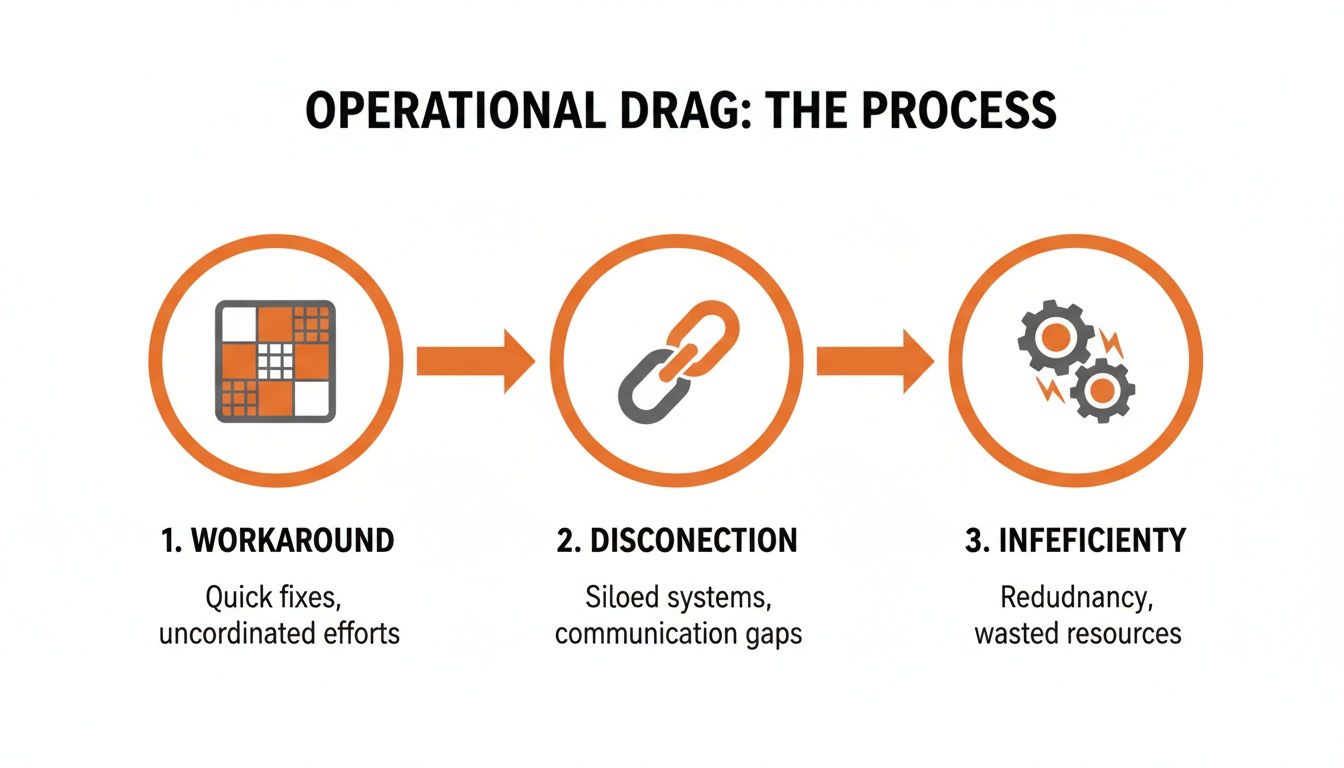
What starts as a simple workaround to a minor headache eventually hardens into a disconnected, inefficient process that wastes everyone's time and energy.
Sort Friction Into Three Buckets
As you gather these real-world insights, you can start sorting them into three buckets. This simple framework helps you diagnose the root cause instead of just chasing symptoms.
Communication Gaps: This is where handoffs fail. Plain and simple. Think of a logistics driver who never gets the last-minute delivery instructions, leading to a missed drop-off. Or in hospitality, the front desk forgets to tell housekeeping a guest checked out early, leaving a room uncleaned for hours. Information gets lost, delayed, or garbled between teams. Learning how to manage workflow dependencies across teams is a game-changer here, as bad handoffs are a primary source of failure.
Tool Chaos: We’ve all seen it: the "death by a thousand apps" problem. It’s the retail manager who has to jump between three different platforms just to build the weekly schedule, approve time off, and then post it for the team. Every time an employee has to switch tools, they lose focus and momentum. The friction isn't in any single tool; it’s in the chaotic space between them.
Process Ambiguity: This happens when people don't have a clear, single source of truth for how to do their jobs. It’s the new healthcare aide who isn't sure of the exact patient transfer protocol because the only guide is buried in an outdated binder. When the "right way" is hard to find, people are forced to guess, which leads to inconsistency and mistakes.
Let’s be honest, this is where unified digital platforms make a huge difference, especially for distributed teams in industries like retail or logistics. A 2025 PwC survey found that 96% of tech and telecom operations leaders gained critical supply chain visibility using AI, cloud, and automation. A single app like Pebb, which brings together chat, tasks, and analytics, does exactly this by closing the gaps between communication, tools, and processes. You can dig into more insights by reading the full PwC report.
Once you start seeing your challenges through these three buckets, the path forward becomes much clearer. You stop chasing symptoms and can finally start fixing the systems themselves.
Redesigning Workflows by Deleting Steps
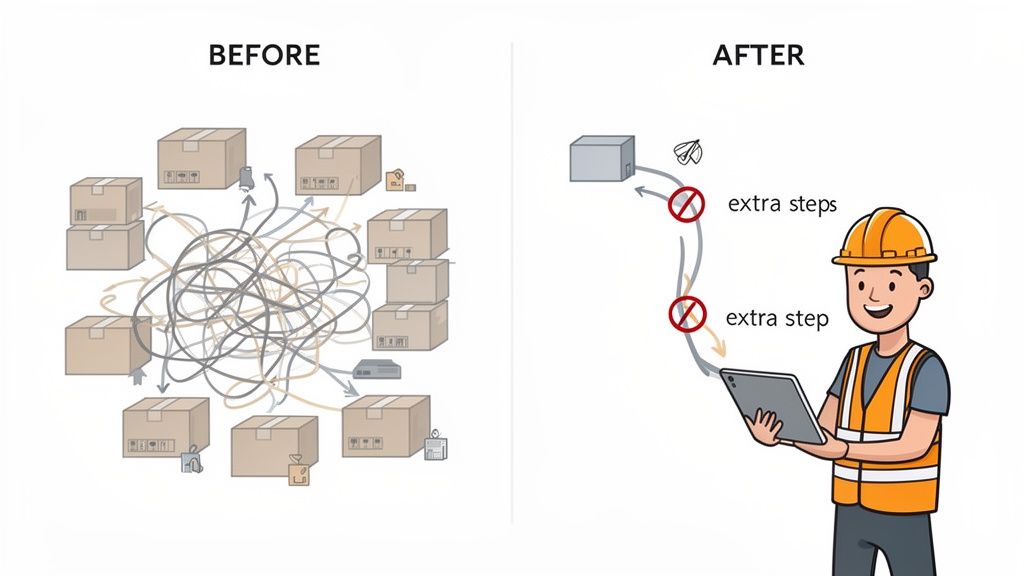
When you spot a problem in your operations, what’s the first instinct? For most of us, it’s to add something. A new tool, another checklist, maybe one more approval step. We’ve been trained to think that improvement comes from adding more.
But I’ve learned the opposite is true. The most impactful way to boost efficiency is to simplify. It’s the art of subtraction—of intentionally deleting steps until only what’s essential is left.
This isn’t about cutting corners. It’s about cutting the clutter.
An Example of Subtraction in the Real World
Let's look at a classic operational headache: the shift changeover at a busy healthcare clinic. In too many places, it’s a chaotic mix of verbal handoffs, sticky notes, and maybe an outdated spreadsheet on a shared computer. The outgoing nurse is mentally exhausted, trying to recall every detail, while the incoming nurse scrambles to keep up.
The old way to "fix" this? Add a mandatory 15-minute debrief and introduce a new, multi-tab Google Sheet. More process, more complexity, more friction.
The better way is to delete. What happens if we strip it all back?
Instead of a verbal handoff and notes and a spreadsheet, we move to a single source of truth. A simple, digital space where the outgoing nurse logs key patient updates, task statuses, and supply needs. The incoming nurse can review it a few minutes before their shift even starts, arriving with complete context.
The handoff becomes a brief, focused confirmation: "I've reviewed the updates in our shift space. Anything I need to know before you head out?"
Suddenly, you’ve deleted the frantic scramble, the lost sticky notes, and the confusing spreadsheet. You’ve replaced ambiguity and repetition with clarity. This is how you build a calmer, more reliable operation—not by adding, but by taking away.
The True Power of a Single Source of Truth
Let's be honest, the real enemy of efficiency is context switching. Every time an employee has to jump from a chat app to an email to a scheduling tool, they lose focus and momentum. A 2024 McKinsey analysis found that companies using AI to target repetitive tasks and information retrieval see productivity jump by 30-40%. You don't need complex AI to apply that same principle to your frontline teams. You can explore more insights on how AI is shaping the future market.
Putting communication, tasks, and knowledge in one place isn’t just a nice-to-have. It fundamentally reduces the cognitive load on your people.
When your team doesn't have to waste mental energy figuring out where to find information or who to ask, they can pour that energy into their actual work. This is the core of thoughtful process design. It’s about making the right thing the easiest thing to do.
It’s easy to spot the difference this makes on the ground. A single source of truth creates clean handoffs, clear ownership, and fewer errors. As work moves between people or teams, all the necessary context moves with it in one predictable place. No more chasing down details. Mistakes love complexity. When you simplify the workflow, you eliminate the cracks where errors hide.
This is what a unified system can bring. We can see the contrast by looking at common operational pain points and how they get resolved when you ditch the fragmented tools.
Diagnosing Operational Drag Before and After Simplification
A look at common symptoms of inefficiency and how a simplified, unified approach directly addresses them.
Operational Symptom | The Old Way (Fragmented Tools) | The New Way (Unified Platform) |
|---|---|---|
Information Silos | Critical updates live in personal chats, emails, and sticky notes. Finding information is a scavenger hunt. | All communication, tasks, and files related to a job or shift are in one centralized, searchable place. |
Delayed Decisions | Managers are out of the loop and have to chase down team members for status updates, slowing everything down. | Real-time dashboards and activity feeds give leaders instant visibility without interrupting the team. |
High Error Rates | Outdated checklists and manual data entry lead to missed steps and inconsistent quality. | Digital, interactive checklists ensure every step is followed. Required photos or signatures prevent skipping. |
Inefficient Onboarding | New hires are overwhelmed with different logins and binders, taking weeks to get up to speed. | A single app provides access to all training materials, SOPs, and communication channels from day one. |
Reactive Problem-Solving | Issues aren't spotted until a customer complains or a major mistake is made. | Proactive alerts and instant communication channels allow teams to flag and fix small problems before they escalate. |
Ultimately, relentlessly asking "Can we delete this step?" is where the real breakthroughs happen. It proves that thoughtful, subtractive design beats adding more complexity every single time. It's not about making people work harder; it's about making their work matter more.
Choosing Your Tools Without the Hype
The market for business software is a noisy, crowded place. It’s filled with vendors promising “solutions” that will revolutionize your entire world. It’s easy to get caught up in the hype, chasing the tool with the longest feature list.
We’ve learned the hard way that the right tool isn’t about having the most features; it’s about solving the right problem with the least amount of fuss. The best technology should feel like it’s barely there—it just works, quietly removing friction so your team can get on with their day.
The Myth of the Specialized App
For a while, the prevailing wisdom was to find the "best-in-class" app for every single task. One for chat, another for tasks, a third for schedules, a fourth for company announcements. On paper, it makes a certain kind of sense. In reality? It’s a recipe for chaos.
Every time an employee has to switch between apps, they pay a cognitive tax. They lose focus, information gets lost in the gaps, and a simple workflow like requesting a shift swap becomes a multi-step, multi-app nightmare.
The biggest win for most frontline teams doesn’t come from more specialized tools. It comes from consolidation. What if chat, tasks, schedules, and training documents all lived in the same digital home? This isn’t about finding one app that does everything poorly; it’s about finding one that handles the core, essential workflows brilliantly.
The goal isn't to find an app that can do everything. It’s to find an app that does the few things your team does every single day, so well that they don't have to think about it. Simplicity scales. Complexity collapses.
This philosophy of consolidation is how you build a calmer, more efficient workplace. When we designed Pebb, we didn't start with a list of features. We started with the friction we saw in the real world—the friction of constantly switching between tools.
A Saner Way to Evaluate Technology
So, how do you cut through the noise? Forget the sales demos that show off a hundred obscure features you’ll never use. Instead, judge every potential tool against three simple, human-centered criteria.
Ease of Adoption: Can a brand-new employee pick it up and feel comfortable using it within minutes, without a two-hour training session? If it requires a manual, it’s already too complicated. The tool should be intuitive enough to need no explanation.
Mobile-First Design: Let’s be honest, your frontline team runs on their phones. Does the tool work brilliantly on the device they actually use every single day? A clunky mobile experience is a non-starter.
Smart Integrations: Does it play nice with the systems you already have? The right tool should connect to your existing HR or payroll software, not force you to replace it or create more manual data entry.
The question isn’t just about the tool itself, but how it fits into your broader operation. This is where automation really shines. In the fast-paced world of frontline operations, companies that embrace it see dramatic gains. Take Tesla's Gigafactories: by integrating robotics, IoT, and AI between 2020 and 2024, they cut vehicle production costs by 30% and boosted efficiency by 40%. You can discover more insights about these 2025 business trends. While you may not be building electric cars, the principle of using technology to streamline work is the same.
Choosing technology is a big decision, especially when it comes to the core of your team’s communication. To help you think through this, we put together some thoughts on how to pick the right team chat app for your business.
This isn't a sales pitch. It’s a philosophy for choosing tools that serve your people, not the other way around.
Rolling Out Change That Actually Sticks
Here’s a hard truth I’ve learned: buying new software is easy. Getting your team to actually use it—and maybe even like it—is the real challenge. It's the exact spot where so many well-meaning plans to improve efficiency fall flat.
The classic mistake? Sending a single company-wide email, holding a one-off mandatory training, and then just hoping for the best. That approach is a recipe for failure. Real, lasting change isn’t an event. It’s a process built on trust, clear communication, and answering the one question everyone has: "What's in it for me?"
Ultimately, this is about the human side of the equation. It calls for a thoughtful plan that puts your people, not just the process, at the center.
Find Your Champions and Start Small
You know who I'm talking about. In every company, there are those influential, respected team members who just get it. They’re curious, they see the big picture, and when they speak, people listen. These are your internal champions, and they are your most powerful asset for making any new initiative succeed.
Forget the big-bang, company-wide launch. Instead, pull together a small, motivated group for a pilot program. Pick one of those redesigned processes—like the chaotic shift handoff we talked about earlier—and test it with a single team. Let your champions lead the way, gathering feedback and showing their peers the benefits firsthand.
People don't resist change; they resist being changed. When you empower a small group of trusted peers to lead the way, the change grows organically from the ground up, rather than being forced from the top down.
This small-scale test accomplishes two critical things. First, it helps you iron out all the unexpected wrinkles in a low-risk setting. More importantly, it creates a genuine success story you can share.
Communicate the “What’s In It For Me”
When it's time to roll the changes out more widely, your communication has to be laser-focused on how this makes life easier for each employee. Nobody gets excited about "synergies" or "optimized workflows."
What they do care about is getting answers without having to hunt someone down, spending less time on tedious paperwork, and ending their shift feeling less stressed.
You have to tailor the message.
For the retail associate: “No more juggling three different apps to check your schedule or request a day off. Now, it’s all in one place, right on your phone.”
For the nurse manager: “Imagine a live dashboard showing all staff check-ins and task statuses. You’ll be able to spot and solve issues before they become real problems.”
For the logistics supervisor: “Forget printing and handing out new receiving protocols. You can send the update to everyone’s device instantly and even get a read receipt.”
Framing the change this way is everything. If you want to dig deeper, our guide on how to use strategic communication to lead change has a ton of practical advice.
The goal is simple: connect your high-level operational goals to the daily realities of your team. When people clearly see how a new tool or process removes a nagging frustration from their day, adoption stops feeling like a chore and starts feeling like a relief.
This Is About More Than Just Efficiency
Let’s be real for a moment. When most leaders talk about “operational efficiency,” they really mean squeezing every last drop of productivity out of their teams. It’s a cold, almost robotic way of looking at work. Frankly, it’s a recipe for burnout, not breakthroughs.
The real prize isn't just making things faster or cheaper. When you truly improve how your business runs, you're creating a calmer, more sustainable, and more human place to work. You're swapping that constant, low-level chaos for clarity and trust.
From a Well-Oiled Machine to a Well-Supported Team
Think about the real-world impact. When a nurse knows exactly who to call for a critical patient transfer without a frantic 10-minute search, that isn't just "efficiency"—it's a profound respect for their expertise and a reduction in life-or-death stress.
Or consider a retail associate who can pull up a training video on their phone in seconds instead of hunting for an ancient binder in the back room. That’s not just about speed; it’s about empowering them with the confidence to handle any customer query that comes their way.
The goal isn't a flawless machine, but a well-cared-for team. When you streamline how work gets done, you're investing directly in your culture and showing your people that you value their energy and well-being.
This shift in mindset is the whole ballgame. It reframes the work from a top-down mandate to a shared mission to make everyone's day a little less frustrating. It's about giving your people the tools and clarity they need to do their best work without fighting the system every step of the way.
That's the bigger picture. Every clunky process you simplify and every bottleneck you remove is a small act of respect for your team's time and talent. True operational excellence isn't measured in seconds saved, but in the collective sigh of relief when things just work. It’s how you build a workplace where people feel supported, not just squeezed.
Common Questions on Operational Efficiency
When teams get serious about improving how they work, the same few questions always seem to pop up. These aren't just minor details; they're the real-world roadblocks that can stop a great initiative before it starts. Let's tackle them head-on.
Where Should We Even Start?
The urge to fix everything at once is powerful, but it's a trap. The best place to begin is almost always with the most obvious and annoying point of friction.
Forget the complex process maps for a moment and just talk to your frontline team. Ask them a simple question: "What one thing slows you down the most every single day?"
Their answer is your starting point. When you solve a high-pain, high-visibility problem first, you build incredible momentum. More importantly, you earn the trust you'll need for bigger changes later on.
How Do We Know if This Is Actually Working?
Success isn't just about a healthier bottom line, though that's usually a nice side effect. The real proof is often more human. You're looking for signs that life is genuinely getting easier for the people doing the work.
True success is when the work itself feels calmer and less chaotic. It’s when your team has more energy for the tasks that matter and less frustration from fighting broken systems.
Are you seeing a drop in the time it takes to finish key tasks? Are there fewer mistakes during shift handoffs? Have you noticed a dip in employee turnover or an uptick in positive feedback? These are the real-world metrics that tell you you're on the right track.
What Is the Biggest Mistake to Avoid?
Without a doubt, the single biggest mistake is buying a shiny new tool before you truly understand the process you're trying to fix. It’s easy to fall for the idea that new software will magically solve a broken workflow.
It won’t.
Technology just makes a process happen faster. If your process is a mess, a new tool just helps you make that mess more quickly. Always map out the workflow, talk to the people who live it every day, and simplify it first. Get rid of unnecessary steps. Clarify who owns what. Then, and only then, bring in a tool that supports that cleaner, saner way of working.
For a deeper dive into practical steps, you can explore more actionable strategies to improve operational efficiency.
Ready to replace chaos with clarity? Pebb is the all-in-one work app that unifies communication, operations, and engagement for your entire team. See how it works at https://pebb.io.
