
What Is Employee Engagement? a No-Nonsense Guide
Confused about 'what is employee engagement'? We cut through the jargon to explain what it really is, why it matters, and how to build it in the real world.
Dan Robin
On one shift, the handoff takes two minutes and nobody misses a beat. On another, people are already frustrated before the day starts because the schedule changed, nobody told them why, and the manager is nowhere to be found.
That gap is what is often being described when the question is asked, what is employee engagement. It just usually gets buried under a pile of soft language.
That Feeling When Work Just Clicks
You can see engagement before you measure it. A team with it moves with less friction. People answer each other quickly. Problems get raised early. Someone notices a gap and fills it without waiting to be told.
A team without it can still look busy. That's what makes this topic slippery. The work gets done, sort of. Tasks are checked off. Meetings happen. But everything feels heavier than it should. People protect their own patch, stop sharing ideas, and keep their head down.
Two teams, same workload
I've seen this play out in offices, stores, warehouses, and support teams. Same company. Same tools. Same pressure. One group treats every issue like a shared problem. The other treats every issue like proof that management doesn't care.
The difference usually isn't charisma or perks. It's not whether there's free lunch on Fridays. It's whether people believe their effort matters, whether they know what's going on, and whether their manager makes work clearer or harder.
Work feels lighter when people trust the system around them.
That's why employee engagement isn't some vague mood floating around the building. It's visible in daily behavior. You hear it in how people talk to customers, how they handle mistakes, and whether they still bother to improve things.
Why the term gets misused
A lot of engagement writing makes this worse. It treats engagement like a vibe, or a branding exercise, or a survey score that HR owns once a year. That framing misses the point.
Engagement is closer to an operational outcome. Leaders build it, damage it, measure it, and rebuild it through everyday decisions. For frontline teams especially, the basics matter more than slogans. Clear schedules. Fast updates. Easy access to answers. Managers who follow through.
If work ever "just clicks" on a good team, that's not luck. That's engagement showing up in practice.
The Real Meaning of Employee Engagement
Ask three leaders to define employee engagement and you'll usually get three different answers. One talks about morale. Another points to a survey score. A third means whether people seem upbeat in meetings. That confusion is part of the problem.
A practical definition is simpler. Employee engagement is the degree to which people put their attention, effort, and care into doing the work well. It shows up when employees take ownership, follow through, speak up about problems, and keep trying to improve the operation instead of just passing the shift.
I use that definition because it holds up on the floor, not just in a slide deck. For a frontline team, engagement is rarely about inspiration in the abstract. It is whether people have enough trust, context, and support to stay switched on during an ordinary Tuesday.
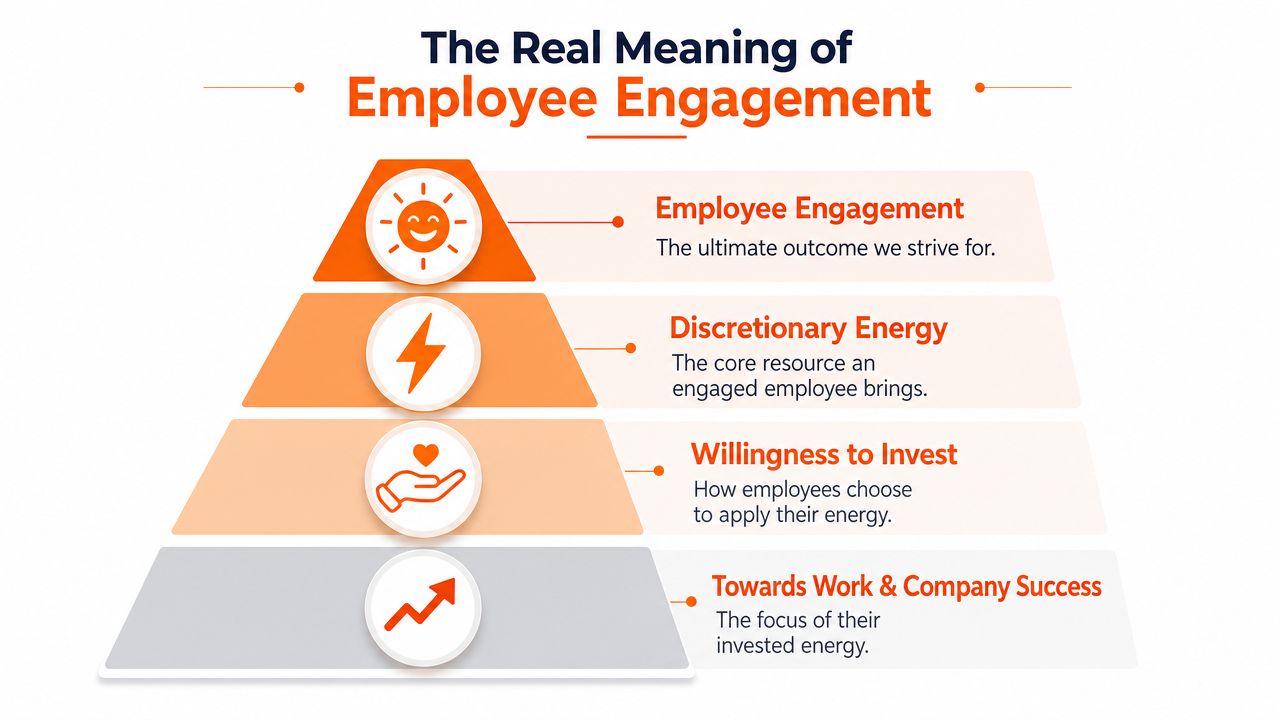
An engine is a useful analogy
On a healthy team, work has momentum. People spot issues early, help each other without being chased, and recover faster when the day goes sideways. On a flat team, the same tasks get done, but only with constant nudging. On a bad team, frustration spreads, small problems sit too long, and managers spend their time putting out fires that should never have started.
Many engagement models group employees into three broad states:
State | What it looks like |
|---|---|
Engaged | People care about the work, contribute ideas, and bring steady effort |
Not engaged | People do the job but mostly stay detached and transactional |
Actively disengaged | People aren't just checked out. They often undermine the work or the team climate |
That framing helps because it separates engagement from personality. Quiet people can be engaged. Cheerful people can be checked out. A tough week does not automatically mean low engagement either.
Engagement has a job to do
Engagement matters because it changes how work gets done. It affects speed, care, judgment, and whether teams solve problems at the source or keep handing them around. In that sense, it sits between attitude and performance. You cannot always see it in one conversation, but you can see it over time in behavior.
That also explains why satisfaction and engagement are different. Good pay, decent benefits, and friendly coworkers can make work more bearable. They do not guarantee commitment. Benefits still matter, especially in hiring and retention, and this guide on attracting employees with benefits covers that side well. But someone can appreciate the package and still stop caring about the result.
If you're separating engagement from the broader employee experience, this guide to what employee experience means in practice is a useful companion. Experience is the environment people work in. Engagement is one outcome that environment produces.
Practical rule: If people only do what the process forces them to do, engagement is weak.
A widely cited summary from the Conference Board's employee engagement research makes a similar point. Engagement is tied to the emotional and cognitive connection employees have with their work, their team, and their organization. I would translate that into plain English this way. People give more when work feels worth the effort and the system does not punish them for caring.
That is why I treat engagement as an operating condition. Leaders influence it through staffing, communication, manager habits, decision speed, and whether daily friction gets fixed or ignored. Call it culture if you want. The practical question is still the same. Does this team have the conditions to care and perform, or are we asking people to carry a broken system with sheer goodwill?
What Drives Engagement
Engagement rises or falls in the daily operating system of work. Teams stay invested when the job is clear, the manager is steady, and people can do good work without fighting unnecessary friction all day. That matters even more on frontline teams, where one bad handoff, one confusing shift plan, or one absent supervisor can drain energy fast.
The strongest influence is still the local manager. Gallup's research on why managers matter points to the same reality many HR and ops leaders learn the hard way. Team engagement is heavily shaped by the person employees report to each day. A company's values poster has very little weight if the supervisor on the floor is inconsistent, slow to respond, or unclear about priorities.
The conditions that move the needle
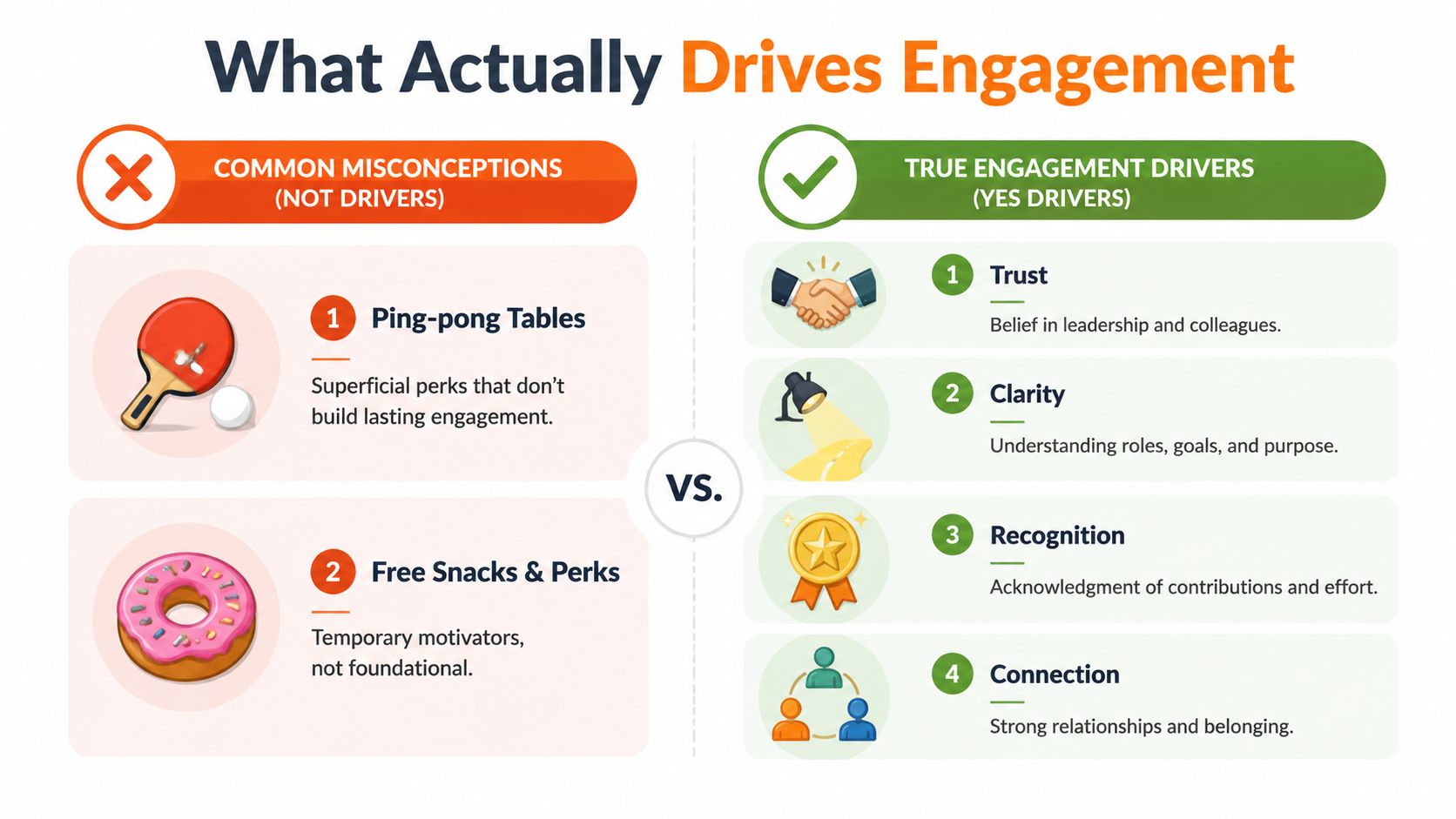
In practice, engagement tends to come from four conditions working together:
Trust: People believe their manager will be honest, follow through, and stay present when problems show up.
Clarity: Employees know what good looks like, what matters right now, and where to focus their effort.
Recognition: Good work gets noticed in a specific, credible way.
Connection: People feel part of a team with shared standards, not a slot on a schedule.
Trust usually comes first. Without it, every update from leadership gets filtered through doubt. Clarity matters just as much because confusion creates drag, rework, and second-guessing. Recognition helps people see that effort still means something. Connection keeps work from becoming purely transactional, especially in high-pressure roles where people need each other to get through the day.
Perks can support this. They cannot substitute for it.
A lot of companies spend money around the edges because it feels easier than fixing manager habits, staffing levels, scheduling discipline, or broken communication loops. Benefits, appreciation programs, and team events all have a place. If you're reviewing that side of the equation, this piece on attracting employees with benefits is worth reading. But benefits shape whether people join and stay. Engagement is shaped by what happens during the shift, in the meeting, on the handoff, and after a mistake.
If a manager gives mixed signals, avoids feedback, and leaves people in the dark, engagement drops fast.
That is the trade-off leaders often miss. The soft, visible stuff is easier to launch. The hard, boring stuff builds engagement. Clear shift briefs. Fast answers. Fair workload distribution. Public credit for solid work. Schedules people can plan their lives around. Follow-through when someone raises a problem.
None of that sounds flashy. It is still where engagement gets built.
Why Engagement Is More Than a Feeling
A store can look fine on paper and still be running on fumes. Sales are steady. The schedule is covered. Nothing is on fire. Then one supervisor quits, two strong hourly employees stop speaking up, customer complaints creep up, and simple mistakes start repeating across shifts. What changed was not mood in some abstract sense. The operation lost energy, trust, and attention.
That is why engagement matters. It shows up in how work gets done.
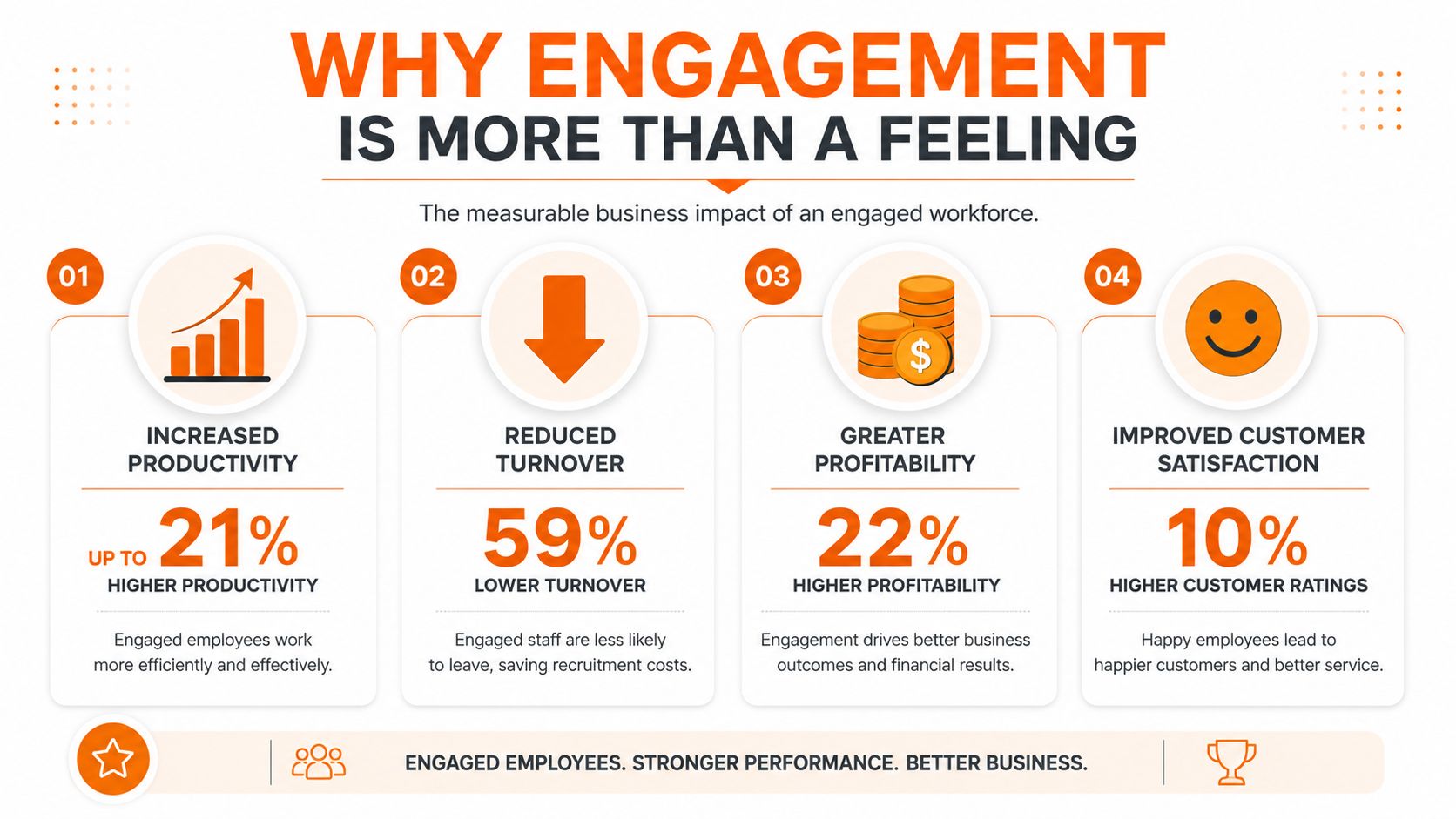
Research from Gallup on the relationship between employee engagement and performance consistently ties higher engagement to stronger business outcomes, including profitability, productivity, retention, safety, and customer measures. Serious leaders pay attention because engagement affects execution. It changes whether people catch issues early, help a teammate without being asked, and stick with a hard day instead of checking out halfway through it.
Where the business impact shows up
The first signs are usually operational, not emotional.
Area | What changes |
|---|---|
Retention | Fewer capable people leave because day-to-day work feels fixable and fair |
Productivity | Teams lose less time to avoidable friction, confusion, and rework |
Profitability | Better execution adds up through stronger output, fewer misses, and steadier service |
Customer outcomes | Customers feel the difference when employees stay attentive and take ownership |
Frontline teams make this plain. In a warehouse, an engaged crew flags a bad handoff before it delays the whole line. In a clinic, an engaged front desk catches a scheduling problem before patients stack up in the waiting room. In hospitality or retail, engaged staff recover a rough customer interaction without passing the frustration to the next person.
Those behaviors protect margin.
Why leaders miss this
Leaders often look for engagement in attitude alone. They ask whether people seem upbeat, whether the survey comments sound positive, whether the culture still feels good. That misses the operating reality.
Engagement is fragile because small breakdowns chip away at it fast. Unclear priorities. A manager who never closes the loop. Schedules that swing wildly. Broken tools that everyone has learned to work around. People do not need a dramatic event to disengage. They need enough daily friction to conclude that effort no longer pays off.
I have seen this happen in teams with decent benefits and good intentions. People were not angry. They were tired of spending extra energy compensating for preventable problems.
Engagement shows up in behavior before it shows up in a headline metric.
That is why measurement has to reach beyond sentiment. If you want a practical framework, use employee engagement measurement methods that combine surveys with operational signals. Engagement becomes easier to manage when you treat it like part of the operating system, not a cultural mystery.
Call it human if you want. It is also structural. People commit more when work is clear, fair, supported, and worth the effort. When those conditions break, the cost lands in turnover, service, output, and manager time.
How You See and Measure Engagement in the Wild
The mistake I see most often is treating engagement like a single survey result. One score, one report, one annual discussion, then everyone moves on. That gives you a snapshot, not a read on how work feels.
A better approach combines survey input with operating signals. AIHR recommends connecting survey data such as eNPS with HRIS and business data so teams can relate engagement changes to outcomes like retention and revenue in its guide to employee engagement metrics. That's the right instinct. Engagement should sit next to operational data, not off in its own HR corner.
Two workplaces, two very different signals
Take a multi-site retail business. If you want to understand engagement there, start with the basics. Are shift updates reaching everyone quickly? Do people know where to find policy changes? Are managers responding when coverage falls apart? You'd also watch voluntary turnover, absenteeism, and how often frontline staff participate in quick pulse checks.
Now take a remote software team. The signs are different. You might look at whether people contribute in team channels, whether cross-functional work gets stuck, and whether feedback loops are still alive. Silence in a remote team can mean focus. It can also mean detachment. Context matters.
For a practical breakdown of that measurement side, this guide on how to measure employee engagement covers the mechanics well.
What to track without overcomplicating it
You don't need a giant listening program to start seeing patterns. You need a few consistent signals:
Short pulse feedback: Ask often enough to spot change while there's still time to act.
Team-level cuts: Break results down by manager, shift, site, function, or tenure.
Operational markers: Watch turnover, retention, absenteeism, and performance trends alongside sentiment.
Qualitative comments: Read what people write. The comments usually tell you what the score can't.
One more caution. Don't turn measurement into surveillance theater. If employees give feedback and nothing changes, they stop believing the process. Then the data gets worse because the trust underneath it gets worse.
The best engagement measurement isn't the most complex system. It's the one leaders actually use to make better weekly decisions.
Building Engagement Day by Day
Most engagement efforts fail because they show up as events instead of habits. A big kickoff. A campaign name. A poster. Then everyone goes back to fragmented communication, unclear priorities, and slow responses.
Engagement doesn't live there. It lives in the daily experience of work.
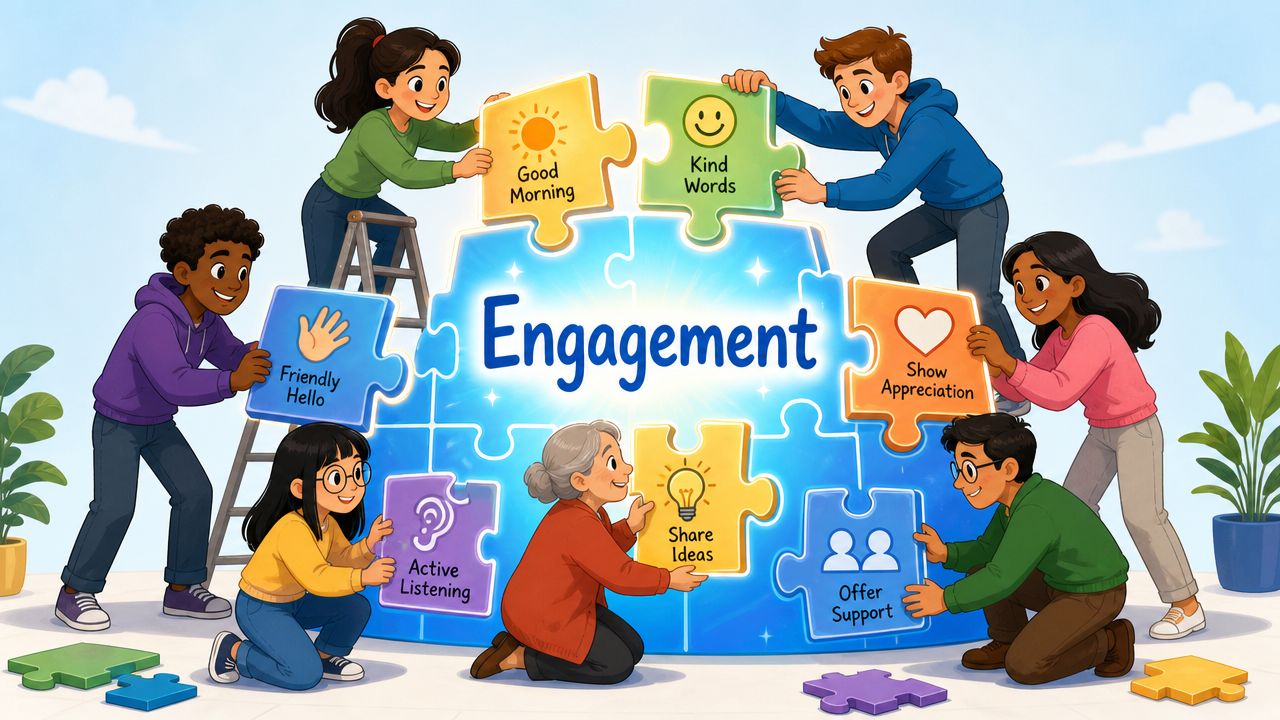
Start with the work itself
Frontline teams are a good reality check. Most engagement theory still sounds like it was written for desk workers. But many employees experience engagement through schedule stability, fast communication, access to information, and manager responsiveness. Gallup's workplace guidance also notes that global engagement fell to 21%, and points to the daily employee experience as a core bottleneck in its workplace engagement advice.
If someone has to hunt for a policy, wait hours for an update, or rely on gossip to know what's changed, engagement erodes fast. Not because they lack passion. Because the work environment keeps wasting their effort.
Build a simple operating rhythm
Teams often do better when engagement is built into the way work runs:
Communicate in one place: Updates, policies, team conversations, and day-to-day coordination shouldn't live across five disconnected tools.
Recognize work close to the moment: Praise loses force when it arrives weeks later in a formal program.
Make managers visible: Employees need regular contact, not occasional speeches.
Reduce friction for frontline staff: Scheduling, shift coordination, and access to documents matter more than office perks.
A unified employee app can help. Tools like Pebb bring chat, updates, tasks, file access, scheduling, clock-ins, and people information into one place, which supports the daily clarity and connection that engagement depends on. The tool itself isn't the answer. But the operating model behind it matters.
Support outside the core workflow matters too. Well-being, health access, and practical support can strengthen the broader employee experience when they're designed thoughtfully. If you're exploring that angle, this roundup from The Lagom Clinic corporate health offers a useful look at wellness program options.
For teams trying to turn these ideas into repeatable habits, these employee engagement best practices are a solid next step.
What is employee engagement, really? It's not a mysterious vibe. It's the result of dozens of ordinary choices about how people get informed, supported, recognized, and managed. That's why it's fragile. And that's why it can be built.
If you're trying to make engagement more tangible, Pebb gives teams one place for communication, updates, tasks, scheduling, and connection across frontline and office work. That's useful when the primary goal is turning engagement from a yearly talking point into part of how work runs every day.
