
Best Practices for Employee Engagement: A No-Nonsense Guide
Discover best practices employee engagement with 10 real-world tips that actually boost connection and performance.
Dan Robin
Most articles on employee engagement feel like they were written by a committee. They're filled with jargon like "synergy" and "empowerment" and promise a neat, five-step plan to a happy team. They're hollow. You can tell they weren't written by someone who has actually managed a team, felt the anxiety of high turnover, or wondered if the frontline staff even read the last critical safety update. They talk about engagement as if it’s a problem you can solve with a new software subscription.
Real engagement isn't a checklist. It's the messy, human result of a thousand small, intentional choices. It’s about treating people like adults. It's about giving them the right tools and then getting out of their way. We’ve spent years at Pebb building a tool to solve these exact problems—not for boardroom presentations, but for the complex, distributed teams that do the actual work. We’ve seen firsthand what works and what doesn't.
This isn’t another corporate whitepaper. It’s a calm, practical guide to the best practices for employee engagement that we've seen work in the real world. We'll skip the buzzwords and get straight to creating a workplace where people genuinely want to be. This is about real communication, meaningful recognition, and giving your teams what they need to succeed. Let’s get started.
1. Create a Single Source of Truth
Let’s be honest. Nothing kills engagement faster than confusion. When your team has to hunt through emails, texts, a forgotten intranet, and sticky notes on the breakroom fridge just to find out this week's schedule, they're not engaged. They're exhausted. This is why a centralized communication hub is one of the most powerful best practices for employee engagement. It’s about creating one, and only one, reliable place for all company news, updates, and conversations.
This isn't about tidying up your digital workspace. It's about fairness. For distributed teams, and especially for frontline workers who don't have a corporate email, a central hub ensures they get the same information at the same time as everyone else. Think of a healthcare network using a tool like Pebb to align staff across multiple hospital locations with instant, critical updates. Or a retail chain using a single app to roll out a new promotion consistently to every store. The goal is to kill information silos and the frustrating "I didn't get the memo" moments.
How to make it work
A successful hub isn't about buying a tool; it's about changing habits.
First, set clear guidelines. Define what goes where. Create dedicated channels for urgent announcements, department updates, project collaboration, and even social chatter. Second, use role-based targeting. Don't blast every message to every employee. Make sure nurses get clinical updates and cashiers get point-of-sale information. This keeps the hub relevant and cuts down the noise. Finally, train your leaders. Managers are the key. Show them how to share information effectively and encourage their teams to participate.
By creating a single, accessible communication platform, you're not just organizing information. You're building a more connected and informed culture.
2. Make Recognition a Daily Habit
A paycheck is for the job. Recognition is for the person. When an employee goes the extra mile, solves a tough problem, or just consistently embodies your company's values, and it goes unnoticed, a little part of their motivation dies. This is why a recognition program is one of the most critical best practices for employee engagement. It’s about creating a culture where appreciation isn’t an annual event, but a daily habit.
Here's the thing: this isn't about expensive gifts. It’s about visibility and validation. A simple kudos system makes appreciation public and easy, reinforcing the exact behaviors you want to see more of. For distributed and frontline teams, this is a game-changer. A retail associate in one store can get celebrated company-wide for amazing customer service, inspiring others to do the same. A simple kudos feature in Pebb can create a wave of positive reinforcement across hospitality teams. The goal is to make saying "great job" frictionless and meaningful.
How to make it work
A great recognition program feels authentic, not forced. It’s powered by genuine moments.
Make it effortless. Recognition should be as easy as sending a text. A one-click kudos or "shout-out" feature built into your central communication tool is perfect. Next, celebrate publicly. Don't let praise get stuck in a private email. A public feed where everyone can see and react to kudos builds momentum and reinforces your cultural values. Lastly, teach your managers how to give specific feedback. Instead of "good work," they should say, "Your calm handling of that angry customer was a perfect example of our 'service first' value."
When recognition is easy, visible, and tied to your values, you’re not just rewarding past performance. You’re fueling future engagement.
3. Build a Library, Not a Maze
Nobody enjoys being a human FAQ. When a new hire has to ask their manager where to find the PTO policy for the third time, it’s not just inefficient—it’s disempowering. This constant hunt for basic information creates friction and pulls people away from their real jobs. That’s why a central knowledge library is one of the most underrated best practices for employee engagement. It’s about creating a single, searchable place for everything from training manuals and safety protocols to the latest shift schedule.
This is about more than just good housekeeping. It’s about autonomy and trust. When your team can find answers on their own, they feel more capable and in control. Think of a retail associate quickly pulling up a return policy on their mobile device without having to find a manager. Or a new warehouse worker accessing a short video on how to operate equipment right from their station. The goal is to remove the bottlenecks that slow down work and make employees feel dependent.
How to make it work
A great knowledge library is a living resource, not a digital filing cabinet where documents go to die.
First, audit and organize. Before you dump everything into a new system, take stock of what you have. Organize policies, procedures, and guides into intuitive categories. Then, use smart tagging. Use clear, consistent tags to make information discoverable. A nurse shouldn't have to sift through marketing materials to find a clinical procedure guide. Finally, establish clear ownership. Assign responsibility for keeping documents up-to-date. Every piece of information should have a designated owner who ensures it’s accurate.
By centralizing knowledge, you help your team solve problems independently. You build a culture of self-sufficiency.
4. Make It Safe to Speak Up
Great leaders don't just talk; they create an environment where everyone feels safe enough to speak up. This is the heart of another critical best practice for employee engagement: creating genuine psychological safety. It’s about building a culture where a frontline cashier can share a brilliant idea, or a nurse can voice a concern about a process, without fearing they’ll be dismissed or penalized. Engagement isn't a top-down mandate. It's a two-way street built on trust.
This approach combines inclusive leadership with manager enablement. It moves beyond the occasional anonymous survey to embed feedback into daily operations. Think of Satya Nadella’s cultural shift at Microsoft, where he replaced a rigid, top-down structure with one that prized curiosity and open communication. The goal is to make listening an active, company-wide habit, where feedback isn't just collected but is visibly acted upon.
How to make it work
True two-way communication requires both the right channels and the right mindset.
Make feedback visible and easy. Don't hide the suggestion box in a digital broom closet. Create dedicated, easy-to-find channels for ideas, questions, and concerns. Then, equip your managers. Your managers are the linchpin. Give them simple toolkits and training on how to receive feedback constructively. Hold them accountable for their team's engagement. Most importantly, close the loop. When you receive feedback, acknowledge it. Then, communicate what actions were taken because of it. Featuring frontline employee ideas in company-wide communications is a powerful way to show you’re listening.
By empowering your managers and creating safe channels for dialogue, you transform feedback from a formal event into a continuous conversation.
5. Design for the Frontline First
Most engagement software is built for people sitting at desks. This leaves out the majority of the workforce—the frontline employees in retail, healthcare, and logistics. A true best practice for employee engagement means designing for them first. It’s about creating an experience that works on a mobile device, can be used in 30-second bursts between tasks, and provides immediate access to what they need most, like schedules and urgent updates.
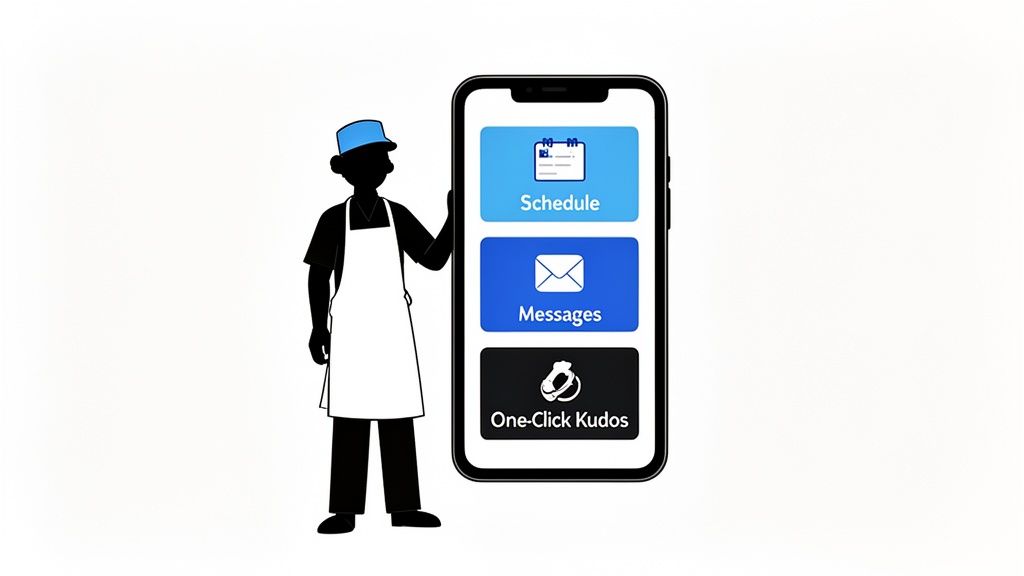
This isn't just about convenience; it's about respect. When a nurse can quickly check a protocol update on their phone or a retail associate can instantly see a shift opening, you are removing friction from their day and showing that you value their time. Companies like Starbucks have seen huge wins by providing mobile-first scheduling and communication apps. They’ve recognized that for frontline teams, the phone is their primary connection to the company.
How to make it work
Empowering your frontline isn't about giving them another app to check. It’s about giving them the right tool that fits into their workflow.
Design for micro-interactions. Assume your users have less than a minute. Information must be glanceable. Prioritize what matters most. Your frontline team cares about their schedule, their pay, critical safety alerts, and recognition. Put these features front and center. And please, test with actual frontline users. Get feedback from cashiers, warehouse workers, and nurses on the floor to understand what truly works. Finally, integrate with core systems. A standalone app is just another login to remember. Connect it to your scheduling and HR systems to create a seamless experience.
By building your engagement strategy around the needs of your frontline majority, you create a more inclusive, efficient, and connected organization.
6. Live Your Values, Don’t Just Print Them
Company values printed on a poster in the breakroom are just expensive wallpaper. They don't mean anything if they aren't lived every single day. True culture isn’t a mission statement; it’s the sum of every decision, conversation, and action. That's why reinforcing your company’s values is an essential best practice for employee engagement. It’s about making your core principles the framework for how work actually gets done.
But that’s only half the story. This is a strategic advantage that creates consistency and trust, especially across distributed teams. Think of Southwest Airlines' legendary fun, people-first culture. It’s not an accident. It's deliberately woven into their hiring, training, and daily operations. When an employee, whether in headquarters or on the front line, sees the company’s stated values reflected in leadership’s actions, they feel a powerful sense of belonging. They know their work matters.
How to make it work
Making culture tangible requires consistent, intentional effort.
Link recognition to values. Don't just say "good job." Say, "Great job living our 'customer obsession' value by finding that solution for the client." This makes praise specific and reinforces the behaviors you want to see. Share value stories. Use your internal communication channels to regularly feature stories of employees who exemplify your core values. This turns abstract concepts into relatable actions. Lastly, train leaders as culture champions. Equip your managers to discuss values in one-on-ones and use them in decision-making. Their actions set the tone.
By embedding your values into the operational fabric of your company, you’re building a more resilient, motivated, and engaged workforce. It's also smart to stay informed about future proofing workplace trends that shape employee experience.
7. Provide a Path Forward
Here's a hard truth: no one wants a dead-end job. If an employee can't see a future with your company, their engagement will flatline. This is why continuous learning and development is a critical best practice for employee engagement. It’s about more than just a training session; it's a visible commitment to helping your people grow their skills and advance their careers within your organization.
This isn’t just for corporate offices. For frontline teams, accessible skill-building is a powerful retention tool. Think of Chipotle’s well-defined track from crew member to manager. When employees see a clear path forward, they feel invested in, not just employed. They start to see their job as a career. It transforms their perspective. Providing opportunities for upskilling for career advancement is vital for keeping their skills current and fostering a sense of growth.
How to make it work
Building these pathways requires a thoughtful approach. It's about integrating learning into the daily work experience.
Make learning accessible. Don't hide opportunities in a forgotten corner of the intranet. Promote courses and mentorship programs directly in your central communication hub. Offer bite-sized learning. Your frontline workers don't have hours for a webinar. Provide micro-learning modules and short videos they can access on their mobile devices during downtime. And tie learning to advancement. The goal isn't just a certificate; it's a better job. Clearly connect training completion to tangible next steps, like eligibility for a promotion.
By investing in your team's development, you're not just filling skill gaps. You're building a more capable and loyal workforce that sees a long-term future with your company.
8. Build a Real Community
We're social creatures. Yet modern work, especially in remote or distributed setups, can feel incredibly isolating. When the only interactions employees have are tied to project deadlines, they aren't colleagues; they're just names on a screen. Fostering authentic connection is a crucial best practice for employee engagement because it builds the human foundation that makes work meaningful. It’s about creating spaces where people can be themselves, not just their job titles.
This isn't about forced fun or mandatory happy hours. It’s about facilitating genuine community. Think of Automattic, the fully distributed company behind WordPress.com, which hosts grand meetups to ensure its team builds real bonds. Or consider the simple culture of Slack's #random channels, which sparked an industry-wide trend of creating dedicated digital spaces for non-work chatter. These initiatives recognize that belonging is a powerful motivator.
How to make it work
Building community requires intention, not just an open-door policy.
Create interest-based groups. Use your communication platform to launch channels for shared interests like hiking, book clubs, or parenting. This helps people find their tribe. Celebrate the person, not just the worker. Make space to acknowledge birthdays, work anniversaries, and personal milestones. Employee spotlights that share someone’s story or hobbies can also humanize the workplace. And enable employee-led initiatives. Give employees the tools and autonomy to organize their own virtual coffee chats or local meetups.
When you intentionally build a community, you’re creating a support system. You’re giving people a reason to care about their work beyond the paycheck. That's the essence of true engagement.
9. Measure What Matters
Guessing what makes your employees happy is a recipe for wasted effort. You can't improve what you don't measure. That’s why a data-driven engagement measurement process is one of the most important best practices for employee engagement. This isn’t about running one annual survey and calling it a day. It’s about creating a continuous feedback loop where you listen, analyze, and act on what the data tells you.
This approach transforms engagement from a vague HR goal into a measurable business strategy. Think of a retailer A/B testing two different communication styles for a new safety protocol to see which one drives higher acknowledgment rates among frontline staff. Or a healthcare system analyzing communication data in a tool like Pebb to see which departments have the lowest read rates on critical updates, allowing them to provide targeted support. The goal is to replace assumptions with evidence.
How to make it work
A successful data strategy is about consistent action, not just collecting numbers.
First, establish a baseline. Before launching a new initiative, measure your starting point. Use a mix of quantitative data (survey scores, adoption rates) and qualitative feedback (interviews, open-ended comments). Second, segment your data. Don't look at the company as a whole. Break down engagement data by department, location, and role to uncover specific pain points. Finally, act and communicate. The fastest way to kill a feedback program is to ignore the feedback. Share the high-level results with your team and, most importantly, show them exactly what actions you're taking based on their input.
By systematically measuring and iterating, you stop throwing tactics at the wall to see what sticks. You build a smarter, more responsive culture.
10. Make Access Equitable for Everyone
Let’s be direct: an engagement strategy that only works for desk-based employees isn't an engagement strategy. It's a club. When your initiatives and platforms exclude your frontline, remote, or non-native speaking staff, you’re not building culture; you’re creating resentment. True engagement equity is one of the most critical best practices for employee engagement because it means deliberately designing access for everyone, regardless of role, location, or language.
This isn't just about being fair. It's about recognizing that every single employee contributes to your success. Think of a global manufacturing company that has to engage employees across more than 190 countries, or a healthcare system needing to connect with both surgeons and janitorial staff. Initiatives that ignore these diverse groups don't just fail; they actively disengage the very people who keep the business running.
How to make it work
Building an inclusive engagement model requires intention.
Audit for accessibility. Before you roll anything out, test it. Is your platform mobile-friendly for workers without a desktop? Does it comply with accessibility standards (WCAG)? Is the language simple and clear? Embrace multilingual support. If your workforce speaks multiple languages, your communications must too. Use tools that offer translation features to ensure no one is left out. And track metrics equitably. Don't just look at your overall engagement score. Segment your data by department and role. If your frontline engagement is 30% lower than corporate, you’ve found a critical gap to address.
By designing for the margins, you create a stronger center. You ensure that every voice can be heard and every employee knows they are a valued part of the same team.
Top 10 Employee Engagement Practices Comparison
Item | Implementation (🔄) | Resources & Maintenance (⚡) | Expected outcomes (📊⭐) | Ideal use cases (💡) | Key advantages (⭐) |
|---|---|---|---|---|---|
Centralized Communication Hub Strategy | Medium–High complexity; change management; 4–8 weeks | Platform & integration work; governance; ongoing content moderation | Faster, consistent messaging; reduced silos; higher engagement (⭐⭐⭐) | Distributed/hybrid + frontline teams needing one source | Single source of truth; real-time updates; mobile-first access |
Recognition and Kudos Programs | Low–Medium complexity; quick launch (2–4 wks) | Low-cost features; needs active participation; light maintenance | Boosts morale & retention; visible cultural reinforcement (⭐⭐) | Distributed teams, morale-driven initiatives, value reinforcement | High-impact/low-cost; public celebration; reinforces values |
Transparent Information Accessibility & Knowledge Libraries | High complexity; organization & taxonomy heavy; 6–12 wks | Significant content creation & upkeep; search UX & HR integrations | Faster answers; fewer HR tickets; quicker onboarding (⭐⭐⭐) | Frontline, compliance-heavy, scale onboarding needs | Single searchable knowledge base; empowers independence; audit trails |
Inclusive Leadership, Two-Way Communication & Manager Enablement | High complexity; cultural change; ongoing (4–8 wks initial) | Training, feedback tools, manager coaching, governance | Greater psychological safety; actionable frontline insights; retention (⭐⭐⭐) | Organizations seeking culture change and manager-led engagement | Surfacing frontline ideas; stronger manager-employee relationships; scalable impact |
Frontline Worker Empowerment & Accessibility | Medium–High complexity; mobile UX focus; 8–12 wks | Mobile platform, BYOD/device mgmt, integrations, offline capability | Higher frontline adoption; improved scheduling & coverage; reduced turnover (⭐⭐⭐) | Retail, hospitality, healthcare, logistics with shift-based staff | Mobile-first, quick interactions, offline support, shift integration |
Company Culture & Values Reinforcement | Medium complexity; ongoing (6–8 wks initial) | Leadership modeling, communications, recognition alignment | Stronger belonging; aligned decisions; better retention (⭐⭐) | Scaling orgs, talent-differentiation, value-driven strategy | Embeds values into daily work; guides behavior; improves employer brand |
Continuous Learning & Development Pathways | Medium–High complexity; 3–6 months | LMS, content creation, mentors, manager time | Skill growth; internal mobility; retention; capability building (⭐⭐) | Growth-focused orgs; frontline career ladders; succession planning | Builds internal pipeline; ties learning to advancement; reduces external hires |
Authentic Connection & Community Building | Low–Medium complexity; fast launch (2–4 wks) | Facilitation, moderation, event coordination, ongoing engagement | Increased belonging; cross-team bonds; reduced isolation (⭐⭐) | Remote/hybrid teams needing social cohesion | Improves psychological safety; informal knowledge sharing; social retention |
Data-Driven Engagement Measurement & Iteration | Medium complexity; 1–2 months to set up | Analytics tools, surveys, data expertise, dashboards | Evidence-based decisions; tracks ROI; identifies gaps (⭐⭐⭐) | Organizations needing measurement, benchmarking, continuous improvement | Targets investments; reveals engagement drivers; supports executive buy-in |
Equitable & Inclusive Engagement Access | High complexity; long runway (6–12 months) | Accessibility compliance, localization, audits, multi‑modal channels | Broader participation; reduced inequality; diverse input (⭐⭐⭐) | Global/diverse workforces; inclusion & compliance priorities | Ensures accessibility & equity; improves representation; unlocks diverse perspectives |
It All Comes Down to This
We’ve covered a lot of ground. Communication hubs, recognition, knowledge libraries—the list can feel overwhelming. It’s easy to get lost in the mechanics of pulse surveys and feedback loops, thinking that if we just implement enough programs, engagement will magically appear.
But let’s be honest. If you strip away all the platforms and the analytics, what are we really talking about?
We're talking about a simple, timeless idea: a workplace becomes engaging when people feel seen, heard, and respected. It’s about creating an environment where people feel like their time is valued, not wasted. Where they have the clarity to do their jobs well and the human connection to feel like they belong.
The best practices for employee engagement we've discussed aren't a checklist. They are frameworks for an old truth: treat people well. The tools are just vehicles to bring that idea to life when your team is spread across different locations, shifts, or time zones. The tool is never the goal. The goal is a calm, focused, and trusting environment where good work can happen without unnecessary friction.
So, what’s the first step?
Thinking about doing all ten of these things at once is a recipe for burnout. Real, sustainable change starts small.
Look back at the list and ask yourself: what is the biggest source of friction for my team right now?
Is it a lack of clear information? Start by building a simple, accessible knowledge library.
Do people feel disconnected? Launch a dedicated channel for non-work chatter or a simple kudos program.
Are frontline managers struggling? Focus on giving them the tools and training they need to lead.
The point isn't to be perfect; it's to be intentional. Pick one thing. Just one. Commit to it. See it through. Observe the impact, listen to the feedback, and build from there. The most successful engagement strategies aren’t flashy. They are built brick by brick, through consistent, small actions that show your people you’re listening and that you care.
This work is never really “done.” It’s a continuous practice of tuning in and adapting. It’s about replacing complexity with clarity and noise with meaningful connection. When you focus on creating a workplace where you would want to work, where you’d feel supported and understood, you’re already on the right track. The rest will follow.
If you’re ready to simplify your approach and put these principles into action, Pebb brings all your communication, recognition, knowledge, and feedback tools into one calm, unified platform. See how you can build a more connected and engaged team by visiting Pebb.
