
What Is Employee Experience, Really?
Confused about what is employee experience? It's more than perks. Discover the key pillars, why it matters, and how to build one that truly works.
Dan Robin
We’ve all had that feeling. The Sunday evening dread. The frustration of a login screen that just won’t work. The slow burn of a pointless meeting. It’s the sum of these tiny moments that defines how it feels to work somewhere. That gut feeling? That’s the employee experience.
And let’s be honest. The term “employee experience” has been co-opted by HR departments to mean free snacks and ping-pong tables. But those are just decorations. They’re a distraction from what really matters.
The real employee experience is much deeper. Think of it like a long road trip. The destination matters, of course. But the quality of the car (your tools), the clarity of the map (your strategy), and the people you're with (your culture)—that’s what makes or breaks the journey.
Defining the Real Employee Experience
For years, we obsessed over “employee engagement,” a term we’ve managed to water down into a quarterly score. But engagement is an outcome, a result. The experience is the cause. It’s the collection of moments that lead a person to feel either connected to their work or completely checked out.
And right now, most people are checked out.
According to Gallup, only 21% of employees globally were engaged in their jobs. That collective disinterest costs the global economy an estimated $438 billion. This isn't a soft problem. It's a massive, quantifiable business failure. A poor experience leads directly to disinterest, burnout, and lost potential. You can discover more insights about the state of the global workplace on Gallup's site.
Experience At a Glance
The shift from perks to experience is a fundamental change in mindset. It’s about moving from superficial benefits to meaningful, day-to-day improvements. It’s about fixing the system, not just decorating it.
Focus Area | The Old Way (Perks) | The Modern Way (Experience) |
|---|---|---|
Technology | The latest gadgets for show | Intuitive tools that reduce friction |
Culture | Friday beers and a foosball table | Psychological safety and trust |
Communication | Top-down corporate announcements | Two-way dialogue and honesty |
Workspace | Trendy open-plan office | Flexibility that suits the work |
Recognition | Annual "Employee of the Month" award | Continuous, meaningful feedback |
So, What Is It?
At its core, employee experience is the answer to a few simple, human questions:
Do I have the tools I need to do my job without wanting to throw my laptop out the window?
Do I trust my manager and feel respected by my team?
Is it clear what’s expected of me, and do I see how my work fits into the bigger picture?
Does this company make my life easier or harder?
A great employee experience isn't about adding more stuff. It's about removing friction. It’s about designing a workplace where people can focus on the work itself, not the chaos surrounding it.
Ultimately, it comes down to a choice. Do you see your employees as resources to be managed, or as people to be served? Your answer defines their experience more than any policy ever could.
The Four Pillars That Shape Every Workday
A great employee experience doesn’t just happen. It’s not about luck. It’s built, intentionally, on a foundation of four pillars that define what it’s like to show up to work every day.
These aren’t just HR concepts; they are the tangible realities of the job. Get them right, and people thrive. Get them wrong, and you create a constant, low-grade friction that quietly drains energy and kills motivation.
Let’s talk about what they really are.
Pillar 1: The Culture We Live In
First, culture. It’s the most important and, ironically, the most invisible pillar. Culture isn’t the mission statement on the wall; it’s the unwritten rules of how things actually get done.
It’s the answer to the questions people really care about: Can I voice a dissenting opinion in a meeting without being shut down? Do I trust my manager has my back? Is it okay to take a risk and fail?
A healthy culture is built on psychological safety. When people feel safe, they bring their whole selves to work. They share half-baked ideas that might turn into breakthroughs. They aren’t afraid to admit when they need help. A 2024 McKinsey study found a direct link between psychological safety and innovation. Think of it as the invisible architecture holding everything else up.
Pillar 2: The Technology We Use
Next, technology. The tools you give your team are either a bridge or a barrier. Think about it: how much of your team's day is spent battling software that’s clunky, confusing, or just plain broken?
Every forgotten password, every crashed app, every frustrating workaround is a tiny papercut to their morale. Over time, these cuts add up. It sends a powerful message: the company doesn't value my time.
On the other hand, providing simple, reliable tools is a profound sign of respect. It’s the difference between giving a chef sharp knives or dull ones. You’re removing needless struggle so they can focus on what they do best. This isn't about having the flashiest new gadget; it's about making the digital side of work feel effortless.
Pillar 3: The Space We Occupy
The third pillar is the physical space. This used to just mean the office. But today, "space" also means the home office, the co-working hub, or wherever your team logs in from.
For those in an office, a well-designed space can be a catalyst for focus and collaboration. It should be calm and organized for humans, not just for cramming in desks. For remote and hybrid teams, a supportive "space" means having the right equipment and a culture that respects the boundaries between work and personal life.
A great workspace, whether physical or virtual, is one that gets out of the way. It supports the work being done, instead of creating new obstacles.
The goal isn't a magazine-perfect office. It's making sure everyone's primary workspace helps them be productive and feel good. Neglecting this is like asking someone to run a marathon in shoes that are two sizes too small. They might finish, but they’ll be miserable.
Pillar 4: The Work Itself
Finally, there’s the work itself. This is about the day-to-day flow of tasks, projects, and meetings. It's the structure of how work gets done.
Is work organized and efficient, or a bureaucratic maze of pointless meetings? Are roles and responsibilities clear, or are people constantly stepping on each other's toes? A poorly designed work process is a massive source of friction. It forces smart people to waste their energy on administrative sludge.
Improving this pillar means getting ruthless about simplification. Question every recurring meeting. Clarify every confusing workflow. Make sure communication is direct and to the point. When the work itself is streamlined, it lets people find their flow and get real satisfaction from what they do.
These four pillars—Culture, Technology, Space, and Work—don't exist in a vacuum. They're all connected. A toxic culture makes the world's best tech feel like a tool for micromanagement. A clunky workflow can suck the energy out of a beautiful office. To build an employee experience that actually works, you have to see how all these pieces fit together.
Why You Can No Longer Afford to Ignore EX
Let's cut right to it. Treating employee experience as a fluffy, "nice-to-have" HR project is one of the costliest mistakes a business can make. This isn't about feelings; it's a hard-nosed business strategy with a direct impact on your bottom line.
Ignoring the quality of your team's day-to-day is like driving with the handbrake on. You might inch forward, but you’re burning fuel, wearing down the engine, and getting nowhere fast. That friction is real, and it has a steep price.
The Real Cost of a Bad Experience
When work is a constant battle against clunky tools, confusing processes, or a culture of mistrust, people don't just get frustrated. They check out. Then, they leave. The line between a poor employee experience and high turnover is painfully direct.
People don’t quit jobs; they quit bad experiences. Every dollar you spend recruiting and training their replacement is a direct tax for getting the experience wrong. A 2024 McKinsey study found that employees with a positive experience are 8 times more likely to want to stay. The math is simple and brutal.
Your internal experience will always, eventually, become your external reputation. There’s no hiding from it.
And this isn't just about keeping people. It's about the quality of their work. When people feel seen, supported, and equipped with tools that help them, they deliver better results. It’s not magic; it’s common sense. Remove the friction, and you unleash their focus and creativity.
This is where the core pillars of the employee experience come into play, as the diagram below shows.
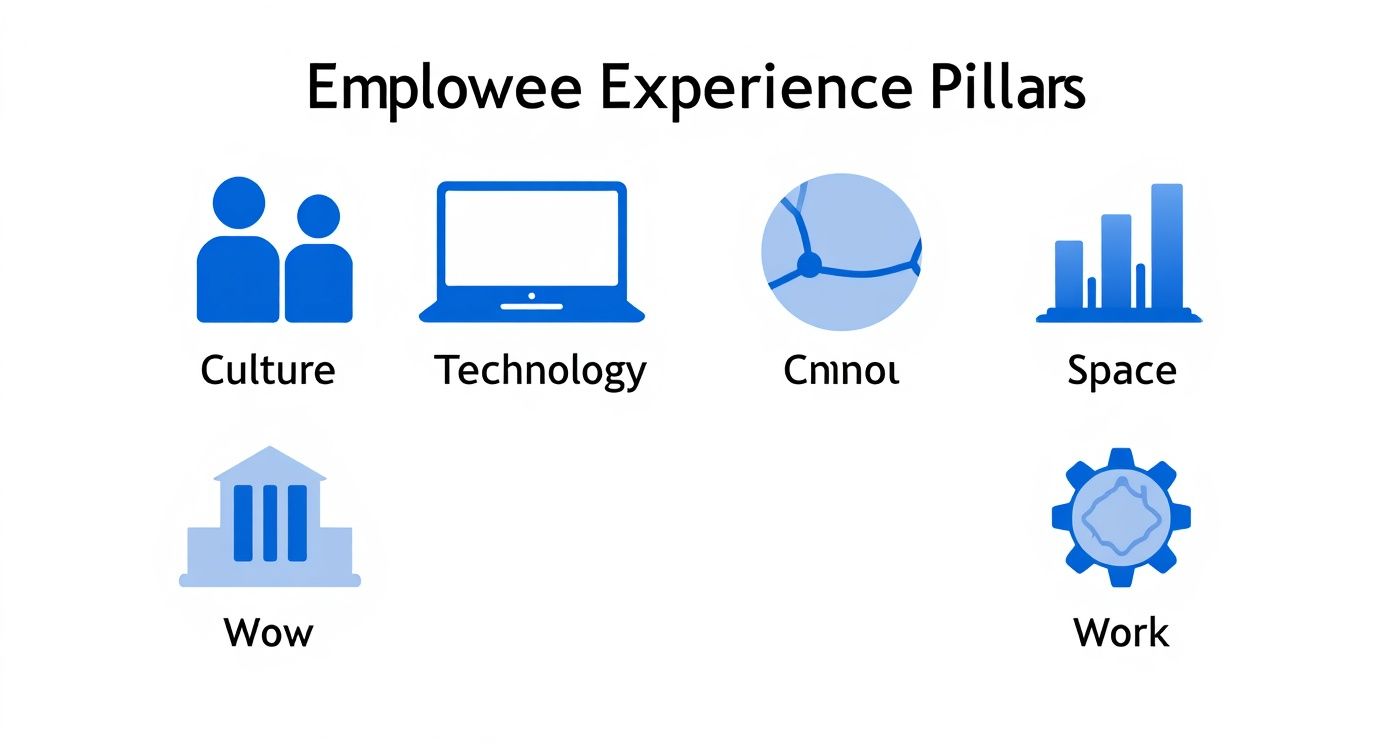
This visual breaks down how Culture, Technology, Space, and the Work itself all have to fit together. If one pillar is weak, the whole structure feels shaky.
Your Brand Is What Your Employees Say It Is
In a world where sites like Glassdoor are a click away, you don’t control your employer brand. It’s an unfiltered reflection of your internal reality. A great employee experience is your most powerful recruiting tool. A poor one is a flashing red warning sign to top talent.
The best people have options. They're looking for more than a paycheck; they’re looking for a place where they can do meaningful work without fighting corporate nonsense. They want to join companies where the system is designed to help them succeed.
Here’s how a great EX translates into real business wins:
Higher Productivity: When teams aren't fighting their tools, they can focus their energy on what actually matters.
Stronger Innovation: People who feel psychologically safe are more willing to share ideas, experiment, and take smart risks. This is the engine of innovation.
Better Customer Outcomes: There is a direct, unbreakable link between how you treat your people and how they treat your customers. Happy, supported employees create happy, loyal customers. It’s that simple.
Investing in your employee experience isn’t an expense. It’s a strategic investment in the health of your entire business. The question is no longer if you can afford to focus on it. The real question is, how much longer can you afford not to?
A Practical Guide to Improving Your Employee Experience
So, we know what employee experience is and why it matters. But how do you actually make things better, right now, without a massive budget or a six-month consulting project?
It starts with a simple, almost radical act.
You have to listen.
Step 1: Start by Listening
I don’t mean sending out that dreaded annual survey—that sterile ritual that produces data nobody knows what to do with. I mean real, continuous, human listening. The goal isn’t to collect metrics for a PowerPoint slide. It’s to understand the actual texture of your team’s daily life.
What are the small frustrations that pile up? Where are the unnecessary roadblocks? What part of the process makes people want to tear their hair out?
You find these answers in informal conversations, in one-on-ones, and in team chats. It requires creating a space where people feel safe enough to be honest. This is the raw material for building a better experience.
Step 2: Simplify Everything
Once you start listening, a theme will emerge: complexity. People are drowning in a sea of apps, processes, and notifications. Their days are fragmented, their focus is shattered, and too much energy is spent just navigating internal chaos.
The single most powerful thing you can do is to simplify.
Identify the daily friction points and get ruthless about removing them. Does your team really need twelve different tools to communicate? Or could you bring all of that into a single, unified place where work actually flows? This isn’t just about convenience. It's about giving people back their time and attention.
Every system you remove, every process you simplify, every unnecessary meeting you cancel is a direct investment in your team's well-being and productivity.
It’s about subtraction, not addition. A great employee experience is often defined by what’s not there: no confusion, no bureaucracy, no pointless hurdles. The goal is to make the work itself the focus, not the work about the work. For a deeper look, our guide on a modern employee experience strategy offers more tools and real examples.
A Quick Story
A tech company we know was struggling with turnover, especially in the first year. Instead of guessing why, they just talked to people. They mapped out the entire employee journey from the first interview to the one-year anniversary.
It didn't take long to find the biggest pain point: a deeply confusing onboarding process. New hires were bombarded with dozens of emails and conflicting instructions. They felt lost from day one.
The fix wasn’t expensive. They created a single, centralized onboarding hub inside their employee platform. All documents and training lived in one place. They also assigned a "buddy" to each new hire for the first 30 days.
The result? First-year turnover dropped by 40%. They didn't need a huge budget. They just needed to pay attention, find the friction, and remove it. That's the whole game.
Focus on What Truly Matters
Improving the employee experience doesn’t have to be a monumental task. It’s a series of small, thoughtful adjustments that show you respect people’s time.
Here are a few places to start:
Audit your tools: Make a list of every app your team is expected to use. Ask honestly: which of these can we eliminate or combine?
Clarify communication: Establish clear guidelines for where different types of conversations happen. When do we use email? When should we use a chat channel?
Invest in development: Show people you care about their future. For instance, learning how to build high-impact business mentoring programs can significantly boost engagement and career growth.
This work is never done. It’s a continuous cycle of listening, simplifying, and iterating. It’s about choosing to build a workplace that is fundamentally calm, clear, and designed for humans. You don't need permission to start. You just need to care enough to ask the first question.
How Technology and AI Are Reshaping Work
Technology can be your team's best friend or their worst enemy. It’s the invisible force that either powers incredible, focused work or creates a constant, low-grade frustration that drains the life out of a workday. It’s never neutral.
We’ve all been on the wrong side of this. We’ve all used clunky software and felt like we were fighting our tools more than doing our actual jobs. This digital friction is a massive tax on your team’s energy and morale. It quietly tells them their time isn’t valued.

The Double-Edged Sword of AI
Now, let's bring AI into the picture. On one hand, it holds the promise of automating repetitive, soul-crushing tasks and freeing people up for more creative work. In many ways, it’s already delivering.
A recent PwC survey found that 54% of workers used AI in their jobs over the past year. Of those, about three-quarters said it boosted their productivity. That’s a huge win. But here’s the catch: the same study revealed a trust gap. Only 45% of employees believe their company will use AI in a way that actually benefits them. You can read the full PwC workforce survey to get the complete story.
This is the tension at the heart of AI in the workplace. It can be a powerful partner, but if rolled out poorly—without transparency or a clear purpose—it just becomes another source of anxiety. It can feel more like a tool for surveillance than for support. It all comes down to how it's introduced and what problem it’s truly solving.
Choosing Human-Centric Tools
The goal isn't to chase after the newest tech. It’s about being thoughtful and choosing tools that genuinely simplify work, reduce cognitive load, and make the digital workspace feel less chaotic. It’s all about getting the digital employee experience and how to get it right.
Technology should serve people, not the other way around. The best tools are the ones that fade into the background, letting your team focus on what they do best.
If you want to see where this is all heading, it’s worth understanding the work that goes into building these systems. A deeper look into AI agent development shows how intelligent systems are being designed to automate complex tasks, offering a glimpse into a future where technology truly acts as a helpful assistant.
Ultimately, every piece of software you ask your team to use is a reflection of your company’s values. Does it respect their time? Does it make their day easier or harder? The answers are a massive part of the modern employee experience. It’s about choosing clarity over chaos.
Building a Workplace That Puts People First
After all the talk of pillars, strategy, and technology, what does employee experience really come down to? Something simple: treating people with respect. It isn’t about flashy perks; it's about creating a workplace where your team can do their best work without running into unnecessary roadblocks.
It's about fostering an environment where people feel trusted and their contributions are seen. This isn't a program you can launch and forget. It's a continuous, deliberate way of doing business.
The Human Side of Work
Let’s be real. The heart of a great employee experience is psychological safety and clear, honest communication. The data doesn't just support this; it screams it. A recent report revealed that 83% of employees globally now value work-life balance more than their salary.
What's more, employees who feel psychologically safe are a whopping 72% more motivated than those who don’t. This tells us loud and clear that today’s experience is defined by flexibility, safety, and supportive leadership. You can discover more insights in these employee experience statistics and see how much the ground has shifted.
This is a fundamental departure from the old command-and-control playbook. It requires a commitment to cutting through red tape, simplifying tools, and trusting people to do their jobs. For a deeper dive, check out our guide on employee experience best practices.
Ultimately, building a better workplace is less about what you add and more about what you take away. It’s about removing the noise so people can focus on what matters.
This isn't just a strategy for better productivity; it's about being fundamentally decent. It’s a return to the human side of work—a call to build workplaces that are calm, clear, and designed for people first. Get that right, and the rest tends to follow.
Frequently Asked Questions About Employee Experience
We get a lot of questions about what "employee experience" means on the ground. It’s a term that gets thrown around and can feel a bit fuzzy, so let’s clear up a few of the most common ones.
What’s the Difference Between Employee Experience and Engagement?
This is the question we hear most often. The easiest way to think about it is this: employee experience is the input, and employee engagement is the output.
Employee experience is the reality of what your people go through every day—the tech they use, the meetings they sit in, the clarity of their goals. Engagement is simply the emotional and intellectual result of all those things.
If the day-to-day experience is positive, people will naturally be more engaged. Trying to boost engagement without fixing the underlying experience is like trying to fix a leaky pipe with a fresh coat of paint. You’re just covering up the problem.
Where Should a Small Business Start?
You don’t need a massive budget or a dedicated EX department to make a difference. The most powerful first step you can take costs nothing: just listen.
Start by asking your team a simple question in your one-on-ones: “What’s one small thing that gets in your way of doing great work?” The answers will surprise you. Often, the biggest frustrations are caused by small, nagging problems that have simply been overlooked.
Your goal isn't to launch a massive initiative. It's to start removing the little pebbles in people's shoes, one by one.
The best way to improve the employee experience is to start solving the small, annoying problems that everyone knows about but no one is fixing. It shows you’re paying attention.
How Can We Measure EX Without Annoying Surveys?
Ah, the dreaded annual survey. While it has its place, the real insights come from more frequent, informal check-ins, not a once-a-year questionnaire.
Instead of a long survey, think about lightweight pulse checks with just one or two questions. Better yet, just build the habit of checking in with your team into your regular management rhythm.
Honestly, though, some of the best data is observational. Are people collaborating and helping each other? Are they taking real ownership of their projects? Is one department seeing a lot more turnover than others? These are all powerful signals about the employee experience, and you don’t need a form to see them. The goal is to keep a finger on the pulse, not just generate a report.
At Pebb, we believe that a great employee experience is built on simplicity, clarity, and genuine human connection. Our all-in-one platform is designed to remove the daily friction that gets in the way of great work, bringing communication, culture, and processes together in one calm, organized place. See how we can help you build a workplace that puts people first at https://pebb.io.
