
Improving Company Culture: A Guide for People Who Actually Do the Work
Discover practical steps for improving company culture with proven strategies to build trust, boost morale, and retain top talent.
Dan Robin
Let's be honest. Most articles about "improving company culture" are filled with nonsense. They talk about ping-pong tables, free snacks, and "synergistic frameworks." It's all fluff. The kind of thing you read in an airport business book and forget by the time you land.
Culture isn't a perk. It’s the raw, unfiltered reality of what it’s like to work at your company on a rainy Tuesday afternoon. It's the gut feeling your team has on Sunday night. And for a long time, we got away with ignoring it.
Not anymore.
Why Culture Suddenly Became Everyone’s Problem
For years, "company culture" was a soft concept, a nice-to-have that lived in HR decks. We thought if we hit our numbers, the culture would sort of take care of itself. We’d throw a happy hour, hand out a bonus, and call it a day.
That world is gone. The ground has shifted under our feet.
Suddenly, this soft, fuzzy idea developed a very hard edge. "Quiet quitting," mass burnout, and waves of resignations aren't just trendy buzzwords—they're alarm bells. They are the human cost of a culture that no longer works. The old excuse that people only leave for a bigger salary has completely fallen apart.
The Real Cost of a Broken Culture
This isn't just a feeling. It's a measurable crisis, and it's costing you a fortune. When you look at the numbers, the link between a bad environment and a bad balance sheet is painfully clear.
Symptom | Key Statistic | Business Impact |
|---|---|---|
Toxic Environment | 44% of workers quit due to poor culture (Randstad). | High turnover, recruitment costs, loss of institutional knowledge. |
Widespread Burnout | 66% of employees report feeling burned out (Forbes). | Lower productivity, increased absenteeism, higher healthcare costs. |
Flexibility Demands | 58% of people would rather find a new job than return to the office full-time (PwC). | Shrinking talent pool, difficulty attracting top candidates. |
Retention Risk | 94% of professionals say culture impacts their decision to stay (EY). | Constant hiring cycle, unstable teams, and inconsistent results. |
When nearly half your people are willing to walk away simply because of the daily environment, you don’t have a perk problem. You have a retention crisis.
The hard truth is that culture is no longer just HR's responsibility. It's a leadership issue. A management issue. A business issue. A broken culture quietly drains your most valuable resource: your people.
Moving Beyond the Surface-Level Fixes
Truly improving company culture means we have to stop treating symptoms and start addressing the cause. It’s less about what you offer and more about how you operate.
Do people feel safe enough to speak up? Is feedback honest? Do leaders actually model the behaviors they expect?
These are the questions where the real work begins. It’s about building a foundation of trust and respect—the only thing that fuels open communication and real collaboration. And as we've talked about before, you quickly realize that great internal communication is everyone's job, not just HR's.
The companies that will thrive are the ones who get this. They’ll stop asking, “How do we make people happy?” and start asking, “How do we create an environment where people can do their best work, together?”
It's a simple question with a complex answer. But it's the only one that matters now.
How to See What's Really Happening
You can’t fix a problem you don’t understand. I've seen it a hundred times: a company decides it needs to "fix the culture," so it throws a pizza party. It's well-intentioned, but it’s like prescribing medicine without a diagnosis. You're just guessing.
To make any real change, you have to get an honest look under the hood first. But how do you measure something that feels as intangible as the mood in a room?
Let’s be real: the dreaded annual employee survey isn't the answer. It’s a lagging indicator. A formal, once-a-year snapshot that feels more like a report card for HR than a genuine conversation. By the time you get the results, the problems are already six months old.
Look for the Story in the Data
The goal isn't just to collect data; it’s to hear the story your team is trying to tell you. This means creating real, continuous feedback loops. Think of it as moving from an annual census to having a constant, quiet conversation.
We’re talking about lightweight pulse surveys that ask one or two simple questions weekly. Things like, "Did you have what you needed to do your job well this week?" or "Did you receive meaningful recognition?" The answers to these small questions, tracked over time, paint a much clearer picture than a 50-question yearly form. You can learn more about the 3 metrics that actually predict employee engagement in our guide.
The data is already there, waiting for you to listen. The flow is simple: small observations reveal larger problems that have a real cost, which then prompts informed action.
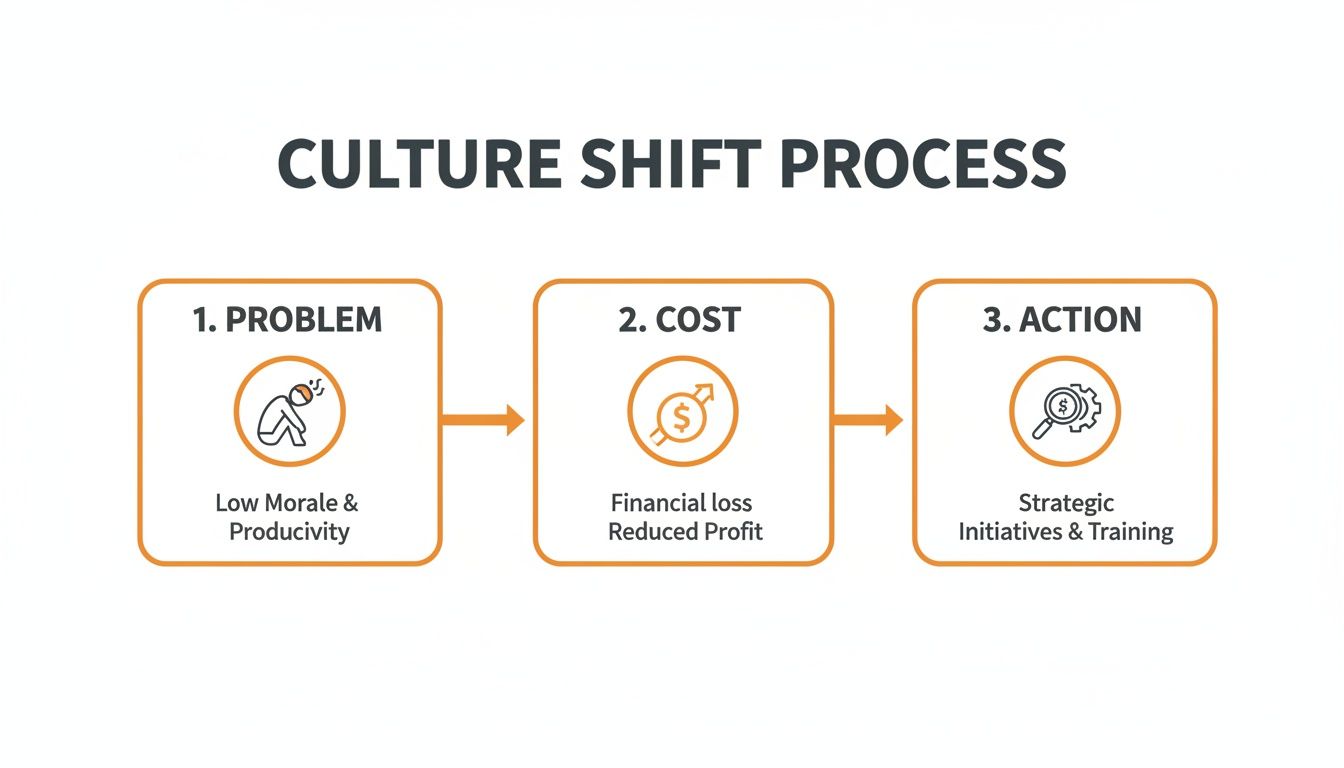
This is a great reminder that identifying a problem like burnout isn't just a "people issue"—it's a financial one that demands a real response, not just another perk.
Uncovering Hidden Frictions
Beyond surveys, some of your best insights come from less formal, more human sources. Exit interviews, for instance, are a goldmine. Are you analyzing the notes for patterns? If three people from the same team leave in six months and all mention a lack of growth, you don't have three isolated incidents—you have a systemic problem.
One-on-one meetings are another critical listening post. Managers should be trained to ask better questions that go beyond status updates.
"What’s one thing making your work harder than it needs to be?"
"Where did you get stuck this week?"
"Is there anything I could be doing differently to help you?"
These questions don't just uncover task-blockers; they uncover the silent frustrations that slowly eat away at a good culture. To really understand what's happening, you need to grasp the dynamics of daily interactions, which involves navigating workplace relationships and managing stress among coworkers and bosses.
Ignoring these signals comes at a huge cost. Right now, only 30% of employees feel engaged at work. This isn't just a morale problem; disengaged teams have 23% higher absenteeism, and toxic environments are the top reason 45% of employees quit. Gallup data even shows this global engagement dip costs the economy a staggering $438 billion in lost productivity.
The best listening tool you have is curiosity. When you stop assuming you know the answers and start genuinely asking, people will tell you everything you need to know.
Ultimately, diagnosing your culture is about paying attention. To what’s said and, just as importantly, to what isn’t. Before you plan the next initiative, take a step back and just listen. The story is there. You just have to be willing to hear it.
Three Pillars for Meaningful Culture Change
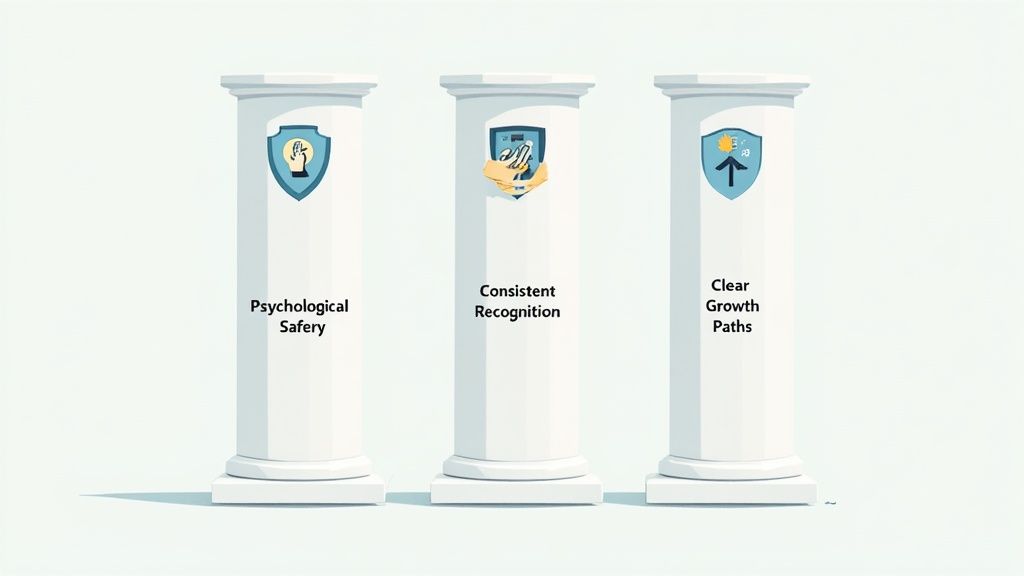
So, you’ve done the hard work of listening. You see the cracks. The temptation is to throw everything at the wall—a new mentoring program, a "values committee," another feedback tool. We’ve all been there. It’s a flurry of activity that usually just ends in exhaustion and cynicism.
Here’s the thing: you don’t need a hundred fixes. You need a simple, sturdy framework.
I've found that real, lasting change is built on three pillars. Not twenty, not ten. Just three. Get these right, and almost everything else falls into place. They are Psychological Safety, Consistent Recognition, and Clear Growth Paths.
Pillar 1: Psychological Safety
This is the most misunderstood of the three. It isn’t about being “nice” or avoiding tough conversations. It’s the opposite. It’s about creating an environment where people feel safe enough to have tough conversations—and even fail—without fear of being shamed or punished.
It’s the gut feeling that you can say, “I don’t get this,” or “I think we’re making a mistake,” and your comment will be met with curiosity, not criticism. It's admitting you dropped the ball and the response is, “Okay, how do we fix it together?” instead of “Whose fault is this?”
When people feel safe, they take risks. They speak up about small problems before they become company-sinking disasters. Without it, you get silence, compliance, and a sea of nodding heads.
Leaders have a huge role here. There are some great insights on transforming organizational culture through corporate leadership events that show how powerful top-down modeling can be.
Pillar 2: Consistent Recognition
Let’s be honest. The annual bonus or the "Employee of the Month" award is mostly theater. It’s a formal, top-down gesture that feels disconnected from the daily grind. Meaningful recognition is small, frequent, and flows in every direction—from peer to peer, from manager to employee, and even from employee to manager.
Think about a teammate dropping a note in a public channel saying, “Props to Sarah for staying late to help me with that bug. You saved the day.” Or a manager taking two minutes in a team meeting to call out a specific, well-handled customer interaction.
This isn’t about participation trophies; it’s about reinforcing the exact behaviors you want more of. When you consistently celebrate collaboration, people collaborate more. When you praise clear communication, communication improves. It’s that simple.
The data backs this up. Frequent, meaningful recognition is proven to dramatically improve culture by slashing attrition by 29%. Modern tools can now even identify at-risk staff based on how much praise they receive, allowing for proactive support.
Pillar 3: Clear Growth Paths
Nobody wants to feel like they’re on a hamster wheel. The ultimate retention tool isn’t a bigger paycheck; it’s a future. A clear growth path shows people they aren’t just a cog in the machine—they’re an asset the company is willing to invest in.
And "growth" doesn't just mean a linear climb up the ladder. It can be many things:
Mastery: Getting deeper expertise in a current role.
Mentorship: Opportunities to teach and guide others.
New Skills: Learning a new technology or moving into a new area.
Leadership: Taking on more strategic responsibility.
The key is making these paths visible and accessible. It means having honest career conversations, investing in real training, and creating opportunities for people to take on stretch assignments. When you see that only 51% of non-managers feel they have the resources for growth compared to 72% of executives, it’s a glaring signal that opportunity isn't trickling down.
Pillar in Action: What Leaders vs. Managers Do
Building these pillars isn't a one-person job. Executives set the strategy, but it's the frontline managers who bring it to life every single day. Here’s how their roles differ but work together.
Culture Pillar | Executive/Leader's Role | Frontline Manager's Role |
|---|---|---|
Psychological Safety | Model vulnerability and accountability from the top. Design systems (like blameless post-mortems) that support safety. | Foster an environment of trust within the team. Encourage questions, listen actively, and respond to failures with support, not blame. |
Consistent Recognition | Champion and fund a company-wide recognition program. Publicly celebrate wins that align with company values. | Make recognition a daily habit. Give specific, timely praise in 1:1s, team meetings, and public channels. Encourage peer-to-peer shoutouts. |
Clear Growth Paths | Allocate budget for training and development. Define company-wide competency frameworks and career ladders. | Hold regular career conversations. Connect team members with mentors and find stretch projects that align with their goals. |
Building a better culture isn't a mystery. It’s the intentional, daily work of building safety, showing appreciation, and investing in your people's future. It’s not easy, but it’s the only work that truly matters.
Where the Real Work of Culture Happens
A beautiful strategy deck is worthless if it doesn't change how people work together on a Tuesday afternoon. Culture isn't built in a conference room over a catered lunch. It’s forged in small, seemingly mundane moments.
It’s what happens in a one-on-one. It’s how a team handles a crisis. It's the tone of a Slack message sent at the end of a long day. This is where culture lives and breathes. It’s all about execution.

The Most Powerful People in Your Company
When it comes to shifting culture, the people with the most leverage aren't in the C-suite. They’re your frontline managers.
These are the people who translate the company’s vision into the team’s daily reality. In many ways, they are the culture.
Think about it. If a manager runs unfocused meetings, your culture is one where people’s time isn’t valued. If they shy away from direct feedback, you have a culture of ambiguity. If they don’t notice when a top performer is burning out, you have a culture that mistakes exhaustion for dedication.
The single biggest lever you can pull is helping your managers get better at their jobs. This isn't about more paperwork. It's about fundamental human skills.
We need to help them:
Give better feedback: In the moment, with clarity and kindness.
Run better meetings: Turn them from obligations into focused conversations.
Spot burnout early: Recognize the subtle signs before it’s too late.
Culture change doesn't cascade from a memo. It radiates out from managers who are equipped, confident, and intentional in how they lead their teams every single day.
Navigating the Remote and Hybrid Reality
This gets even harder when your team is spread out. In a remote world, you can’t rely on the accidental culture-building that happens by the coffee machine. Everything has to be more intentional.
Suddenly, the little things become the big things. The way you run a Zoom call—do you start with a moment of human connection or dive straight into the agenda? How you share wins—is it a quick, forgettable note or a celebrated moment in a public channel? These choices define your remote culture.
A simple ritual like a daily "good morning" thread in a team's chat channel can do more to build connection than a quarterly virtual happy hour. It’s a small act that reminds everyone they are part of a team of real people. You can read more about how leadership communication impacts employee engagement to understand why these small signals matter so much.
Building Rituals, Not Rules
This is where rituals come in. Rules are rigid and create resentment. Rituals are shared habits that reinforce the behaviors you want to see. They are the practical actions that bring your values to life.
Here are a few examples:
"Wins of the Week" on Fridays: A dedicated time or channel for everyone to share one win. This builds a habit of recognition and ends the week on a positive note.
Meeting "Pre-Reads": The organizer sends a short doc a day in advance outlining the goal and context. This respects everyone’s time and leads to far more productive discussions.
"How Can I Help?" Check-ins: Managers make a point to end their one-on-ones by asking this specific question. It changes the dynamic from a status report to a genuine offer of support.
These aren't grand, expensive programs. They are small, consistent behaviors that, over time, become the fabric of how your team works.
This is the slow, unglamorous, and essential work of building a culture that lasts. It’s not about launching an initiative; it’s about changing habits. One Tuesday afternoon at a time.
Common Traps That Derail Culture Initiatives
So, you’ve listened, built a framework, and launched your initiatives. Six months later, nothing feels different. Maybe things have even gotten worse.
I've seen this happen more times than I can count. A well-intentioned effort fizzles out, leaving a trail of cynicism. It’s rarely because leaders are bad people. It’s almost always because they fell into one of a few common traps.
The hard truth is that building a great culture is fragile work. It takes years of consistent effort to build trust and only a few missteps to burn it all down.
The Rise of Culture Theater
The most common trap is what I call “culture theater.” This is all the flashy, performative stuff that looks great but lacks substance. The ping-pong table in a company riddled with burnout. The mandatory “fun” happy hour after a grueling 60-hour week.
Culture theater is easy. It’s a box you can check. But your people see right through it. They know a free lunch doesn’t fix a toxic manager, and a wellness app doesn’t make up for an unsustainable workload. These gestures aren't just ineffective; they’re insulting. They signal you’re not serious about solving the real problems.
A great culture is about how you handle the tough stuff—a failed project, a difficult conversation, a tight deadline. It’s not about how you celebrate when everything is going great.
Real culture is what happens on a rainy Tuesday, not at the company picnic.
The Poison of Executive Disconnect
The second, and most lethal, trap is executive disconnect. This is when leaders say one thing and do another. They talk about work-life balance while sending emails at 10 PM. They preach psychological safety but publicly criticize someone for a mistake.
This hypocrisy doesn’t just undermine the initiative; it destroys trust. When an employee sees a leader violate the very values they claim to champion, the entire effort becomes a joke. A 2024 study on workplace credibility found that while 83% of employees at the best companies say management’s actions match its words, that number plummets to just 42% at average workplaces. That gap is where culture goes to die.
You simply can't delegate culture. It has to be modeled, consistently and authentically, from the very top. If your leadership team isn’t living it, nobody else will.
The Slow Grind of Initiative Fatigue
Finally, there’s initiative fatigue. This is what happens when a company launches a constant stream of new programs. "This quarter, we're focusing on recognition! Next quarter, it's all about wellness!"
Each launch kicks off with a burst of energy but is quickly replaced by the next shiny object. The result? Everyone gets tired. People learn that if they just wait a few months, this "priority" will fade away like all the others. The programs become background noise, and the team’s default setting becomes apathy.
Real change is a slow burn, not a fireworks display. It’s about choosing one or two critical areas and committing to them for the long haul—even when it gets boring. Authenticity, consistency, and patience are the only things that work. Anything else is just theater, and your audience is too smart to be fooled.
Your Questions on Improving Company Culture Answered
Once you get past the strategy decks, a lot of practical questions pop up. It's one thing to talk about frameworks; it's another to navigate the messy reality of changing how people work together.
We get these questions all the time. Here are a few common ones, with some honest answers.
How Long Does It Really Take to See a Change?
Let’s be realistic. You can start to feel small shifts in morale and communication within three to six months, if you're consistent. This is when people notice that meetings are more focused, or that their manager is giving better praise. These are the early green shoots.
But for deep, lasting change—the kind where new behaviors become the default—you're looking at a much longer road. Think 18 to 24 months. It’s like turning a massive ship. The momentum is slow to build, but once it turns, it's powerful.
The trick is to watch for the leading indicators. Don’t just stare at your annual retention numbers. Instead, keep an eye on things like:
Improved pulse survey scores: Are those weekly check-ins trending up?
Better one-on-one conversations: Are managers telling you discussions feel more open?
Increased peer-to-peer recognition: Are people celebrating each other more often without being prompted?
These are the signals that the ship is slowly, surely, starting to turn.
What’s the Single Biggest Mistake Leaders Make?
Without a doubt, it's outsourcing the problem to HR. While your HR team is an essential partner, culture is ultimately owned by leadership. It just has to be.
When executives delegate "culture" and don't actively model the behaviors they claim to want, the effort is doomed. Employees have an incredible radar for hypocrisy. They see it immediately when a leader preaches work-life balance while firing off emails at midnight.
Culture change fails when it's treated as a side project. It has to be woven into every business decision—from who you hire to how you handle tough news.
This work can’t be contained in a committee. It has to live in every team huddle, every performance review, and every decision made by the people in charge.
Our Budget Is Tight. What Are Some Low-Cost Ways to Improve Our Culture?
This is a great question. You absolutely do not need a huge budget to make a meaningful difference. In fact, some of the most powerful actions you can take are completely free. They just require time and consistency.
If you're starting from scratch, focus on these three things:
Improve Communication: A simple weekly update from the CEO explaining the "why" behind decisions can work wonders for building trust. It costs nothing but an hour of someone’s time.
Encourage Recognition: The most meaningful recognition isn't a gift card; it's a specific "great job" in a team chat. It costs nothing to build the habit of noticing good work and calling it out.
Fix Your Meetings: Are they all necessary? Do they have agendas? Do they end on time? Respecting everyone's time is a massive, and completely free, culture win.
These actions build the trust and safety that form the bedrock of any great culture. They don't cost a dime, but their return is immeasurable. So, where will you start?
Ready to build a culture where everyone feels connected, informed, and valued? Pebb brings your people, work, and culture together in one simple app. See how you can improve communication and engagement at your company.
