
Unlock Growth: Understanding Workplace Culture for Leaders
Move beyond abstract values. Our 2026 guide to understanding workplace culture offers HR & Ops leaders a real plan to build connection & drive results.
Dan Robin

The poster in the break room said Integrity, Teamwork, Excellence. On the warehouse floor, a new hire spent her first shift trying to guess who to ask for help, where the latest process lived, and whether anyone would notice if she got it wrong.
That gap is workplace culture.
The Culture on the Wall vs The Culture on the Floor
Most culture problems don't start with bad intentions. They start with a polished story at the top and a messy reality on the ground. Leaders write values, launch a town hall, and feel like they've done the work. Then a frontline employee starts a shift with outdated instructions, no context, and a supervisor who is too stretched to explain the why behind anything.

I've seen this in retail, logistics, and healthcare. The office talks about openness. The people serving customers or moving product learn that the prevailing rule is to keep your head down and figure it out yourself. That kind of disconnect doesn't just feel bad. It kills credibility.
The trust gap is the culture gap
The clearest sign of this split comes from SHRM research on employer and employee views of workplace culture. 72% of executives believe their organizational culture has improved since the pandemic began, yet only 14% of working Americans agree. That's not a rounding error. It's a leadership blind spot.
When leaders think culture is improving and employees don't, every initiative gets harder. Communication sounds scripted. Recognition feels staged. Feedback surveys become theater. People stop telling you the truth because they've learned it won't change anything.
Culture fails when leadership describes an experience employees don't recognize.
Frontline and distributed teams feel this first. They don't sit near headquarters. They don't overhear the strategy. They don't get the benefit of hallway clarification after a confusing announcement. If the culture isn't built into the daily work itself, they get the weakest version of it.
What glossy values can't fix
A values poster can't fix a broken handoff between shifts. It can't make a manager follow through. It can't help a night team feel included when all the important updates happen during the day.
That's why understanding workplace culture starts with a simple question. What is it like to work here on a normal Tuesday? Not during onboarding week. Not during the annual all-hands. Not when executives are visiting the site.
If the answer changes wildly depending on role, shift, or location, the culture isn't strong. It's fragmented.
What We Really Mean When We Say Culture
People make culture too abstract. It doesn't need to be.
Workplace culture is the story your team tells about what it's really like to work here. It's the pattern beneath the policy manual. It's what people expect will happen when they raise a concern, make a mistake, ask for help, or do great work.
Culture is behavior, not branding
If a company says it values candor but people get punished for bad news, the culture is fear. If it says it values teamwork but rewards only individual heroics, the culture is competition. If it says it cares about frontline voices but all decisions still flow one way, the culture is distance.
That's why I like the operating system analogy. Culture is the company's operating system. It runs in the background and shapes how everything else works. Hiring, meetings, customer service, quality, speed, retention. All of it.
You can install that system on purpose, or you can accept the buggy default version that grows on its own.
For a broader plain-English breakdown, this guide to what company culture is gets the core idea right. Culture isn't a side project. It's the environment people work inside every day.
The simplest test
If you want to know your culture, don't start with your mission statement. Start with questions like these:
When someone makes a mistake, what usually happens
How do people hear important news
Who gets praised in public
What behavior gets tolerated from high performers
What do new hires learn in their first week about how things really work
Those answers tell the truth faster than any slide deck.
Practical rule: Your stated values matter far less than your repeated behaviors.
The same company can have a decent stated culture and a damaging lived culture. That's common in distributed organizations. Headquarters experiences one workplace. Field teams experience another. Leaders assume the values are universal because they hear them often. Frontline teams judge culture by whether they can get answers, whether managers follow through, and whether work feels fair.
Understanding workplace culture means treating it as observable. Not mystical. Not aspirational. Observable. If people can see it, feel it, and predict it, it's culture.
Why Culture Is Critical for Distributed and Frontline Teams
A regional ops leader once told me, "Corporate says we have one culture. I manage six locations, and each one feels like a different company." That is the problem in plain language.
For office-based teams, weak culture can stay hidden longer. People overhear decisions, catch context in hallways, and patch over bad systems with personal relationships. Distributed and frontline teams do not have that buffer. If leaders are unclear, inconsistent, or absent, employees feel it on the next shift.
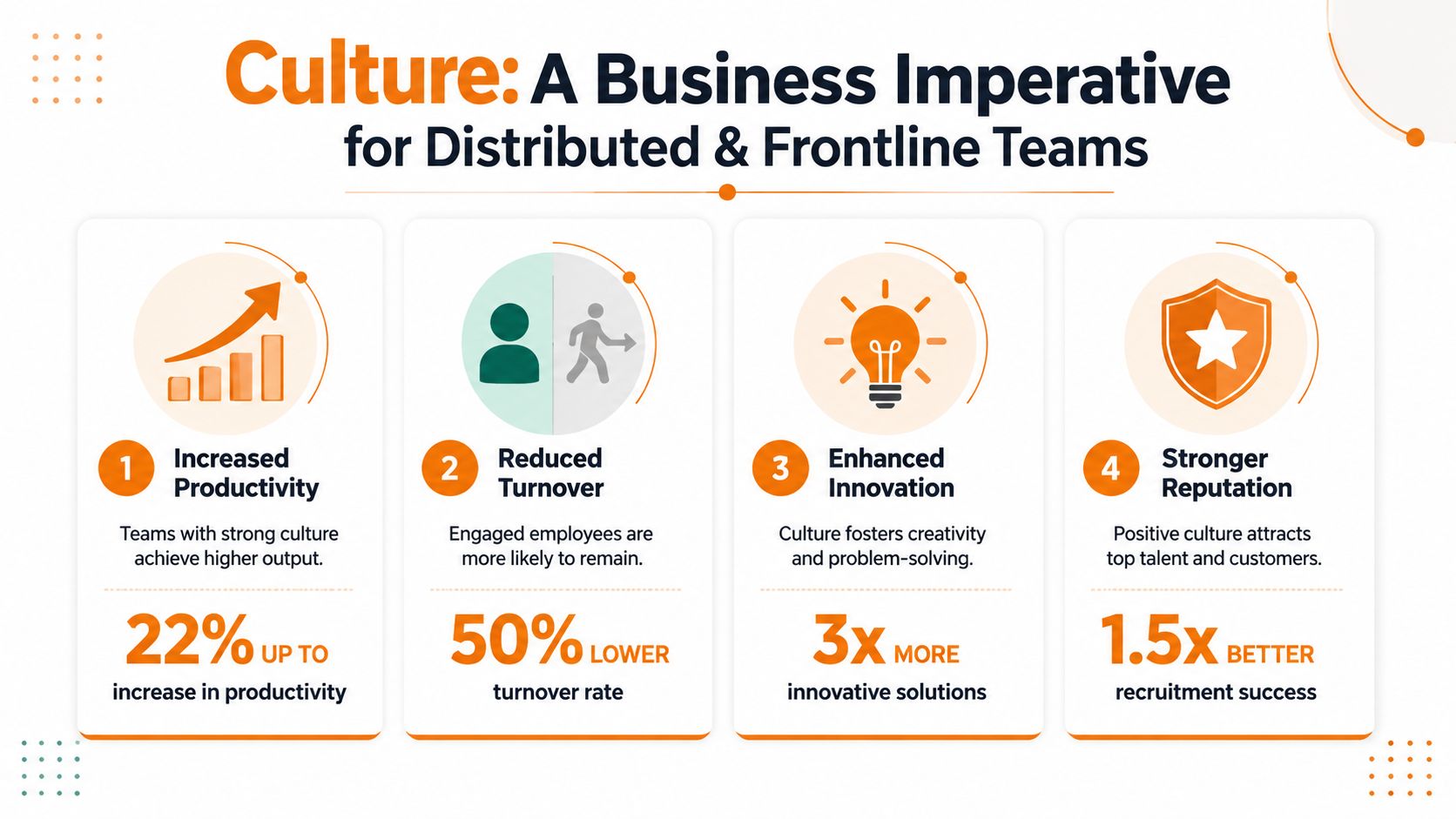
Community affects whether people stay
Community gets dismissed as a soft topic by leaders who rarely work nights, weekends, routes, floors, or multiple sites. In practice, it shapes retention, trust, and effort.
Research highlighted by UNC on mending work culture found that many U.S. workers report a lack of community at work, and people who do feel a sense of community are far more likely to stay. That matters more in environments where employees rarely see senior leaders and often rely on one supervisor, one shift lead, or one group chat to make sense of the day.
Once people feel disconnected, the job becomes purely transactional. They stop raising issues early. They stop offering fixes. They do the minimum needed to get through the shift.
For teams spread across shifts and sites, this frontline team communication guide is useful because it deals with the operating reality that office-centric culture advice usually misses.
Culture shows up in operating results
I have never seen a frontline culture problem stay "just cultural" for long. It turns into service misses, safety shortcuts, no-shows, avoidable turnover, and supervisors burning time on clarification that should have been built into the system.
Gallup figures summarized by Speakap point to a broad drop in engagement and a large productivity cost tied to disengagement. At the local level, the pattern is familiar. Teams with weak culture miss handoffs, repeat mistakes, and spend too much energy interpreting mixed signals from management.
That is why distributed culture work has to be concrete. People need timely information, fair treatment, clear standards, and managers who follow through. If those basics are missing, no values campaign will save you.
What weak culture looks like in the field
In distributed operations, culture problems are usually easy to spot if you know where to look:
Information moves unevenly. Day shift hears updates first. Night shift gets fragments.
Managers become translators. Every company message has to be explained, softened, or corrected locally.
Belonging depends on location. One site feels supported. Another feels invisible.
Standards drift. Teams create their own version of what good work looks like.
Trust erodes. Employees stop believing that feedback will lead to action.
Executives often miss these signals because headquarters still feels functional. The floor tells a different story. For frontline and distributed teams, culture is the system that decides whether work feels coordinated or chaotic, fair or political, human or disposable.
The Six Core Components of a Real Culture
Real culture is built from operating choices people deal with every day. I have seen leaders call culture a feeling, then wonder why nothing changes. Feelings follow systems. If the system is inconsistent, unfair, or hard to understand, the culture will feel that way too.
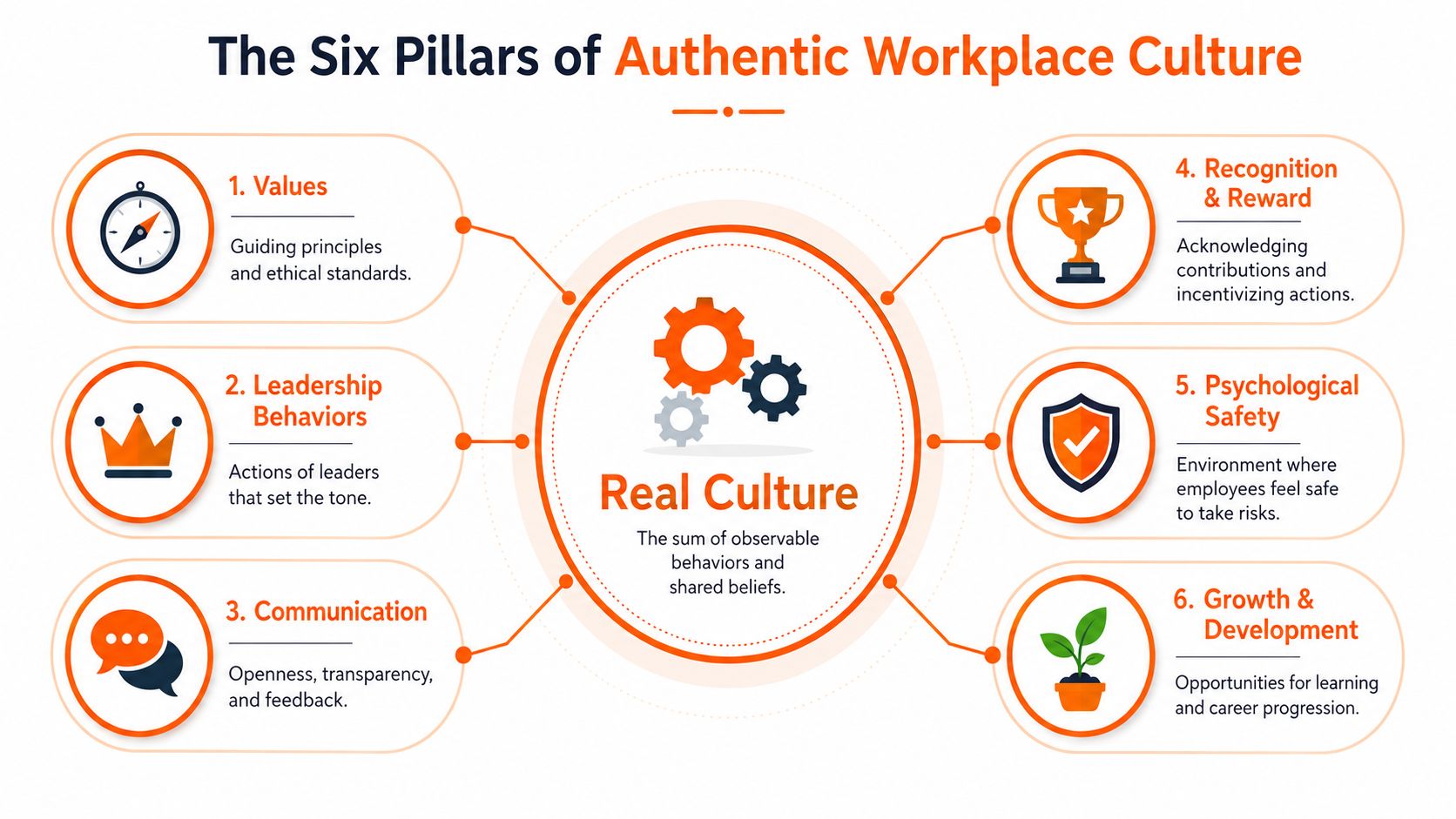
These six components show where culture becomes real or falls apart, especially across shifts, sites, and field teams.
Values people can see
Values matter when they shape decisions under pressure. If safety slips the second output is behind, safety is not a value. It is a slogan. If respect disappears for the top performer who gets results but burns out everyone around them, employees notice that immediately.
A simple test works well here. Ask people which behaviors lead to praise, promotions, and extra trust. Their answers will tell you far more than the framed values in the lobby.
Rituals that make culture repeatable
Rituals are the repeated actions that teach people how work gets done here. A shift handoff note that is reviewed. A five-minute start-of-day huddle that covers priorities and risks. A manager check-in that begins with blockers instead of status theater.
Small routines create consistency across locations. That matters more in distributed operations than many executives realize. Without repeatable habits, culture gets outsourced to individual supervisors. One site feels clear and steady. Another feels chaotic, even though both report to the same company.
Communication that reaches the edge
Communication works only when frontline employees can use it in the moment. Sending an email to headquarters and site leaders is not the same as reaching a nurse on nights, a driver between stops, or a warehouse picker halfway through a shift.
Strong culture uses a few trusted channels, plain language, and clear ownership. People know where the latest update lives. They know what changed, what stays the same, and who can answer questions without guessing. That kind of clarity prevents local managers from having to translate every company message after the fact.
Recognition that reinforces the standard
Recognition sets the standard in public. It shows people what the company wants more of.
The problem is that many recognition programs drift into favoritism, anniversaries, or generic praise from the intranet. That does not build culture. Specific recognition does. Name the behavior. Name the impact. Tie it to the standard the team is supposed to repeat.
“Thanks for staying late” is polite. “Thanks for staying late to leave the next shift fully stocked and caught up. That made the handoff cleaner for everyone” teaches the team what good work looks like.
Onboarding that starts the story right
Onboarding is often the first proof point. New hires are deciding whether the company is organized, honest, and worth trusting. A weak first week creates confusion that managers spend months trying to fix.
Culture Amp's company culture guide notes that workers who feel aligned with their role from day one are 48% more likely to perform at a high level. For frontline teams, that alignment usually comes down to practical basics, not inspiration. What does good performance look like? Who do I go to with a problem? How do schedules, policies, and handoffs work here?
A useful Day One onboarding experience usually includes:
Role clarity so the person knows what success looks like
Behavioral context so they understand how the team works together
Access to basics like schedules, policies, contacts, and current priorities
Human connection so they know who has their back
Policies that reveal whether you trust people
Policies expose leadership assumptions fast. Employees can tell the difference between a rule designed for fairness and a rule designed because someone at headquarters assumes people will abuse any freedom they get.
Some controls are necessary. Safety, compliance, payroll, and customer risk all require discipline. But if every process adds friction, approvals, and hidden exceptions for favored people, employees read the message clearly. The company does not trust them, and fairness is negotiable.
Here is a practical way to assess the six components:
Component | Healthy signal | Warning sign |
|---|---|---|
Values | Leaders make consistent trade-offs | Values disappear under pressure |
Rituals | Good habits repeat across teams | Every manager runs a different culture |
Communication | Frontline teams get timely, usable updates | Rumors move faster than updates |
Recognition | Praise names the behavior and impact | Recognition feels random or political |
Onboarding | New hires get clarity early | People learn by trial and error |
Policies | Rules support trust and fairness | Rules mainly signal control |
If three of these are weak, employees feel it long before leadership does. That is why culture work needs to get out of the brand deck and into the daily operating system.
How to Measure What Actually Matters
A leadership team once showed me a strong culture survey result at headquarters while two field locations were bleeding supervisors and missing shift handoffs every week. On paper, culture looked fine. On the floor, people were covering gaps with favors, guesswork, and overtime.
That is the measurement problem. Companies often track what is easy to collect from desk-based teams and miss what frontline and distributed teams live every day.
Skip vanity metrics
Sentiment scores have a place. They are just weak on their own. A decent score can hide low trust in the survey, low response rates from frontline teams, or pockets of dysfunction small enough to disappear in an average.
Use a mixed view instead. Pair what people say with what they do and what managers are dealing with week to week. If new hires leave in the first 90 days, if one site never opens updates, if recognition only happens after HR prompts a manager, those are culture signals. They show whether the daily experience matches the message from leadership.
A useful measurement stack usually includes:
Early turnover patterns that show whether the job people joined is the job they received
Participation signals from surveys, team updates, and routine communication
Open-text feedback that gives employees room to describe friction in plain language
Manager-level patterns that reveal where culture is stable and where it depends on one overstretched supervisor
For leaders who want a more grounded view, this guide to employee engagement measurement treats culture data like an operating input, not a branding exercise.
Tie culture to outcomes people respect
Culture gets budget and attention when leaders can connect it to outcomes they already review. Retention is one. Safety is another. Customer experience matters too, especially in frontline environments where one confused handoff or one unsupported manager can show up in service quality within days.
As noted earlier, research on engagement has linked stronger employee engagement with better business performance. The mistake is turning that into a slogan. The practical takeaway is simpler. Better onboarding, clearer communication, and consistent recognition improve execution because people know what matters, who to ask, and whether anyone notices good work.
Watch for patterns by manager, shift, and location. Company averages hide too much. A single region with high turnover, weak participation, and constant confusion is not an outlier to explain away. It is an operating warning.
It also helps to borrow ideas from adjacent measurement work. T-Shirt Envy's apparel metrics guide is a useful reminder that the best scorecards track lived experience, not just easy dashboard numbers.
Measure often enough to catch drift early. Ask questions people can answer without translating corporate language. Then fix something visible. If feedback goes into a system and nothing changes, employees learn that measurement is theater.
A Simple Plan to Start Building a Better Culture
I've seen this go wrong in a familiar way. A leadership team spends weeks drafting culture principles, announces them in an all-hands, prints posters for the break room, and waits for morale to improve. Three months later, the night shift still misses key updates, new hires still learn by rumor, and supervisors still improvise because nobody fixed the daily friction.
A better plan starts smaller. Pick the parts of work people trip over every day and repair those first.
Start with plain-language listening
If trust is shaky, skip the long survey. Ask three questions people can answer fast: what should we stop, start, and continue.
That format works because it sounds like real work, not HR language. It also gives frontline teams room to name problems executives rarely see. A warehouse lead might point to handoff confusion between shifts. A field tech might say policy updates arrive after customers have already heard about them. A store associate might tell you the schedule app matters more than the values slide.
Then sort responses by pattern, not volume alone. Look at role, shift, site, and manager. If the same complaint keeps showing up from one part of the business, treat it as an operating issue and assign an owner.
Listening only helps if people can see what happened next.
Fix one communication failure people already hate
Culture work gets traction when it removes irritation. Start there.
Choose one broken communication path that wastes time, creates inconsistency, or makes people feel excluded. Keep the scope narrow enough that employees notice the change within weeks. One reliable update channel is better than six channels no one trusts. One clear rule with examples beats a vague memo managers interpret differently.
Use a simple filter. Ask: where does confusion cost us the most today?
Problem | Weak response | Better response |
|---|---|---|
Employees miss updates | Send the same message in more places | Choose one primary channel and train people to rely on it |
Managers apply policy differently | Tell managers to align | Rewrite the policy in plain language and add examples |
Frontline staff hear news late | Brief directors first and hope it trickles down | Publish the update where crews already work, at the same time leadership gets it |
For distributed teams, this step matters more than leaders think. People do not judge culture by the quality of the town hall deck. They judge it by whether they can get the information they need before a customer, patient, or production problem lands in front of them.
Build one recognition habit managers can sustain
Recognition fails when it is vague, rare, or reserved for office-visible work. Frontline teams notice that fast.
As noted earlier, research has linked regular recognition with stronger engagement. The useful lesson is practical. Recognition works when it is specific, timely, and tied to behavior the team wants repeated.
Give managers one standard they can keep. Once a week, ask them to recognize one concrete action in public. Name what the person did and why it mattered. Good examples are the behaviors that hold distributed operations together: documenting a clean handoff, helping a new hire get up to speed, flagging a safety concern early, covering a shift without drama, calming an upset customer, or sharing a fix another location can copy.
Name the behavior. Name why it mattered. Do it while people still remember the moment.
That is enough to start changing what gets noticed.
Rewrite Day One for the reality of the job
If new hires spend their first day filling out forms and chasing logins, they learn something about the culture right away. They learn the system matters more than their experience.
A stronger first week answers the questions people are usually too embarrassed to ask twice. Where do I find updates? Who can approve what? What does a good handoff look like here? How do we raise a problem without getting brushed off? What should I do if the written process and the actual situation do not match?
This matters even more for hourly, field, and shift-based roles, because they often get less access to informal context. Office teams can absorb culture through meetings and hallway chatter. Frontline teams need it built into the work itself. A useful Day One plan gives them a clear contact, a short guide to how the team operates in practice, and a first-week checklist that reflects real conditions, not ideal ones.
Make progress visible at the team level
Employees do not need a culture report. They need proof that speaking up leads to change.
Tell people what you heard. Tell them what you changed. If you cannot fix something yet, say that too and explain why. Share small wins by site and team so progress feels local, not abstract. A cleaner handoff between shifts in one location is worth broadcasting if another location can copy it next week.
Much culture work breaks down when leaders keep the discussion at the executive level, then wonder why nobody believes it. If the floor, the van, the site office, or the late shift cannot see the difference, the effort stays theoretical.
The strongest culture improvements I've seen were modest at the start. One clearer update path. One onboarding fix. One recognition habit that managers could keep without reminders. Small changes earn trust because people can feel them in the job, not just hear about them in a meeting.
Culture Is a Practice Not a Project
A lot of leaders talk about fixing culture as if it's a renovation. Finish the work, cut the ribbon, move on. It doesn't work like that.
Culture is closer to maintenance. Daily, ordinary, repeated maintenance. You share information before rumors fill the gap. You explain decisions people don't like. You thank someone for the behavior you want repeated. You make it easier for a night shift employee to feel as informed as someone at headquarters.
An honest culture is better than a polished one. People don't need perfection. They need consistency, fairness, and signs that someone is paying attention to the reality of their work.
If you're serious about understanding workplace culture, don't ask what program to launch next. Ask what practice you want your team to experience every day, starting now.
If you're trying to connect office staff, frontline teams, and managers in one place without patching together a pile of separate tools, Pebb is worth a look. It brings communication, operations, and engagement into one mobile-friendly app, so updates, chat, tasks, knowledge, scheduling, and employee connection all live in the same digital home. For teams building culture across shifts and locations, that kind of shared space makes the work a lot more practical.
