
Employee Engagement Measurement Is Broken. Let's Fix It.
Stop chasing meaningless scores. Learn a better approach to employee engagement measurement that reveals what’s actually happening and drives meaningful change.
Dan Robin
For a long time, we’ve been trying to solve a very human problem with a very clunky tool: the annual survey. We’ve all been there. You run a massive poll once a year, spend weeks crunching numbers, and present a shiny report full of charts that are already out of date.
And then everyone wonders why nothing really changes.
The truth is, measuring employee engagement isn't about chasing a score. It’s about understanding the real, day-to-day experience of work. It’s time we stopped treating it like an HR project and started treating it like a conversation.
Why We Get Employee Engagement Measurement Wrong
The problem isn't the intention. We all want to know if our teams are connected and motivated. The problem is the entire mindset we've been using. For decades, we treated engagement like a number to be managed, a box to be checked.
It’s an outcome, not an input. You can't "do" engagement. You can only create the conditions where it happens naturally.
The real trap is treating engagement as a score to be managed, rather than a reflection of the daily experience of work.
The Frustration of Annual Surveys
We used to follow this playbook, too. The annual survey was a big ritual. We’d craft dozens of questions, promise anonymity, and then wait for the results. The process was painfully slow, the feedback was often vague, and by the time we had a plan, the company had already moved on.
This cycle is frustrating for everyone. Leaders get vanity metrics but no clear way forward. Employees feel like they’re shouting into a void. They share their honest thoughts, and then… crickets. That silence teaches them one thing: their voice doesn't actually matter. Ironically, this tanks engagement more than anything else. A McKinsey study found that a positive employee experience drives performance, but disconnected measurement efforts often miss the mark completely.
Shifting from a Project to a Practice
Here’s where our own story begins. We realized the old way was a guaranteed recipe for failure. We saw that genuine employee engagement measurement couldn't be a once-a-year event. It had to be a continuous, living practice.
It’s about looking at the real signals of connection happening every day, not just asking people how they feel every twelve months. This guide is about what we learned when we stopped chasing scores and started paying attention to the work itself. If you're looking for a better way to measure employee engagement, you’re in the right place.
Measuring What Actually Matters—Not Just What’s Easy
Once you ditch the outdated annual survey, a simple question pops up: what should you measure instead? The answer is simpler than the consultants want you to believe. It’s about looking for the real, observable signals of connection, collaboration, and progress.
This requires a shift in perspective. We need to move away from lagging indicators—things like annual survey results that only tell you what already happened—and start focusing on leading indicators. These are the day-to-day behaviors you can actually see, influence, and improve in real-time.
It means caring less about a 1-to-5 scale on ‘satisfaction’ and more about the real texture of how work gets done. Who is communicating with whom? Are people actually using the tools you’ve built? This is the heart of a modern approach to employee engagement measures.
From Feelings to Actions
The old way measures feelings about the work. The new way measures the work itself. We’ve found that tracking communication within a project space gives you a far richer, more accurate picture of engagement than any survey ever could.
Why? Because actions are honest. Someone can say they’re engaged, but if their team’s project channel has been silent for a week, that tells a different, more urgent story. True engagement isn't a feeling people report once a year; it's a pattern of behavior that shows up every day.
This model illustrates the shift from the old, broken way of thinking to a new, more human one.
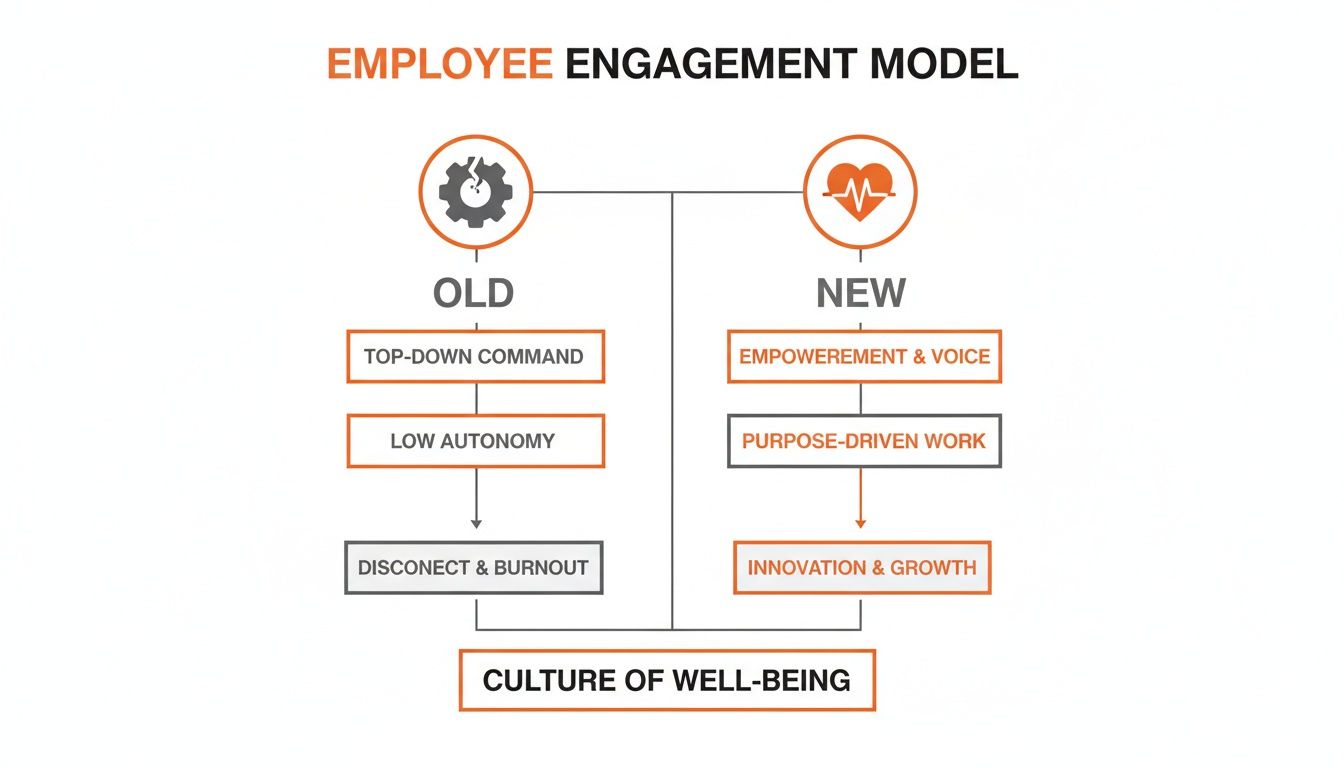
It’s about moving away from top-down, burnout-inducing cycles and toward a system that actually fosters genuine well-being and innovation.
The Staggering Cost of Getting It Wrong
Let's be honest about the stakes. The consequences of getting this wrong are enormous. Gallup's State of the Global Workplace: 2023 Report found that 59% of employees are "quiet quitters," and another 18% are "loud quitters."
The estimated cost of this lost productivity? A mind-boggling $8.8 trillion a year. That’s 9% of global GDP. This isn't just a soft HR metric; it's a massive financial drain.
The table below breaks down the difference between the metrics that contribute to this problem and the ones that can help solve it.
Traditional vs. Behavioral Engagement Metrics
Metric Type | Traditional Approach (Lagging) | Modern Approach (Leading) | Why It Matters |
|---|---|---|---|
Collaboration | Self-reported team satisfaction scores | Network analysis of cross-functional communication | Shows you who is actually working together, not just who says they are. You can spot silos before they become a problem. |
Productivity | Annual performance review ratings | Task completion rates and project velocity | Provides a real-time view of momentum, allowing you to identify roadblocks as they happen, not six months later. |
Knowledge Sharing | Survey question: "I can easily find information." | Usage rates of wikis, knowledge bases, and shared docs | Measures whether people are actively contributing to and using your collective knowledge, a key sign of a healthy culture. |
Recognition | Annual "Employee of the Year" awards | Frequency and spread of peer-to-peer recognition | Highlights organic appreciation and identifies influential team members who are lifting others up daily, not just once a year. |
This shift gives you the power to act before disengagement sets in and becomes a costly problem.
When you measure what’s easy—like a satisfaction score—you get a tidy number and a false sense of security. When you measure what matters—like communication patterns—you get the truth.
This truth is where real improvement begins. It allows you to spot a team that’s drifting apart long before it shows up in a quarterly report. It’s proactive, not reactive. You stop managing a score and start nurturing the conditions for great work.
The Tools for Real-Time Employee Engagement Measurement
If you want a true picture of engagement, you need the right lens. But this isn't about buying yet another survey platform. The real breakthrough comes from using the digital space where your team already works.
Modern employee engagement measurement isn’t a separate task; it's about paying attention. It’s about listening to the quiet signals just as much as the loud ones.
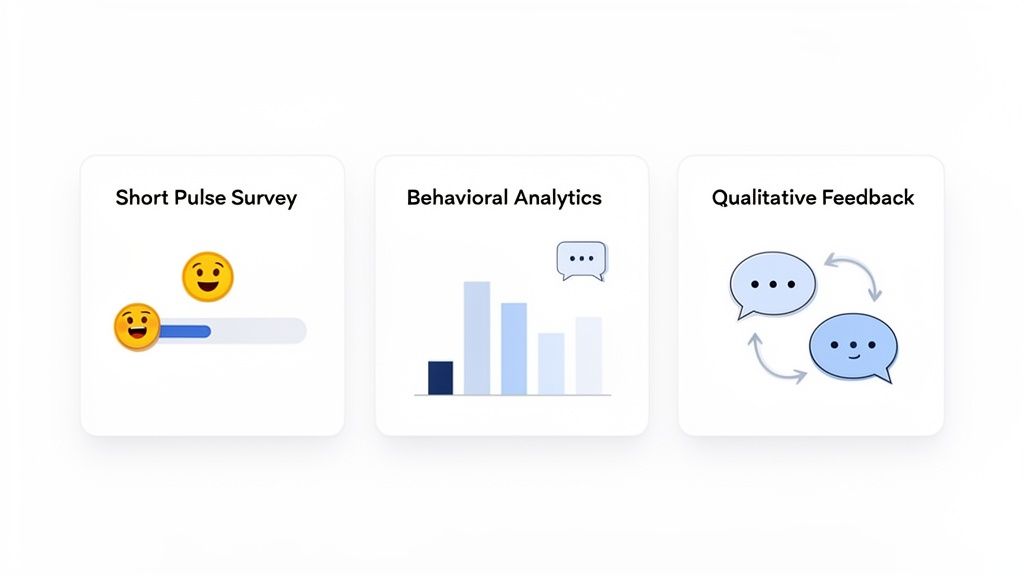
From what we've seen, the most insightful approach boils down to three core methods working together: lightweight pulse checks, behavioral analytics, and open feedback loops. When these live in one place, you start connecting the dots between how people feel, what they say, and what they actually do.
The Power of the Pulse Check
Let's be clear: we're not talking about another 50-question survey. A pulse check is short, frequent, and specific—maybe just two or three questions. It’s the difference between taking a single photograph once a year and watching a continuous film of your company.
Say you just changed your shift scheduling process. Instead of waiting a year to ask if people are happy, send a quick, two-question pulse check the following week. This gives you a snapshot of how the change landed right now, when you can still do something about it.
The key is to make them easy and fast. A good pulse check should take less than a minute and deliver insight almost instantly.
Behavioral Analytics: The Honest Signals
This is where things get interesting. Behavioral analytics means looking at passive, anonymized data to see how work happens. It’s about observing the work, not the worker. Think of it less as surveillance and more as organizational health science.
What does this look like? It could mean spotting trends in:
Channel Activity: Are project spaces buzzing with conversation, or have they gone quiet? A silent channel is often the first sign of a stalled project.
Task Updates: How quickly are tasks moving from “to-do” to “done”? Watching the flow of work gives you a real sense of momentum.
Knowledge Sharing: Are people contributing to and accessing shared documents? This shows if your team feels connected to the bigger picture.
These passive data points tell a story that people might not always say out loud in a survey. They are the unfiltered signals of how work is actually happening.
Closing the Loop with Qualitative Feedback
Numbers only tell half the story. A chart can show you that a team’s activity has dropped, but it can’t tell you why. That’s where qualitative feedback comes in. It’s about creating simple spaces for open conversation.
This could be a dedicated channel for suggestions, a regular “ask me anything” session, or simply encouraging managers to check in with their teams. The tool matters less than the intention: to show people you’re genuinely curious.
This part is critical because it builds trust. When people see their feedback leads to real conversation and change, they’re far more likely to stay engaged. They see their voice matters.
The most powerful strategy connects the dots. It combines the what from behavioral data with the why from direct feedback, creating a complete picture.
This integrated view is vital for understanding the influence of leadership. Recent Gallup data revealed a troubling drop in global engagement, driven largely by a fall in manager engagement. This highlights a critical insight: disengaged managers often lead to disengaged teams. You can read about the direct impact of manager engagement in the full report.
Ultimately, these tools aren't just for measurement. They are for listening. And when you listen better, you build a healthier organization. It’s a simple idea, but it changes everything.
A Simple Roadmap to Start Measuring Better
Alright, we've covered the theory. We know why modern employee engagement measurement matters. But how do you actually start?
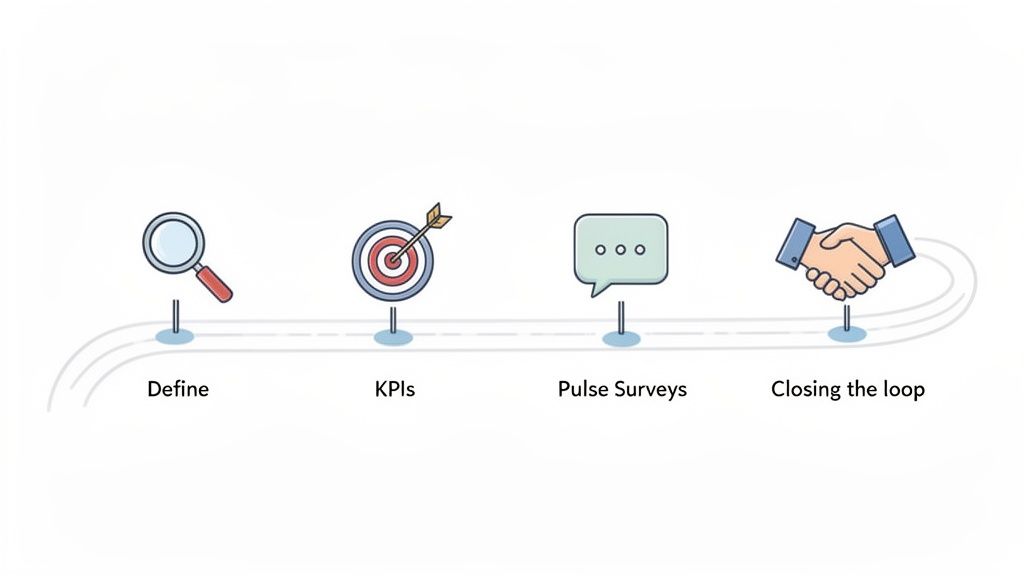
The good news is you don't need a massive project plan. It’s about starting small, learning as you go, and building momentum. Think of it less as a checklist and more as a simple, continuous loop you can start running today.
First, Define What Engagement Looks Like for You
Let's be honest: engagement for a team of remote engineers looks completely different than it does for a retail crew. So, step one is to ditch the generic definitions.
Instead, ask yourself a simple question: "What does it look like when this team is firing on all cylinders?"
For that engineering team, it might be frequent code commits and lively debates in their project channels. For the retail team, it could be everyone picking up shifts for each other and actively sharing customer feedback.
Start by identifying just two or three of these observable behaviors for one key team. This makes engagement real and tangible.
Next, Choose a Few Core Behavioral KPIs
Once you know what you're looking for, you can pick a few simple things to track. Again, don't overcomplicate this. You don’t need a fancy dashboard to start.
Just look at what you can already see:
Communication Flow: Is the team's main chat channel a hub of activity or a ghost town?
Task Velocity: Are people actually completing tasks? A steady pace is a great sign of forward motion.
Knowledge Sharing: Are people contributing to the team's shared documents? This shows they’re invested in the team's collective brainpower.
Think of these as vital signs, not judgment calls. A sudden drop in communication isn't a reason to point fingers; it's a signal to check in and ask, "Hey, how can I help?"
Then, Design Lightweight Pulse Surveys
While behavioral data shows you what is happening, pulse surveys help you understand why. The trick is to keep them incredibly light. A pulse survey should feel like a quick text message, not a final exam.
The purpose of a pulse check isn’t to gather endless data. It’s to open a specific conversation. Ask two questions, not twenty.
For example, after you roll out a new process, you could send a quick poll asking:
On a scale of 1-5, how clear is the new inventory system?
What's one thing that would make it even easier?
That's it. It’s fast, focused, and gives you immediate feedback. You're not trying to boil the ocean; you're just taking the temperature.
Finally, Close the Loop. Always.
This is, without a doubt, the most important step—and it's the one most companies skip. It’s not enough to collect feedback. You absolutely must show the team you’re listening. This is how you build trust.
Closing the loop can be as simple as posting a message in the team's channel:
"Hey everyone, thanks for the feedback on the new inventory system. We heard that the login process is a bit clunky. We're working on a fix for that this week. In the meantime, here’s a quick tip..."
This single message does three powerful things: it acknowledges their input, communicates an action, and provides immediate help. When people see their voice leads to change, they become more invested. They see feedback as a genuine way to make their work better.
This simple roadmap—define, track, ask, and respond—isn’t a project. It’s a habit.
Common Pitfalls and How to Sidestep Them
We’ve made plenty of mistakes on this journey. It's a messy, human process. Here’s some hard-won wisdom so you can avoid the same traps we fell into.
One of the biggest pitfalls is measuring for the sake of measuring. It’s easy to get seduced by beautiful dashboards, but data without action is just noise. It's performance art.
If a metric doesn’t spark a conversation, why are you tracking it? The goal isn't to admire the data; it’s to use it to make work better. Every KPI should tie back to a real business outcome, whether that's improving collaboration or speeding up a project.
The Problem of Survey Fatigue
Let’s be honest: nobody enjoys filling out long surveys. The second biggest trap is survey fatigue. This happens when you ask too many questions, too often, without ever showing people what came of their feedback. It teaches them that their voice doesn't matter, and pretty soon, they stop responding.
Finding the right cadence is an art. A quick two-question pulse check after a big project launch is far more valuable than a 50-question annual beast. Respect your team’s time, and they’ll give you gold in return.
This is especially critical right now. A five-year analysis by Mercer shows engagement levels in many regions fell back to 2019 levels by 2023. This highlights the danger of relying on annual snapshots, as they can easily miss the dips and recoveries happening in between. You can find more details in the full Mercer report on global engagement trends.
Don't Ignore the Stories Behind the Numbers
Data can tell you what is happening, but it rarely tells you why. A chart might show you that activity in a team’s channel has dropped by 30%. That’s a fact. But only a conversation can tell you the story behind it.
Maybe the team is heads-down in focused work. Maybe they’re burned out. Or maybe they’ve just found a better tool. The numbers are the starting point for curiosity, not the conclusion.
A dashboard is a map, not the territory. To truly understand what’s going on, you have to get out of the car and walk around. Talk to people. Listen.
Keeping Feedback Human and Safe
This leads to the most important point: employee engagement measurement must be handled with care and trust. The moment data is used for surveillance, the whole system breaks down. People will clam up, and you’ll be left with junk data.
It’s on you to create a culture where feedback is a gift, not a risk. This means being crystal clear about how data is used. It means guaranteeing anonymity for sensitive topics. And it means leaders must model vulnerability by receiving feedback with grace, not defensiveness.
When you get this right, measurement stops feeling like a test. It becomes what it was always meant to be: a quiet, continuous conversation about making work better for everyone.
From Measurement to a Healthier Culture
Ultimately, all this talk about employee engagement measurement isn't really about the report. It's not about hitting a target. It's about starting a conversation. It's about building a healthier, more connected company, one small step at a time.
If you’re just chasing a score, you’re missing the point. The real goal isn't a flawless number; it's a culture of continuous, humble improvement. It's the effort to make the experience of work just a little bit better, every day.
Reinforcing What You Value
When you decide to measure what actually matters—like collaboration or communication—you’re doing more than just tracking metrics. You are reinforcing what your culture values. You’re sending a clear signal that teamwork and open communication aren't just buzzwords on a mission statement. They’re the very things you pay attention to.
This shifts the entire conversation. Measurement stops feeling like a judgment and starts acting like a mirror. It reflects the truth of how work gets done, creating a shared understanding of where you are and where you want to go. It’s a move away from cold, impersonal analytics and toward a more human-centered view of your company.
Measurement is simply the tool. The real work is in the listening, the adapting, and the caring. It’s the constant, quiet practice of building a better place to work.
From Data to Action
Getting this right means seeing measurement as the first step, not the last. The data is an invitation to be curious, to ask better questions, and to connect with your team on a deeper level. You have to turn engagement data into action consistently. When people see their feedback leads to real change, they start to trust the process.
This is how a healthier culture is built. It grows from small, consistent acts of listening and responding. It's about fostering an environment where people feel safe enough to share their honest thoughts and confident that their voice will be heard.
So, as you look at your own company, don't just ask, "What should we measure?"
Instead, try asking a few better questions:
What conversations do we need to be having that we aren't?
What does a truly supportive team look like here, in practice?
How can we make it easier for our people to do their best work?
The answers won’t be in a spreadsheet. They’ll be in the daily interactions, the shared challenges, and the collective effort to build something meaningful together. That’s the only work that truly matters.
Frequently Asked Questions About Engagement Measurement
We hear a lot of the same questions when people start rethinking employee engagement measurement. The old way is a hard habit to break, so let's tackle a few of the most common ones.
How Often Should We Measure Employee Engagement?
If you're still thinking about the annual survey, it's time to let that idea go. The right rhythm depends on what you're trying to learn.
For a general vibe check on culture, a lightweight pulse survey once a quarter is probably plenty. If you want feedback on a specific project, a quick poll right after a big milestone makes sense.
But the most insightful data often isn't from a survey at all. The true pulse of your company is found in continuous, passive behavioral analytics. Seeing how work is flowing on a daily basis tells you what's really happening, no questions asked. The trick is to blend the active (surveys) with the passive (behavioral data) to get a full picture without burning everyone out.
Is Employee Engagement Measurement Anonymous?
This is a great question. The answer is "yes and no." Getting this right is essential for building trust.
Direct feedback, like from pulse surveys, must always be anonymous. Full stop. It's the only way you'll get the honest truth.
Behavioral analytics are different. The goal isn't to monitor individuals—it's to understand the health of the organization. The data should always be aggregated to show trends at a team level. For example, you might see that "the marketing team's new project channel is buzzing with activity." It should never be used to spy on what a specific person is doing.
A trustworthy tool makes this distinction clear. It gives leaders valuable insights into patterns while fiercely protecting individual privacy. It’s about spotting trends, not watching people.
What Is the Single Most Important Engagement Metric?
This is a trick question. The honest answer is: there isn't one.
This search for a single "engagement score" is exactly where most companies go wrong. It reduces a complex, human issue into a simple number, which leads to people chasing a score instead of actually making work better.
But if you twisted our arm, we’d suggest looking at communication density within teams. Are the people in a project group actually talking and sharing ideas? This is a huge leading indicator because real, healthy interaction is the foundation of genuine engagement.
At the end of the day, the real goal of measuring engagement is to build a healthier culture. This means being proactive about things like stress and implementing effective workplace stress management techniques. A healthy team talks to each other, and that’s a signal worth watching.
Ready to see how work really gets done in your company? Pebb unifies communication, operations, and real-time engagement analytics in one simple app. Start building a more connected culture today.
