
Your Front Line Team Is Your Whole Company
Your front line team is the backbone of your business. This guide explains their challenges and how to manage, engage, and connect them for real impact.
Dan Robin
A lot of leaders think they’re running one company. They’re not.
They’re running the company they see from headquarters, inside dashboards, meetings, and planning decks. And they’re running the company customers meet, inside stores, hospital floors, loading docks, kitchens, service counters, and job sites.
If those two companies are in sync, things feel steady. If they’re not, no amount of strategy language will save you.
I’ve seen this up close. The front line team usually knows what’s broken before anyone else does. They know which process slows the shift down, which policy annoys customers, which handoff creates mistakes, and which manager people trust. They also know when nobody at the top is listening.
That disconnect is the story. It sits underneath turnover, low morale, weak communication, and the constant feeling that one part of the business is talking at the other. Fix that, and a lot of other problems get smaller. Ignore it, and everything gets harder than it should be.
The Most Important People You Never See
A company can spend all morning talking about brand, service standards, and growth plans. By lunch, all of that gets tested by someone stocking shelves, answering a patient’s question, delivering an order, checking in a guest, or calming down an upset customer.
That’s your front line team.
They aren’t a subset of the business. In practice, they are the business. They are the people customers remember, the people who keep operations moving, and the people who absorb the friction created elsewhere.
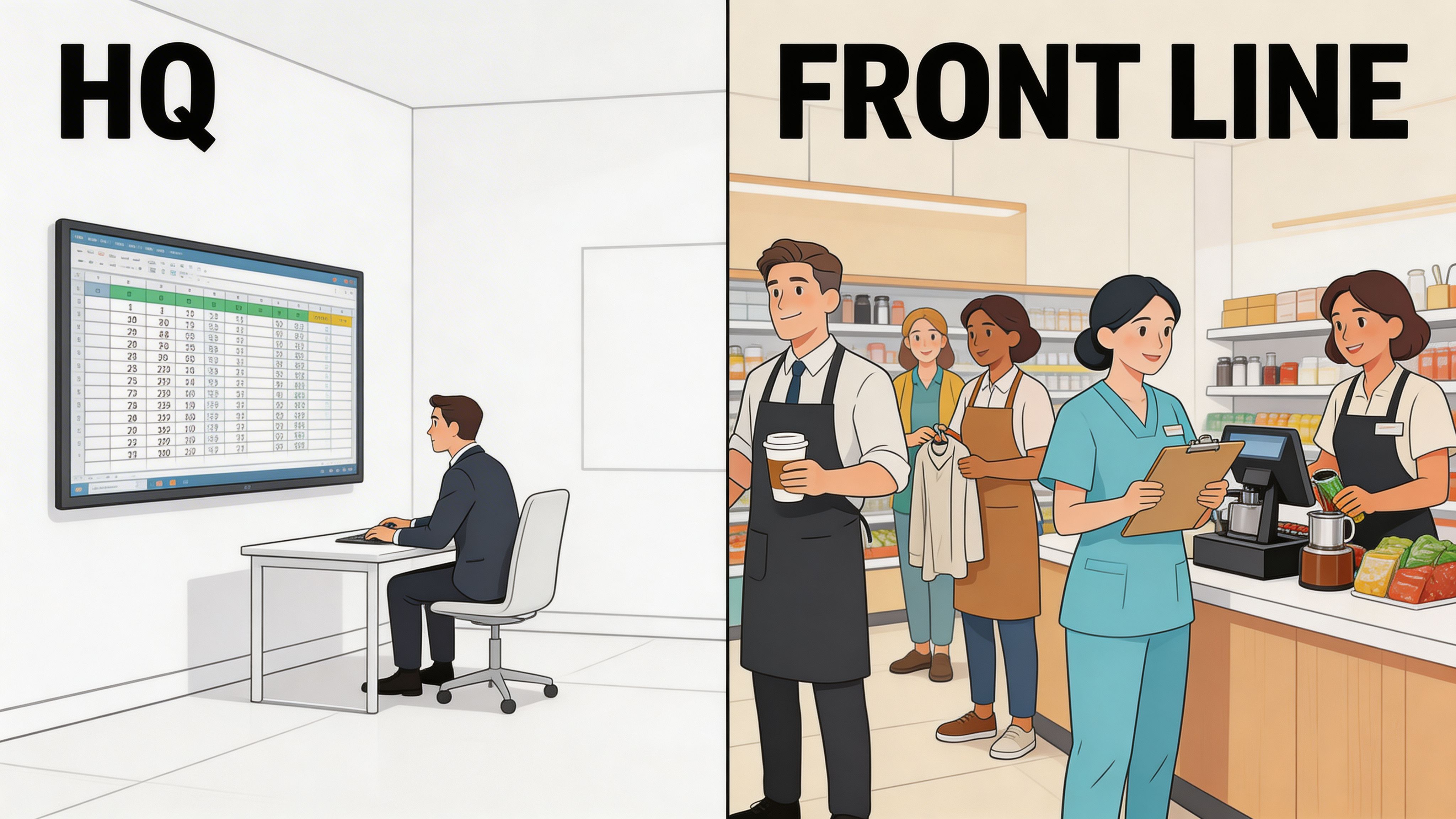
The scale is bigger than most leaders admit
Frontline workers make up 80% of the global workforce, or about 2 billion individuals, and onsite frontline workers show 29% lower engagement than hybrid or remote peers, according to Beekeeper’s frontline statistics roundup. That’s not a niche workforce issue. That’s the center of the labor market.
And yet many organizations still treat the front line team like an audience for announcements instead of the operating core of the company.
You can see the result in small daily moments. A new policy gets sent by email to people who rarely sit at desks. A schedule changes with almost no notice. A process gets designed by someone who has never worked a Saturday rush. Then leaders wonder why adoption is weak and frustration spreads.
Practical rule: If the people doing the work didn’t help shape the change, the change probably isn’t ready.
They carry the emotional load too
The front line team does more than execute tasks. They carry the emotional tone of the company. They deal with impatient customers, messy realities, staffing gaps, broken equipment, unclear instructions, and all the little workarounds that keep the day from falling apart.
That’s why recognition matters so much. Not the fake kind. Instead, offer respect, context, timely information, and a sense that their role matters beyond filling shifts. If you want a useful primer on that mindset, Helpside has a grounded piece on how to help your employees feel important.
There’s also a simple test. Ask yourself whether people at headquarters understand what frontline employees wish leaders knew. Most don’t. This is why pieces like https://pebb.io/articles/what-frontline-employees-wish-hq-knew tend to resonate. The gap is familiar.
A company rarely fails because the front line team isn’t important enough. It fails because leadership acts like they’re farther from the operational work than they are.
The Two Companies You Run
Most organizations have a front office culture and a front line culture. They use the same logo, same payroll system, same values page. But day to day, they feel like two different companies.
The front office usually has context. People hear the reasoning behind decisions. They know what’s changing and why. They can ask questions in meetings, message coworkers quickly, and find documents without much trouble.
The front line team usually gets the outcome, not the reasoning. They get the new rule, the updated script, the shift change, the revised target. What they often don’t get is the story that makes it make sense.
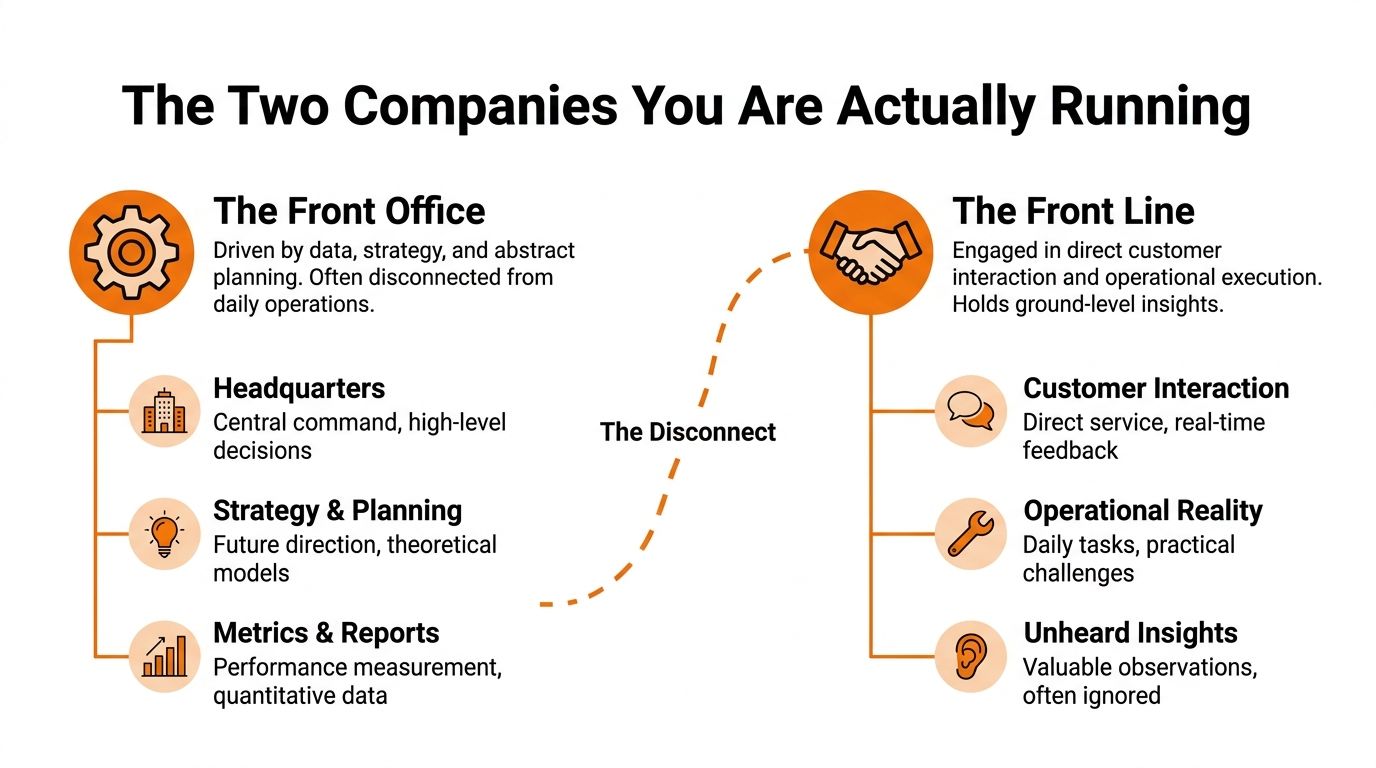
The front office gets context, the front line gets instructions
The split starts here.
Research highlighted by Psychology Today describes a front-line-to-front-office experience gap that creates an innovation bottleneck. It also notes that 72% of frontline workers don’t understand the broader company strategy, which makes it hard to connect what they see every day to what leadership says it wants to achieve (Psychology Today).
That’s a brutal number, but it fits what many operators already know. Plenty of frontline employees can tell you today’s tasks. Fewer can tell you how those tasks connect to the larger direction of the company.
When that happens, work becomes narrow and defensive. People stop making judgment calls because they don’t know what leadership values. They stop suggesting improvements because they assume nobody wants to hear them. They learn to comply, not contribute.
This isn’t a communication problem alone
Bad communication is part of it, but the bigger issue is structural.
If one group works at desks with calendars, chat tools, meeting access, and regular visibility into company decisions, while another group works in motion with limited access, inconsistent updates, and little influence, you haven’t created one culture. You’ve created a class system.
That split shows up in simple contrasts:
Experience | Front office | Front line |
|---|---|---|
Access to information | Usually immediate | Often delayed or filtered |
Ability to ask why | Built into meetings and chat | Depends on manager time |
Voice in decisions | More direct | Usually indirect |
Visibility to leadership | High | Low |
This is why so many companies end up needing to focus on https://pebb.io/articles/reducing-miscommunication-between-hq-and-store-locations. Store miscommunication is rarely about one unclear memo. It’s the result of a system built for one side of the business and tolerated by the other.
The front line team doesn’t need more slogans. They need context they can use during a shift.
What gets lost goes both ways
Leaders often talk about getting information down to the front line. Fair enough. But the harder failure is getting insight back up.
Frontline staff spot operational failures in time. They see where customers get confused, where stock runs short, where safety corners get cut, where handoffs fail, and where policy collides with reality. Those observations are valuable. They are also fragile. If there’s no easy path to capture them, they disappear by the end of the shift.
That’s how a business gets slower without understanding why.
A healthy front line team doesn’t just receive direction. It sends intelligence. It closes the loop between strategy and reality. When that loop is broken, headquarters starts making cleaner plans based on dirtier assumptions.
What Your Front Line Team Is Telling You Without Words
Most leaders don’t need another employee survey to know something is off. They can already see it.
They see the open shifts. The call-outs. The manager who looks worn down by Wednesday. The new hires who leave before they settle in. The good employees who stop volunteering ideas. The rule-following on paper and the workaround culture in life.
Those aren’t random annoyances. They are signals.
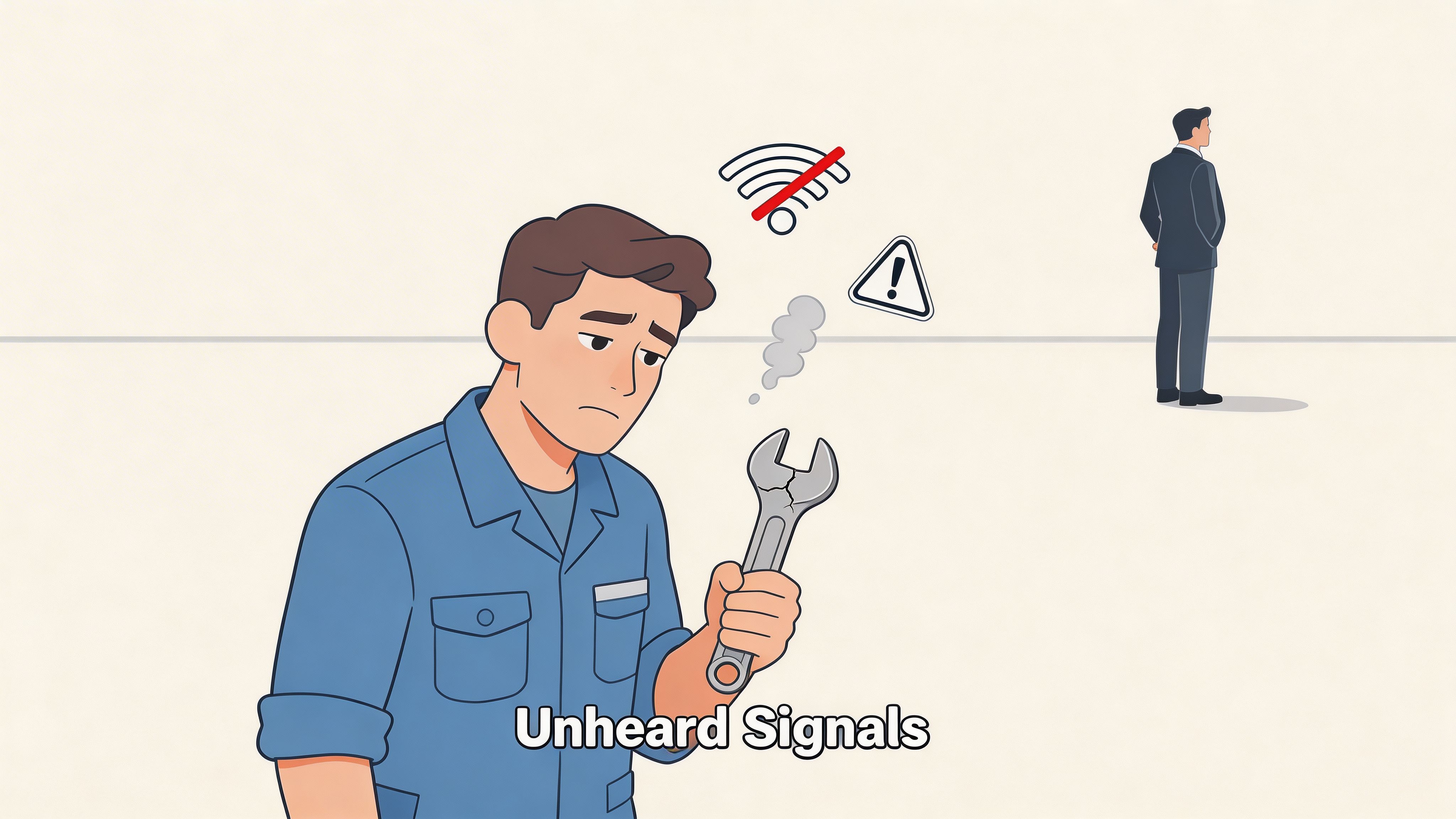
Turnover is often a trust problem in disguise
Only 42% of frontline workers say communication is adequate at their companies, 53% of frontline managers report burnout, and 55% of workers considered quitting in 2024. The average replacement cost is 40% of salary per employee, according to GetFlip’s roundup of frontline engagement statistics.
That replacement cost matters, of course. But the bigger operational damage often starts before someone leaves.
People pull back first. They stop caring about improvements that won’t go anywhere. They do what’s required and little more. They avoid extra responsibility because extra responsibility hasn’t felt fair. By the time a resignation lands, the disconnect has usually been there for months.
Silence is not stability
Leaders sometimes mistake a quiet front line team for a stable one.
It usually means one of three things:
People are tired: They don’t have the energy to raise another issue.
People have learned the pattern: They’ve seen feedback disappear before.
People are protecting themselves: Speaking up feels risky, pointless, or both.
That silence spreads. Supervisors stop surfacing concerns upward because they don’t want to look negative. Employees stop surfacing concerns downward because they don’t want to be ignored. Soon the business starts operating on partial truth.
If your front line team only tells you good news, you don’t have alignment. You have fear, fatigue, or both.
Burnout isn’t only about workload
Yes, staffing pressure matters. So do difficult customers and long shifts. But burnout on the front line team often comes from friction that feels unnecessary.
Think about the kinds of stress people will tolerate when they feel connected. A busy day with a solid team. A hard season with a manager who has their back. A policy they don’t love but at least understand.
Now think about the stress people won’t tolerate. Confusing instructions. Last-minute changes with no explanation. Tools that make simple tasks harder. Leaders who ask for accountability without offering clarity.
One kind of pressure feels like work. The other feels like disrespect.
Read your operating problems as cultural clues
A struggling front line team usually tells you what’s broken before anyone writes it in a report.
Look at these patterns as clues, not isolated events:
Signal | What it often means |
|---|---|
Frequent call-outs | Schedules, stress, or trust are off |
Low participation | People don’t believe input matters |
Manager burnout | The middle is carrying too much translation work |
Constant workarounds | Official process doesn’t match reality |
This is why the disconnect matters so much. You can treat each symptom one by one. Or you can fix the relationship between the company making decisions and the people living with them.
The second path is harder at first. It’s also the only one that holds.
Stop Managing and Start Connecting
A lot of frontline management still works from an old assumption. Give clear instructions, track compliance, fix mistakes, repeat.
That’s not enough anymore. Not because standards don’t matter. They do. But because the front line team doesn’t stay with companies that treat every interaction like control instead of connection.
Good operators already know this. The schedule is a relationship tool. Onboarding is a trust-building moment. Training is a sign of respect. Communication is where people decide whether this company sees them as adults or as labor.
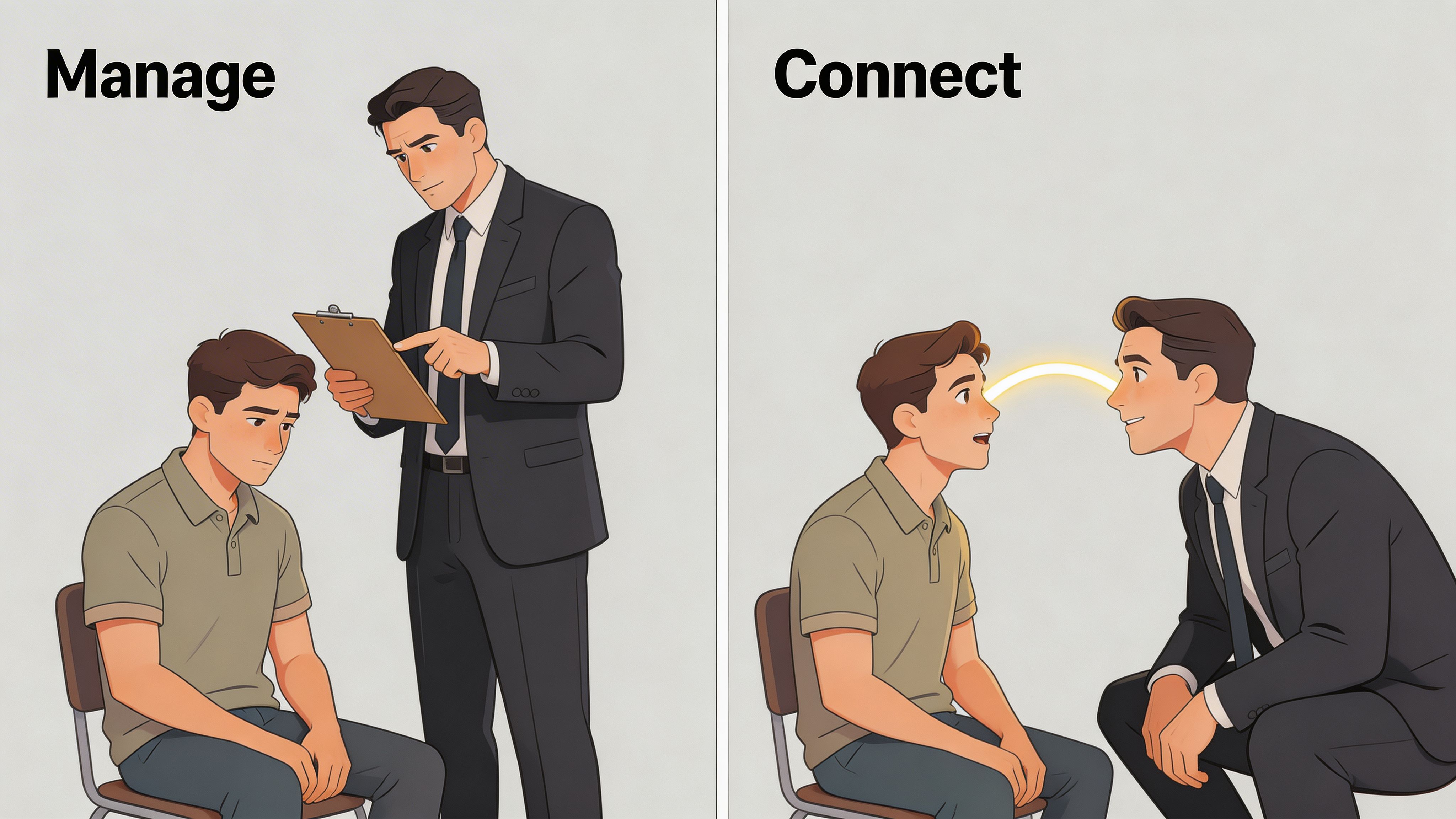
Communication should feel like a loop, not a broadcast
Most company communication fails for a simple reason. It answers the question leadership wanted to send, not the question employees have.
A better pattern is plain and repeatable.
Say what is changing
Say why it matters
Say what the front line team should do next
Give people a way to ask questions or push back
That fourth part matters more than leaders think. Once employees see that questions are welcome, the message changes shape. It stops feeling like instruction from nowhere.
Manager habit: End every operational update with one line. “What part of this will be hardest in real life?”
You’ll learn more from that than from most formal feedback channels.
Scheduling is culture in disguise
Nothing destroys trust faster than a schedule that tells people their time doesn’t matter.
Frontline leaders sometimes treat scheduling as pure logistics. Fill coverage, hit labor targets, move on. But the people on the receiving end experience it as respect or disrespect.
A bad schedule says, “Your life exists around our gaps.” A good one says, “We know you’re a person with a life, and we’re trying to run this place fairly.”
That doesn’t mean every request can be honored. It means the system should feel understandable. Predictable where possible. Transparent when it can’t be flexible.
A front line team can handle hard realities. What it resents is arbitrary hardship.
Onboarding should explain the company people are joining
Many organizations treat onboarding like a paperwork event. Forms. Policies. Training videos. Passwords. Uniform issue. Done.
That’s administration, not onboarding.
Real onboarding answers questions people won’t ask out loud:
What kind of place is this
How do people get help here
What makes someone trusted on this team
What does leadership cares about
What should I do when the manual doesn’t match the moment
When those answers are missing, new hires build their own from rumor and observation. Usually fast. Usually inaccurately.
Training has to live where the work happens
Annual modules and long classroom sessions miss the point for most frontline environments. People need training they can reach during the flow of work. Short refreshers. Clear examples. Easy references. Practical coaching from someone who understands the shift.
Here’s what tends to work better than one-off training dumps:
Short, repeatable lessons: Small pieces people can revisit when needed.
Role-specific guidance: Not every location, shift, or role needs the same examples.
Manager follow-through: A quick conversation after training often matters more than the training itself.
The shift here is simple. Stop seeing management tasks as separate from culture. They are culture.
The front line team doesn’t judge the company by what leaders say in meetings. They judge it by the quality of daily contact. Who explained the change. Who listened. Who made the schedule fair. Who followed up. Who made it easier to do good work.
That’s connection. And it scales better than control.
The Right Tools for the Practical World
A lot of companies say they care about the front line team, then give them a pile of disconnected tools.
One thing for chat. Another for scheduling. A bulletin board for updates. Email for policies. Text messages when something is urgent. Paper when the system is down. A manager’s memory when everything else fails.
That isn’t a system. That’s a patchwork held together by patient supervisors.
Consumer tools create workarounds
WhatsApp, text threads, printed schedules, and breakroom notices feel convenient because they’re already there. But each one creates a new version of the truth.
The problem isn’t just mess. It’s exclusion. If a shift change lives in a group chat, who missed it? If a policy update was taped to a wall, who never walked by? If the latest task list changed during the day, who’s still working from the old one?
A front line team needs one place where work lives. Not because software is exciting, but because clarity is.
Mobile first isn’t optional
Frontline work happens on the move. On a floor, in a truck, between rooms, behind a counter, across locations. Any tool that assumes people are sitting at desktops has already misunderstood the job.
For that reason, app design matters. Workday’s analysis notes that native mobile apps can deliver up to 40% faster performance and 95% offline reliability for frontline work, which is critical for clock-ins, tasks, and other operations in places where connectivity is unreliable (Workday).
That matters in practical terms:
What the team needs | What weak tools do | What better tools do |
|---|---|---|
Urgent updates | Arrive late or get buried | Reach people fast on mobile |
Shift info | Lives in multiple places | Stays current in one place |
Tasks and forms | Depend on paper or memory | Stay accessible during the shift |
Clock-ins and basic actions | Break when connection drops | Keep working reliably |
Pick tools that reduce translation
The best frontline tools do three things well.
First, they give every employee a single source of truth. That means the same update, same schedule view, same task status, same policy version.
Second, they stay simple enough to use in seconds, not minutes. If an action takes too long, people fall back to old habits.
Third, they include both HQ and the field in the same environment without forcing everyone into the same workflow.
That is the true standard. Not feature count. Not a flashy demo. Can the tool reduce the amount of manual translation managers do every day?
Platforms built for this category can help. For example, https://pebb.io/frontline-employee-app combines chat, updates, tasks, scheduling, clock-in, PTO, and a knowledge library in one app for frontline and office teams. The value in a setup like that isn’t hype. It’s fewer gaps between decision, communication, and execution.
A good tool won’t fix a broken culture by itself. But bad tools will absolutely keep a broken culture in place.
An Action Checklist for Leaders
If you want to know whether your front line team feels connected to the company, don’t start with a workshop. Start with friction.
Go where the work happens and look for the places where people compensate for bad systems, unclear decisions, or absent leadership. That is where the underlying issues lie.
Do these this month
Work a real shift: Spend a full shift on the floor, in the store, on the unit, or at the site. No presentations. No entourage. Write down every workaround you see.
Ask one uncomfortable question: Ask five frontline employees, “What’s the dumbest rule we still make you follow?” Don’t defend the rule. Listen.
Audit message delivery: Pick one recent company update and trace how it reached the front line team. If the answer depends on a supervisor remembering to pass it along, fix that.
Review manager load: Look at what frontline managers spend time translating, repeating, chasing, and clarifying. That hidden labor is usually where systems are failing.
Kill one piece of pointless friction: Remove one approval step, one duplicate form, one confusing handoff, or one outdated policy. Small wins rebuild trust faster than slogans do.
Training can help, but only if it matches the job. If you need a clean framework for building training on purpose, Master the Training ADDIE Model is a useful reference point.
Ask yourself these questions
Not in theory. In your own operation.
Would a new frontline employee understand how their work supports company goals
Can employees raise a problem without needing a brave manager
Do frontline managers have enough time to coach, or are they trapped in admin
Can people find what they need during a shift, from their phone
When the front line team gives feedback, can they see what happened next
If too many answers are no, the issue isn’t motivation. It’s design.
The companies that close the gap don’t wait for a perfect transformation plan. They start by removing obvious disrespect from the daily work experience. Then they keep going.
Your Company Is What They Do
Customers don’t meet your strategy deck. They meet your front line team.
They meet the person who answers the question, fixes the problem, handles the complaint, fills the order, checks the patient in, cleans the room, stocks the shelf, or keeps the shift moving when three things go wrong at once.
That’s the company.
Not the values poster. Not the investor story. Not the all-hands message. Those things might matter. But they only become real when someone on the front line team turns them into action during an ordinary day.
That’s why the disconnect between HQ and the front line is so damaging. It breaks the one relationship that makes the rest of the business believable.
If leaders close that gap, people feel it quickly. Work gets clearer. Feedback gets sharper. Managers spend less time translating. Employees stop feeling like outsiders inside their own company.
And if leaders don’t close it, the company keeps splitting in two. One version plans. The other one copes.
Most of the time, the second one is doing the harder job.
If you’re trying to bring HQ and the front line team into the same operating rhythm, Pebb is worth a look. It gives teams one place for communication, scheduling, tasks, knowledge, and day-to-day coordination, which helps reduce the usual gaps between office decisions and frontline execution.
