
Understanding Data Governance: A Guide for Real Teams
Stop wrestling with data chaos. This guide makes understanding data governance simple. Learn core ideas, benefits, and a practical roadmap for your teams.
Dan Robin

A manager grabs the promo sheet everyone's been using for weeks. It looks fine. The logo is right. The layout is familiar. A customer asks a simple question, the manager gives a confident answer, and by the afternoon someone in finance is untangling a mess that never should've happened.
That's how data trouble usually starts. Not with some dramatic breach or a board-level crisis. It starts with the wrong spreadsheet, the outdated policy, the file named “final_v2_USE_THIS” sitting next to “final_v2_USE_THIS_new.”
Many organizations don't have a data problem because they lack tools. They have a data problem because nobody agreed on what's current, who owns it, where it lives, and who should use it. That's why understanding data governance matters so much. Not for analysts in a back room. For HR, ops, comms, store managers, shift leads, and anyone else trying to run a normal day without getting tripped by bad information.
That Messy Folder Is Costing You Money
I've seen the same scene play out in different companies with different logos. Someone means well. They save a file locally, forward a PDF, post a screenshot in chat, or pull a policy from an old folder because they're busy and it's close enough. Then the confusion starts.
A new employee gets trained on last season's process. A frontline supervisor prints an outdated checklist. A marketing team builds a campaign on a report that wasn't cleaned up. Nobody set out to make a bad decision. They just used what was easiest to find.
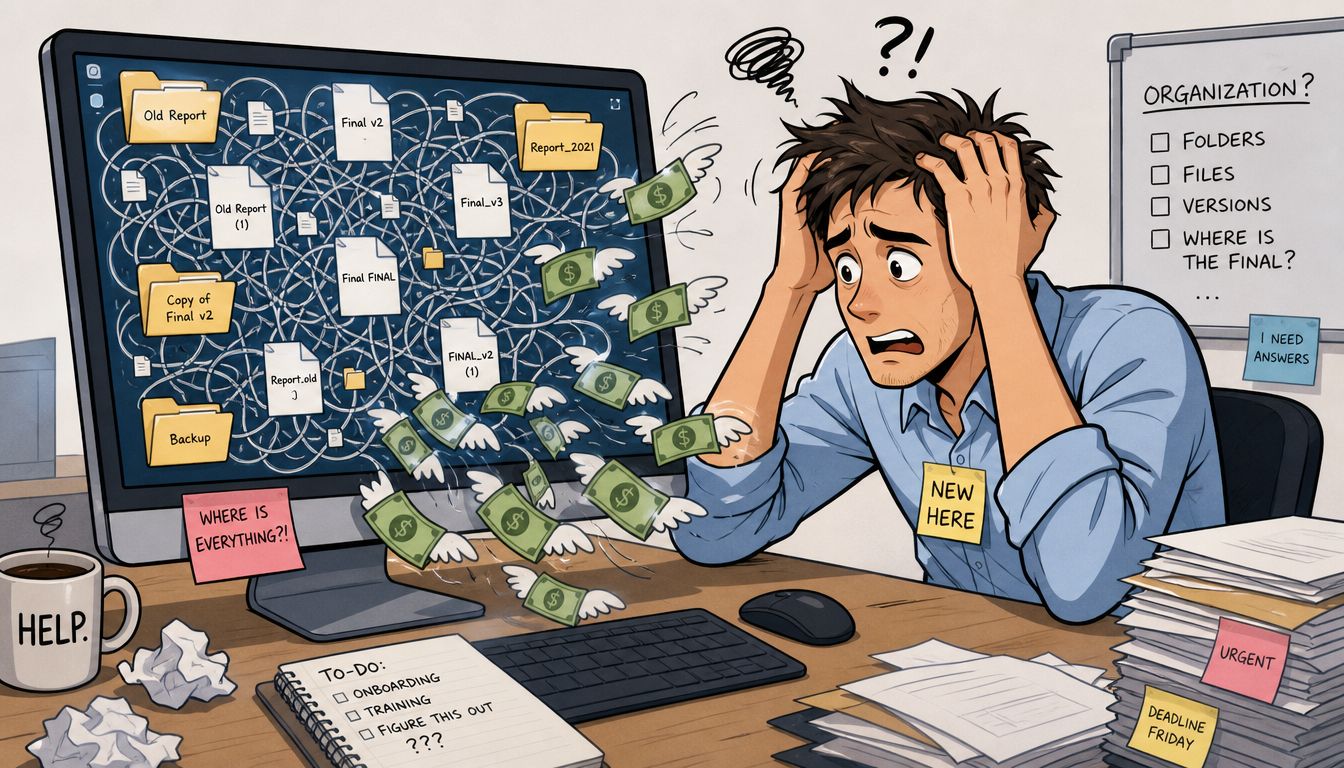
The cost shows up in ordinary places
This is why data chaos is so expensive. The damage isn't always dramatic enough to trigger a big meeting. It leaks out through rework, mixed messages, and small failures that pile up.
A few of the usual symptoms look like this:
People ask the same question again and again because the answer exists in three places and none of them feel reliable.
Managers become human search engines because everyone trusts a person more than the system.
Teams keep private copies of important files because the shared version feels risky.
Customers hear different answers depending on who picked up the phone or opened the shift.
None of that looks like a “data governance issue” at first glance. It looks like normal workplace friction. That's the trap.
Bad data rarely arrives with a warning label. It usually shows up looking convenient.
Confusion becomes a culture problem
The deeper cost is emotional. People stop trusting what they find. Then they stop using the shared system. Then every team invents its own workaround.
HR starts keeping onboarding notes in one place. Operations keeps process docs somewhere else. Internal comms sends updates, but supervisors still text screenshots because “that's what people read.” Once that habit sets in, the company doesn't have one source of truth. It has competing folk traditions.
That's when simple work starts taking too long.
If you've got folders nobody understands, duplicate files everywhere, and teams checking with each other before they trust the document in front of them, you don't need better terminology. You need order. That's where understanding data governance stops being abstract and starts becoming useful.
What Data Governance Actually Means
Data governance gets overcomplicated fast. In day-to-day operations, it usually comes down to a few practical decisions. What counts as the official version, who is allowed to change it, where it lives, how long it stays active, and who can safely use it.
Data governance is a shared system for deciding how information gets created, stored, updated, used, and protected. That applies well beyond analytics teams. HR uses it for onboarding records and policy updates. Operations uses it for checklists, schedules, and SOPs. Internal comms uses it for announcements, templates, and version control. Frontline managers use it every time they need the right document without calling three people first.
City planning is a useful comparison because order only works when the basics are clear. Streets have names. Buildings have owners. Rules define what goes where and what needs inspection before people rely on it. Data works the same way inside a company.
Policies set the rules for where information belongs, what needs approval, and what should never be shared casually. Ownership answers a simpler question. Who is responsible for keeping this current? Quality control matters for the same reason building codes matter. If a file is outdated, incomplete, or inconsistent, people need to know before they use it to make a decision.
This visual captures the structure well.
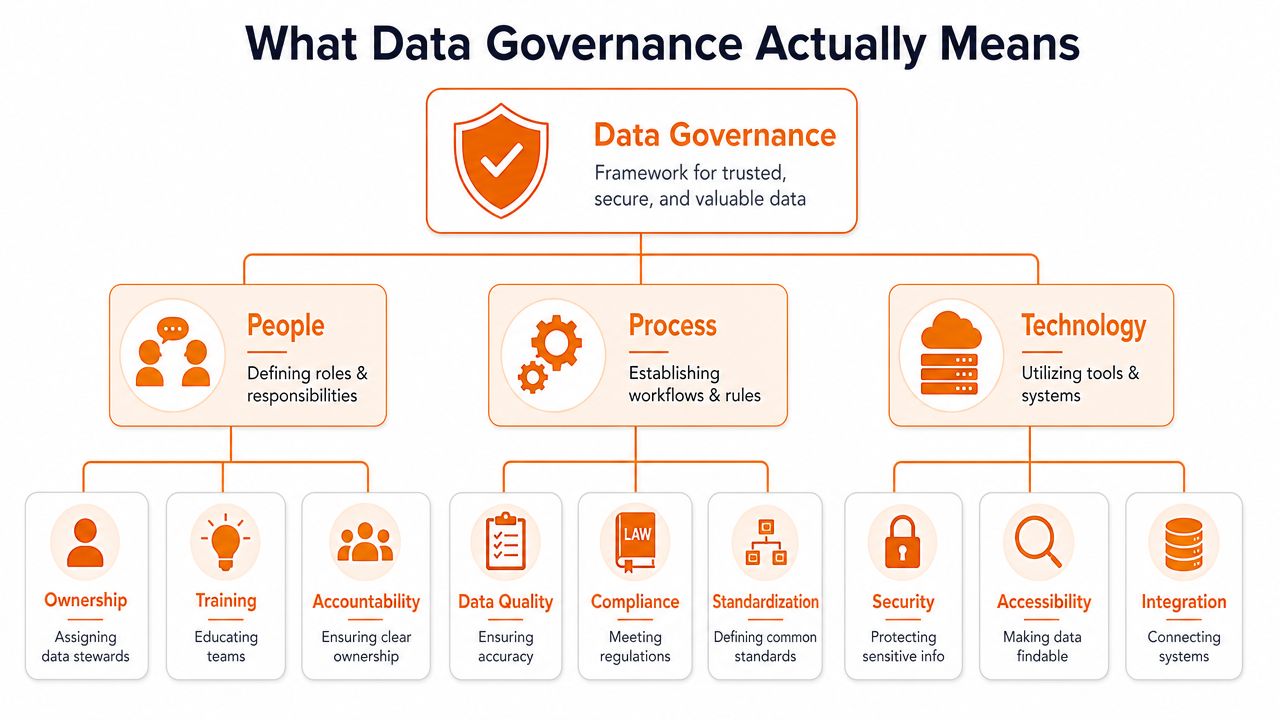
The parts that matter on the ground
Teams in the messy middle usually do not need a giant governance program. They need a few rules that survive contact with real work, especially in departments where documents get copied, edited, forwarded, and reused all day.
Part | What it means in plain English | What goes wrong without it |
|---|---|---|
Ownership | Someone is clearly responsible for keeping a piece of information current | Everyone assumes someone else updated it |
Standards | Names, versions, approvals, and formats follow a simple pattern | Files become hard to compare or trust |
Access | The right people can find and use what they need, while sensitive data stays protected | Teams either get blocked or overshare |
Lifecycle | Information is reviewed, replaced, archived, or retired on purpose | Old files linger and get reused |
Quality | Important data is accurate enough to support real decisions | Reports and workflows drift apart from reality |
Access is where a lot of teams get stuck. Leave everything open, and private employee or customer information spreads too far. Lock everything down, and supervisors start saving local copies so they can keep work moving. Good governance sets permissions with real job needs in mind. These role-based access control best practices are a solid starting point if you need to tighten access without slowing people down.
Practical rule: If a team can't answer “who owns this?” in a few seconds, governance isn't in place yet.
Governance is mostly about agreements
The hard part is rarely the software. The hard part is getting people to follow a shared operating rule.
A workable agreement can be simple. The policy lives in one approved location. HR owns updates. Managers can read it. Only named owners can edit it. Every revision gets a date. Old versions get archived instead of sitting beside the current one and causing confusion. That is governance.
It is not flashy, and that is usually a good sign.
Once teams treat governance as a set of working agreements instead of a specialist discipline, the term gets a lot less intimidating. It becomes what it should have been all along. A practical way to keep everyday information usable, trusted, and under control.
The Real Payoff of Getting Organized
The obvious benefit of governance is cleaner information. The ultimate benefit is calmer work.
When teams know where the right file lives, who maintains it, and whether it's safe to use, they stop wasting energy on verification. They spend less time hunting, less time second-guessing, and less time asking five people to confirm the same detail. That changes the mood of a workplace more than most leaders expect.
A better day looks boring, and that's the point
A frontline manager starts a shift and pulls the latest checklist without asking around. HR updates a policy once and knows everyone is seeing the current version. Internal comms posts an announcement and doesn't have to chase down old copies floating through chat.
That kind of order doesn't feel flashy. It feels steady. People can trust the system instead of building personal backup systems around it.
Here's the contrast that matters:
Without governance people rely on memory, side chats, downloaded copies, and the most responsive coworker.
With governance people rely on a known source, clear ownership, and a simple path to the right information.
The risk of doing nothing is slow and sticky
Most companies won't hit a dramatic breaking point right away. They'll just get slower and harder to run. Every outdated file teaches employees to be skeptical. Every conflicting report trains managers to validate data by instinct instead of by process. Every mismatch between what headquarters says and what the field sees chips away at trust.
When people stop trusting shared information, they stop acting like one company.
That's why I don't think of governance as an IT project. It's an operating discipline. It supports decision-making, yes, but it also protects morale. Teams get frustrated when the basics feel unreliable.
Clarity helps the people closest to the work
This matters most in the messy middle. Not just in finance or analytics. In stores, clinics, warehouses, restaurants, and support teams. In HR and internal comms. In all the places where information gets turned into action by people who don't have time to decode a broken system.
A good governance habit says, “You shouldn't have to wonder if this is the right version.” That's a small promise, but it carries a lot of weight.
Once a company delivers that promise consistently, people move faster with less drama. They don't need heroics. They need clarity. And clarity, once built, pays back every single day.
A Practical Roadmap to Data Clarity
Most governance advice falls apart because it starts too big. A company hears “data governance” and tries to map every system, every file, every team, every rule. That usually creates a new layer of complexity on top of the old one.
Start smaller. Pick one piece of information that matters and fix that first.

Start with something people touch all the time
Choose one high-friction item. The employee handbook. The onboarding checklist. A safety procedure. The approved pricing document. A leave policy that supervisors reference constantly.
Don't choose something because it sounds strategic. Choose it because people are already tripping over it.
A practical roadmap looks like this:
Pick one thing
Find the document, report, or dataset that causes repeated questions, repeat work, or avoidable mistakes. If your team keeps asking where the latest version is, you've found a good candidate.Name an owner
Not a department. A person. Departments don't update files. People do. The owner doesn't need to create every piece of content, but they do need to be accountable for accuracy and review.Give it one home
One official location. Not “the folder plus the chat plus the shared drive plus the email attachment.” One home. If people can't tell which version is official, the system is still broken.Communicate the rule and repeat it
Tell the team where the source lives, who owns it, and what to stop using. Then repeat that message until it becomes habit.
Keep the standard plain enough to survive real work
The biggest mistake is making governance too elegant. Teams under pressure won't follow a beautiful process that takes extra effort. They'll follow the simplest process that helps them move.
Use a small set of rules people can remember:
Use clear names so files don't hide behind vague labels like “update” or “new version.”
Date important revisions so people can see recency at a glance.
Archive old versions instead of leaving them mixed in with active materials.
Limit editing rights to people who maintain the information.
Review on a rhythm that fits the risk. Some items need frequent checks. Others just need a clear owner and a reminder.
Good governance should remove decisions from busy moments, not add more of them.
Build momentum before you expand
Once one area is working, copy the pattern. Don't redesign it from scratch for every team unless there's a real reason. Most organizations benefit more from a boring standard than a clever custom setup.
A useful way to think about maturity is this:
Stage | What it looks like |
|---|---|
Chaotic | Files live everywhere and trust is low |
Defined | One source exists, but habits are inconsistent |
Working | Ownership, location, and review are clear |
Reliable | Teams use the system without constant reminders |
If you need a broader playbook after that first cleanup, these data governance best practices can help you extend the habit without turning it into a bureaucracy project.
The goal isn't perfection. It's reducing uncertainty where work happens. Once people experience the relief of not having to guess, they usually don't want to go back.
How Pebb Makes Good Governance Easy
A governance plan only sticks if the daily workflow supports it. That's where most efforts wobble. The rules sound reasonable in a meeting, but the actual tools make people bounce between chat threads, folders, email attachments, and whatever file happened to be downloaded last.
That's why a good workplace app matters. Not because software replaces judgment, but because it can make the right behavior easier than the messy one.
One home beats five half-homes
The hardest part of governance is usually not writing the rule. It's giving people a place they'll use. Pebb's Knowledge Library fits that need well because it gives teams a clear home for policies, onboarding materials, handbooks, and operational documents.
That matters in HR and operations because the question isn't just “Does this file exist?” It's “Can a manager on a busy shift find the current version without asking around?” A central library turns that into a yes or no issue instead of a scavenger hunt.
Ownership works better when access is obvious
Naming an owner sounds simple until editing rights are fuzzy. Then one well-meaning person updates a file, another shares an older copy, and the whole thing drifts.
Pebb's Roles & Permissions help tighten that up. Teams can decide who maintains a resource, who can edit, who can view, and who shouldn't have access to sensitive material at all. That's where governance starts to feel less theoretical. The operating rule exists inside the tool.
A few examples make the fit clear:
For HR the handbook can live in one official place, with editing limited to designated owners.
For operations shift procedures and checklists can sit where supervisors already work, rather than in a separate system nobody opens.
For internal comms announcements can point back to the current resource instead of creating another detached copy.
Context matters as much as storage
A lot of systems are good at storing files and bad at supporting real work around them. Governance gets stronger when documents live close to the team conversations and tasks that depend on them.
That's where Spaces and File Sharing help. A team can keep relevant materials attached to the context where they're used, while still maintaining a more official home for core documents. Done well, this cuts down on the “I found a version, but I'm not sure it's the one” problem.
The best governance tool doesn't force people to become librarians. It helps them find the right thing inside the flow of work.
Visibility keeps the system honest
Governance also needs feedback. If leaders publish the right information but nobody reads it, the system may look organized on paper and fail in practice.
Pebb's Analytics help close that gap by showing whether teams are engaging with updates and shared resources. That's useful because governance isn't only about storage and control. It's about whether the information is reaching the people who need it.
Used this way, the tool supports the roadmap instead of replacing it. You still need an owner. You still need a home. You still need clear rules. But when the platform makes those habits natural, teams are far more likely to follow through.
Its About Trust Not Just Tech
The phrase “data governance” makes this sound technical. It is technical in places, but that's not the heart of it. The heart of it is trust.
People want to believe the policy they opened is current. They want to trust that the report in front of them means the same thing to finance, operations, and leadership. They want to know that when they follow the documented process, they won't get blindsided later by a different version someone else was using.
Trust is the operating system
A company with weak governance asks employees to carry too much uncertainty. They compensate by building personal safety nets. Private folders. Screenshots. Side messages. “Check with me before you use that.” Those habits aren't signs of laziness. They're signs that the system hasn't earned confidence.
The same lesson shows up in newer organizational models too. If you're curious how trust and rules get designed in distributed structures, it's worth looking at how firms building decentralized autonomous organizations think about ownership, permissions, and shared decision-making. The context is different, but the underlying challenge is familiar. People need clear rules if they're going to act with confidence.
Clarity protects people, not just files
Security matters, of course. Sensitive information should stay protected, and practical data protection strategies are part of any mature system. But the best governance habits do more than reduce exposure. They lower stress.
When people know where truth lives, work gets lighter. When teams share a common playbook, handoffs get cleaner. When leaders stop tolerating document chaos as “just how things are,” they make the organization easier to trust from the inside.
A well-run company feels calm long before it feels sophisticated.
That's why understanding data governance is worth your time even if you never touch a dashboard or write a query. This work belongs to every team that creates, updates, shares, or depends on information. Which is to say, all of them.
So the useful question isn't whether your company has data. It does. The question is simpler than that. Do your people trust what they're using when they need it most?
If you want a simpler way to bring policies, communication, files, permissions, and daily operations into one place, Pebb is worth a look. It gives frontline and office teams a shared digital home, which makes good governance much easier to maintain without adding another layer of clutter.
