
We Need to Talk About Annual Reviews
Explore annual employee performance review examples that help you deliver clear, actionable feedback and boost engagement.
Dan Robin
Let’s be honest. The annual performance review is broken.
We’ve all seen it. A manager, swamped with deadlines, gets a calendar ping: “Performance Reviews Due.” A sigh. A frantic search through old emails and project files. A few hours later, a document appears, packed with phrases like ‘demonstrates a results-driven mindset’ and other corporate speak that means almost nothing. The whole thing is written to satisfy a process, not to help a person grow.
We’ve all been on the receiving end, too. We’ve been handed feedback so vague it’s useless, or so disconnected from our actual work it feels like it was written for someone else.
But what if the annual review wasn’t a bureaucratic chore? What if it was a moment for real reflection and a launchpad for whatever comes next?
The problem isn't the idea of a review; it's the execution. It’s the soulless, templated language we've all been taught to use. We believe there's a better way. A calmer, more human way. It starts by throwing out the corporate playbook and learning to talk to each other like people.
This article isn't just a list of annual employee performance review examples to copy and paste. It’s a guide to understanding the why behind different approaches, from 360-degree feedback to competency checks for frontline teams. We’ll show you how to structure conversations that lead to clarity, not confusion. Let’s get started.
1. 360-Degree Feedback Review
Most performance reviews feel one-sided. It’s a top-down conversation where a manager’s perspective is the only one that really matters. The 360-degree feedback model flips that on its head. Instead of a monologue, it creates a dialogue by collecting anonymous feedback from a circle of people who actually work with an employee: their manager, direct reports, and peers.
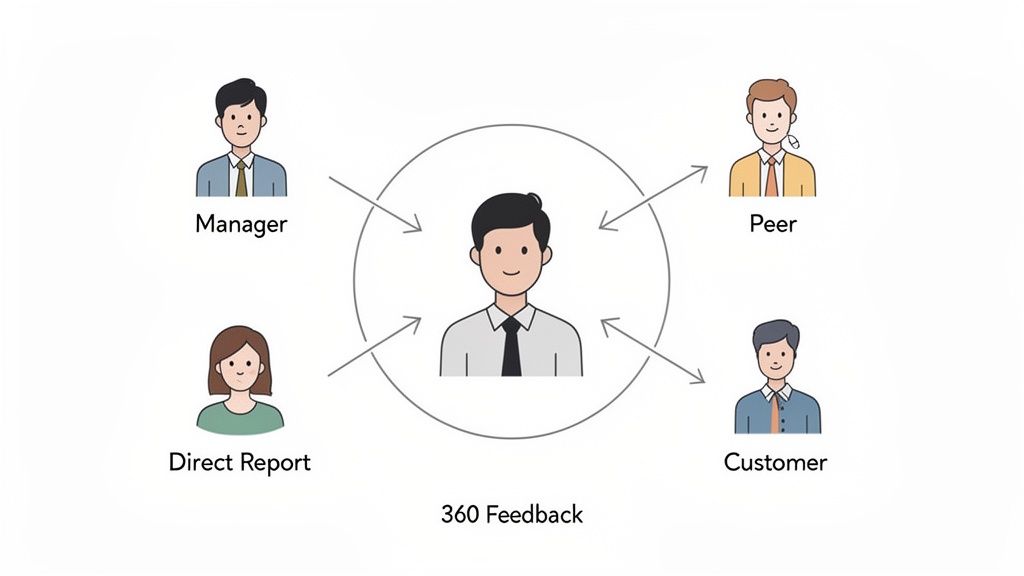
This gives you a much more complete picture. A manager sees how a project was delivered, but peers see the collaborative spirit—or lack thereof—that happened behind the scenes. Direct reports offer a rare upward view into someone’s leadership and communication style. It's one of the most powerful annual employee performance review examples for uncovering blind spots and building self-awareness.
Here's why it works: It shifts the review from a judgment into a tool for growth. By showing someone how their actions are perceived by different groups, it gives them concrete, multi-angled insights they can actually use.
A Better Way to Do It
Getting 360-degree feedback right requires structure. Don't just ask everyone for their "thoughts."
First, define clear criteria. Before you send out requests, decide what you're measuring. Are you looking at communication, reliability, or leadership? Be specific. Next, keep the circle small—maybe 5-7 people. This keeps the data manageable and prevents survey fatigue.
The most important part? Guarantee anonymity. Use a tool that collects responses privately. People give much more honest feedback when they know their name isn't attached to a difficult comment. Finally, follow up. The goal isn't to punish but to develop. Within a week or two of sharing the results, sit down and create a development plan based on what was said. This shows you’re invested in their growth, not just pointing out flaws.
2. OKR-Based Performance Review (Objectives and Key Results)
Traditional reviews can feel totally disconnected from what someone does day-to-day. The OKR-based review ties performance directly to impact. It focuses on Objectives (what you want to achieve) and Key Results (how you’ll measure success). Popularized by companies like Intel and Google, this method shifts the conversation from subjective feelings to concrete, data-driven outcomes.
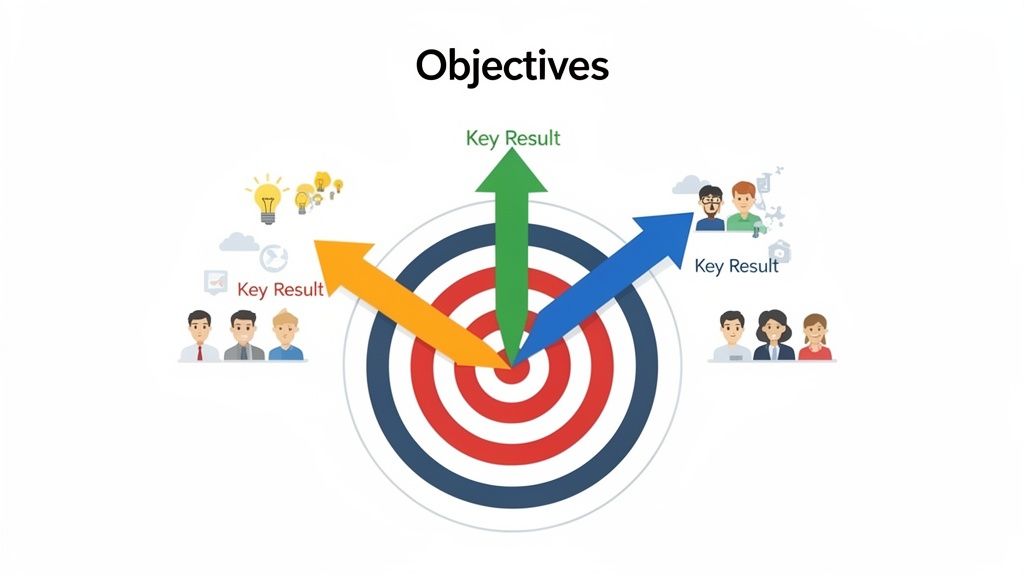
This framework makes it clear how an individual's work contributes to the company's bigger goals. When an employee can draw a straight line from their key result to a team objective, their work gains a powerful sense of purpose. This makes it one of the best annual employee performance review examples for creating alignment and motivating teams around a shared mission.
Here's why it works: It replaces ambiguity with clarity. Instead of guessing what "good performance" looks like, employees have a clear roadmap. The review becomes a practical discussion about progress, roadblocks, and what was learned along the way.
A Better Way to Do It
Success with OKRs isn't about setting perfect goals; it's about building a rhythm of focus and learning.
Keep your Objectives ambitious and inspiring. The Key Results are where you get specific and measurable. Stick to 3-5 key results per objective. This forces focus and prevents people from getting overwhelmed.
When it's time to review, grade for learning, not judgment. At the end of the quarter, grade each key result on a 0 to 1.0 scale. A score of 0.7 is often considered a success because it means the goal was challenging. The focus is on progress, not just hitting 100%. Lastly, involve people in setting their own goals. When they help build the plan, their commitment skyrockets. Understanding how goal setting and tracking enhance performance is the key here.
3. Competency-Based Performance Review
Too often, performance reviews measure the "what" (did you hit your sales target?) but ignore the "how" (did you alienate the entire team to do it?). A competency-based review fixes this. It focuses on the specific skills and behaviors that lead to success, not just the final numbers.
This approach defines what "good" looks like in concrete terms. For a developer, competencies might include code quality and problem-solving. For a project manager, it could be client communication and resource planning. It creates a clear, shared vocabulary for performance, moving conversations from vague feelings to specific, observable actions. This makes it one of the most effective annual employee performance review examples for building a high-skill workforce.
Here's why it works: It provides a clear map for employee development. By defining competencies and mastery levels, it shows people exactly where they stand and what they need to learn to advance in their careers.
A Better Way to Do It
A good competency model isn't just an HR document; it’s a living guide for your team.
First, define your competencies. Talk to top performers in each role and identify the key skills that make them successful. What do they do differently? Codify those actions into clear behaviors. Then, create mastery levels for each one—think Beginner, Intermediate, Advanced, Expert. This gives people a clear path for growth.
Use behavioral examples. Don't just say "Communication." Describe what it looks like in action: "Actively listens without interrupting in team meetings." Finally, integrate it everywhere. Use competencies during onboarding, link them to projects, and use them to frame feedback in one-on-ones, not just during the annual review. This makes skill development a daily habit, not a yearly chore.
4. Narrative/Essay-Based Performance Review
Checkboxes and rating scales can feel cold, reducing a year of complex work into a few simple scores. The narrative or essay-based review takes the opposite approach. Here, a manager writes a detailed story describing an employee’s performance, strengths, challenges, and specific contributions.
This format allows for nuance that a 1-to-5 rating system can’t capture. It’s a great fit for roles where performance is hard to quantify, like in creative fields or non-profits. Companies like Patagonia use it to connect performance directly to their core values, telling a richer story about how an employee’s work supports the bigger picture. This makes it one of the most personal annual employee performance review examples out there.
Here's why it works: It moves the conversation beyond metrics to focus on context, behavior, and impact. A narrative forces managers to think critically and provide specific, memorable examples, making the feedback feel more genuine.
A Better Way to Do It
A great narrative review isn't just a stream of consciousness. It needs some structure to be fair and useful.
Provide a guiding template. Don't just give managers a blank page. Offer sections like Strengths, Growth Areas, and Key Accomplishments. Encourage specific examples. Train managers to ground their writing in real events. Instead of saying "Jane is a great collaborator," they should write, "During the Q3 launch, Jane took the lead in organizing cross-departmental syncs, ensuring marketing and engineering were always aligned."
This next one is critical: Keep notes year-round. Managers should document achievements and challenges as they happen. A quick note in a dedicated document prevents recency bias and makes writing the final review much easier. And before they deliver it, have the manager read it aloud. This simple step helps catch awkward phrasing and ensures the message lands as intended.
5. Peer Recognition and Feedback Review
The annual review often feels like a final exam you only get to study for once a year. The Peer Recognition model turns that on its head by making performance conversations an ongoing, collaborative effort. Instead of waiting for a single manager’s verdict, this approach integrates continuous peer-to-peer feedback into the daily fabric of work.
This model is built on a simple idea: the people working alongside you every day have a unique and valuable perspective on your contributions. Companies like Adobe and Zappos have famously adopted this approach, moving away from ratings to create a culture of mutual accountability. It’s one of the most effective annual employee performance review examples for building a stronger, more connected team.
Here's why it works: It shifts the focus from a single, high-stakes evaluation to a steady stream of positive reinforcement and constructive input. This makes feedback less intimidating and encourages behaviors that the whole team values, not just the manager.
A Better Way to Do It
A peer feedback system doesn’t happen by accident. The goal is to make giving and receiving feedback a normal part of the job.
Create a dedicated space for it. Set up a specific channel, like a 'Kudos' feed in your chat tool, where people can give public shout-outs. This makes appreciation visible and encourages others to join in. Be specific about what to recognize. Guide your team by defining the values or behaviors you want to see, like ‘Going Above and Beyond.’ This helps people give more meaningful feedback.
Don't let peer feedback live in a separate system. Collect it throughout the year and use it as a key data point in development conversations. This shows everyone that their peers' input truly matters. And finally, recognize the recognizers. Acknowledge employees who consistently provide thoughtful feedback. This reinforces the importance of the practice.
6. Continuous/Real-Time Feedback Review Model
The traditional annual review is like a final exam where a year's worth of work is judged in a single, tense meeting. The continuous feedback model scraps that idea entirely. Instead of one big event, it turns performance management into an ongoing conversation, using quick check-ins and real-time notes to guide growth all year long.
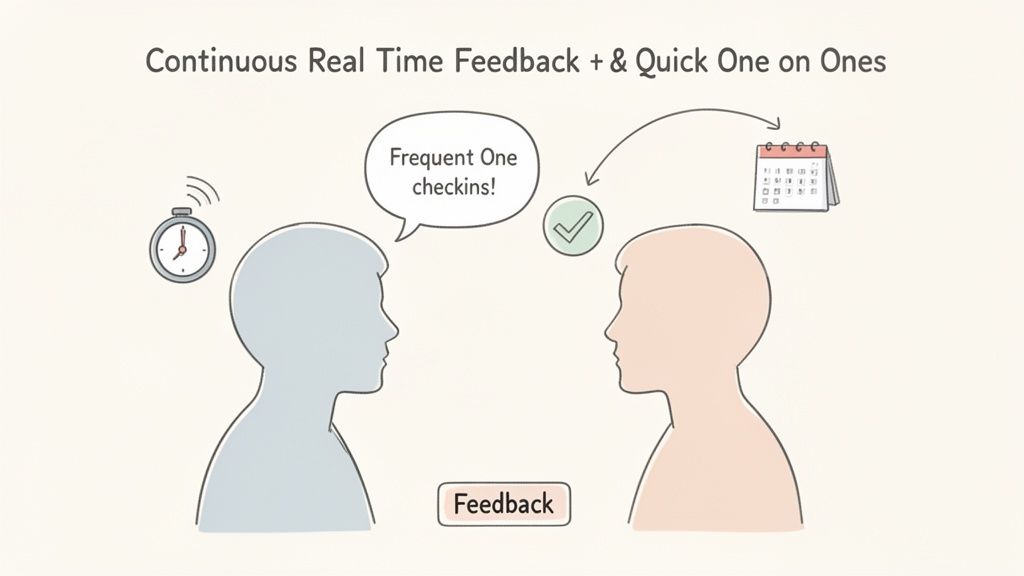
This method keeps feedback relevant and timely. When a manager can reference a specific project from last week, the conversation is grounded in reality, not distant memory. Companies like Microsoft famously moved to this model to build a culture of constant learning. For fast-moving teams, waiting a year for feedback is just too long. This makes it one of the most pragmatic annual employee performance review examples.
Here's why it works: It eliminates surprises. By making feedback a normal part of the weekly or monthly routine, it transforms the review from an annual judgment into a consistent, supportive coaching dialogue.
A Better Way to Do It
Success with continuous feedback depends on simple habits, not complex systems.
Schedule quick check-ins. Block 15-20 minutes on the calendar every couple of weeks for a simple check-in. Ask three direct questions: What’s going well? Where are you stuck? What’s next? Document lightly. After each chat, jot down a few notes in a shared space. This creates a running record that makes any end-of-year summary a breeze.
Balance the conversation. Aim for a 3:1 ratio of positive recognition to constructive feedback. This builds trust and keeps people open to hearing about areas for improvement. And finally, encourage your team to ask for feedback proactively. This shifts the culture from a top-down process to a shared responsibility.
7. SMART Goal-Based Performance Review
Vague expectations are the silent killer of performance. When people don't know what the target is, you can’t blame them for missing it. The SMART goal-based review brings absolute clarity to the process. It evaluates performance against specific, measurable, achievable, relevant, and time-bound goals set at the beginning of the review period.
This approach removes the guesswork and subjectivity that can make reviews feel unfair. Instead of relying on a manager’s memory or general impressions, the conversation is grounded in data and clear outcomes. It’s one of a handful of annual employee performance review examples that create a culture of accountability and transparent achievement.
Here's why it works: It turns the performance review into a simple, objective scorecard. Did the employee meet the agreed-upon goals or not? This direct link makes conversations more focused, fair, and forward-looking, as it naturally leads to discussing what support is needed to hit the next set of targets.
A Better Way to Do It
Success with SMART goals isn’t just about writing them down; it’s about integrating them into the workflow.
Keep it focused. Limit each person to 3-5 core goals per review cycle. Too many goals create noise and dilute focus. Involve employees in setting the goals. Goals handed down from on high rarely inspire commitment. Co-create them to ensure they are both ambitious and realistic, which builds a powerful sense of ownership.
Track progress regularly. Don't wait for the annual review to check in. Use monthly check-ins to discuss progress, remove roadblocks, and adjust goals if priorities shift. This prevents surprises. Finally, use a clear grading scale. Define what success looks like from the start. A simple scale like Not Met, Partially Met, Met, or Exceeded provides a clear way to evaluate outcomes for everyone.
8. Behavioral/Interview-Style Review
Too often, performance reviews rely on vague feelings or recent memories. The interview-style review gets rid of the guesswork. It turns the conversation into a structured assessment based on an employee's past actions, using behavioral questions to understand how someone achieves their results, not just what they achieve.
The idea is simple: past behavior is the best predictor of future behavior. Instead of asking, "Are you a good team player?" you ask, "Tell me about a time you had a conflict with a colleague. What did you do?" This forces a conversation grounded in real-world examples, moving beyond generalizations to concrete evidence. This makes it one of the best annual employee performance review examples for objectively assessing skills like problem-solving.
Here's why it works: It shifts the focus from subjective ratings to objective evidence. By asking for specific stories, managers can evaluate performance against a consistent set of competencies, reducing bias and making the review feel more like a fair, two-way discussion.
A Better Way to Do It
A good interview-style review depends on preparation. You can't just show up and wing it.
First, align questions to core competencies. Develop 6-8 behavioral questions that tie directly to the most important skills for the role, like communication, innovation, or customer focus. Then, use the STAR method. Coach managers to listen for the STAR format (Situation, Task, Action, Result) in the answers. This helps organize the stories and ensures you capture the full context.
Document everything. Take detailed notes during the conversation. These real-life examples are invaluable for justifying ratings and setting meaningful goals. Lastly, prepare your team. Let employees know what to expect. For reviews in this format, knowing how to approach competency-based interviews can help them prepare their examples, making the conversation more productive for everyone.
9. Multi-Rater Competency Assessment Review
While 360-degree feedback gathers general perceptions, the Multi-Rater Competency Assessment goes a level deeper. It’s a structured evaluation designed to measure specific, predefined behaviors. Instead of open-ended questions, this method collects quantitative ratings and qualitative examples from a manager, peers, and direct reports, all tied to skills like strategic thinking or decision-making.
This approach creates a detailed, data-rich picture of how an employee demonstrates critical skills in different contexts. It's less about general feelings and more about a rigorous analysis of an individual’s capabilities against a clear standard. This makes it one of the most effective annual employee performance review examples for succession planning and leadership development.
Here's why it works: It translates abstract skills into measurable data. By breaking down leadership into specific competencies and gathering evidence from multiple sources, it gives leaders a clear, objective roadmap for their professional development.
A Better Way to Do It
A successful multi-rater assessment hinges on a well-defined process and absolute confidentiality.
First, define your competencies. Don't measure everything. Select 5-8 core competencies that are critical for the role. For each, define the behaviors that demonstrate that skill. Select raters strategically. Choose 6-8 people who have a meaningful perspective.
Guarantee confidentiality. This is non-negotiable. Use a third-party platform or have HR manage the process to ensure all feedback is completely anonymous. And finally, facilitate the debrief. The results of these assessments can be intense. Have a trained coach or an experienced HR partner deliver the report and help the employee interpret the findings and build a concrete development plan. This turns data into action.
10. Shift-Based Performance Review for Frontline Teams
Frontline teams are the backbone of many businesses, but a standard 9-to-5 performance review just doesn't work for them. A shift-based review acknowledges that a warehouse worker on the night shift faces different challenges than a day-shift cashier. This approach evaluates performance within the unique context of an employee's specific working hours and duties.
This method accounts for different managers, customer traffic, and unique operational demands. A hospital nurse on a chaotic night shift is judged on different pressures than a day-shift nurse doing routine rounds. It moves beyond a one-size-fits-all model to create one of the most relevant annual employee performance review examples for industries like retail, logistics, and healthcare.
Here's why it works: It’s fair. By contextualizing performance, it prevents unfair comparisons between roles and shifts. It shows employees you understand the realities of their job, whether they’re stocking shelves at 3 a.m. or managing the lunch rush.
A Better Way to Do It
A great shift-based review system is built on data and clear communication, not just a manager’s memory.
Create shift-specific templates. Don't use the same form for everyone. Build templates for the “Day Shift” and “Night Shift” that reflect their specific goals. Lean on attendance data. Clock-in data is a foundational metric. Consistency and on-time arrivals are objective measures of reliability.
Gather multi-supervisor feedback. Frontline staff often report to different managers. Collect input from the primary shift supervisor and one or two others who have observed the employee. Talk to teammates. Peer feedback is golden here. They see things a manager might miss. Finally, schedule with respect. Don't ask a night-shift employee to come in mid-day for their review. Schedule the meeting at a time that works for their schedule.
Top 10 Annual Performance Review Methods
Review Method | Implementation Complexity 🔄 | Resource Requirements ⚡ | Expected Outcomes 📊 | Ideal Use Cases 💡 | Key Advantages ⭐ |
|---|---|---|---|---|---|
360-Degree Feedback Review | High — coordination of multiple raters and anonymization | High — many respondents, survey platform, HR facilitation | Holistic view of performance; blind-spot identification | Leadership development, matrix orgs, cross-functional roles | Balanced multi-source perspective; credible for development and promotions |
OKR-Based Performance Review | Medium — set alignment, cadence, and tracking | Medium — OKR templates, analytics, manager coaching | Alignment to company goals; measurable progress tracking | Startups, product teams, distributed/remote teams | Clear outcome focus; data-driven and motivational |
Competency-Based Performance Review | High — build and maintain competency frameworks | High — SMEs, rubrics, training, documentation | Standardized skill assessment; clear development plans | Professionalized roles, healthcare, succession planning | Consistent evaluations; directly links to training/promotions |
Narrative/Essay-Based Performance Review | Medium — simple structure but time-intensive writing | Medium — manager time, templates, archival storage | Deep contextual insight; personalized development feedback | Creative/specialized roles, leadership, small teams, academia | Rich qualitative feedback; employees feel understood and valued |
Peer Recognition and Feedback Review | Medium — platform setup and cultural adoption | Medium — engagement tools, moderation, ongoing participation | Increased morale and peer visibility; continuous recognition | Culture-focused companies, customer service teams, remote teams | Encourages collaboration and psychological safety; continuous motivation |
Continuous/Real-Time Feedback Review Model | Medium — requires manager discipline and cadence | Medium — frequent check-ins, simple tracking tools | Timely, actionable corrections; fewer surprises at reviews | Fast-paced orgs, agile teams, remote work environments | Immediate, actionable feedback; improves retention and agility |
SMART Goal-Based Performance Review | Medium — disciplined goal setting and review | Medium — goal templates, tracking systems, analytics | Clear, measurable outcomes and objective evaluation | Roles with quantifiable KPIs: sales, operations, logistics | Removes ambiguity; easy to measure and communicate success |
Behavioral/Interview-Style Review | High — structured interviews and interviewer training | High — long interview time, trained assessors, documentation | Evidence-based assessment of problem-solving and leadership | Leadership selection, promotion interviews, high-stakes roles | Reduces bias via concrete examples; predicts future performance |
Multi-Rater Competency Assessment Review | Very high — complex logistics, anonymity, data synthesis | Very high — vendor/software, coaching, HR coordination | Comprehensive multi-context competency profile; blind-spot mapping | Executive assessments, C-suite succession, high-potential tracks | Most comprehensive and credible for advancement decisions |
Shift-Based Performance Review for Frontline Teams | Medium — coordinate multiple supervisors and shift metrics | Medium — time/attendance systems, task data, supervisor input | Fair, context-aware evaluations using operational data | Retail, healthcare, logistics, 24/7 frontline operations | Fairness across shifts; leverages objective operational metrics |
So, What's the Point of All This?
We’ve just walked through ten different ways to look at performance. It's a lot. And if you're looking for the single "best" method, you’re going to be disappointed. Let's be honest: the perfect, one-size-fits-all performance review system is a myth. The real goal isn't to find a flawless template. It's to choose a method—or combine a few—that actually fits how your team works.
Think about it. Does your team live and die by quarterly metrics? An OKR-based review makes sense. Is your team’s greatest strength its collaborative spirit? A peer-feedback model might give you a far more accurate picture of someone's impact.
The annual employee performance review examples we’ve covered aren't rigid prescriptions. They’re starting points. They are frameworks for conversation, not scripts to be read aloud once a year. The real work is in adapting them to your culture, your team, and your goals. It’s about building a consistent rhythm of feedback so the annual review becomes what it always should have been: a summary of a conversation that’s been happening all year long.
The Real Goal: A Conversation, Not a Checklist
The most common failure of performance reviews isn't the form you use, but the spirit in which they're delivered. When a review feels like a surprise audit, it’s already failed. The objective isn't to check a box for HR or to document failures for a paper trail. It's to have a genuine conversation, grounded in real work, between two people who are both trying to do their best.
This shift from a yearly event to an ongoing dialogue is the single most important takeaway. It means capturing notes after a great customer interaction in February. It means tracking progress on a key project in June. It means giving constructive feedback on a presentation in September. When you do this, the year-end review writes itself. It becomes a simple, low-stress recap of challenges met, skills developed, and goals achieved.
Making It Stick
So, where do you go from here? Don't try to boil the ocean. Pick one idea from this article that resonated with you and try it out. Maybe it's incorporating more peer feedback or structuring goal-setting around the SMART framework. To get started, you might find it helpful to use a comprehensive annual performance review template as your initial foundation.
The key is to start small and build a habit. The point of all this isn't to become an expert in performance review theory. It’s to get better at talking with your people about what matters most: their work, their growth, and their future with the company. And that’s something no corporate template can ever replace.
Tired of the year-end scramble? Pebb helps you build a culture of continuous feedback, not annual anxiety. Use it to track goals in real-time, collect feedback on the fly, and turn every check-in into a meaningful conversation, making your annual reviews simple and effective.
