
How to Survey Job Satisfaction and Get Real Answers
Stop running pointless surveys. Learn how to survey job satisfaction to get honest feedback, start meaningful conversations, and build trust with your team.
Dan Robin

Let's be honest about job satisfaction surveys. Most of them are a waste of time. They’re a top-down, check-the-box exercise that makes everyone feel a little more cynical.
The good news? It doesn’t have to be this way. We’ve learned that a better approach involves asking direct questions, checking in more often, and—most importantly—actually doing something with what you learn.
Why Most Job Satisfaction Surveys Are a Waste of Time
We’ve all been there. The email lands with a chipper subject line: “Your Voice Matters! The Annual Employee Happiness Survey.” You sigh, click the link, and face a wall of 50 generic questions.
You click "somewhat agree" on repeat, type a vague comment you hope won't get you in trouble, and hit submit. Then… nothing. Silence. Six months go by, and not a single thing has changed. Your feedback vanished into a digital black hole.
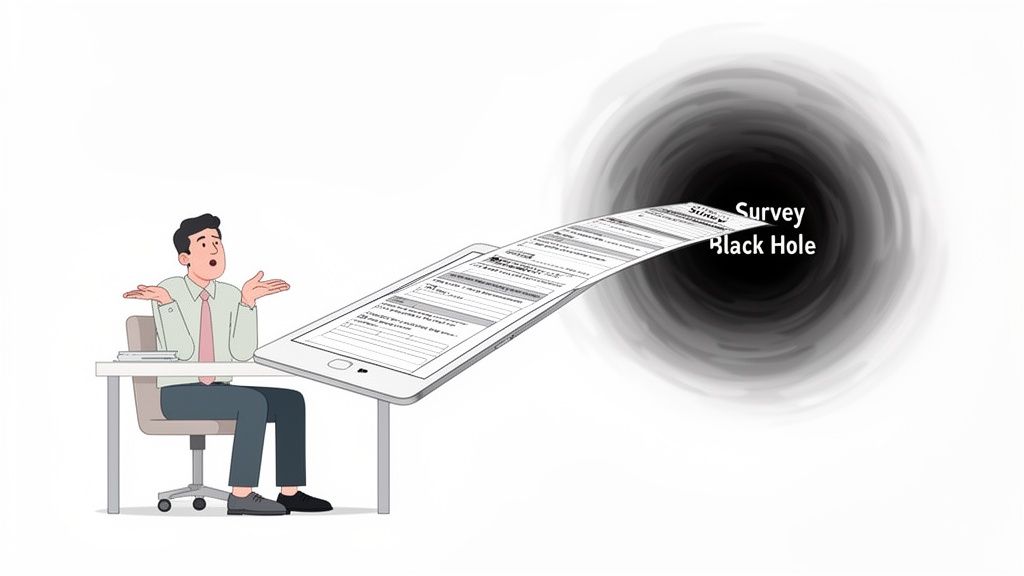
This image nails it. All that effort, gone without a trace. This cycle of asking without acting doesn’t just fail to help; it actively poisons the well. It breeds cynicism.
The Broken Promise of Traditional Surveys
The problem isn't asking for feedback. It's the execution. After years of running these and seeing what works, I’ve found that traditional surveys almost always fall flat for a few reasons:
They're too infrequent. An annual survey is a single snapshot in time. It misses the day-to-day realities of frontline work, where the mood can shift in an afternoon.
The questions are generic. Asking "How would you rate our synergistic alignment with company goals?" means nothing to someone juggling three tables or a long line of customers. The questions have to connect to their actual work.
There’s zero follow-through. This is the cardinal sin. When you ask for opinions and then do nothing, you send a clear message: We don't actually care. You make the whole thing feel like a performance.
Here’s the bottom line: A survey isn't a task. It's the start of a conversation. If you’re not ready to have that conversation and take action, don’t send the survey.
What Really Drives Satisfaction
Here’s the thing. Even with these broken systems, job satisfaction is climbing. A recent study found U.S. job satisfaction hit an all-time high of 62.3%. But the real story wasn't just the number. The biggest gains weren't in pay, but in things like work-life balance and workload.
This tells us something crucial: the texture of daily work—the stuff beyond the paycheck—is what truly makes a difference. You can read more about these findings on job satisfaction from The Conference Board.
This is where a modern approach comes in. It’s not about grand, once-a-year gestures. It's about building a continuous feedback loop into the daily workflow. It’s about asking the right questions at the right time and, most critically, showing people they were heard.
This guide is about ditching that old, broken model and embracing one that actually works.
Designing a Survey People Actually Want to Answer
Let’s be honest. The secret to a good survey isn't its length or a slick design. It’s the questions. A great survey should feel less like a corporate interrogation and more like a real conversation. It’s your chance to ask, “So, what’s it really like working here?” and get a straight answer.

The best feedback we've ever received came when we ditched the HR jargon and just asked about daily life at work. Your team isn't thinking in terms of “strategic alignment.” They’re thinking about their last shift, their manager’s attitude, and whether they have what they need to do their job well.
From Vague to Valuable Questions
The single biggest mistake we see is asking questions that are far too vague. Consider, “Rate your satisfaction with our company culture.” What does that even mean? Am I rating the free coffee, the mission statement on the wall, or the fact that my manager emails me at 10 PM?
To get answers you can actually use, you have to get specific. Instead of asking about "culture," break it down into tangible things.
Here’s how we think about turning fuzzy corporate questions into clear, human ones that get to the heart of the matter.
Satisfaction Driver | Vague Question (Avoid) | Clear Question (Use This) |
|---|---|---|
Recognition | How satisfied are you with our recognition programs? | Do you feel your contributions are recognized and appreciated? |
Management | Rate the effectiveness of your manager. | Is your manager someone you can bring a problem to? |
Resources | How do you feel about the available resources? | Do you have the tools and equipment you need to succeed in your role? |
Work-Life Balance | Does the company support work-life balance? | How manageable has your workload felt over the past month? |
Teamwork | Rate the level of collaboration on your team. | Do you feel your teammates have your back when things get busy? |
See the difference? Specific, direct questions give you a clear signal. A "yes" or "no" to whether someone can approach their manager tells you infinitely more than a "3 out of 5" on a generic scale.
A well-crafted survey job satisfaction question is a spotlight. It doesn't just ask for an opinion; it illuminates a specific part of the employee experience, showing you exactly where to look next.
Mix Your Questions for a Clearer Picture
A good survey strategy uses a mix of questions to paint a full picture. You wouldn't use just one color to paint a landscape, would you?
Here’s a simple framework that works:
Pulse Checks (Scale/Yes-No): These are your quick, quantitative questions. A simple 1-5 scale or clear yes/no options are perfect for tracking trends. For example: "On a scale of 1-5, how manageable was your workload this week?"
Open-Ended Questions (The 'Why'): This is where you find the gold. After a scaled question, add a simple, optional follow-up: "Could you tell us a bit more?" This is where you uncover the stories and ideas you'll never get from numbers alone.
eNPS (Employee Net Promoter Score): The classic, "How likely are you to recommend our company as a great place to work?" is still a powerful benchmark for overall loyalty.
But that’s only half the story. The trick is finding the right balance. Too many open-ended questions lead to survey fatigue. Too few, and you’re left with data but no meaning. We cover this in more detail in our guide to designing a better employee survey format.
Set the Stage Before You Ask
Finally, how you introduce the survey matters as much as the questions inside. People are skeptical. They’ve seen too many surveys lead to nothing.
Before you ask the first question, you need to answer the ones already in their heads:
Why are we doing this? ("We're trying to improve shift scheduling and need your honest input to get it right.")
What happens with my feedback? ("The results will be shared with department heads to help build fairer schedules next month.")
Is it safe to be honest? ("Your individual answers are 100% confidential. We only look at overall team trends.")
When people trust the process, they give you thoughtful feedback. It transforms the survey from a corporate task into a team effort to make work better. And that's the whole point.
Finding the Right Rhythm for Getting Feedback
Let's be honest, the annual survey is a dinosaur. In a world where business changes by the minute, waiting twelve months to check in with your team is like trying to navigate a new city with a map from last year. You're guaranteed to get lost.
But the opposite isn't the answer either. Bombarding your employees with daily pop-ups is just digital harassment. People will tune it out faster than a bad commercial.
So, what's the right rhythm? After years of trial and error, we've landed on a blended approach. It's about getting the quick pulse of the day-to-day while still making time for the bigger picture.
The Power of the Pulse Check
Instead of one huge survey event, think of feedback as a constant, easy habit. This is where pulse surveys come in. They’re short, frequent check-ins that are simple to answer and easy for you to act on.
We’re talking one or two questions, delivered right where your teams already work.
"How clear are your priorities for this week? (1-5)"
"Did you get the support you needed from your manager last week? (Yes/No)"
"How was the new shift schedule? (Thumbs Up/Down)"
These quick hits give you a real-time signal. You can spot a small fire before it becomes a blaze. You show people you're listening now, not just once a year. This consistent listening builds incredible momentum. It’s no coincidence that U.S. job satisfaction climbed steadily for years, hitting 54 percent in 2019 and a record high in 2022. Slow-and-steady growth comes from continuous listening. You can dig into the long-term trends in job satisfaction from Muncie Journal.
Go Deeper with Quarterly Check-Ins
Pulse checks are only one piece of the puzzle. They're great for taking the temperature, but you still need to go deeper to understand the "why." That's what quarterly check-ins are for.
These are a bit more substantial—maybe 10-15 questions—and let you explore bigger themes like career development, team dynamics, or overall well-being.
When you put the two together, you get a powerful rhythm:
Weekly Pulses: Keep a finger on the operational pulse.
Quarterly Check-ins: Step back to see the long-term picture.
This combination turns the whole survey job satisfaction process from a static report into a dynamic, ongoing conversation.
The goal is to make giving feedback feel as natural as a quick chat in the breakroom, not as formal as a performance review. It should just be a normal part of the workweek.
Tailor the Cadence to Your Team
Of course, the "right" frequency depends on your business. A remote software team has a different rhythm than a high-turnover retail crew.
For a fast-paced restaurant, a single question at the end of every shift ("How was your shift today?") can be incredibly valuable. For an office-based team, a weekly pulse might be enough.
The key is to adapt. Don’t just grab a template and run with it. Think about the natural flow of work for your specific teams. When would feedback be most helpful and least disruptive? A tool like Pebb can help by automating the right questions to the right people at the right time, all within the app they already use.
Ultimately, finding the right rhythm isn’t about hitting a magic number. It's about changing your mindset. You're not just "running a survey"—you're building a system for continuous listening. When people feel heard, they start to trust that you actually care. That’s the real win.
Turning Survey Data into Real Conversations
The results are in. Your dashboard is lit up with charts and comments. For too many companies, this is where it all stops. They’ve collected the data, and now they’re just… staring at it.
Let's be real. A pile of numbers isn't insight. It’s just noise. The real work of a job satisfaction survey program begins after the responses arrive. This is where you turn raw data into understanding and, most importantly, into conversations.
You don't need a Ph.D. in statistics to find the story in your survey results. You just need to be curious.
Weaving the Numbers and Narratives Together
The biggest mistake is looking at the quantitative data—the ratings—by itself. A manager sees a low score for "communication" and jumps to conclusions. But a score alone doesn't tell you anything. It's just a signal.
The magic happens when you pair the numbers with the written comments. The numbers tell you what is happening; the comments tell you why.
Think of it like this:
Quantitative Data (The What): You see that "Satisfaction with Tools" has a low score of 2.8 out of 5. That’s a red flag.
Qualitative Data (The Why): You dig into the comments and find three people on the warehouse team mentioning the barcode scanners are constantly failing. This forces them to enter codes by hand, which slows them down.
Boom. Now you have a story. The problem isn't "dissatisfaction with resources." The problem is broken barcode scanners. That’s something you can fix. The numbers pointed you in the right direction, but the comments gave you the roadmap.
It’s a Dialogue, Not a Report Card
Once you have a few stories, the goal isn't to write a report. The goal is to start a conversation. And how you frame this conversation is everything.
Your survey results are not a report card for your managers. They are a diagnostic tool for the team. Treat them as a starting point for collective problem-solving, not a judgment.
When you sit down with a manager, a collaborative approach works wonders.
Instead of this: "Your team scored low on communication."
Try this: "I was looking at the survey feedback, and it seems there’s some confusion around shift priorities. A few people mentioned getting conflicting directions. What are your thoughts on that? How can we help make it clearer?"
This simple shift reframes the issue from a personal failing to a shared challenge. It invites the manager to be part of the solution. For more on this, check out our guide on how to improve your employee engagement measurement process.
From Feedback to Daily Actions
The best part is when you see managers take this data and run with it.
I remember one supervisor at a distribution center who saw feedback about a lack of clarity at the start of the day. So, he made a tiny change. He began every pre-shift huddle by writing the top three priorities for that shift on a whiteboard.
It took him two minutes. But it completely changed the tone of the day. In the next survey, his team’s scores for clarity jumped. That’s the whole point—turning feedback into visible, everyday action.
It's also critical to remember that general satisfaction can hide specific pain points. Research shows 65 percent of workers are content, but only 34 percent are satisfied with pay and 33 percent with promotions. This is why targeted action is so important. Discover more insights about these specific drivers of job satisfaction.
Using a tool like Pebb helps centralize things like communication and recognition, allowing you to directly address the specific pain points your data uncovers.
At the end of the day, your survey is just a tool. It's a way to listen at scale. But the real work is in the conversations that come after. It’s about helping your managers turn a piece of feedback into a better way of working together.
Closing the Loop to Build Lasting Trust
This is where the rubber meets the road. You can design the perfect survey and get a fantastic response rate, but if you fail at this final step, all that work was for nothing. Worse, you’ve damaged trust.
Closing the loop is the single most critical part of the entire survey job satisfaction process. It’s your chance to prove this wasn't just a box-checking exercise. It’s how you show people that their input matters.
And it doesn't always require a massive initiative. Sometimes, the smallest visible changes speak the loudest.
From Feedback to Visible Action
Think of closing the loop as simply connecting the dots for your people. It's your job to draw a clear line from, "You told us this," to, "So, we did this." Without that connection, any changes you make will feel random.
I find it helps to think of the process in three simple stages: Gather, Analyze, and Discuss.
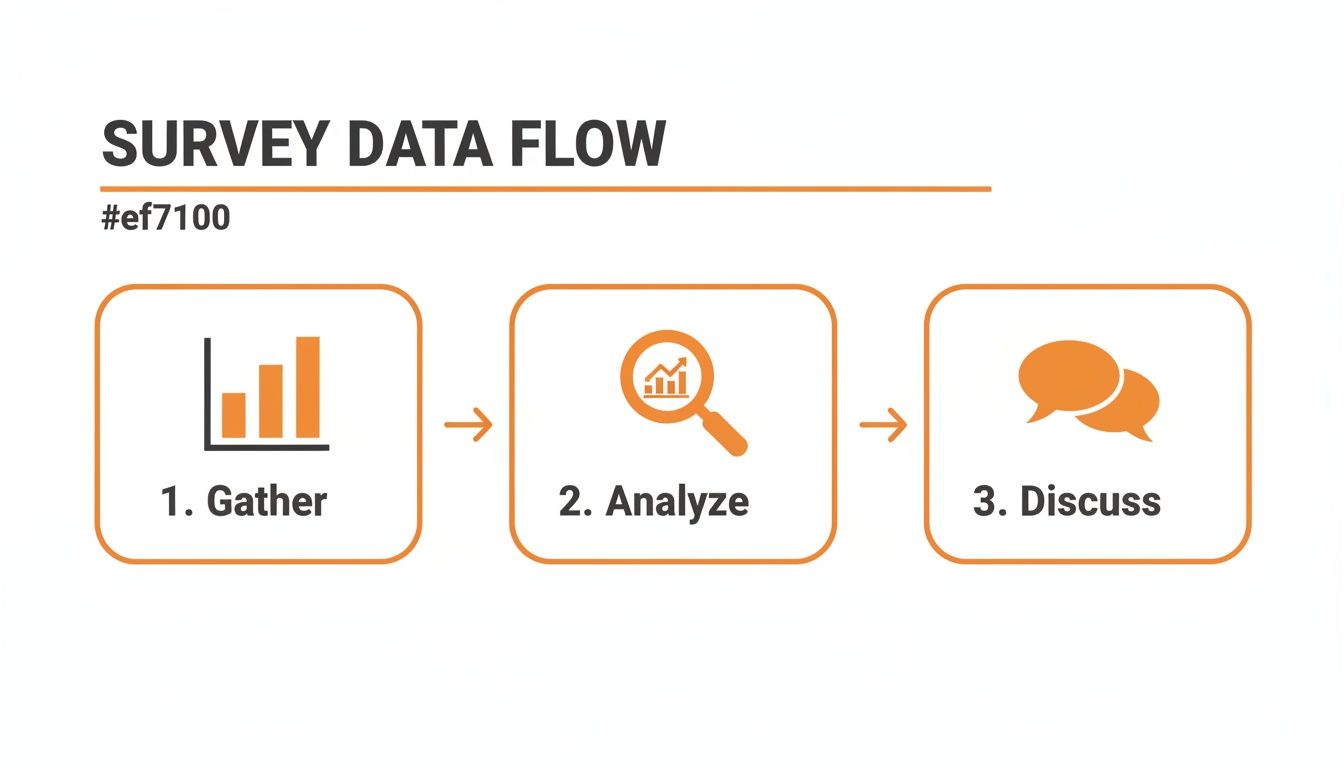
The process can't stop at a report. The analysis must lead to a conversation, and that conversation is where you build trust. Then, action must follow.
Here are a few ways to communicate those actions:
Company-Wide Update: If you're tackling a big-picture issue, a general announcement works. Did feedback reveal confusion about the new PTO policy? Announce the clarification and explicitly state that it's a direct result of the survey.
Manager-Led Share-Out: For team-specific feedback, let managers deliver the news. Nothing is more effective than a manager saying, "Hey team, some of you mentioned our weekly meeting felt draining. Let's try a new format."
Personal Follow-Up: A direct reply can be incredibly powerful. A simple "Thanks for this suggestion, we're looking into it" makes all the difference.
The goal isn't just to make changes. It's to broadcast that you're making changes because you listened.
Closing the loop is the receipt you give employees for their honesty. It’s proof that their investment of time and vulnerability was valued.
The Power of Small, Visible Wins
I'll never forget a story from a retail partner. Their frontline team’s survey was filled with comments about the miserable break room. It was windowless and drab. Management could have easily dismissed it.
They didn't.
Instead, the store manager spent a couple hundred dollars. They painted the room a brighter color, bought a new microwave, and put up a bulletin board for team shout-outs. He then posted a quick note in their team chat inside Pebb: "We heard your feedback about the break room. Hope this makes your breaks a little better."
The effect was immediate. It wasn't about the new microwave. It was about the fact that management listened to a small, human problem and did something. That single act did more to boost morale than a dozen corporate memos ever could. It turned skeptics into believers.
Making It Part of Your Culture
When you consistently close the loop, something amazing happens. The survey stops feeling like a top-down mandate and starts becoming a shared tool for improvement.
Using a platform like Pebb makes this straightforward. You can post updates and celebrate wins right where your team already works. Everyone sees the direct link between the survey they answered on their phone and the positive change happening in front of them. This is how you turn engagement data into action that people can feel.
This isn't just about making people happier. It's about building a smarter, more resilient company. When your team trusts that their feedback matters, they’ll bring you their best ideas and help you spot problems long before they spiral.
So, once you have those results, ask yourself one simple question: "What's one small thing we can do this week to show our team we're listening?" You'll be surprised how far the answer can take you.
Common Questions About Job Satisfaction Surveys
Alright, that's the theory. But what about the real world? After running through the strategy, I find the same smart, practical questions always come up from leaders who want to get this right. They want to know what actually works.
Here are the most common ones I hear, along with my honest, field-tested advice.
What's a Good Response Rate for a Survey?
This is the question everyone asks, and my answer usually surprises them: stop obsessing over the response rate. Let’s get real. Would you rather have an 80% response rate from people just clicking buttons to make the notification disappear, or a 30% rate from people giving you honest, thoughtful feedback you can act on? I'll take the quality of that 30% every single time.
Your real job isn't to chase a number; it's to make the survey job satisfaction experience something people want to be a part of. Keep it short. Make sure the questions matter to their daily work. And make it dead simple to complete.
When your team sees that their feedback leads to actual change, your response rate will take care of itself. We see this all the time. Engagement climbs when surveys are delivered right where teams already communicate, making it a natural part of the day.
Should Our Surveys Be Anonymous?
This is a big one. The right answer depends entirely on the level of trust in your organization. If you're just starting out or know trust is shaky, anonymity is non-negotiable. It’s the only way to create the safety people need to speak their minds.
Your long-term goal, however, should be to build a culture so open that people feel comfortable putting their name on their feedback. That’s the sign of a truly healthy workplace.
A great middle ground is the 'confidential' survey. With this, a trusted third party can see who said what for analysis—like spotting trends in a department—but individual responses are never shared with direct managers.
For quick, low-stakes pulse checks ("How was the new scheduling software?"), non-anonymous can work perfectly. It often leads to more direct and productive follow-up conversations. It's all about choosing the right tool for the job.
How Do We Handle Negative Feedback Without Creating Fear?
First, let's stop calling it "negative feedback." It's an opportunity. When a team member takes the time to point out a problem, they're handing you a gift. The most dangerous feedback is silence.
When you see a critical comment, your first job is to just listen. Read it, and then read it again. Fight the impulse to get defensive or explain why something is the way it is. Just seek to understand.
When you eventually share themes with your team, focus on the issues, not the people. Frame it as a problem you all need to solve together.
So instead of saying, "Some of you complained about communication," try this: "A key theme from the survey was that scheduling changes are a major source of stress. Let's brainstorm how we can make that process smoother."
This approach does two crucial things. It validates their concerns, proving you heard them. And it invites collaboration instead of assigning blame. When your team sees that raising an issue leads to a constructive conversation, not a witch hunt, you start to systematically replace fear with trust. That's how you build a great culture.
Ready to stop chasing survey responses and start having real conversations? Pebb unifies communication, operations, and feedback into one simple app your whole team will actually use. See how it works.
