
A Better Employee Survey Format for Honest Feedback
Tired of useless surveys? We'll show you a better employee survey format that gets honest, actionable feedback from the teams you actually rely on.
Dan Robin
So, what is an employee survey format? I think of it as the blueprint for how you talk to your team. A good format isn't one big, slow annual review. It's a smart mix of different surveys—pulse, engagement, lifecycle—each designed to get you timely, honest answers.
Why Your Annual Survey Is Probably a Waste of Time
Let’s be honest. That massive, formal annual survey? It often feels like a relic. A sluggish, impersonal process that serves up results so late they're practically useless.
We’ve been there. We spent months crafting the perfect 100-question survey, only to get vague feedback that was impossible to act on. The real issue wasn't just the questions; it was the entire outdated format.
It's built on a flawed idea: that you can bottle up a whole year's worth of an employee's experience in one go. But work isn't an annual event. It's the day-to-day grind, the quick chats, the late-night shifts, and the quiet moments between meetings. A single, heavy-handed survey just can't capture the real rhythm of work. By the time you’ve sorted through the data, the moment has passed.
The Real Cost of Stale Feedback
This isn't just a minor annoyance; it has a real cost. The drag created by these old-school feedback methods is a big reason why employee engagement numbers have barely budged for years.
A 2024 McKinsey study found that global employee engagement is stuck at a dismal 23%. That apathy costs the global economy an estimated $8.9 trillion in lost productivity—a problem directly tied to feedback systems that miss what’s happening in the moment. Read the full Gallup report on workplace trends.
When people see their thoughtful feedback vanish into a corporate black hole, only to result in some vague, top-down initiative months later, they learn a simple lesson: sharing their opinion is pointless. Cynicism creeps in. And you can bet participation in the next survey will take a nosedive.
A More Human Way to Listen
It's time to ditch that old model. A better employee survey format is faster, more personal, and designed for how modern teams actually talk.
It's about having the right conversation at the right time, not just ticking a box once a year. It's about building a continuous dialogue, not conducting a formal interrogation.
Matching the Survey Format to the Moment
There’s no such thing as a one-size-fits-all survey. Sending a massive engagement survey to a new hire on their third day is just as confusing as sending a two-question pulse check to uncover deep-seated cultural issues. You wouldn't use a hammer to turn a screw.
The secret to getting real insight is matching the employee survey format to the moment you want to understand. The goal isn't just to collect data; it's to start the right conversation at the right time.
Asking the right question is only half the battle. Asking it at the right time is what makes the answer valuable.
We've moved away from the old annual model to a more continuous approach. This simple decision tree shows how we think about it.
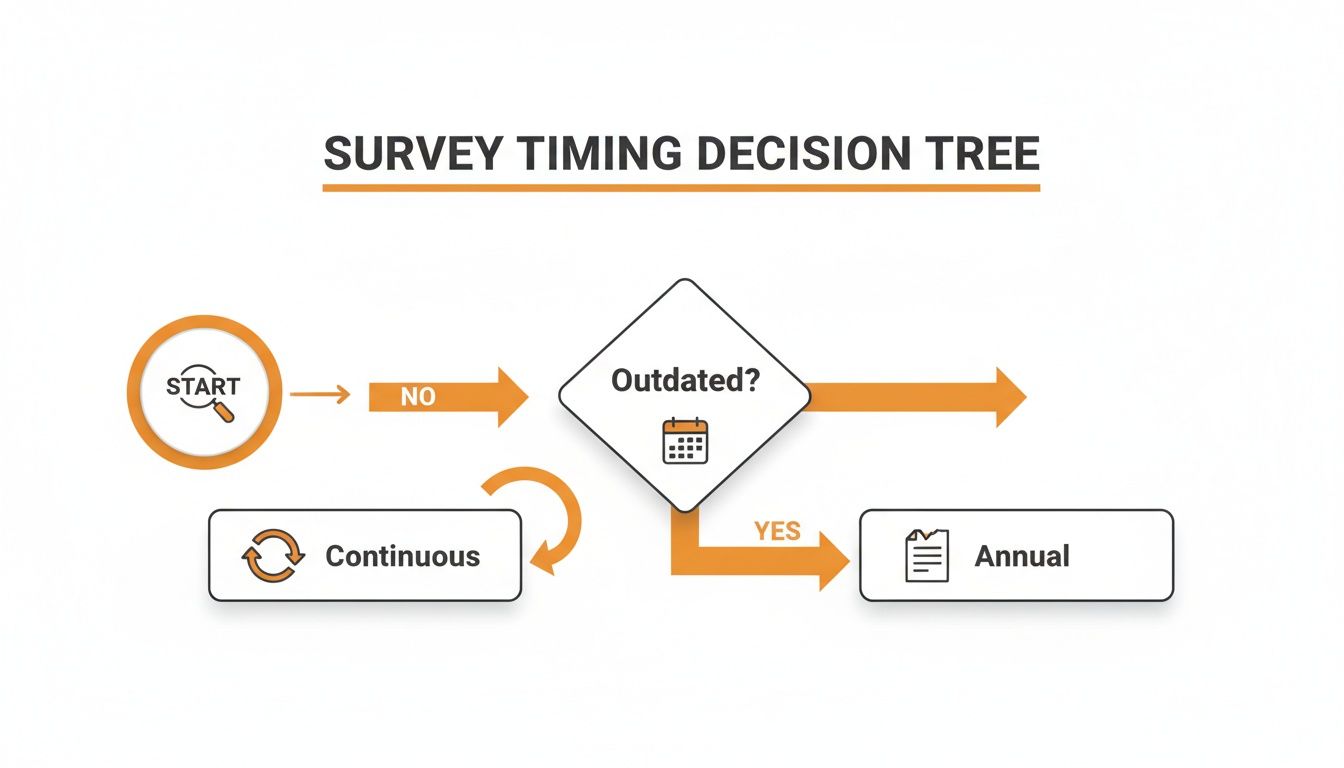
The takeaway is clear: unless your data is fresh, it's outdated. A continuous feedback loop gives you a real-time pulse of your organization, while a big annual survey offers little more than a historical snapshot.
The Four Core Survey Formats
Over the years, we've found that most of our needs can be covered by four distinct types of surveys. Think of them as different tools, each designed for a specific job.
Matching Survey Format to Your Goal
Not sure which survey to use? This table breaks down which format works best for different situations. It’s a handy guide to picking the right tool.
Survey Format | Best For | Frequency | Example Question |
|---|---|---|---|
Pulse Surveys | Quick, real-time check-ins on specific topics (e.g., morale, new initiatives). | Weekly, bi-weekly, or monthly. | "How are you feeling about your workload this week?" |
Engagement Surveys | Deep dives into long-term drivers of satisfaction and company culture. | Annually or semi-annually. | "Do you see a clear path for career growth at this company?" |
Onboarding Surveys | Gauging the new hire experience and identifying friction points early on. | At 7, 30, and 90-day milestones. | "Did you receive the resources you needed to feel successful in your first week?" |
Exit Surveys | Understanding why people are leaving and identifying areas for improvement. | At the end of an employee's tenure. | "What was the primary reason you started looking for a new opportunity?" |
By aligning your survey format with your goal, you get much clearer, more useful feedback.
1. Pulse Surveys
These are the lightweight champions of feedback. Pulse surveys are short, frequent check-ins—often just one to five questions—designed to get a quick read on team morale or a specific initiative. Think of them as taking your company’s temperature.
A well-designed pulse survey can tell you a lot with minimal effort. If you want to learn more, our guide explains what are pulse surveys and how do they work.
2. Engagement Surveys
This is where you go for the deeper dive. Sent less frequently—maybe quarterly or semi-annually—these surveys are much more comprehensive. Engagement surveys explore broader themes like career development, leadership, work-life balance, and overall satisfaction.
This format is great for spotting long-term trends and systemic issues that a quick pulse check might miss.
We’ve learned that the most effective engagement surveys focus on action. If you ask about career growth, you better be prepared to talk about it afterward. Otherwise, you’re just creating noise.
3. Onboarding Surveys
The first 90 days of a new job are critical. Onboarding surveys are designed to check in with new hires at key milestones—say, at day 7, day 30, and day 90.
They help you find and fix friction in your onboarding process before it causes a new team member to question their decision. It's about making sure they feel supported from the start.
4. Exit Surveys
When someone leaves, it's a valuable learning opportunity you can't afford to miss. A respectful, thoughtful exit survey provides honest feedback you’re unlikely to get anywhere else.
It’s your last, best chance to understand what’s working and what isn’t, directly from someone with nothing to lose by being candid.
Writing Questions That Get Real Answers
The biggest difference between a survey that sparks change and one that collects digital dust comes down to the questions you ask. We learned this the hard way. Early on, our questions sounded like they were pulled from a corporate textbook—and surprise, we got lifeless, corporate-sounding answers back.
Corporate-speak, leading phrases, and confusing “double-barreled” questions are the fastest way to kill any chance of honest feedback. Your team is smart; they can spot a loaded question from a mile away. It signals you're fishing for a specific answer, not their real opinion.
Think about it. Who wants to answer, “Rate your satisfaction with our technology enablement solutions?” It’s clunky and impersonal. A much better way to ask is, “Do you have the tools you need to do your job well?” It’s simple, direct, and human.
The Mix of Art and Science
Crafting an effective survey is a bit of an art, but there's some science to it, too. It’s about balancing two types of questions: the ones that give you hard numbers and the ones that give you personal stories.
You need quantitative data from rating scales (like a classic 5-point Likert scale from "Strongly Disagree" to "Strongly Agree") to spot trends. These are your early warning signals. A sudden dip in scores around "work-life balance" for a department tells you exactly where to dig.
But the numbers only tell you what is happening, not why. That’s where open-ended questions are gold. A simple prompt like, “What is one thing we could do to improve your experience here?” can uncover brilliant insights you would never have thought to ask about. This is how you stop collecting ratings and start a real conversation.
The goal isn’t to chase a perfect score. It's to understand the reality on the ground. A good mix of question types gives you a far richer picture than any single format ever could.
Clarity Is Everything
Every word in your survey matters. Ambiguity is the enemy of good data. If a question can be interpreted in more than one way, it will be, and your results will be a mess.
We treat survey writing like any other important piece of communication. We read our questions out loud. We have a few people from different teams read them over to check for clarity. We even run our questions through a grammar and punctuation checker before sending them out.
Here are a few simple rules we live by:
One idea per question. Never ask, “Are you satisfied with your pay and benefits?” Someone might feel great about their benefits but feel underpaid. That question forces a confusing answer. Just split it into two.
Use neutral language. Instead of a leading question like, “Don’t you agree that our new software is a huge improvement?” try, “How has the new software impacted your workflow?” The first version wants validation; the second asks for an honest assessment.
Keep it simple. Ditch the jargon. Your questions should use language that everyone in the company, from the front desk to the executive suite, can instantly understand.
Ultimately, a good question is one that someone actually wants to answer. If you want to see this in action, we have plenty of employee engagement survey questions examples you can borrow from. It all comes down to writing with respect for the person on the other end.
Reaching Your Entire Team Where They Work
A survey is only as good as the number of people who take it. I’ve seen it time and again: companies design a beautiful survey, but it falls flat because it never reaches the right people at the right time.
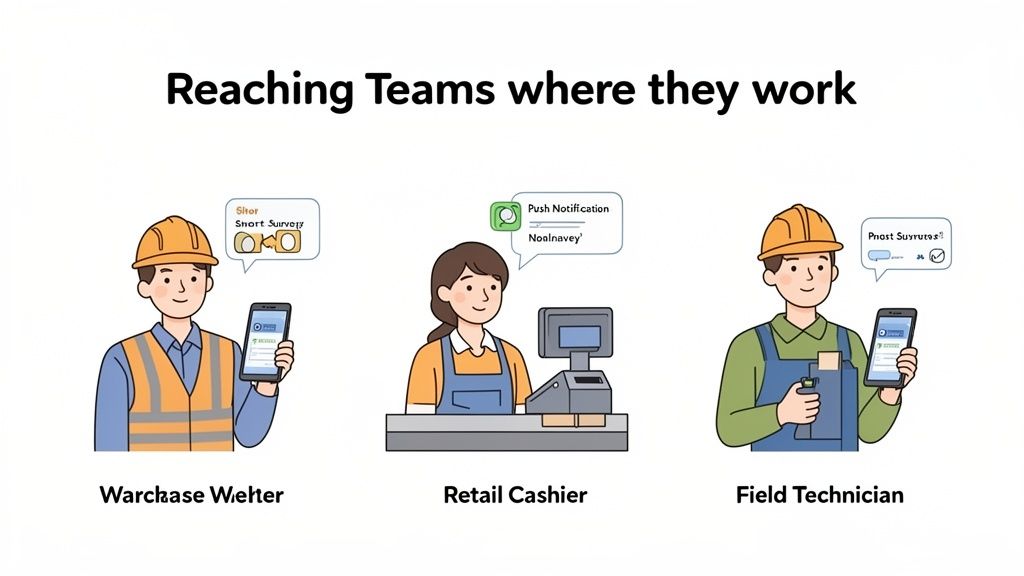
For any business with teams spread across warehouses, retail stores, or out in the field, just emailing a link is a surefire way to get a dismal response rate. Asking a frontline worker to check their personal email and fill out a survey after a long shift? That’s completely disconnected from their reality. The format of your survey and how you deliver it are two sides of the same coin. You can't separate them.
Meet People Where They Are
This is where modern tools change the game. For a distributed workforce, a mobile-first approach isn't just a nice-to-have; it's essential.
Imagine this: instead of another forgotten email, you push a quick, two-question pulse survey directly into the team app your employees already use, right as a busy shift wraps up.
It’s immediate. It’s convenient. Most importantly, it respects their workflow. You’re not asking them to stop what they’re doing, log into a clunky HR portal, and navigate a complex form. You’re meeting them in the same digital space where they clock in, check schedules, and chat with teammates.
When you make it easy and natural for people to respond, participation skyrockets. You get a much more honest picture of what’s really going on, not just feedback from the handful of people who sit at a desk all day.
The Right Message at the Right Moment
Thoughtful delivery also means paying attention to timing. An interesting find from the Gensler workplace research is that time spent in in-person collaboration is rising, while solo desk work is shrinking. This shift highlights a huge gap in traditional survey methods, which often miss the dynamics of hybrid and frontline work. Modern tools can bridge this gap by connecting feedback directly to specific moments.
So, what does this look like in the real world?
Post-Shift Pulse: Send a quick survey about team support right after a tough shift in the warehouse.
Onboarding Check-In: Push a notification to a new retail hire on their phone after their first week, asking if they have what they need.
Project Feedback: Ask a field service team for their thoughts on a new process right after they’ve used it for the first time.
This isn’t about bombarding people. It's about being intentional. When your request for feedback is tied to a recent, relevant experience, the quality of the answers you get is infinitely better. The format has to fit the context of their work, not the other way around.
Turning Feedback Into Action (Without Drowning in Spreadsheets)
Collecting feedback is the easy part. The real work—the part that matters—is doing something with it. I can't tell you how many times I've seen great survey results get dumped into a slide deck, never to be seen again. That's how you teach employees their feedback doesn't matter.
When that happens, you breed cynicism. It's the fastest way to kill participation in any future survey. We’ve learned there's a much calmer, more effective way to handle this that skips the data paralysis and gets right to the point.
Find the Signal, Ignore the Noise
Let’s be honest. You don’t need a data science degree to figure out what’s important. Instead of getting lost in endless spreadsheets, just look for one or two clear themes that keep popping up.
What's the one thing you're hearing over and over? It might be a frustration with clunky software, a desire for clearer career paths, or a need for better communication. Pick one and focus your energy there. Don't try to boil the ocean.
The Magic of Closing the Loop
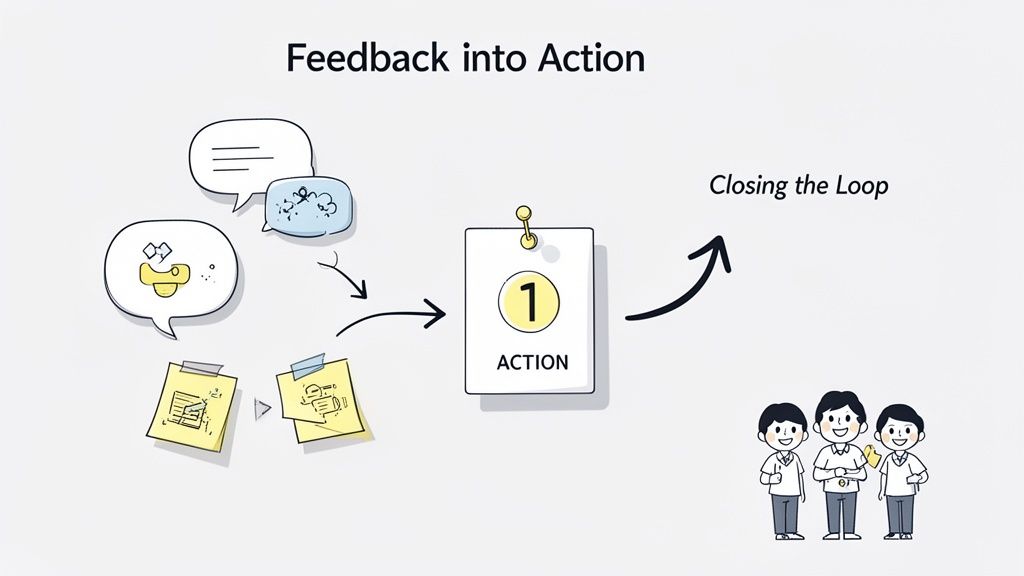
Now for the most critical step: you have to close the loop.
This means sharing the key findings with everyone—yes, even the uncomfortable stuff. Being transparent builds trust faster than almost anything else.
Next, announce one specific, tangible action you’re taking based on that feedback. This isn’t about promising to fix every problem overnight. It’s about proving you heard what people said and that you’re willing to act.
The goal isn’t perfection; it’s progress. A single, visible action shows more respect for your team’s feedback than a dozen well-meaning but empty promises.
This simple act of listening and responding is what separates a healthy feedback culture from a performative one. It’s the core principle that will help you improve employee engagement in a real, sustainable way.
Connect Action to What Really Matters
This process also shows your team you see them as whole people, not just workers. For example, PwC's 2024 Global Workforce Hopes and Fears Survey found a telling gap: while 70% of employees feel satisfied with their job, over half are also dealing with significant financial strain and fatigue.
Acting on feedback shows you care about the real issues affecting them. It makes sense, then, that when employees feel their goals align with their company’s, their motivation is 78% higher. A responsive employee survey format is a direct line to creating that alignment.
This isn't just about making people happier. It’s about building a more resilient, motivated organization. It all starts by turning a simple survey into a real conversation—one action at a time. For a deeper dive, check out our guide on how to turn engagement data into action.
So, what will your first action be?
Common Questions We Hear About Employee Surveys
People ask us about employee surveys constantly. Everyone seems to be searching for that one magic formula—the perfect number of questions, the right frequency, the gold-standard response rate.
Honestly, a magic formula doesn't exist. But after years of doing this, we've figured out a few simple truths that help cut through the noise. Here are the questions that come up most often, with our straight-to-the-point answers.
How Often Should We Really Send These Things?
This is less about a rigid schedule and more about finding a rhythm that works for you. Think purpose, not protocol. That big, annual engagement survey can be a great yearly health check, but it’s not enough on its own. You'll want to pair it with much lighter, more frequent pulse surveys—maybe quarterly, or even monthly for some teams.
And don't forget about surveys tied to specific moments. Big events in an employee's journey, like their first few weeks or their last day, need their own feedback loop. The key is consistency without creating survey fatigue. If your team sees you’re actually doing something with the results, they’ll be more likely to keep giving you their time.
What’s a Good Survey Response Rate?
Industry benchmarks love to toss around numbers like 70-80% for big annual surveys. But let's be real, that can be a misleading metric. If you just chase a number, you end up pestering people for clicks instead of getting genuine feedback. For a quick pulse survey, even a 50-60% response rate can give you incredibly valuable insights.
My advice? Stop obsessing over the percentage. Focus on making it ridiculously easy to respond (mobile-first is essential) and proving that the feedback leads to real change. I'll take a lower response rate with thoughtful, honest answers over a high rate of mindless clicking any day.
Should Surveys Always Be Anonymous?
Ah, the big one. The honest answer is: it depends on your goal and, more importantly, the level of trust in your organization.
Anonymity is a powerful tool. It can unlock incredibly candid feedback on sensitive topics that people would never put their name on. There's no doubt about that.
However, confidential surveys (where a neutral party knows who said what but won't share individual identities) or even named feedback can be more actionable. If someone has a great idea or a specific problem, you need to know who they are to follow up. We’ve found a hybrid approach usually works best. Keep the big-picture culture surveys anonymous to protect that feeling of safety. But for other feedback, consider making identification optional for anyone who wants a direct conversation.
Ready to move beyond clunky annual surveys and start having real conversations with your team? Pebb brings communication, operations, and engagement into one simple app, making it easy to send the right survey at the right moment. See how it works at https://pebb.io.
