
The Messy Truth About Making a Shift Schedule
Ditch scheduling chaos. Our guide shows how a modern shifts schedule maker restores sanity, ensures compliance, and gives your team the flexibility they crave.
Dan Robin
I’ve spent more hours than I’d like to admit staring at a spreadsheet, trying to piece together a shift schedule. It feels like a high-stakes game of Tetris, but with people's lives. You start with a simple grid, a few names, a few time slots. For a week, maybe two, it works.
Then, the chaos creeps in.
A last-minute sick call triggers a frantic chain of text messages. A vacation request gets lost in an email thread. Soon enough, you’re spending half your Monday just juggling availability, trying to be fair, and praying the business is actually covered.
Let’s be honest. That spreadsheet isn't a tool; it’s a trap. And we’ve all been caught in it.
We lived this story for years, patching together schedules with outdated templates and a lot of wishful thinking. The biggest thing we learned? The real cost of bad scheduling isn’t the time you lose. It’s the constant, low-grade stress it dumps on everyone.
More Than Just Wasted Time
When you’re stuck in a manual scheduling loop, it slowly chips away at team morale. Unpredictable, last-minute schedules send a clear message: your time doesn’t matter. Your best people feel it first. They start quietly looking for the door.
Managers feel it, too. You end up feeling less like a leader and more like a full-time firefighter.
And that’s before you even get to the real risks. One mistake can snowball into a compliance violation, an understaffed shift that kills customer service, or a payroll error that breaks trust. These aren't just headaches. They're expensive problems that pull you away from the work that actually matters.
The pain of manual scheduling is a universal experience. It’s why a dedicated shifts schedule maker has gone from a nice-to-have gadget to the bedrock of modern business.
This isn’t a small trend. The global market for these tools hit USD 1.6 billion in 2024 as companies finally decided their spreadsheets were doing more harm than good. That number reflects a fundamental shift in how we manage our most valuable asset: our people’s time. You can read more about the market growth of scheduling software on Apps Run The World.
This guide is about more than just picking software. It’s about a calmer way to work. One that helps you reclaim your time, build a predictable environment, and treat your team with respect. It’s about ending the cycle of chaos.
Why Most Schedules Fail Before They Even Start
When you get a new tool—like a shiny new shifts schedule maker—the temptation is to jump right in. You want to start dragging names into time slots and feel that immediate sense of progress. But this is exactly where things go wrong.
The real work, the stuff that makes or breaks a schedule, happens before you assign a single shift. It’s the quiet work of understanding the ground truth. Skip this, and you walk right into a predictable, painful cycle.
It always starts with a messy spreadsheet. It quickly devolves into scheduling chaos. And it inevitably ends in burnout for both you and your team. The only way to break this spiral is to get your inputs right from the start.
The Foundation of a Bulletproof Schedule
If you want to build something that lasts, you need a solid foundation. In scheduling, that foundation is built on three things: roles, availability, and rules. Get these right, and the rest is surprisingly simple.
First, who can do what? It’s not enough to know you need three people on the floor. You need to know that Maria is the only one certified for the forklift and that Ben is your go-to for training new hires. Documenting these specific skills is critical.
Next, when are people really available? Don't just ask for preferences. You need concrete information. This means capturing a student's class schedule, blackout dates for planned vacations, and maximum weekly hours. A good employee scheduling app can gather this for you without a storm of emails.
Finally, what are the hard rules? These are the non-negotiables. What do labor laws require for meal breaks? Are there union rules about overtime? What about your own policies on consecutive workdays? Getting these documented isn't just a good idea—it's essential.
There’s a reason businesses are investing heavily here. Global spending on workforce management is projected to climb to a staggering USD 14.64 billion by 2032. The cost of getting it wrong—in fines, turnover, and lost productivity—is enormous. When you consider that up to 70% of workers in some industries are on shift-based schedules, you see how high the stakes are.
You're not just filling boxes on a calendar. You're orchestrating a complex system of people, skills, and legal requirements. Treating it like a simple puzzle is the first mistake.
I know this initial work can feel slow. It might seem like you’re not making progress. But trust me, this is the most valuable part. It gives you a clear blueprint before a single shift gets assigned, saving you from a world of headaches down the line.
Designing Schedules People Don’t Hate
Here’s a hard truth: you can create a schedule that is technically perfect—full coverage, no overtime, skills matched to tasks—and still have it be absolutely miserable to work. It’s a classic case of winning the battle but losing the war. A schedule that burns people out isn't a success. It's a quiet failure.
The real art of scheduling isn’t about filling slots. It’s about creating a rhythm your team can build their lives around. This is where so many managers get it wrong. They treat scheduling like Tetris, jamming pieces together until the board is full, forgetting there's a human being at the end of each block.
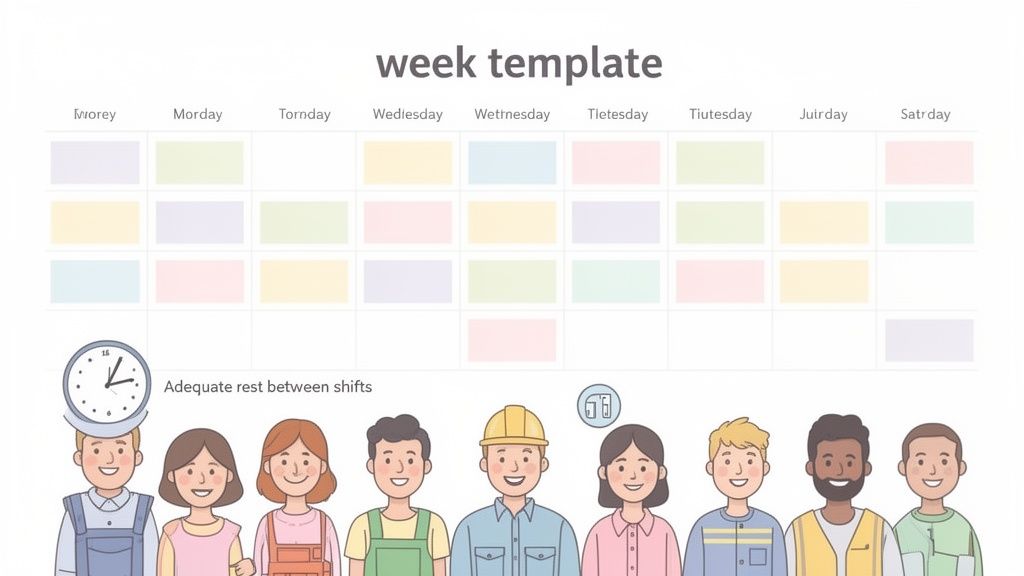
This is why we lean so heavily on templates. A good shifts schedule maker lets you build a foundational weekly pattern that becomes your default. Instead of staring at a blank slate every Monday, you start with a structure that’s already 80% right. For your team, that consistency is a huge relief. It cuts down on the anxiety of wondering, "What will my life look like next week?"
Beyond Filling Slots
Once you have that baseline, you can focus on fairness. This is where you move from being a scheduler to being a leader. It means being intentional about the things that make a huge difference.
Let’s be honest, nobody wants to close every Saturday night. A fair rotation system shows you’re paying attention and distributing the tough work evenly. And please, kill the “clopen”—making someone close late at night only to open again early the next morning is a notorious burnout machine. A schedule that respects rest builds loyalty.
And post schedules early. A schedule dropped 24 hours in advance isn't a plan; it’s a command. Giving your team at least two weeks' notice allows them to actually plan their lives.
These aren't just nice ideas; they are strategic decisions. It’s about mastering resource allocation optimization by treating your team’s time as the valuable, finite resource it is.
The Old Way vs. The Calm Way
The difference between wrestling with a spreadsheet and using a dedicated tool is stark.
Task | The Old Way (Spreadsheets & Texts) | The Calm Way (A Shifts Schedule Maker) |
|---|---|---|
Building the Schedule | Hours of plugging in names, cross-referencing notes, and fixing mistakes. | Apply a template and auto-fill based on rules. Minutes, not hours. |
Handling Time-Off | A mess of emails, texts, and sticky notes. Easy to forget or double-book. | Requests are centralized. Approved time-off automatically blocks that slot. |
Finding Shift Covers | Frantic group texts and phone calls. Stress for everyone involved. | Employees swap shifts in the app (with your approval). The system finds eligible people. |
Communicating Updates | Emailing a new file, hoping everyone sees the latest version. Confusion is guaranteed. | Instant push notifications to your team's phones. Everyone is on the same page. |
The difference is clear. One path is manual, error-prone, and stressful. The other is built for speed, accuracy, and sanity.
A well-designed schedule is a silent form of respect. It tells your team, "I see you. I value your life outside of these walls." That message is more powerful than any team-building exercise.
When you use a proper tool, these principles become second nature. You can find excellent starting points with a well-designed shifts schedule template that already incorporates these ideas. A schedule isn't just a list of times. It’s the operating system for your team’s work-life interface. Making it humane is one of the most important things a manager can do.
Handling Chaos With Calm
Let’s be real: no schedule is perfect. No matter how well you plan, life happens. Someone wakes up sick, a kid gets sent home from school, or a surprise dinner rush means you need all hands on deck, now.
This is where manual systems completely fall apart. They don't just bend under pressure; they shatter.
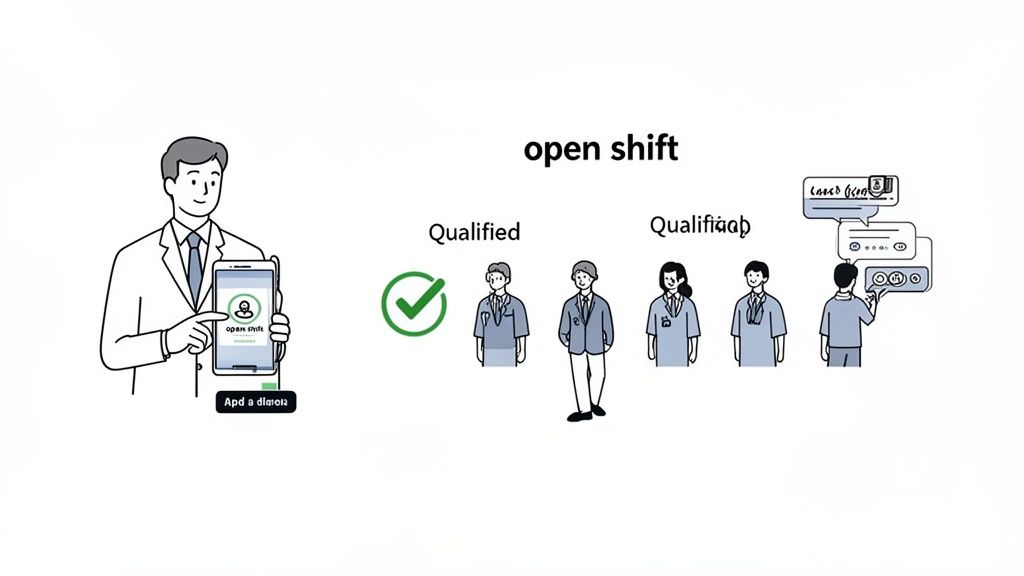
And this is the moment a modern shifts schedule maker proves its worth. It’s not about how it organizes a perfect week. It’s about how gracefully it handles an imperfect day. It turns a crisis into a simple task.
Instead of spamming everyone with a desperate “Can anyone cover closing?!” message, you post an open shift. The system instantly knows who is qualified, available, and won’t hit overtime. It notifies only those people. Done.
Give Your Team the Keys
Here’s something I’ve learned: the more you empower people to solve their own problems, the fewer problems land on your desk. Employee-led shift swapping is a perfect example.
Do you really need to be the middleman every time Sarah wants to trade her Tuesday morning for Ben's Thursday afternoon? Of course not. A good tool provides a simple, structured way for this to happen. Sarah offers her shift to Ben through the app. Ben gets a notification and accepts. You give the final nod. The swap is official.
This gives your team the autonomy they want while you maintain control. They get the flexibility to manage their lives, and you get a filled shift without the headache. It’s a system built on trust, not top-down micromanagement.
I talked to a retail manager who used to burn five hours a week just dealing with call-outs and swaps. After switching to a proper tool, that number dropped to less than an hour. That's an 80% reduction in time spent putting out fires.
From Firefighting to Resilience
This is about more than just plugging a hole in the schedule. It's about building a more resilient system. When your team knows they can easily pick up extra hours or swap a shift for a doctor's appointment without a huge fuss, they feel more respected.
That feeling is powerful. It cuts down their stress, which in turn cuts down yours. You stop being the person who always has to say "no" and become the one who oversees a system that just works.
The old way—the chaotic group chats and the out-of-date spreadsheet—is designed to fail. It assumes a perfect world that doesn't exist. A modern approach accepts that chaos is part of the job and gives you the tools to handle it with confidence.
Beyond the Schedule: Connecting the Dots
Think your job is done the moment you publish the schedule? Not even close. That’s just the starting gun. The real work is seeing how that schedule plugs into the rest of your operation.
For the longest time, the schedule was a piece of paper pinned to a corkboard. It was out of date in five minutes, covered in pen marks, and invisible to anyone not standing right in front of it. That old way can’t keep up anymore.
Today's teams expect instant access. They want to pull up their schedule on their phone and get a ping when something changes. This isn't a luxury; it's the new standard.
The Bridge Between Time and Money
But communication is only half the story. A schedule that exists in a vacuum is just a suggestion. To give it real teeth, it has to connect directly to your time clock. This is the one connection manual scheduling always fumbles.
When your schedule is integrated with how your team clocks in, it becomes the source of truth.
It keeps everyone honest. The system can automatically flag unauthorized early clock-ins or overtime. It also makes payroll a breeze. Hours worked are logged directly against scheduled hours, erasing that end-of-week headache of matching messy timesheets to a chaotic spreadsheet.
An employee requests time off. You approve it. The system automatically makes them unavailable for scheduling on those days. The loop is closed.
A schedule that doesn't talk to your payroll system is a liability. It creates a gap where confusion, errors, and frustration thrive. Closing that gap is one of the most powerful things you can do for your own sanity.
Once everything is connected—the schedule, time clock, time-off requests, and team chat—you’re no longer juggling information from texts, emails, and spreadsheets. You’re managing one cohesive system. We've written more about the smartest ways to share shift schedules if you want to dig deeper.
Of course, a good system is just the start. You also need to improve overall workplace communication to build a team culture where people feel heard.
At the end of the day, a schedule isn't just a document. It's the operational heartbeat of your team. When you treat it like the central, connected piece of the puzzle it is, it stops being a source of chaos and becomes your greatest source of clarity.
Still on the Fence? Let's Be Honest About Switching.
Changing how you schedule your team feels like a big deal. I get it. I've talked with hundreds of managers stuck in the "spreadsheet zone," and they all ask the same questions. They're real worries about time, money, and how the team will react.
Let's tackle those head-on.
"My team is used to the spreadsheet. How do I get them on board?"
This is the number one concern. People are creatures of habit. The secret isn't a mandate; it's showing them what’s in it for them.
Forget pitching it as a management tool. Focus on how a modern shifts schedule maker makes their lives easier. They can see their schedule on their phone, anytime. They can request time off with a single tap. They can trade shifts with coworkers without you playing middleman.
Start with a small pilot group. Pick a few tech-friendly employees, let them try it, and watch them become your biggest advocates. Once the rest of the team sees how much simpler things are for their coworkers, they'll want in. The best tools feel so natural there's almost no learning curve.
"Can a tool really handle our complex labor rules?"
Yes. In fact, this is one of the best reasons to switch. Let's be honest—keeping track of every local labor law, union agreement, and internal policy is a full-time job. One slip-up can be incredibly costly.
Good software is designed for this. You can set up custom alerts for overtime thresholds, mandatory meal breaks, required rest periods between shifts, or certification requirements. Instead of you being the compliance cop, the software becomes your safety net. It flags potential issues before you publish the schedule, turning a stressful manual review into an automated, worry-free process.
"Is this worth the cost for a small business?"
This question is really about the hidden costs you’re already paying.
How many hours does your manager spend building the schedule each week? How much time is wasted on last-minute changes? What’s the price of a single payroll mistake or a compliance fine? What’s the cost of losing a great employee who’s fed up with chaotic scheduling?
For most businesses, a good shifts schedule maker pays for itself almost immediately. It frees up hours of your time, cuts down on unnecessary overtime, and boosts morale. That time you get back isn't just a number. It's time you can pour back into training your team, talking to customers, and actually growing your business.
Ready to see how one platform can bring clarity and calm to your workday? Pebb pulls scheduling, time clocks, communication, and team operations into one intuitive app. Discover how Pebb can transform your team’s workday.
