
Shift Differential Calculation: A Practical Guide
Learn shift differential calculation with clear formulas, real examples, and tips for handling overtime and payroll integration.
Dan Robin

The first time a mixed week goes sideways, it usually looks harmless. A coordinator sees a clean schedule on Monday, a night shift on Wednesday, a few overtime hours on Friday, and thinks the premium is just a simple add-on. Then payroll runs, someone asks why the overtime looks off, and suddenly the “small” differential is the part everyone is staring at.
That's the trap. Shift differential calculation is not just about adding a little extra to certain hours. It's about deciding which hours qualify, whether the premium is a flat dollar amount or a percentage, and how that premium changes the worker's regular rate before overtime gets calculated. For teams that run nights, weekends, or rotating schedules, that sequence matters more than the headline formula.
Why Shift Differential Calculation Is Harder Than It Looks
A lot of payroll mistakes start with a decent instinct. Someone looks at a schedule and says, “Just pay the night hours a bit more.” That works until the week includes a mix of premium and non-premium time, a partial night assignment, or overtime layered on top of those premium hours. Then the easy answer stops being enough.
I've seen this most often in frontline operations where people move across shifts. A restaurant manager covers the close, a warehouse lead picks up a swing shift, and a nurse works a split week with day and night hours. If you need a quick way to frame why those shifts create different pay rules, compare shift types for restaurants is a useful reference for the staffing side of the problem.
The actual question is not the formula
The key question is what the hour counts as. Is it eligible for the premium at all? Is the premium flat or percentage-based? Does it apply only to worked time, or to every hour on a qualifying shift? Those choices shape the final paycheck just as much as the base rate does.
Practical rule: if you cannot explain which hours qualify in one plain sentence, the policy is probably too loose for payroll.
The federal wage-system standard shows how specific this can get once a policy stops treating the premium like a casual bonus. The Office of Personnel Management sets night differentials at 7.5% for a 3 p.m. to midnight shift and 10% for an 11 p.m. to 8 a.m. shift, and it defines majority of hours as more than half of the scheduled shift, including meal breaks, such as a 5-hour majority within an 8-hour shift (OPM night shift differential guidance). That kind of rule is a reminder that payroll needs precise inputs before it can produce a clean result.
The payroll lesson is simple. Shift differential calculation is a chain of decisions, not one formula. Get the order wrong, and the overtime math will punish you later.
The Two Core Methods for Calculating the Premium
The cleanest way to handle differential pay is to choose one of two models and stick to it. ADP's guidance breaks it down the same way, as either a flat hourly add-on or a percentage of base pay, applied only to eligible hours (ADP shift differential guidance). That's the part policy teams should get right before they ever hand the math to payroll.
Flat dollars are easy to explain
A flat differential is simple. If the policy says night hours get an extra dollar per hour, the employee's qualifying hours get that dollar and nothing else changes in the definition of the premium. That's easy to communicate, and it's usually the less painful option when the premium is meant to feel like a fixed incentive.
Flat-dollar logic is especially comfortable in hourly environments where supervisors want a quick rule they can remember. If the shift qualifies, add the premium. If it doesn't, don't. There's no need to translate a percentage, and no one has to wonder whether a raise changed the premium.
Percentage pay scales better with base rate changes
Percentage-based pay is cleaner when the goal is to keep the premium proportional to the worker's base pay. For salaried employees, that method is generally preferred, while hourly workers can go either way depending on policy (ADP). It also stays aligned when base rates move, which matters more than people admit.
The implementation sequence is straightforward. First, identify the qualifying shift. Second, decide whether the premium is fixed or percentage-based. Third, calculate the premium amount per eligible hour. Fourth, multiply by the eligible hours in the pay period. That sequence keeps the math honest and keeps payroll from improvising under pressure.
A percentage model feels a little more elegant, but it's not always the better fit. A flat premium is easier to audit. A percentage premium is easier to keep proportional. Choose based on policy, not habit.
How the Differential Changes the Overtime Math
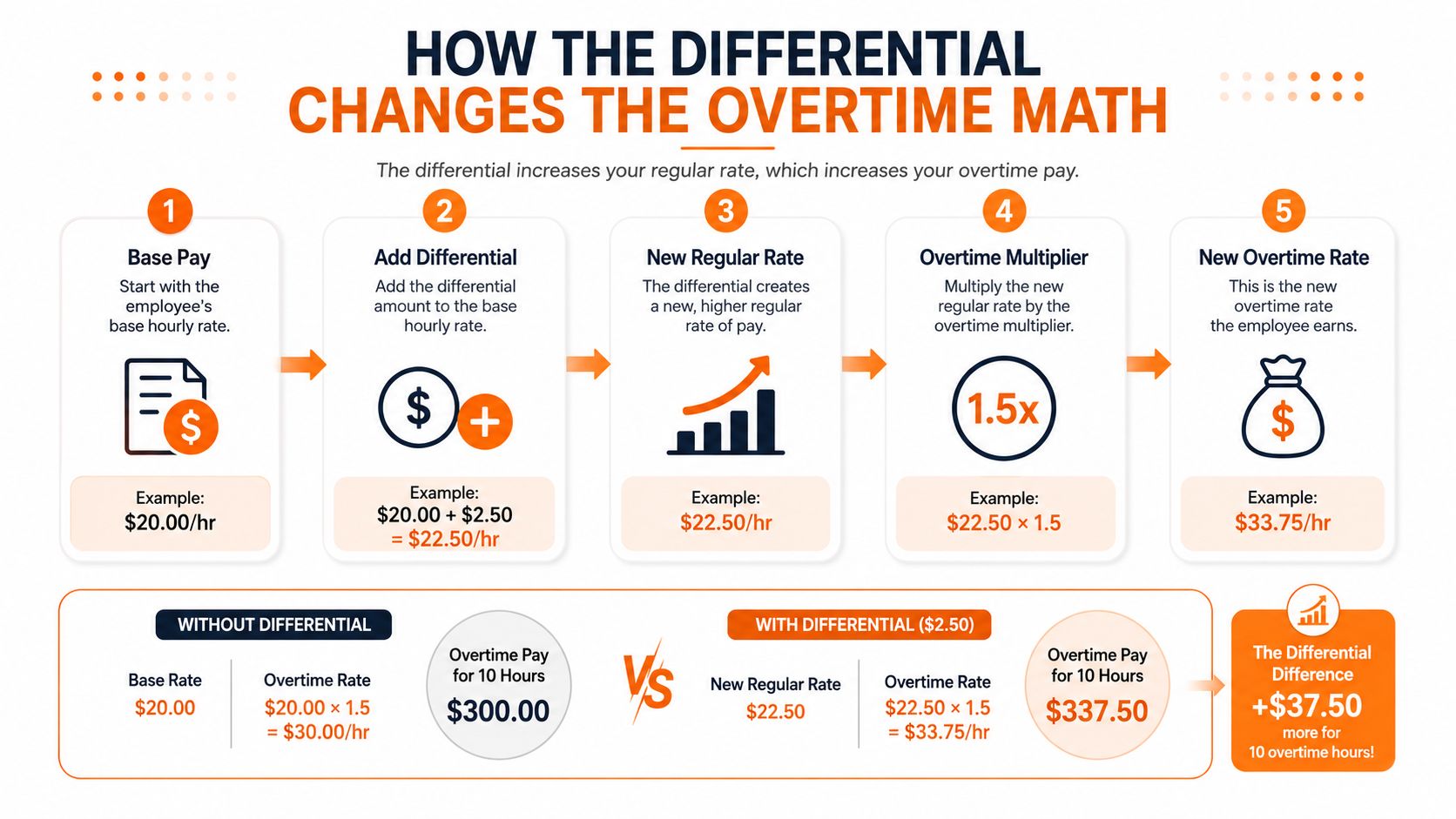
The calculation gets serious. The premium doesn't sit beside overtime like a separate garnish. It goes into the worker's regular rate first, and overtime is built from that combined number. A lot of guides skip that part because it's messier, but payroll doesn't get to skip it.
A 48-hour week shows the mechanics
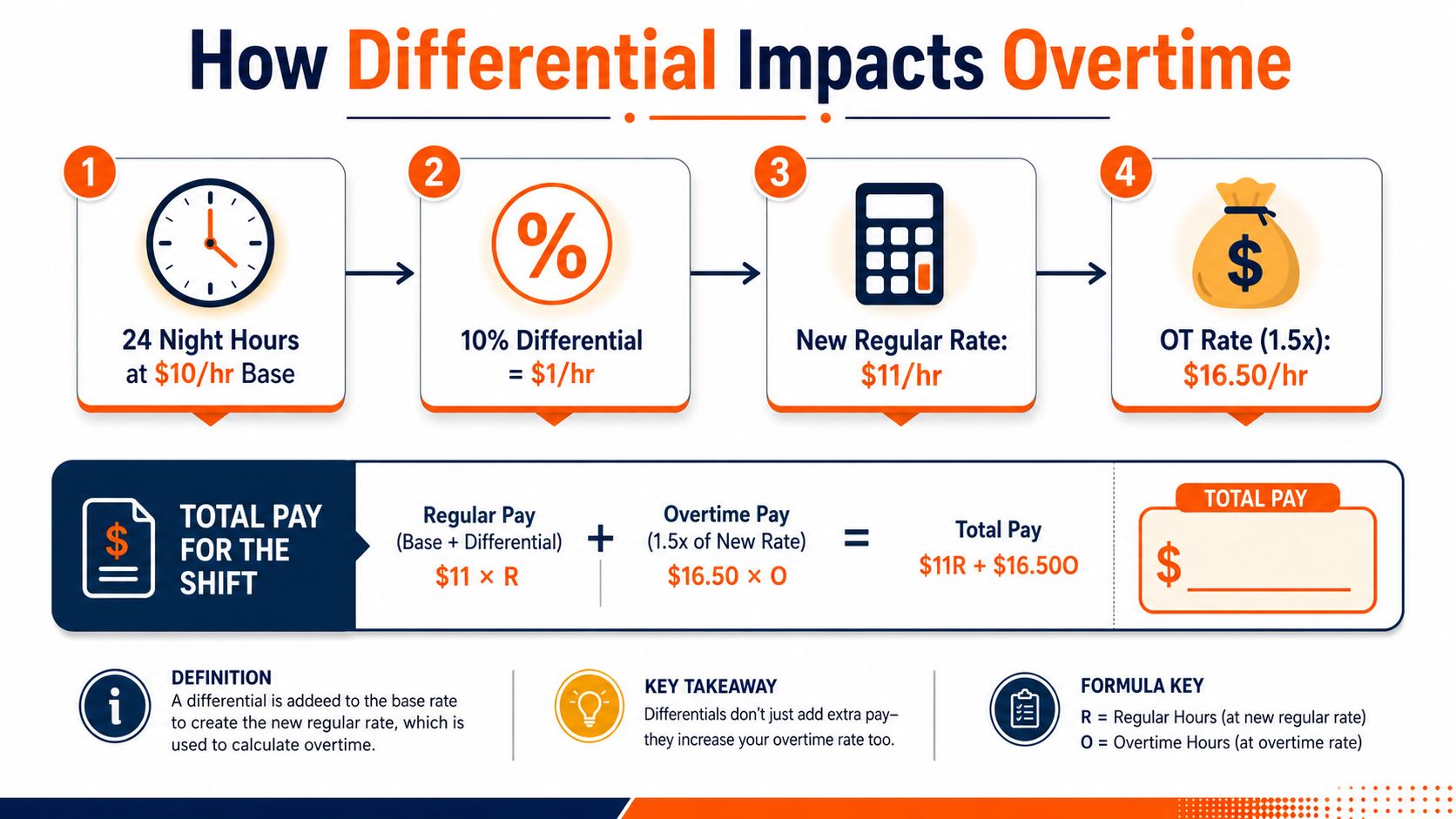
Payroll Partners gives the cleanest example I know. An employee earning $10/hour works 24 night hours with a 10% differential, which equals $1/hour. That adds $24 in premium pay, bringing straight-time wages to $504 over 48 hours, which produces a revised regular rate of $10.50/hour (Payroll Partners).
At that point, overtime isn't based on the old base rate anymore. It's based on 1.5× the revised regular rate, or $15.75/hour, which creates $126 of overtime pay for 8 hours and total gross pay of $546 (Payroll Partners). That's the part people miss when they try to bolt the differential on after overtime is already calculated.
Overtime is not just base pay times a multiplier. It's the regular rate, and the regular rate already carries the differential.
The common shortcut breaks the week
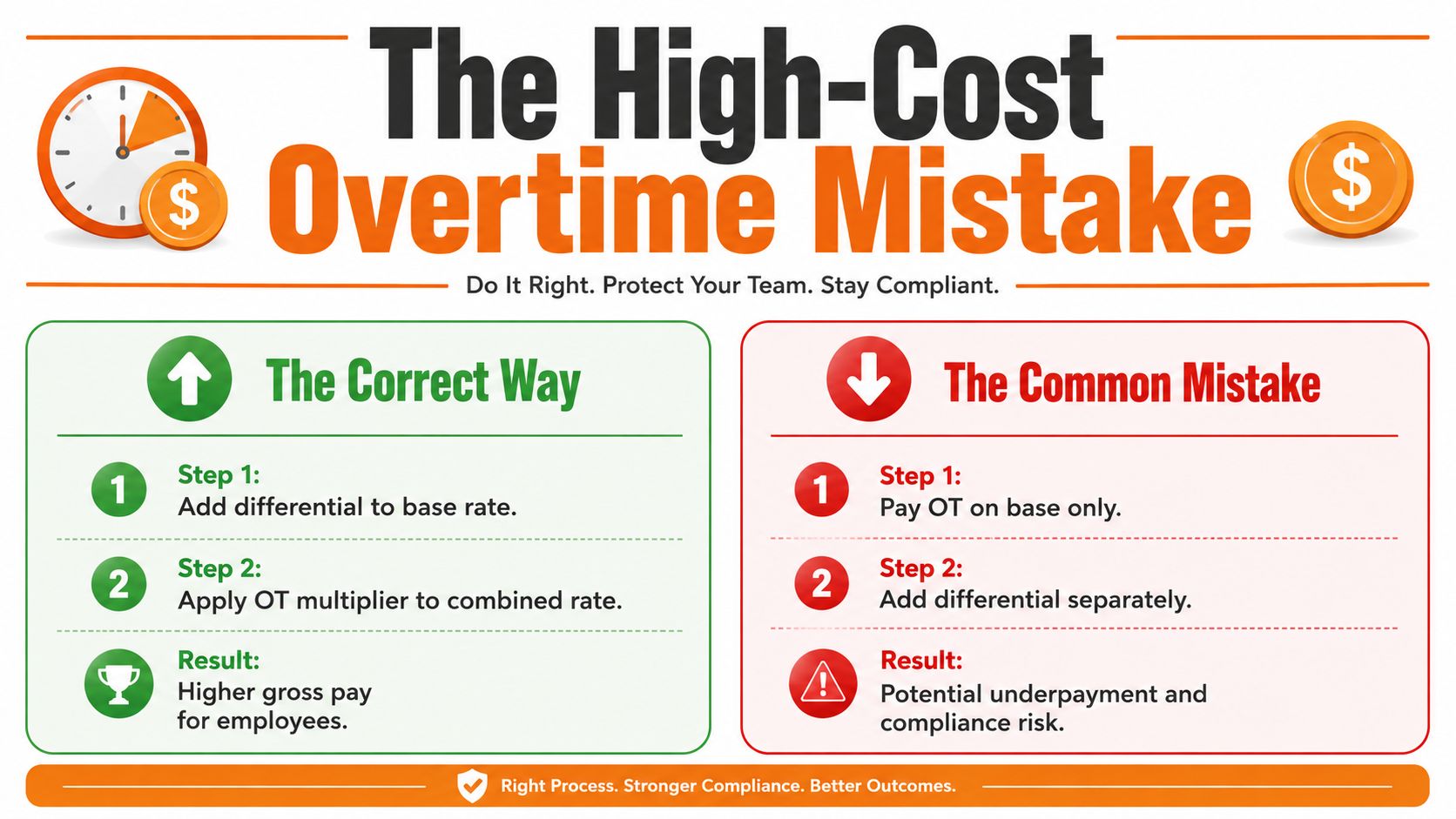
If payroll pays overtime on base pay alone and then adds the differential separately, the math looks tidy but the legal logic is wrong. The worker's total straight-time earnings are the base for overtime, not the base hourly rate in isolation. That's why mixed weeks with both premium and non-premium hours are the ones that expose bad setup fast.
For readers who want the overtime side of this viewed from a state-law angle, how overtime is handled in California is a useful companion read. The principle stays the same even when the surrounding rules change, the premium belongs in the regular rate before the overtime multiplier hits.
Salaried Employees and Other Edge Cases
Salaried workers make this messier, not simpler. A percentage-based differential usually fits them better because the premium can be rolled into a weekly or annualized adjustment without pretending they are just hourly workers in different clothing. Some employers still convert that premium into an effective hourly figure for bookkeeping, but the policy has to be clear before the math starts.
Federal wage-system rules show how specific qualifying-shift language can get. Night differentials are tied to the schedule itself, with one rate for 3 p.m. to midnight and another for 11 p.m. to 8 a.m.. Those rules also define majority of hours as more than half of the scheduled shift, including meal breaks, which is the kind of detail that decides borderline eligibility.
Edge cases are where policy gets tested
New York State's payroll manual is a good reminder that local rules can be much more granular. It says a pay differential may apply when four or more hours of a night shift fall between 6 p.m. and 6 a.m., the premium may be a percentage or fixed dollar amount, and eligibility requires a regular assignment to the night shift. It also states that a worker regularly assigned one night shift per week gets one-fifth of the total differential per biweekly period, and a temporarily reassigned day-shift worker must stay on nights for ten working days in a two-week period to qualify.
Those edge cases matter because they show how quickly “night shift” becomes a policy question, not a calendar question. If your handbook is vague, managers will guess. Payroll will pay for the guess.
For teams that also need to think about PTO math in the same payroll cycle, calculate PTO payout is a useful adjacent reference because it reminds you how many pay rules can collide in one run.
A Spreadsheet Template You Can Copy Today
A spreadsheet is still the fastest way to catch bad assumptions. I like a setup with named cells or clear row labels, because the goal is to make the regular rate visible before payroll software hides it behind a button. If the numbers don't line up in a sheet, they won't magically line up in production.
Here's a clean structure: base hourly rate, differential amount or percent, eligible premium hours, total straight-time earnings, total hours, regular rate, overtime hours, and overtime premium. For a flat-rate policy, the premium cell is a dollar amount. For a percentage policy, it's a rate like 10%.
Use formulas that show the chain
A simple Excel or Google Sheets layout can look like this:
Base rate in B2.
Differential percent or flat amount in B3.
Eligible premium hours in B4.
Total hours in B5.
Base pay in B6, with
=B2*B5.Premium pay in B7, with
=B3*B4for flat pay, or=B2*B3*B4for percentage pay.Total straight-time earnings in B8, with
=B6+B7.Regular rate in B9, with
=B8/B5.Overtime hours in B10.
Overtime premium in B11, with
=B10*B9*1.5.
That middle step matters. The premium has to sit inside the straight-time total before you divide by total hours. Otherwise the regular rate is wrong, and overtime just repeats the mistake.
If you want to translate time punches into decimals before you build the sheet, this time conversion guide is a handy companion. It keeps the inputs clean, which is half the battle.
Compliance, Rounding, and Payroll Integration Pitfalls
The most expensive errors usually aren't dramatic. They're small rounding choices, unclear policy language, or a time export that strips away the difference between premium and non-premium hours. Once that data is flattened, payroll has to guess. Guessing is how corrections happen.
Round time consistently, but don't pretend rounding is harmless. A minute here and a quarter-hour there can change the pool of eligible hours, which then changes the regular rate. If your time system rounds one way for paid hours and another way for eligibility, the payroll team ends up reconciling two versions of the same shift.
Build the policy so people can read it
The policy should say who qualifies, which hours count, and whether the premium is flat or percentage-based. If managers can't explain it without opening a spreadsheet, the employees probably can't trust it either. That's where grievances start, not in the math, but in the confusion around the math.
A smart way to pressure-test that policy is to use 8 compliance interview questions as a checklist for the people who run the rules. The point isn't to memorize legal language. It's to make sure the process holds up when a manager, an auditor, or an employee asks the obvious question.
Payroll habit that saves time: verify the time export, confirm eligible hours, recompute the regular rate, check one sample by hand, then reconcile against the prior cycle.
Paychex is blunt about the common miss. Overtime still has to be calculated correctly with the shift differential included, and that's the part employers most often miss when running payroll (Paychex). That's not a software problem first. It's a policy and setup problem.
The Mistake That Costs Frontline Teams the Most
The worst shortcut I see is paying a separate “shift differential overtime premium” on top of overtime, as if overtime and differential are two unrelated layers. They're not. The differential belongs in the worker's regular rate first, and overtime is then calculated from that combined number (NightOwling).
That shortcut creates two kinds of pain. It can overpay some hours, underpay others, and make two employees with similar schedules look like they're being treated differently just because one hit 40 hours on premium time and the other didn't. In a frontline operation, that kind of inconsistency travels fast.
Frontline schedules expose the weak spots
Hospitals, warehouses, and restaurants rarely hand employees neat, repeatable weeks. People swap shifts, extend coverage, and cross from day to night work without much warning. If payroll only works when the schedule is tidy, it doesn't really work.
The better approach is boring, and that's a compliment. Recalculate the regular rate from total straight-time earnings, including differentials, then apply the overtime multiplier. That is the compliant weekly method, and it holds up even when the week includes a mix of premium and non-premium hours.
A clean paycheck does more for trust than a dozen policy memos.
This is also a culture issue. Frontline workers notice their paychecks long before they read the handbook. When shift differential calculation is clean, it says night and weekend work is valued, not just tolerated. That message matters in every 24/7 business.
If you want the operational side of this to feel less fragile, easy overtime handling with is a useful reminder that the best payroll process is the one managers don't have to improvise every week. Pick a method, write it down in plain language, test it against a real week, and automate it inside your scheduling and time-tracking tools so nobody's hand-entering premium hours at 4:55 p.m.
Getting this one piece of math right clears room for better decisions everywhere else. Once payroll stops fighting the same overtime mistake, HR can focus on shift design, coverage, and the human reality of round-the-clock work.
If you're building a cleaner shift, pay, and communication flow for a 24/7 team, take a look at Pebb. It gives frontline and office teams one place to handle shifts, updates, tasks, and the day-to-day coordination that makes payroll less chaotic. For teams that live in mixed schedules, that kind of clarity pays for itself in fewer mistakes and fewer angry Friday questions.
