
Security Guard Shift Communication That Actually Works
Fix security guard shift communication with proven handover checklists, templates, and workflows that keep every shift aligned and accountable.
Dan Robin

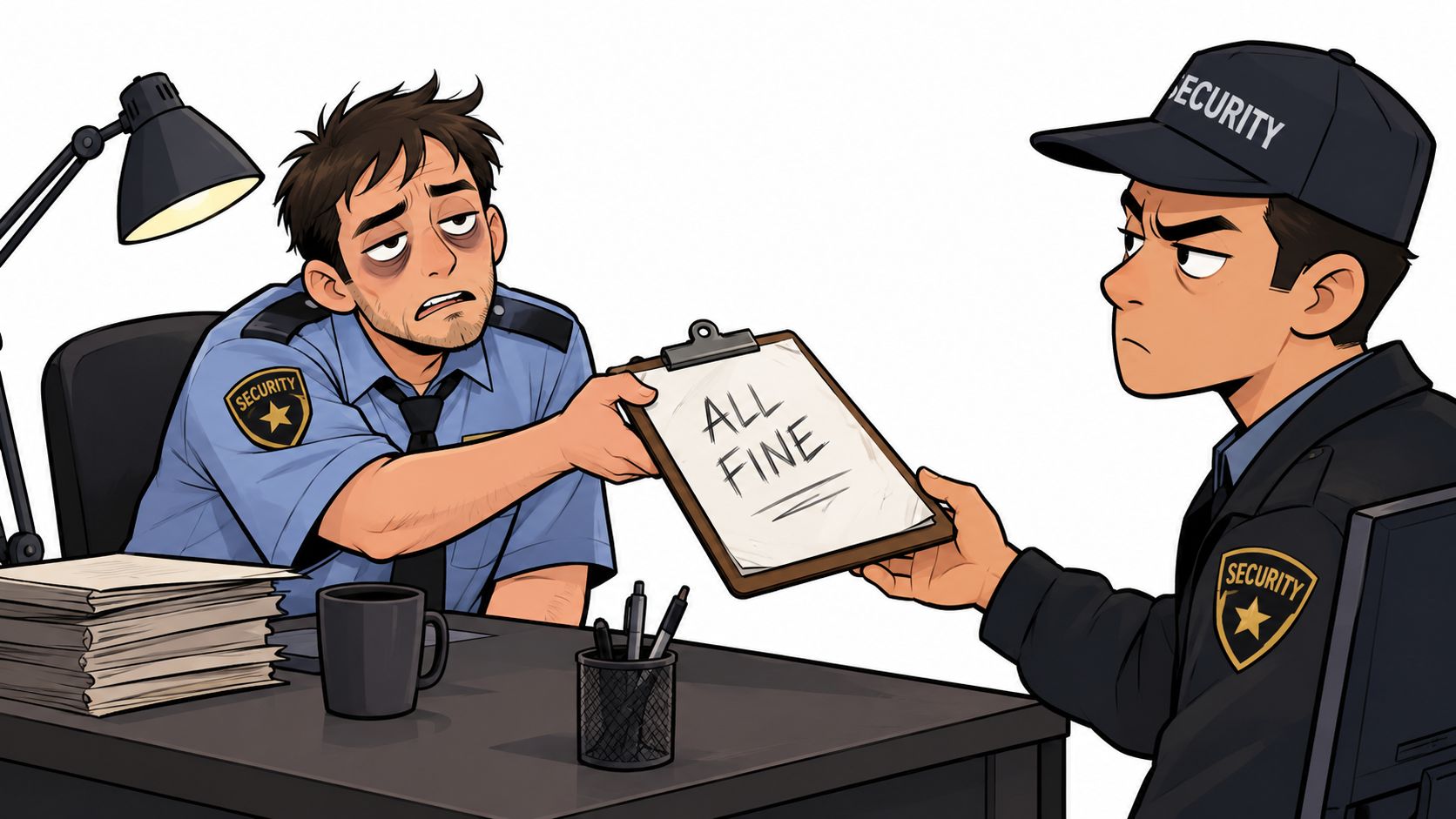
The worst handovers I've seen all started the same way. The outgoing guard shrugged, said “all fine,” and walked off while the incoming guard inherited a shaky radio, an unresolved visitor issue, and a note that only made sense to the person who wrote it. That's not paperwork trouble. That's a live risk being handed to the next person on post.
Good security guard shift communication is what keeps a site from drifting into guesswork. It protects continuity, and it keeps the next guard from starting blind. In practice, that means the handoff has to work like a working memory, not a casual chat.
I've also seen teams treat communication as a soft skill problem when it's really a process problem. When content teams need a repeatable workflow, they use systems and checklists, not hope, and the same thinking shows up in the guide to scaling content creation. The same discipline applies here. If the handover is weak, the shift starts behind.
For frontline teams, the cost of sloppy communication shows up fast. It creates gaps between shifts, and those gaps are where incidents get forgotten, equipment issues get missed, and supervisors lose the thread. That's why the fix is a system that captures active risk, keeps it searchable, and makes the next guard able to act without chasing anyone down. You can also see how that shows up in broader workplace communication patterns in Pebb's own insights on communication problems in the workplace.
Why Security Guard Shift Communication Breaks Down
A bad handoff usually doesn't look dramatic. It looks normal. The outgoing guard says the site was quiet, the incoming guard nods, and then the first real problem shows up ten minutes later when nobody is sure whether a visitor was cleared, whether a door alarm was reset, or whether the faulty radio was ever logged.
Security guard shift communication still relies on a mix of radio chatter, paper logbooks, and verbal briefings that vary from one officer to the next. That mix works only when everyone is disciplined and the site is calm. In messy conditions, it breaks fast. I've seen the same pattern in a guide to scaling content creation, repeatable workflows beat ad hoc handoffs because they reduce drift. Security handover needs that same structure.
That's why I don't treat shift communication as a courtesy. I treat it as a transfer of live risk. Industry guidance ties shift logs and handover notes to continuity and contract compliance, because the incoming guard needs a continuous operational picture, not a memory test incident reporting and field notebook guidance.
Critical details get lost between shifts, and no one realizes it until something goes wrong. That failure looks a lot like the common workplace communication problems you see in any rushed team, missed context, vague assumptions, and people acting on half a picture.
High turnover makes every handoff heavier
Security teams change often, and every change raises the odds that something gets lost. One industry analysis reports 50.8% turnover in the U.S. security industry in 2023, compared with 38.4% across all industries, and it cites New York City's Investigation and Security Services sector at 77% turnover in 2024, up from 69.3% five years earlier turnover analysis. Another industry source says annual turnover among security guards can average 200% to 300%, with some environments reaching 400% turnover analysis.
Those numbers matter because turnover multiplies handovers. More handovers mean more chances for vague notes, missed patrols, and weak supervisor follow-up. When coverage changes often, the handoff can't be casual.
Practical rule: if the incoming guard can't name the open risk without asking a second question, the handover failed.
Informal verbal updates decay fast
Verbal handovers feel efficient because they're quick. They're also fragile. A guard remembers the visitor's badge problem, but not the exact time it happened. Someone mentions a key issue, but not which key. By the time the next shift starts, the details are already thinning out.
That's why long-standing notebook practice still matters. Training materials describe security notebooks as official, paginated chronological records written in ink, with no erasures or removed pages, and reviewed by supervisors at the end of shifts incident reporting and field notebook guidance. Digital tools should copy that discipline, not weaken it.
A handover also needs enough structure to survive fatigue, delayed relief, and a busy gate line. In real operations, a structured overlap gives the outgoing and incoming guards a short window to brief each other on unusual activity, access granted, and equipment issues. That overlap isn't dead time. It is the moment the site stays coherent.
What Every Handover Must Capture to Keep Coverage Continuous
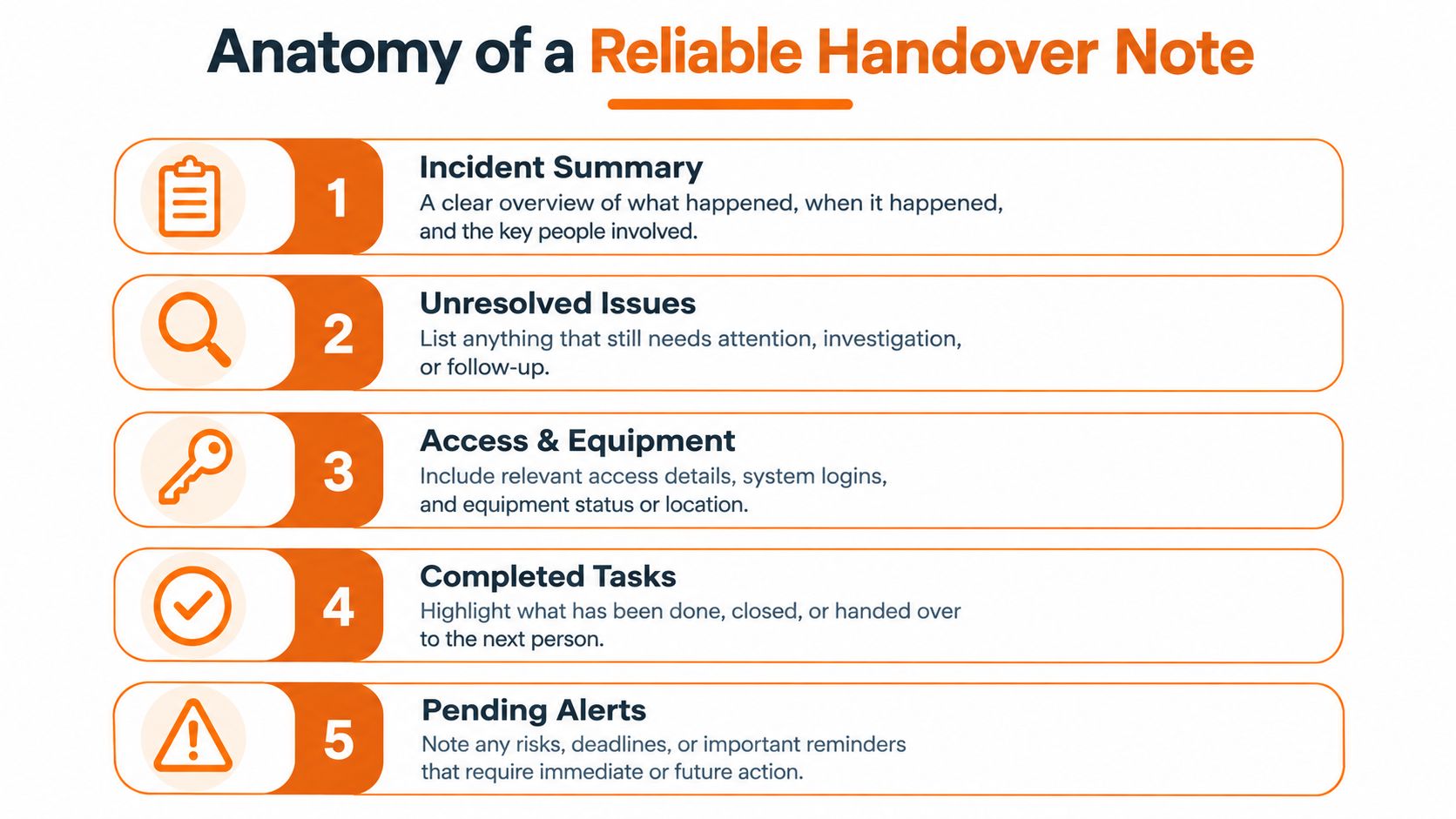
Treat every handover as a transfer of live risk. The note has to do more than recap the shift. The next officer must be able to act on the information without calling the previous shift. That means the record needs to capture what happened, where it happened, who was involved, what is still open, and what proof exists security guard shift handover notes.
The five essentials that earn a place in the log
Each entry should answer five questions. What happened. Where it happened. Who was involved. What is still open. What proof exists. If one of those is missing, the note turns into a story instead of a working handoff.
That structure sounds plain because it is. The trouble starts when a guard is tired, rushed, or assumes the next person will sort it out. They won't, and they shouldn't have to.
Complete means the next guard can act immediately, not just read it politely.
The fields that make it auditable
The note also needs the unglamorous details that make it useful later. Include the time and date of handover, access point status, patrol and checkpoint activity, equipment and key transfers, unresolved incidents, and supervisor instructions shift handover procedures. Those fields create a clear chain of responsibility.
A daily activity report should also read like a chronological record. Guidance says reports should include arrival and departure times, early arrival for briefing, end-of-shift pass-on, patrol rounds in order, checkpoint scans, radio checks, and observations about doors, windows, alarms, and lighting daily activity report essentials. A report that just says “patrolled site” is too vague to help anyone later.
That discipline is worth carrying into digital workflows. Use digital forms for frontline employees so the same fields appear every time, in the same order, with no guessing. Paginated logic, fixed order, objective notes, and supervisor review all make the record harder to distort. That is the point. If the log can't be trusted, the handover can't be trusted either.
The handover is a working document, not a diary
A solid note avoids fluff. It does not say “normal evening” when the issue is a broken gate latch and a contractor waiting at the side entrance. It states what is unresolved, what changed, and what the next guard should check first.
Here's the business truth. If the incoming guard can reconstruct the shift from the record, the handover is strong. If the guard needs a phone call to decode it, the record is weak. For sites that need continuity under pressure, the logic lines up with the business continuity management guide. Records matter when they help the next person keep the site moving.
How to Run a Reliable Shift Handover From Overlap to Sign Off
A good handover has a rhythm. It starts before the outgoing guard clocks out and ends only when the incoming guard has acknowledged the open items. In practice, a short overlap of about 15 to 30 minutes works best when the site allows it, because it gives both guards time for a written record, a quick face-to-face briefing, and, where possible, a joint walk-through handover workflow guidance.
Start with the written record
The written note comes first. Not later. That's where exact times, incident IDs, access-control changes, radio or key issues, alarms, and equipment faults get logged while they're still fresh security log best practice. The habit I push hard is simple. Write factual entries, not summaries.
Use language like this, “10:40 p.m., visitor issue at south gate, contractor badge not cleared, access denied, supervisor notified.” That gives the next guard a clean picture. “Visitor problem handled” does not.
Then brief face to face
Once the record is written, the outgoing guard briefs the incoming guard directly. The details behind the note get confirmed here, especially if something unusual happened or a situation is still open. Safety guidance on shift transfer keeps pointing to structured handover, enough written detail, and face-to-face two-way exchange with time to verify understanding safety-critical communication guidance.
If the site is active, keep the briefing short and specific. One guard speaks, the other confirms back the next action and the risk that remains. That back-and-forth matters more than a polished summary.
Short rule: if it takes a paragraph to explain a problem, the handover note needs more work.
Walk the site when the risk deserves it
A joint walk-through is worth doing when access points, equipment, or an incident scene need visual confirmation. It's not necessary every shift, but it's smart when the handoff includes keys, radios, broken devices, or a live issue that could change overnight. Seeing the exact door, panel, or camera beats arguing about it later.
The bad habits are easy to name. Do not leave before relief arrives. Do not hand off away from the post. Do not delay the report until the end of the shift handover best practices. Those mistakes create the very gaps the handover is supposed to close.
Sign off like responsibility changed hands
Both guards should sign or acknowledge the handover. That matters because the log is a chain of responsibility, not a courtesy note shift handover procedures. The outgoing guard confirms what's been passed. The incoming guard confirms what's been received.
For radio discipline, keep calls short. Say what changed, what needs attention, and whether a reply is needed. End with Over when you want a response, or Out when the message is complete radio etiquette guidance. That tiny habit keeps traffic clean during live incidents and shift changes.
Choosing and Configuring Tools That Make Handovers Stick
Paper notebooks still have a place. So do radios. But neither one is enough on its own when teams need searchable, mobile, auditable shift communication. The question is which tool keeps context alive without letting it drift between shifts.
Tool Options for Guard Shift Communication Compared | Strengths | Gaps to Close |
|---|---|---|
Paper notebooks | Simple, familiar, works without battery or signal | Hard to search, hard to share, easy to delay, weak for multi-shift follow-up |
Radio | Fast for live alerts and brief status updates | Not built for detail, no durable record, easy to lose context |
Messaging apps | Familiar and quick for teams already on phones | Can become noisy, uneven in structure, and hard to audit if messages live in scattered threads |
Dedicated operations platform | Searchable, time-stamped, mobile-first, supports follow-up and review | Needs clear setup, permissions, and consistent use |
Choosing a platform usually comes down to whether it was built for frontline teams or adapted from office software. A dedicated operations platform is usually the cleaner choice when a team needs handoffs to survive turnover, multiple locations, and supervisors who need to check the record later. Pebb fits naturally as one option, since it brings communication, tasks, and shared documents into one searchable space. In a security context, the value is not polish. It is keeping the handover in the same place every shift.
Configure the system for the way guards actually work
Set up separate Spaces for posts or sites so information does not get buried in general chatter. Use Tasks for open follow-ups, and keep policies or post orders in a Knowledge Library so guards do not rely on memory or screenshots. Make every entry time-stamped at creation, and require acknowledgment so nothing sits in limbo.
A guard on a noisy loading dock should be able to open the app, find the last handover, and confirm the open items in under a minute. That is the practical test. If the workflow slows the shift down, people will route around it and the log will rot.
That setup also helps with information decay. A live issue should carry forward across shifts until it is closed, not disappear because a new guard started a fresh thread. The handoff should preserve the risk, the status, and the next action. That is the whole job.
For smaller single-site teams, a simpler stack can work if the log is consistent and searchable. For multi-site teams, the threshold is higher. You need mobile access, roles and permissions, and a clear place where the incoming guard can see unresolved items without digging.
Training Your Team to Follow the System Every Single Shift
Systems fail when people treat them like optional admin. Guards already know that. They can feel the difference between a log that helps them and a log that just makes them type more. If you want good handovers, train to the habit, not the form.

Make onboarding fast and specific
A new guard should be able to join the process quickly, understand the site, and see exactly where to find the handover record. A single invite link, clear permissions, and a short walk-through beat a long orientation that everyone forgets by next week. Keep the first checklist tight.
The habit I've seen work is direct coaching on one real handover. Show the guard a good note, a vague note, and the difference between them. Then have them rewrite one bad example into a usable one. That sticks.
Coach the note, not just the guard
Supervisors should review logs the way a supervisor reviews a paginated notebook. Look for objective facts, exact times, and clear next actions. If someone writes “all okay,” push back. If someone names the issue, the location, and what still needs attention, praise it.
This is also where role-based access matters. People need to search what they need, but they don't need to see everything. The record stays useful when it stays organized. A handover is still a chain of responsibility, and both guards should sign it or acknowledge it shift handover procedures.
Keep standards steady when the roster keeps changing
High-churn teams need repetition. Temporary assignments need the same structure as long-term posts. Delayed relief needs the same discipline as an easy night. If the standard changes with the roster, the system isn't a standard.
I've found that short scenario drills help more than long lectures. Practice a radio call. Practice passing a faulty key. Practice logging an unresolved visitor issue. The work gets easier because the behavior gets familiar.
Measuring Handover Quality and Improving It Over Time
You don't need a huge dashboard to know whether shift communication is working. You need a few metrics tracked consistently and the discipline to act on what they show. The practical ones are shift coverage rate, post punctuality rate, missed checkpoints, and open-incident carryover. If those numbers wobble, the handover process is wobbling too turnover and coverage metrics context.
Watch the pattern, not just the incident
A single missed handoff can happen on a rough day. The deeper problem shows up when the same issue keeps appearing on the same shift change, at the same gate, or with the same post. That's the pattern supervisors need to spot.
Daily review helps here. Look at unresolved items from one shift to the next, then ask whether the incoming guard could name them without clarification. If not, the record is not doing its job. That's the clearest test I know.
Use short reviews to improve the template
After-action reviews don't need to be formal. A five-minute check with the outgoing and incoming guards is often enough. Ask what was unclear, what was missing, and what should be written differently next time. Then update the template or pass-down log so the same mistake doesn't repeat.
A mobile-first workflow pays off. Searchable records, timestamps, and linked tasks make it easier to see what carried over and what closed out. The goal isn't to collect more data. It's to make better handovers easier to repeat.
The best teams treat the handover as a living system. They don't wait for a failure to care about it. They keep tightening the note, the sign-off, and the follow-up until the incoming guard can pick up the post cold and still know what matters. That's trust, and on a guard shift, trust is built one transfer at a time.
If you're ready to make handovers cleaner, faster, and easier to verify, take a look at Pebb. It gives teams one place for communication, tasks, and searchable records, which is exactly what shift work needs when responsibility changes hands.
