
Your Workplace Communication Isn't Broken. Your Tools Are.
Tired of communication problems in the workplace? Learn why most advice fails and discover a practical, system-based approach to foster clarity and trust.
Dan Robin
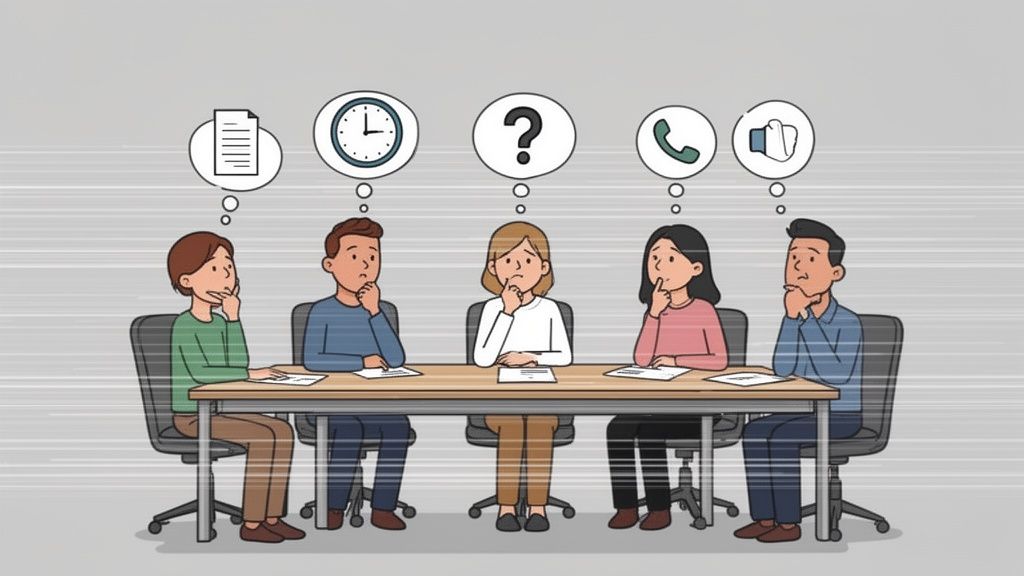
We’ve all been in that meeting. The one where a big new plan is announced, everyone nods, but you can practically see the question marks floating over their heads. A week later, you find out the sales team is promising a feature the engineers haven't even heard of.
This isn’t just a minor hiccup. It’s the quiet, grinding friction that wears down morale, wastes piles of money, and brings good ideas to a halt. We call it "communication problems in the workplace," but that's not quite right.
The problem isn't that people are bad at communicating. It's that we're asking them to do it in a hopelessly broken environment.
The True Cost of All That Noise
Think about the last time something went wrong at work. A missed deadline, a costly mistake, a frustrated customer. Chances are, if you trace it back far enough, you'll find a communication breakdown at its core.
A critical update on a new safety procedure gets buried in an email chain with 50 replies. The people on the floor who actually need it never see it. A simple, preventable mistake turns into a dangerous one.
Or how about the daily scramble just to figure out what's going on? Key conversations are splintered across emails, a few different chat apps, text messages, and that project management board no one really updates. It's organized chaos, and it’s exhausting for everyone.
This isn't just frustrating. It's a hidden tax on every single thing you're trying to do.
Let's Be Honest About the "Fixes"
Most advice for fixing communication is full of empty phrases like "improving synergy" or "fostering open dialogue." They sound nice in a presentation but rarely lead to real change. Why? Because the problem usually isn't about bad intentions. It’s about broken systems.
The single biggest problem in communication is the illusion that it has taken place. — George Bernard Shaw
This hits especially hard for companies with frontline workers—the people in your stores, on your delivery routes, or in your warehouses. They aren't sitting at a computer all day. Bombarding them with another email or adding them to yet another chat group just creates more noise. It doesn't actually connect them to the work.
If this sounds familiar, you can read more about the price of these gaps in our article on communication silos and how to break them.
The Real-World Damage
When communication fails, the ripple effects are felt everywhere. This isn't just about misunderstandings; it's about measurable damage.
A recent study found that miscommunication costs U.S. businesses a staggering $1.2 trillion every single year. That's not some abstract number. It shows up as:
Wasted Hours: Team members spend an unbelievable amount of time just trying to find basic information that should be obvious.
Costly Rework: Projects get redone from scratch because the initial instructions were vague, misinterpreted, or never reached the right people.
Sinking Morale: When people feel confused, ignored, or constantly out of the loop, they lose their motivation. Eventually, they just stop caring.
Safety Risks: For many businesses, a missed message isn't an inconvenience—it's a real hazard.
This is not a "soft skill" problem. It's a fundamental operational failure. The way your team shares knowledge is as critical as your supply chain. Treating it like an afterthought is a recipe for frustration.
But here’s the good news. This is a solvable problem.
Why "Communicating More" Is Terrible Advice
We’ve all heard it. "We need to communicate more." "Let's foster open dialogue." It sounds great on a motivational poster, but let's be honest—it’s vague advice for a very real, structural problem. It’s like telling someone with a flat tire to just "drive better."
The uncomfortable truth is that most communication advice misses the point. The issue isn't a lack of effort. Your team isn't lazy or unwilling to talk. The problem is that the tools, habits, and systems we've cobbled together are fundamentally broken for the way we work today.
The Myth of "Better Communication"
"Good communication" has become a meaningless buzzword. We chase it with more meetings, longer emails, and yet another chat app, hoping that if we just throw more words at the problem, it'll magically fix itself. But all this does is crank up the noise and confusion.
The real reasons things break down are much deeper.
Take information silos. That's when the sales team has no idea the warehouse is buried under a massive backorder, so they keep making promises the company can't keep. It's not a personal failure; it's a system that puts up walls between departments, blocking the flow of critical information.
Let’s be honest: Communication isn’t just a soft skill. It’s a critical operational system. If the foundation is cracked, no amount of well-intentioned advice will fix it.
This disconnect causes a ripple effect of frustration. Customers get angry, salespeople feel foolish, and the warehouse team feels completely hung out to dry. Everyone is working hard, but they’re pulling in opposite directions because they’re all working from a different set of facts.
The Chaos of Too Many Tools
Then you have the sheer chaos of tool sprawl. The work schedule lives in one app. Team messages fly around in another. Company policies are buried in a shared drive that feels like a digital black hole. And those crucial project updates? They’re scattered across emails, text messages, and a project management tool.
This isn't a system; it's a digital junk drawer. We burn a shocking amount of our day just hunting for information that should be right there. This constant context-switching is mentally exhausting and a huge productivity killer. You can dig into some of the most common traps in our guide on the top employee communication mistakes and how to avoid them.
When information is everywhere, it’s effectively nowhere. It forces everyone to piece together their own version of the truth, which is a perfect recipe for misalignment.
The Leadership Disconnect
Finally, there’s the leadership gap. Management makes a big announcement in an all-hands meeting or sends a company-wide email. In their minds, they’ve communicated. But there's no simple, clear channel for frontline employees to ask questions, give feedback, or flag a problem they see coming.
The message is sent, but it lands in a void. This one-way street is a massive reason people disengage. Recent data shows that 22% of employees worldwide have left a job simply because they didn't feel trusted or heard. When people feel like their voice doesn't matter, they eventually stop trying to use it. You can explore more about how vital communication is for retention on High5Test.
If we really want to fix this stuff, we have to stop blaming people and start fixing the broken systems they’re forced to use. It’s not about talking more; it's about building a smarter, simpler place to work.
Let's Name the Problems
Communication issues rarely show up as one big, dramatic failure. It’s more like a slow leak—a series of small, nagging frustrations that quietly drain your team's energy and focus. You feel the effects long before you can name the cause.
Let's be real. When things fall through the cracks, it’s not because someone just forgot to send an email. The real problems are baked into our work structures and tend to follow a few familiar patterns.
The first step to fixing anything is knowing what you're dealing with. So, let’s give these problems a name.
The Echo Chamber
This is the classic information silo, and it's a productivity killer. It happens when a team becomes so focused on its own goals that critical information never makes it out of the room. Think of the marketing team launching a massive promotion, only for the customer support crew to find out when a flood of confused customers starts calling. It’s a structural failure.
Information gets trapped, bouncing around inside a single department, but it never reaches the other people who desperately need it. The result? Duplicated work, conflicting priorities, and that nagging feeling of being caught off guard.
The Message Graveyard
You know this one. A critical update—a new safety protocol, a major policy change—is carefully written and sent out. And then… crickets. It dies a quiet death, buried in a noisy channel.
Maybe it was a company-wide email that got lost between a dozen other "urgent" alerts. Or a post in a chat channel that was immediately pushed out of view by a stream of GIFs.
When every channel is treated as the right channel for every message, the important stuff is forced to compete with the trivial. The trivial almost always wins.
The message was sent, but it was never truly received. This isn't your team's fault for not paying attention; it's a system failure. You’ve sent a vital signal into a sea of static and hoped for the best.
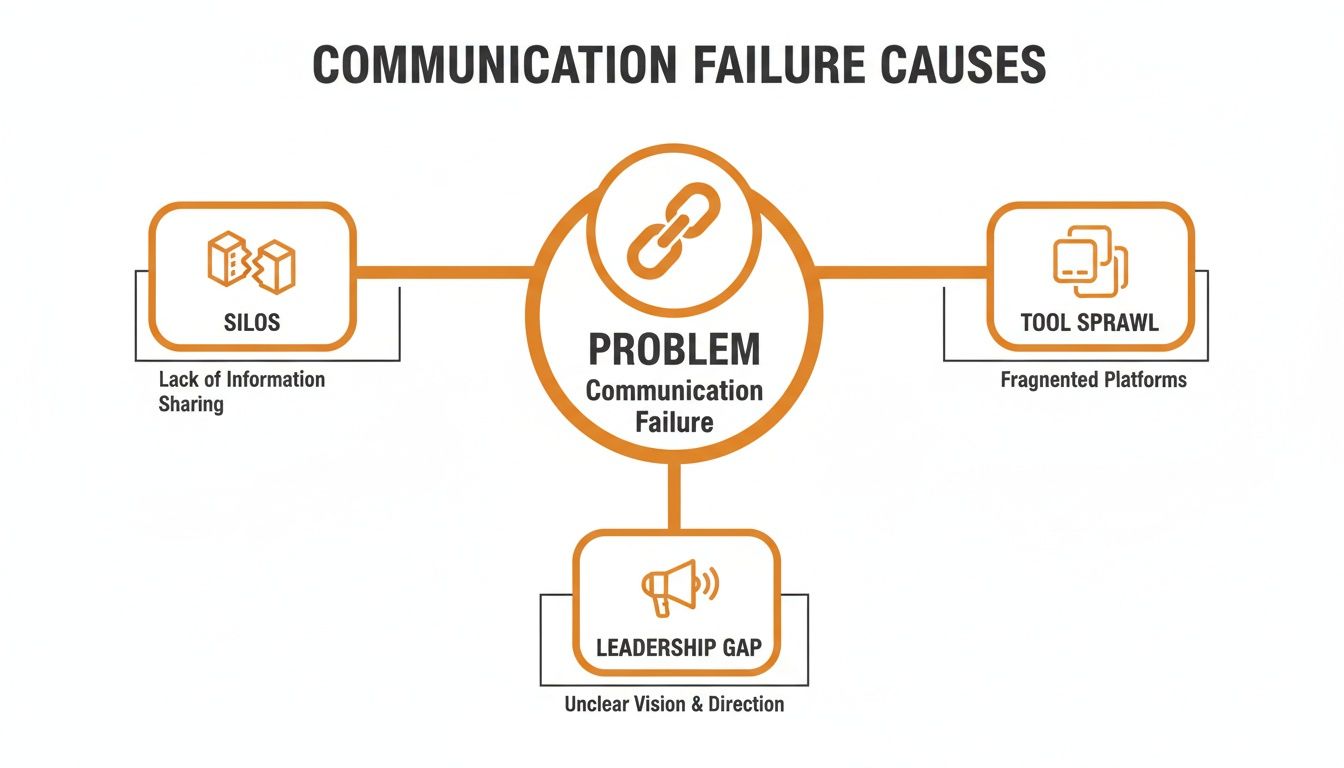
As you can see, these aren't isolated incidents. They’re interconnected problems that all stem from a shaky foundation.
The Translation Gap
This one is subtle but incredibly damaging. It’s the gap between leadership’s high-level vision and the day-to-day tasks your frontline teams perform. The CEO might talk about "innovating the customer experience," but the person on the shop floor has no idea what that means for how they should handle a product return.
Big ideas don't automatically translate into action. Imagine a delivery driver still using an old, inefficient route because the memo about the new process was written in corporate-speak that made zero sense for their reality.
Without a clear bridge connecting strategy to execution, employees are left to guess. They fill in the blanks, which leads to inconsistent work and a brilliant strategy that never really leaves the boardroom.
The Feedback Void
And finally, we have the feedback void. This is what happens when there's no simple, obvious, or safe way for people to ask questions, share ideas, or flag concerns. It’s not that your employees have nothing to say—it’s that the path to saying it is either confusing or intimidating.
When a warehouse worker spots a potential safety hazard, do they know exactly who to tell and how? If the answer is no, most people will take the path of least resistance: silence. Over time, that silence is corrosive. You miss out on priceless insights from the people who know the work best, and you create a culture where people feel like their voice doesn't matter.
Identifying Your Gaps
So, how do you know which of these issues is plaguing your team? Sometimes, the symptoms are easier to spot than the root cause. Use this quick table to match what you’re seeing with the likely problem behind it.
Symptom You're Seeing | What It's Likely a Sign Of |
|---|---|
Teams are duplicating work or working at cross-purposes. | The Echo Chamber (Silos) |
Important announcements get missed or ignored. | The Message Graveyard (Information Overload) |
Employees seem disconnected from company goals. | The Translation Gap (Strategy vs. Execution) |
You rarely hear new ideas or concerns from frontline staff. | The Feedback Void (Lack of Upward Channels) |
"I didn't know about that" is a common excuse. | The Echo Chamber or The Message Graveyard |
Morale is low, and employees seem disengaged. | The Feedback Void or The Translation Gap |
Once you can put a name to the problem, you're no longer fighting in the dark. You can start building a smarter way to work.
How Disconnected Teams Hurt Your Business
So, we've put a name to the frustrations—the echo chambers, the message graveyards. But let's connect those dots to what really matters: the bottom line. This isn't about office harmony. It's about the very real, often painful, costs that show up on your balance sheet.
When messages get dropped and teams aren't on the same page, the consequences are sharp. It's the small papercuts that, over time, add up to a major wound. It's the daily friction that grinds perfectly good plans to a halt.
Let’s be honest. This is about the operational health of your company.
The Hidden Tax on Everything
Think of it like a construction project. A change is made to the blueprint, but that update never makes it to the crew on site. They spend a week building something that has to be torn down and redone. That’s not just a delay; it's thousands of dollars in wasted labor and materials, all because of one broken link in the communication chain.
Or picture a busy hospital. An unclear shift handover note creates a moment of confusion about a patient's medication. Best-case scenario? A delay and a lot of stress. Worst case? A serious safety risk.
These aren't hypotheticals. They happen every day, in every industry.
When communication fails, it’s rarely a loud explosion. It's a slow leak, silently draining resources, time, and trust.
The costs pop up in painful ways. Wasted hours hunting for information. Duplicated effort where two teams unknowingly solve the same problem. And the slow, corrosive dip in morale when people feel perpetually out of the loop.
A Failure by the Numbers
This isn't just a hunch. The data paints a stark picture. An almost unbelievable 86% of employees and executives point to a lack of effective collaboration and communication as the main cause of workplace failures.
Let that sink in. Nearly nine out of ten major breakdowns—botched projects, missed deadlines, customer service fiascos—can be traced back to unclear instructions or siloed teams. The same research shows that leaders see project timelines extended by 37% and direct financial hits in 32% of cases, all due to miscommunication. You can dig into more of these eye-opening communication statistics on ElectroIQ.
This tells us that communication isn't a soft skill; it’s a core operational competency. It’s the central nervous system of your business. When it’s faulty, the whole body suffers.
Beyond the Bottom Line
But the damage goes deeper than just numbers. When communication is consistently broken, it erodes trust.
Employees start to assume they don't have the full story. They become hesitant to take initiative, fearing they might be acting on outdated information. Innovation stalls because no one feels confident enough to share a new idea.
This is the true, long-term cost. It doesn't just make work inefficient; it makes it frustrating. It replaces clarity with confusion and confidence with doubt. And no business can thrive for long in that kind of environment.
There's a Better Way to Work
We’ve spent enough time staring at the problems. The echo chambers, the message graveyards, the sheer frustration. So, let's talk about a real fix.
Here’s the thing: the answer isn’t another mandatory workshop or a stricter email policy. Those are just band-aids. The real solution is to change the environment itself. It’s about creating a single, calm place where communication and work happen together.
This isn’t about adding yet another tool. It’s about replacing the chaotic jumble of apps with an organized system designed for how teams, especially frontline teams, actually operate.
The Power of a Single Workspace
Imagine a dedicated digital 'Space' for a restaurant's morning shift. The manager posts the daily prep list, cooks tap to confirm tasks, and servers see real-time updates on menu changes—all in one place, on their phones. No more frantic group texts or notes taped to a wall.
This is what we mean by creating clarity by design. It’s a practical shift. You stop forcing people to hunt for information and instead bring the right information directly to them, in a context that makes sense for their job.
Here’s a glimpse of how a unified space can cut through the noise.
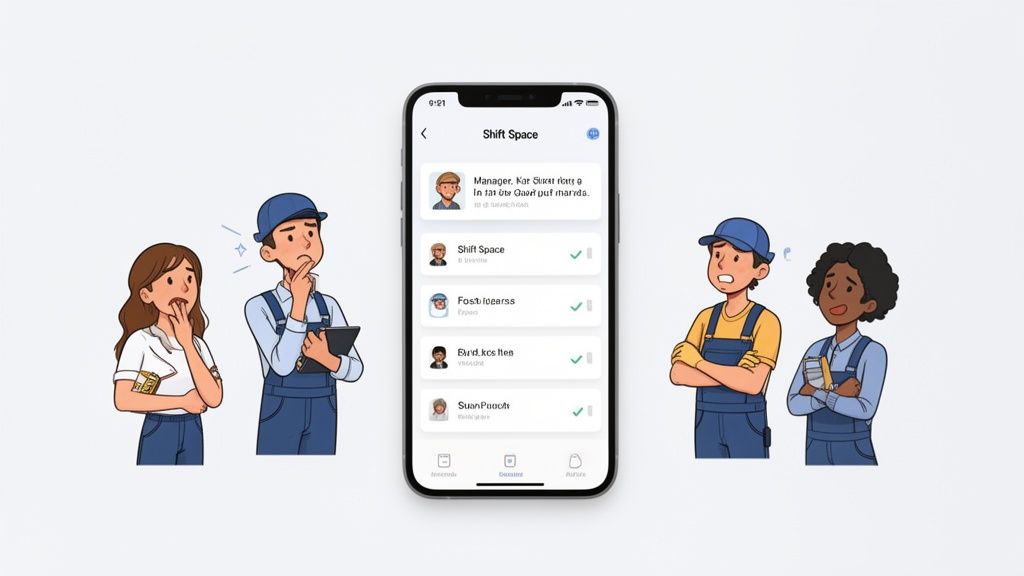
What you're seeing isn't just another chat app. It's an organized hub where conversations, tasks, and announcements live together, making work visible and accessible.
When everything is in one place, you eliminate the guesswork. You reduce the chances of someone acting on outdated information because there’s only one source of truth. This is the foundation for solving communication problems in the workplace.
From Chaos to Cohesion
This approach fundamentally changes how work feels. Instead of information being something you have to chase, it becomes part of the environment.
For a warehouse team: The supervisor can post a safety alert that requires every team member to acknowledge they’ve read it. No more ambiguity.
For a retail chain: A new visual merchandising guide can be shared instantly across all locations, complete with photos and a Q&A thread. Consistency is no longer a struggle.
For a healthcare clinic: Shift schedules, patient handover notes, and urgent updates can all live in a dedicated space for nurses, ensuring continuity of care.
Let’s be honest. When you remove the friction and noise, you do more than improve efficiency. You build trust. People feel more connected to the mission and more confident in their work because they know they have the information they need.
To address these issues proactively, consider integrating sound corporate communications best practices into your operational framework.
The goal is to create a system where clear communication is the path of least resistance. It’s not about forcing people to be better communicators; it's about giving them a better place to communicate.
From Noise to Clarity
So, where do you go from here? We’ve seen the problems and the real damage they cause. Now it's time to bring it all together.
Fixing deep-rooted communication issues isn't about finding a magic script. It’s about making a fundamental change to the environment where work gets done. It’s about giving every single person—from the CEO to the newest hire on the factory floor—a clear voice and a direct line to the information they need.
The goal is simple: to get from a state of constant static to one of genuine confidence.
The Real Shift Isn't a Tool, It's an Environment
Let’s be honest. Throwing another app at your team won’t fix a broken culture. But creating the right environment can. The shift we're talking about is moving from a jumble of disconnected tools to a single, organized hub where conversations, tasks, and company news all live together.
This goes beyond just sending messages more efficiently. It’s about building a system where alignment happens naturally. When the daily schedule, an urgent safety alert, and the new project brief all exist in the same logical space, you lighten the mental load on your team. People stop wasting time hunting for information and can dedicate that energy to doing their best work.
The ultimate question isn't just about how your team talks. It's about where they talk—and whether that place is helping or hurting them.
When that "where" is a unified platform, it does more than just pass information along. It reinforces your culture with every interaction. It shows your team that their work is connected, their voice is heard, and their contribution matters. That's how you build trust.
Clarity, Confidence, and a Simpler Way to Work
Picture a workplace where a frontline employee can ask a question and get a straight answer without navigating a confusing chain of command. A place where a manager can feel certain that a critical update has been seen and acknowledged by everyone who needed to see it.
This level of clarity isn't a fantasy. It’s the direct result of creating a single source of truth—one reliable place for everything that matters. The right platform doesn't just put out communication fires; it prevents them from starting.
It builds alignment by making work visible. It strengthens culture by connecting people across shifts and locations. Most importantly, it makes work simpler and more focused for everyone. It replaces the noise of a dozen apps with the calm confidence that comes from knowing exactly where to look.
Frequently Asked Questions
What Is the Single Biggest Sign of Communication Problems in the Workplace?
It's the gap between what leadership thinks is happening and what the frontline team is actually experiencing. When executives feel confident that information is flowing smoothly, but your people on the floor feel disconnected and unheard, you have a critical breakdown.
You can see it in recurring mistakes, high turnover in certain departments, and a general sense of low morale that no one can quite put their finger on.
How Can We Improve Communication Without Expensive Training?
Let's be real—training often falls flat if the systems people use every day are broken. The most practical fix is to simplify your communication infrastructure.
Instead of forcing your team to jump between multiple, disconnected apps for chat, schedules, and policies, bring it all into a single, unified platform. This creates one source of truth and removes the digital friction that causes miscommunication. It’s less about teaching new skills and more about giving everyone a simple, intuitive place where clear communication happens naturally.
How Do You Keep Desk-Based and Frontline Workers in Sync?
This is where most traditional tools fail. The secret is a mobile-first platform that is just as easy and useful for someone on their feet as it is for someone at a desk.
The goal is to close the gap between headquarters and the front lines, making everyone feel like part of the same team, regardless of their role or location.
Think about dedicated team channels, a company-wide news feed everyone can see, and integrated task management. This kind of setup ensures everyone gets the same critical information at the same time. It stops feeling like two different companies operating under one roof.
Ready to replace the static with clarity? Pebb unifies your team's communication, operations, and engagement in one simple, powerful app. See how you can build a more connected workplace.
