
Scheduling Conflicts: How to Prevent and Resolve Them
Scheduling conflicts drain morale and cost companies millions. Learn the real causes, practical fixes, and tools that help managers keep teams in sync.
Dan Robin

You check the schedule before the day gets busy. Two people are assigned to the same shift. Someone changed a start time in a private message. A hybrid team has one meeting, two teams, and no available room. By midmorning, you're apologizing to employees, moving appointments, and trying to work out who knew about the change.
That isn't a calendar glitch. It's an operations problem.
Scheduling conflicts happen when people, shifts, rooms, meetings, availability, and time off aren't visible in the same system. The fix isn't asking everyone to “communicate better.” It's creating clear rules, publishing changes properly, and giving managers and employees one reliable view of what's happening.
The Cost of Scheduling Conflicts
A shift swap approved in a chat can leave the roster unchanged. A meeting moved on one calendar may still appear at its original time for people working remotely. A supervisor may solve one coverage problem while creating another because the latest information sits in separate calendars, group chats, spreadsheets, and memory.
The visible issue is an overlap. The operational cost starts earlier, when managers cannot see which people, rooms, shifts, locations, and approvals are connected.
Practical rule: If a schedule change is not recorded where affected employees already look for work information, it has not been communicated.
The consequences reach beyond a missed appointment:
Lost time: Managers chase confirmations instead of planning. Employees wait for answers, travel to the wrong place, or repeat work after a meeting breaks down.
Coverage risk: A shift can look staffed while the assigned employee is unavailable, lacks the required training, or has another commitment.
Compliance exposure: Notice requirements and fair-workweek rules can make scheduling practices a legal concern, not merely an internal inconvenience.
Trust erosion: Employees notice who receives flexibility and who repeatedly absorbs last-minute changes.
Customer impact: Late openings, missed handoffs, and thin service coverage eventually affect customers.
The human cost is different across teams. Frontline employees may have to rearrange transport, caregiving, rest, or another job when hours change. Office employees may lose focused work time to avoidable meeting collisions. Hybrid teams also compete for rooms, in-office days, and the physical presence of a person needed to make a decision.
A unified tool such as Pebb can close part of this visibility gap by giving employees and managers one place to see schedules, updates, and relevant team information. The tool does not resolve unclear ownership or unreasonable notice by itself. It does make the current plan easier to find, confirm, and update.
That distinction matters. A reliable process must track people and resources together. Before approving a change, managers need answers to four practical questions: who is expected to attend, where will they be, what changed, and who has confirmed it?
When those answers are scattered, a small conflict consumes supervisory time and shifts uncertainty onto employees. When they are visible in one shared view, the team can address the conflict before it becomes a missed shift, an empty room, or a customer-facing failure.
What Causes Scheduling Conflicts
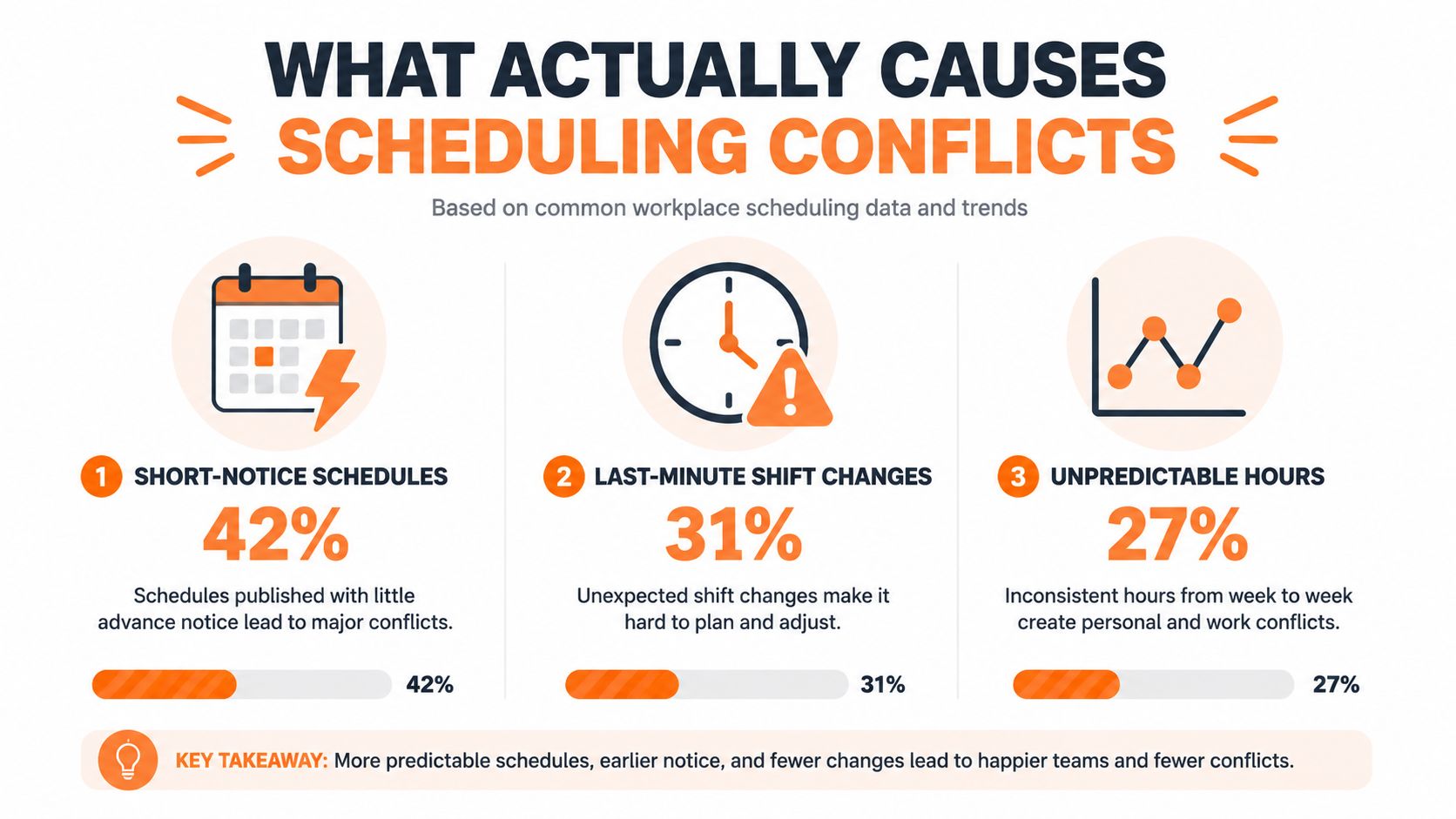
Scheduling conflicts usually begin with a visibility gap. One person has the newest information, while everyone else is still working from an older plan. On a busy floor, that difference can turn a routine shift adjustment into a missed handoff or an uncovered position.
For frontline teams, short notice is a common starting point. A large U.S. scheduling study of 30,000 employees across 120 major retail and food-service firms found that two-thirds of workers received less than two weeks' notice of their schedules, and half of those workers received less than one week's notice. The same study reported that 14% experienced at least one canceled shift in the previous month, while 70% had at least one shift-timing change during that month, according to the large U.S. scheduling study.
Workers build transport, childcare, education, second jobs, and appointments around expected hours. A late change transfers the disruption to the employee, even when the original schedule was the plan they had arranged their life around.
Three root causes worth checking
Short-notice schedules leave little time to identify a clash. Publishing a schedule does not give employees a usable opportunity to review it unless they can find it, understand it, and raise an issue promptly.
Last-minute changes create competing records. A manager may treat a direct message as authoritative, while an employee relies on the posted schedule. Both can act reasonably and still arrive at different conclusions.
Unpredictable hours make availability difficult to interpret. Someone may appear free on a calendar but still be unable to accept a newly added shift or stay late because of commitments arranged around the expected hours.
Office and hybrid teams face the same visibility problem in another form. A 2026 study of more than 500 employees and workplace operations professionals in the U.S. and Canada found employees could lose up to 10.5% of their workweek finding meeting space, aligning in-office days, and resolving conflicting schedules. The researchers estimated about $9 million in annual cost for an average midsized company, as reported in the hybrid scheduling cost analysis.
Meeting coordination is operational work, not background administration. If teams cannot see where colleagues will work, which rooms are available, or who must attend, managers spend time locating people and resources instead of making decisions. The same issue appears in quarterly planning, where guidance on resource allocation during quarterly planning helps teams surface constraints before commitments harden. A unified tool such as Pebb can place schedules, updates, and team information in one shared view, making changes easier to find and confirm.
How Scheduling Conflicts Damage Operations and Morale
Unstable schedules create practical harm first. Workers arrive late, miss shifts, ask for emergency changes, or turn down hours they can't safely fit into their lives. Managers then interpret the outcome as an attendance problem, even when the scheduling process helped cause it.
Research on inconsistent work schedules found them in about 10.7 million shifts, or 37% of all shifts analyzed, while lateness or absenteeism appeared in about 4.6 million shifts, or 16%. The same research showed that changing a shift to a day the worker hadn't worked the prior week raised the probability of lateness by at least ten minutes by 12.1 percentage points, and raised the probability of absenteeism by 7.4 percentage points, according to the research on inconsistent schedules and attendance.
The lesson is straightforward. A missed shift isn't always a careless employee failing to plan. Sometimes the organization changed the conditions that made reliable attendance possible.
Frontline workers carry the sharpest edge
A 2025 Gallup-backed U.S. study of 15,968 employed workers found that 27% reported schedule unpredictability, 28% reported schedule instability, and 41% said they had little or no control over their schedules. More than half of workers with low-quality schedules, 57%, said work often or sometimes conflicted with personal life, compared with 39% of workers with high-quality schedules, according to the study of schedule quality and work-life conflict.
Those findings change how a manager should respond. The question isn't only whether someone can cover a shift. It's whether the business has built a process that gives people enough stability to plan their lives and enough control to flag genuine constraints.
For office teams, the damage looks different but follows the same path. A room conflict delays a meeting. A missing participant pushes a decision into another week. Repeated changes teach employees that calendar commitments are provisional, so they keep backup plans and stop trusting the official schedule.
Compliance is part of the operating model
Several fair-workweek laws cover sectors such as retail, food service, cleaning, hospitality, and warehousing. These laws require employers in covered settings to provide schedules at least 14 days in advance, and some rules trigger pay penalties when employers miss that window, as explained in the Schedules That Work Act summary.
San Francisco's rule requires employers to provide at least two weeks' notice of work schedules. Employers can post the schedule in a visible workplace location or send it electronically, provided employees can access it at work, according to the San Francisco scheduling rule.
Philadelphia goes further for covered retail, hospitality, and food-service employers. At hire, the employer must provide a written good-faith estimate covering expected average weekly hours over a typical 90-day period, whether on-call shifts are expected, and a subset of days or shifts the worker can typically expect, as described in the Philadelphia fair workweek law overview.
Good scheduling protects more than compliance. It protects the relationship between the person assigning work and the people expected to deliver it. Managers dealing with mobile teams can also find useful operational thinking in these practical strategies for hauliers, especially around coordination, handoffs, and keeping changes visible. Communication failures deserve direct attention too, and the issues described in workplace communication problems often surface first through missed or misunderstood schedule changes.
A Step-by-Step Process for Resolving Scheduling Conflicts
A conflict rarely ends with filling one empty slot. If the same person is repeatedly asked to give up personal plans, the team learns that availability rules can be ignored. Resolve the immediate gap while protecting trust and future coverage.
First, define the problem. It may be a double-booked employee, an uncovered shift, a room clash, a last-minute call-out, or an update that never reached the people affected. The category determines which records and constraints require review.
Four actions that keep the response calm
Identify the exact collision. Record the people involved, shift or meeting, location, start and end times, and source of the latest change. Do not rely on a verbal summary. Small details determine whether a swap is workable.
Check coverage and availability. Review approved time off, current assignments, required skills, location, rest constraints, and recorded availability. Someone who appears free may lack the right qualification or may be unable to reach the site.
Offer options, not pressure. For a shift, ask whether a qualified colleague wants to swap or cover. For a meeting, consider another room, a remote participant, a shorter session, or an asynchronous update. Explain the trade-off and give affected people space to respond.
Communicate and confirm. Send one clear update to everyone affected. State what changed, who owns the work, where the current schedule is stored, and what confirmation is required. Update the official record immediately, not after the shift begins.
Use a short message that leaves little room for confusion:
Conflict update: The Tuesday closing shift is now assigned to Jordan, with Priya's swap approved. The schedule has been updated. Please reply in the team channel if any coverage detail is still unclear.
Close the loop afterward
Record the cause once the conflict is resolved. If a swap began in private chat, require approval and a recorded schedule update for future trades. If a meeting room was double-booked, assign ownership for room coordination and identify the system where reservations must be made.
Managers handling restaurant or café coverage can review these shift-swapping apps for restaurant and café managers. A unified workspace such as Pebb can keep chat, updates, and shift scheduling in one flow, reducing the chance that a manager or frontline employee must search across disconnected tools to find the latest change.
Preventative Scheduling Strategies and Policies
Prevention starts with a published schedule people can trust. That means setting a clear deadline for managers, a clear review window for employees, and a clear process for changes after publication.
A policy doesn't need to be complicated. It needs to answer the questions employees ask when a schedule changes: Who can change it? How much notice should people receive? Where will the update appear? Who approves a swap? What happens when the business has an emergency?
Build predictability into the policy
Set the notice standard before the scheduling pressure arrives. In covered sectors and locations, the standard may need to meet fair-workweek requirements, including the 14-day notice rules described earlier. Even where a specific law doesn't apply, predictable notice gives employees a fair chance to identify conflicts before the schedule becomes operational.
At hiring, document the expected pattern clearly. Philadelphia's requirement for a written good-faith estimate is a useful model because it makes expected hours, likely days or shifts, and on-call expectations visible from the beginning.
Then create a change protocol:
Use one official record: A private message can alert a manager, but it shouldn't replace the posted schedule.
Require approval for swaps: Employees can propose trades, while managers confirm qualifications and coverage.
Record time off early: PTO and availability should be visible before assignments are made.
Set an escalation path: Employees should know who to contact when a conflict appears outside normal hours.
Review recurring collisions: Repeated conflicts usually point to a staffing, timing, or communication rule that needs adjustment.

Choose tools that match the work
A shared calendar can help office teams see meetings and room bookings. Frontline teams need more than calendar visibility. They need mobile access, shift assignments, availability, swap requests, clock-in information, and time-off records in a workflow people can use away from a desk.
Pebb brings those functions into configurable Spaces, where teams can manage conversations, updates, events, shifts, clock-in, and PTO tracking. It can be considered alongside other scheduling tools, but the important test is practical: can an employee see the current schedule, ask for a change, and know whether the request was approved without checking several systems?
Managers looking for a practical framework can also use this guide to create a staff shift schedule that works. The best process is the one people follow under pressure. A perfect policy that lives in a document no one checks won't prevent a conflict.
Real-World Examples and Manager Scripts
A retail manager notices that a cashier's shift has moved from the afternoon to the morning. The change solved a store coverage gap, but the employee has already arranged transport for the original time. The manager shouldn't write, “Can you make the new shift?” That turns a planning problem into a personal favor.
A better message is direct:
Schedule change: I moved your shift from the afternoon to the morning because we have a coverage gap. I realize this is a change from the posted schedule. Can you confirm whether the new time works? If not, tell me by the stated deadline and I'll check qualified coverage before finalizing anything.
The message acknowledges the change, explains why it happened, and gives the employee a fair way to respond. It doesn't pretend that a last-minute adjustment is harmless.

A hospitality supervisor may receive a call-out shortly before service. The useful response is not a string of private messages sent to whoever usually says yes. It's a visible request with the key facts:
Shift: Closing service, today
Requirement: Closing-trained employee
Action requested: Reply if you can cover
Approval: Supervisor confirms the final assignment
Record: Updated schedule is the official version
The confirmation should be equally plain:
Coverage confirmed: Alex will cover the closing shift today. Morgan's absence is recorded, and the schedule has been updated. Please use this thread for any further coverage issue.
Hybrid teams need similar discipline. If two groups need the same room, the team lead can say:
Room conflict: Product and Support both need Cedar Room for the same meeting time. Product will use the room, and Support will join remotely from the existing invite. I've updated the room booking and meeting details. Please check the revised invite before joining.
That last sentence matters. People need to know which record changed and what action they should take.
Private chat still has a place for sensitive conversations. Group chat works for coordination. Updates and a heartbeat-style news feed help distribute broader changes. The operating rule is simple: use private messages for context, then place the decision where the whole affected team can find it.
Rethinking Scheduling as a Culture and Operations Issue
Scheduling tells employees what the organization values. A schedule published early says their time matters. A visible change process says managers take responsibility for disruption. A fair swap policy says flexibility belongs to the team, not only to the people with the loudest voice or the strongest relationship with a supervisor.
That culture is built through small operating choices. Employees need to know which schedule is official, how availability is recorded, who approves changes, and what happens when the plan no longer fits reality. Managers need a way to act quickly without creating a second, unofficial system.
The strongest scheduling process combines three things:
Predictability: People receive usable notice and understand the expected pattern of work.
Visibility: Employees and managers can see shifts, meetings, locations, time off, and changes in one trusted place.
Accountability: Someone owns the decision, communicates it clearly, and updates the record.
Scheduling conflicts won't disappear. Service demand changes, people get sick, meetings run long, and rooms fill up. But a mature operation doesn't confuse unavoidable change with avoidable confusion.
Ask yourself what your team has to do today to find the truth about tomorrow's schedule. If the answer involves searching several apps, asking several managers, or trusting a message that may not be current, the problem isn't employee effort. The system needs work.
Pebb brings chat, updates, Spaces, shift scheduling, clock-in, and PTO tracking into one connected workplace for frontline, office, and hybrid teams. Visit Pebb to see how a shared operational home can make schedule changes visible, manageable, and easier to trust.
