
A Sample Employee Development Plan That Actually Works
Ditch the templates. Get a sample employee development plan built on real conversations. Learn how to set goals, track progress, and help your team grow.
Dan Robin

Many organizations already have a sample employee development plan somewhere. It's buried in a shared drive, attached to a review form, or trapped in HR software nobody opens unless they have to. The sad part isn't that the template exists. The sad part is that everyone knows it won't change much.
I've seen plans written with polished language and good intentions, then ignored the moment the meeting ends. The employee goes back to work. The manager gets pulled into other fires. Three months later, nobody remembers what “build executive presence” was supposed to mean.
That's why the useful question isn't “What template should we use?” It's “What kind of conversation are we willing to keep having?”
More Than a Document
Two people sit down for a development conversation. One treats it like a form to finish before lunch. The other hopes it might lead to better work, more support, or a real next step. The outcome usually depends on which of those mindsets wins.
Plans fail when they become administrative artifacts instead of shared commitments. I have seen polished forms with neat language go nowhere because nobody translated them into daily work. I have also seen a rough three-line note change someone's trajectory because the manager kept returning to it, asked better questions, and made time to practice.
A good sample employee development plan does one job well. It gives a manager and employee a simple record of an honest conversation they plan to keep having. If you want examples that stay grounded in real roles instead of generic HR language, this collection of employee development plan examples for managers is a better starting point than a downloadable blank template.
Why the old version breaks
The usual plan falls apart in predictable ways.
It names traits instead of work. “Improve leadership” sounds respectable. It gives nobody a clear behavior to practice on Tuesday.
It lives on the annual review calendar. Development happens in the flow of work, during handoffs, one-on-ones, customer issues, project resets, and feedback after something went wrong.
It mistakes length for rigor. A longer form can look serious while hiding the core question. What should this person get better at next, and how will you help?
The better structure is simple. Start with current strengths and gaps. Name one meaningful development goal. Add a few actions, a few signs of progress, and a review rhythm people can maintain. The review cadence matters because growth slips fast when nobody owns the follow-up.
A plan you revisit beats a perfect plan you archive.
What to use instead
The plan works best as a short written record of an ongoing coaching relationship. That is the entire concept.
Keep the conversation anchored to a small set of questions that expose whether the plan is real or decorative:
Question | What it reveals |
|---|---|
What skill or capability matters most right now? | Focus |
Why does it matter to this person and this team? | Relevance |
What will they do to build it? | Action |
How will both of you know it's working? | Evidence |
When will you talk again? | Accountability |
Good frameworks help because they keep the conversation tied to role reality, not aspiration alone. The Acheloa Wellness executive framework does that well. It treats career planning as a sequence of deliberate choices and manager conversations, which is closer to how development works.
A development plan is the handle on the work. The work is the coaching, the practice, and the follow-through.
The Only Employee Development Plan Sample You Need
Let's use a real-world example instead of another sterile template.
Say you manage Maria, a retail team lead. She's reliable, customers like her, and newer staff copy her habits. You can also see the next step for her. She could move into a store operations role if she gets better at shift handoffs, delegation, and coaching under pressure.
That's enough to start. Not a giant competency matrix. Just a clear observation and an honest conversation.
Here's the visual version of the simple plan.
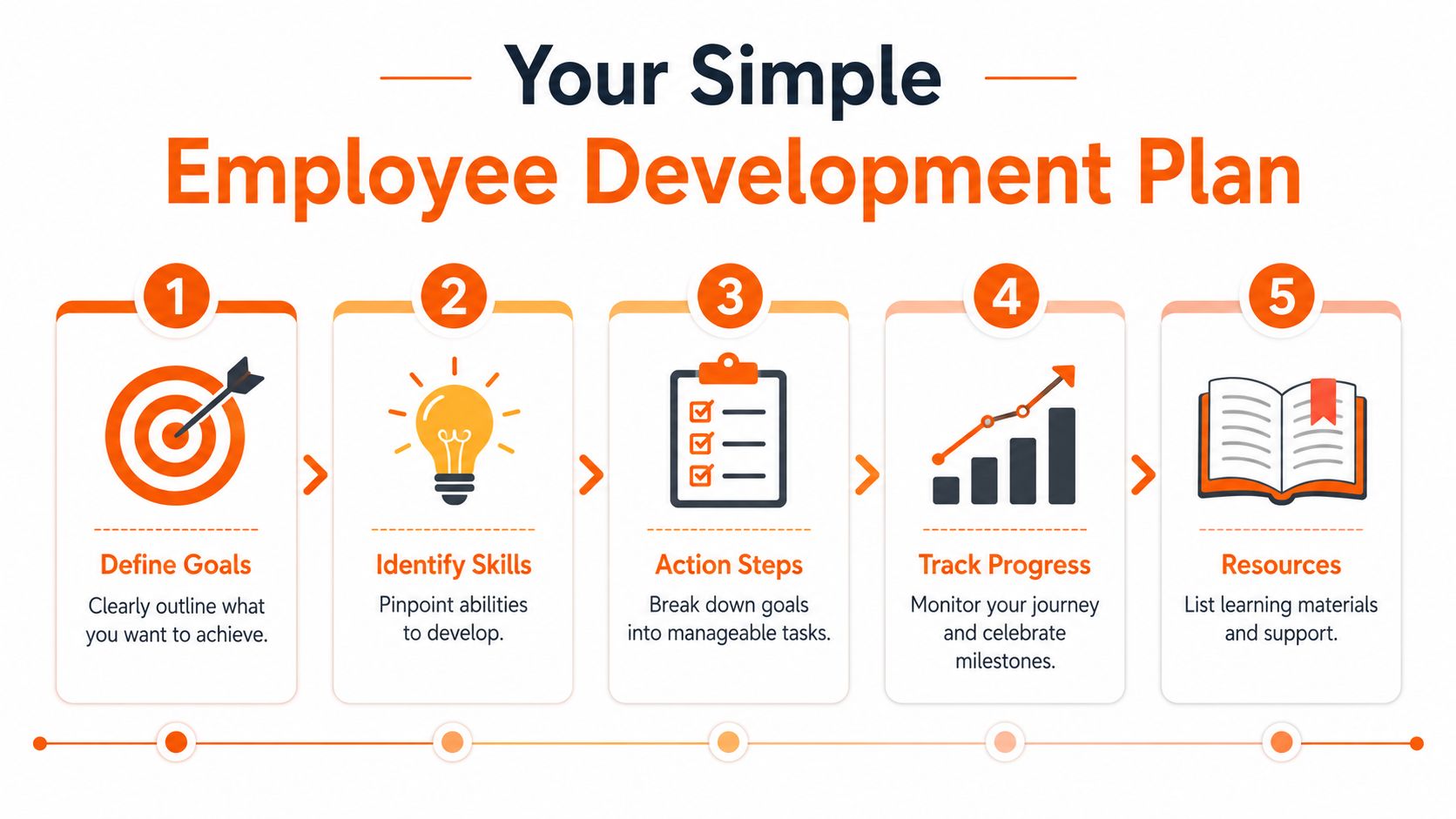
Maria's plan in plain English
The plan has only three parts. Goal. Measures. Actions.
First, the goal.
Maria doesn't need a goal like “develop leadership skills.” She needs something tied to the work in front of her. In her case, the goal might be to become strong enough at running smooth shifts and coaching teammates that she's ready for broader store operations responsibility.
Second, the measures.
Most plans frequently become unclear. You need signs that progress is real. For Maria, that might include cleaner shift transitions, fewer avoidable mistakes during handoff, stronger feedback from her manager after she leads busy periods, and visible improvement in how she delegates tasks to newer associates. Keep the measures close to the job. If the work changes, the plan can change with it.
Third, the actions.
Maria shadows the assistant store manager during opening and closing routines. She leads one shift huddle each week. She creates a simple handoff checklist and tests it for a month. Her manager watches one handoff per week and gives direct feedback afterward. They meet monthly to talk through what's improving and what still feels messy.
That's a sample employee development plan. Short. Concrete. Alive.
Why this works better than a generic template
The best plans follow a skills-gap workflow. Start with role needs, compare them to current capability, then turn the gap into SMART goals, milestones, and a review rhythm. That sequence matters even more now because the World Economic Forum projects that 44% of workers' core skills are expected to change in the next few years, as cited in TMI's guide to building an employee development plan.
If you skip that workflow, you get generic training. Generic training feels productive because people completed something. It rarely solves the actual gap.
For more role-based formats, this collection of employee development plan examples is useful because it shows how the same structure can flex across different jobs.
The goal isn't to make the plan impressive. The goal is to make the next conversation easier and the next action obvious.
A sample you can adapt
If you want a simple starting point, use this shape:
Goal: Build one meaningful capability that matters to the role and the person's next step.
Measures: Choose a few signals from daily work that show the skill is showing up on the job.
Actions: Pick a small set of repeatable activities, not a giant learning catalog.
Support: Name what the manager will do, not just what the employee will do.
Review rhythm: Decide when you'll check in before the plan starts drifting.
That's enough for many teams. If your template needs a tutorial to understand, it's already too big.
From Sample to Specific Your Guide to SMART Goals
A manager writes, “Improve communication,” drops it into a template, and feels done. Three months later, nothing has changed because nobody ever agreed on what “better” would look like in the work itself.
That is how development plans turn into paperwork.
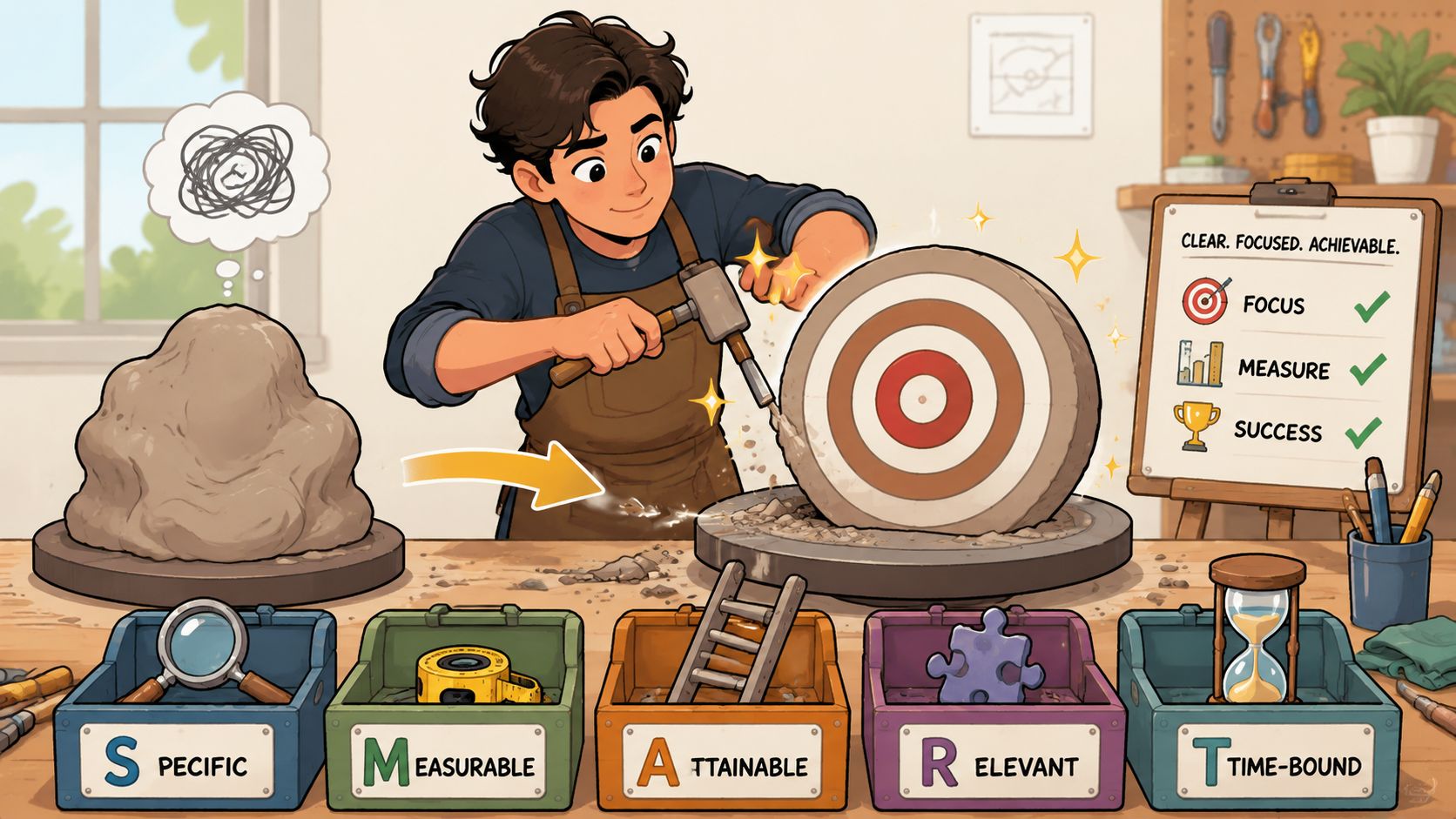
SMART goals help, but only if you use them to sharpen a real conversation. Used badly, SMART becomes box-ticking. Used well, it turns a generic sample employee development plan into something a manager can coach against and an employee can act on.
Translate SMART into plain English
Managers do not need a workshop on acronyms. They need five clear questions.
SMART part | Plain question |
|---|---|
Specific | What exactly needs to improve in the job? |
Measurable | What would we see if progress is real? |
Achievable | Is this realistic with the person's current scope and support? |
Relevant | Why does this matter now, for the team and for the employee? |
Time-bound | When should we expect evidence, not perfection? |
Relevant is usually the make-or-break piece.
If the goal matters only because the form requires a goal, it will sit untouched. If it connects to a problem the employee feels and a result the team needs, it has a chance. Good development planning is closer to good coaching than good administration.
Bad goal versus useful goal
Take Maria, a frontline employee who keeps running into trouble during shift handoffs.
“Get better at communication” is not a development goal. It is a label. It gives Maria no direction and gives her manager no clue what to watch, correct, or reinforce.
A useful goal sounds more like this: reduce customer issues caused by poor shift handoffs by consistently documenting open tasks and verbally flagging urgent issues at every shift change over the next 60 days.
Now the plan has something to work with. The manager can observe handoffs. Maria can practice a visible behavior. Both people know what progress should look like in real life, not in a spreadsheet.
You do not need legal language. You need enough precision that two people can discuss the same thing without guessing. For a straightforward refresher, SMART goals for better productivity is a practical read.
Practical rule: If the manager cannot name what they will observe in the next week, the goal is still too vague.
A simple way to tighten the goal
Here is the edit I make with managers all the time.
Start with the vague version. Then keep asking what that means in the work.
Vague: Improve leadership
Better: Lead the weekly operations huddle with a clear agenda
Stronger: Lead the weekly operations huddle for the next eight weeks, keep it under 20 minutes, assign owners for follow-ups, and send a same-day recap with decisions and next steps
That last version is not fancy. It is usable.
This matters even more if you are managing the plan in an app instead of a static document. A good system for goal setting and tracking in performance management keeps the goal tied to check-ins, notes, and progress signals, so the plan stays part of the working relationship instead of disappearing after the kickoff meeting.
Goals fail without a cadence
Even a well-written goal can drift if nobody revisits it.
The pattern is predictable. The employee starts with good intent. Work gets busy. The manager assumes development is still happening. By the time anyone checks, the plan has gone stale and both sides feel mildly guilty.
Keep the rhythm simple:
Quick check-ins: Talk about what happened while it is still fresh
Monthly review: Look for patterns across several weeks of work
Formal reset: Decide whether the goal is still right, needs to change, or has been met
That is the craft of it. Write a goal that describes a real behavior, tie it to a real business need, and revisit it often enough to keep it alive. A sample plan gives you the shape. The conversation makes it worth using.
Beyond Courses Choosing the Right Learning Activities
The default answer to almost every development need is still “send them to a course.” Sometimes that's right. Often it's lazy.
Courses are neat. They're easy to assign, easy to complete, and easy to report on. Real development is messier. It usually happens while someone is doing the work, missing a beat, getting feedback, and trying again.
What tends to work better
If the goal is behavior change, use activities that live close to the behavior.
Job shadowing: Best when someone needs to see judgment in action. Watching a strong operator handle a shift change or a difficult conversation teaches timing and nuance that slides never will.
Stretch assignments: Good when the person is almost ready and needs reps. Let them lead a meeting, own a small rollout, or coordinate a cross-shift handoff.
Mentoring: Useful when the gap is confidence, judgment, or context. A mentor can name patterns the employee can't yet see.
Deliberate practice: Strong for skills that improve through repetition. One hour a week focused on a specific behavior is often worth more than a day-long workshop.
Teach-back exercises: Ask the employee to read, observe, or learn something, then present the takeaways to the team. If they can explain it clearly, they've probably learned it.
Match the activity to the skill
Managers either help or waste everyone's time.
If someone needs technical knowledge, formal learning may make sense. If they need better delegation, conflict handling, or coaching, the best classroom is usually the shift, the project, or the team meeting. Pick the activity that fits the actual gap.
A practical way to think about it is this:
Skill gap | Better activity |
|---|---|
Judgment | Shadowing and debriefs |
Communication | Repeated live reps with feedback |
Leadership | Stretch ownership and mentoring |
Process discipline | Checklists, observation, repetition |
One more point matters. Personalized plans beat generic ones. Guidance summarized by AIHR notes that personalized development programs are associated with 15% higher retention, as reported in AIHR's employee development plan guide. That rings true because people can tell when a company is investing in their growth versus assigning off-the-shelf content.
A course can support a plan. It can't carry the whole thing.
Bringing the Plan to Life in an Employee App
A plan stored in a folder gets forgotten because it lives outside the work. If you want development to matter, it has to sit where people already communicate, assign tasks, and find information.
That changes the feel of the whole process. The plan stops being a yearly artifact and starts acting like a lightweight project.
Turn actions into visible work
Take Maria's plan. “Lead one shift huddle each week” should become a recurring task with an owner and due date. “Test handoff checklist” should live as an active item, not a note hidden in a review doc. “Manager observes and gives feedback” should be assigned too, because support work belongs on the manager's list.
This is the big mistake in many plans. Only the employee gets actions. Then the manager says they support development while doing nothing concrete.
A simple setup inside a work app should include:
Tasks with due dates: So action steps don't disappear into intention.
Shared notes or comments: So feedback can be attached to the actual work.
A resource hub: So the article, checklist, video, or SOP is easy to find.
Quick chat check-ins: So not every development conversation needs a formal meeting.
Keep resources close to the action
This matters more than people think.
If Maria is trying to improve handoffs, the checklist, examples, and store procedures should sit in the same system where she sees her tasks. If she has to hunt through email or an old shared drive, the friction kills momentum.
That's why teams often move this work into a unified employee platform. An all-in-one employee app makes development easier to manage because the actions, conversations, and reference materials can live in one place instead of being scattered across separate tools.
Development gets real when the next action is two taps away.
Use the app for small moments, not just formal reviews
A modern employee app is most useful between the big meetings.
A manager can send a quick message after a shift. “Your handoff was clearer today. Next time, slow down during the inventory note.” That kind of feedback is specific, timely, and easy to apply. It feels like coaching because it is coaching.
When the plan lives where work lives, follow-up stops feeling forced. It becomes part of the week.
The Rhythm of Review Why It Matters Most
This is the part that decides whether the plan matters.
Not the template. Not the wording. Not the kickoff meeting.
The rhythm.

Coaching beats judging
A healthy review rhythm doesn't feel like surveillance. It feels like two people paying attention.
Weekly or semi-weekly check-ins are for the immediate work. What happened? What got better? What felt awkward? What should we try next? Quarterly or biannual reviews are for stepping back and asking a different question. Is this still the right goal? Has the employee grown past it? Did we learn that the actual gap was something else?
That shift matters because development isn't linear. Someone may improve quickly in one area and stall in another. A rigid annual cycle misses that.
Measure transfer, not attendance
A lot of teams still measure the wrong thing. They ask whether the employee completed the course, attended the workshop, or checked the box.
Better questions are:
Are they using the skill on the job?
Is the work getting better because of it?
Can the manager describe the difference with examples?
Guidance summarized by AIHR, Growthspace, and Chronus points to tracking outcomes such as completion rates, manager approval, task performance improvement, improved task completion times, and customer satisfaction movement. The point is simple. Completion is not the finish line. Application is.
Why this matters beyond performance
This work affects retention too. A study cited by AIHR found that 76% of employees are more likely to stay with a company that offers ongoing training and development, according to AIHR's individual development plan examples.
That number doesn't surprise me. People stay where they can feel movement. Not promises. Movement.
The best sample employee development plan is the one that creates that feeling. It gives someone a path, gives their manager a role, and creates enough rhythm that growth doesn't depend on memory or good intentions. That's not flashy. It's just disciplined, human management.
If your team wants development plans to live in the same place as chat, tasks, knowledge, and day-to-day operations, Pebb is worth a look. It gives frontline and office teams one simple space to keep work visible, follow through on commitments, and make employee growth part of the weekly routine instead of an annual document.
