
Fair & Flexible Roster for Staff: Boost Morale
Stop fighting spreadsheets! Build a fair, flexible roster for staff that respects team time & boosts morale. A practical guide for managers.
Dan Robin

You probably know the moment.
It's Sunday night. The roster goes live. Ten minutes later, the messages start. Someone forgot they can't do the open. Someone else is asking why they got another weekend. A supervisor is trying to patch holes from a phone full of screenshots, while tomorrow's shift already feels short.
That is often treated as a scheduling problem. I don't. I think it's a culture problem wearing a scheduling hat.
A roster for staff tells people what kind of place they work in. It tells them whether managers plan ahead, whether fairness matters, whether personal constraints are taken seriously, and whether the business sees human beings or just empty boxes that need names. That's why bad rosters don't just create admin pain. They create resentment. Subtly at first, then all at once.
The Sunday Scramble Is a Symptom Not the Disease
I've seen plenty of teams blame the wrong thing. They blame the no-show, the last-minute text, the spreadsheet, the “younger staff,” the season, the labor market. But when the same mess keeps repeating, the mess is the system.
The classic Sunday scramble usually starts days earlier. A roster was built too fast. Preferences were treated as optional. Tough shifts landed on the same people again. Changes lived in texts instead of one visible record. By the time someone says they can't work, the team is already operating on thin trust.
That matters more than a lot of managers want to admit. In 2024, U.S. employee engagement hit a decade low, with only 31% of employees feeling engaged, and disengagement costs U.S. organizations an estimated $450 to $550 billion annually, according to employee engagement statistics compiled here. Those numbers are huge, but the day-to-day version is smaller and more personal. It looks like eye rolls when the rota drops. It looks like people stopping volunteering to help. It looks like managers spending their nights chasing coverage instead of leading.
If you run shifts in hospitality, retail, healthcare, or logistics, the roster is part of the job itself. It shapes whether the day begins calm or angry. Teams looking for practical scheduling habits can learn a lot from this guide on mastering staff scheduling for restaurant owners, especially if your operation lives or dies by handoffs, rush periods, and opening coverage.
Why the roster carries emotional weight
A roster isn't neutral. It communicates priorities.
When one person always gets clopens, they notice. When parents get their schedule too late to arrange childcare, they notice. When swaps require three calls and a manager's blessing, they notice that too. For a lot of frontline teams, the roster is the clearest expression of respect they'll see all week.
A broken roster doesn't stay in the roster. It leaks into service, teamwork, and retention.
That's why I'd stop thinking about the roster as an admin document and start treating it like part of the employee experience. If your current process still depends on version-controlled spreadsheets and scattered messages, it helps to study what a more connected workflow looks like in online employee scheduling practices. Not because software is magic. It isn't. But because fragmented process turns ordinary change into chaos.
Build Your Roster on Bedrock Not Sand
Most bad rosters are built from memory. “Tuesday mornings are usually quiet.” “We always put three people on close.” “Last week worked well enough.” That's sand. It shifts under pressure.
A solid roster for staff starts with two things only. Demand and constraints. Not names. Not preferences. Not who complained last week. First you figure out what the work requires. Then you add the boundaries that make the schedule legal and realistic.

Start with demand, not habit
Look at the patterns you already have. Sales by hour. Foot traffic. Admissions. Support volume. Delivery windows. Whatever your operation runs on, use that. The point is simple. Staff to the work, not to your guess.
The strongest process I know follows a straightforward sequence: assess historical demand, identify peak periods and seasonal variation, then determine staffing needs by role and time slot before assigning anyone. When teams use that structured approach and layer constraints in after demand, they can reduce scheduling conflicts by 40% and cut overtime costs by up to 25% in healthcare and retail, based on the rostering method described in this roster management guide.
That doesn't mean every forecast will be right. It means your mistakes will at least be honest ones, based on evidence instead of folklore.
Constraints are not annoying details
Once demand is clear, add the things you can't wish away.
Some constraints come from the law. Rest breaks, maximum hours, night shift rules, local labor requirements. Some come from contracts. Some come from skills and certifications. Some come from approved leave, training, travel, or fixed availability. If you ignore any of these until the end, you aren't building a roster. You're building rework.
I like to think of constraints in three buckets:
Hard limits like legal rest periods, certified roles, and contract caps.
Known absences like approved time off, training blocks, and business travel.
Operational fit like who can supervise, who can float, and which combinations create a stronger shift.
A quick way to sense-check your draft is this:
Question | If the answer is no |
|---|---|
Does this shift match actual demand? | You're likely overstaffing or leaving gaps |
Does every assignment meet legal and contract rules? | You're creating compliance risk |
Can this roster survive one absence? | You've built something too brittle |
Practical rule: If compliance and availability are checked after the roster is drafted, the draft was never real.
Managers sometimes want to jump straight to names because that feels productive. It isn't. Build the frame first. The names come later.
The Human Element of a Roster for Staff
Once the skeleton is solid, the main test begins. Does the roster feel fair?
That word makes some operators uncomfortable because it sounds soft, almost sentimental. It isn't. Fairness is operational. If people think the schedule is biased, careless, or one-sided, they stop cooperating with it. Then absenteeism rises, swaps multiply, and supervisors burn hours managing avoidable friction.

The evidence is blunt. Failing to distribute unpopular shifts equitably can increase absenteeism by 30%, not accounting for employee preferences leads to a 45% drop in staff satisfaction scores, and publishing rosters less than two weeks in advance causes 50% more swap requests, according to rostering basics data collected here.
Fair doesn't mean everyone gets what they want
It means people understand the rules, and those rules are applied consistently.
Nobody expects a perfect schedule. Adults can handle trade-offs. What they can't handle is mystery. If weekends always land on the same three people, they'll assume favoritism. If one employee gets every preferred shift because they complain the loudest, others will stop bothering to engage. If availability is collected and then ignored, you've trained the team that honesty doesn't matter.
A practical fairness standard usually includes:
Rotation for hard shifts so weekends, holidays, opens, and closes don't stick to the same names.
Preference collection before publishing so people have a real chance to influence the schedule.
Advance notice because predictability is part of respect.
Visible logic so staff know how decisions are made.
Flexibility needs guardrails
I'm in favor of flexibility. I'm not in favor of vague flexibility that creates more politics than relief.
Let people state preferences. Let them request certain patterns. Let them trade when coverage stays intact. But write the rules down. Who can swap with whom? Which shifts require approval? What skills must be matched? What notice is required?
Teams don't call a roster fair because everybody wins. They call it fair because the process is visible.
That's the cultural heart of it. A roster for staff isn't just assigning labor. It's proving that the business can balance business needs with ordinary human lives.
Managing Swaps and Time Off Without the Chaos
A roster is never finished. It's just published.
People get sick. Parents get school notices. Medical appointments move. Someone wants to swap a close for an open. None of that is unusual. What creates chaos is pretending change is an exception instead of the rule.
The old way still shows up everywhere. PTO requests in one place. Availability in another. Shift swaps in a group chat. Final approvals in a manager's head. Then everyone wonders why the schedule feels unstable. It feels unstable because the process is.
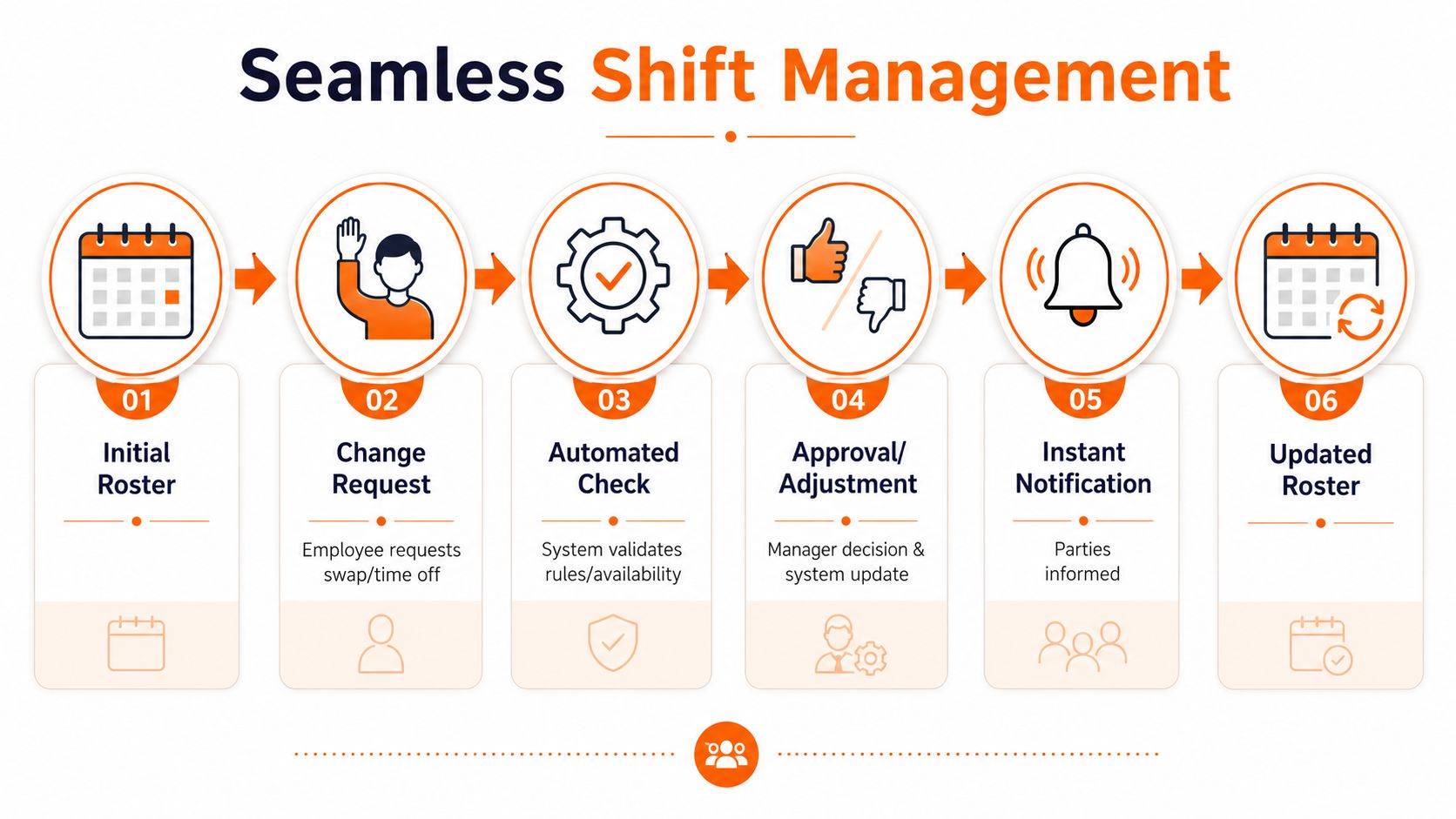
A 2025 survey found that 74% of frontline supervisors manually adjust rosters to accommodate PTO and availability changes, spending an average of 11 hours per week on rework. The same source says integrated systems that automate this can cut coverage errors by 57%, as noted in this summary of PTO and scheduling integration findings.
The manager should not be the switchboard
Managers need oversight. They don't need to be the messenger, referee, and data-entry clerk for every shift change.
A decent swap process does three things well:
It gives employees one clear place to submit the request.
It checks basic rules before the manager gets involved.
It updates the shared roster immediately after approval.
That sounds simple because it is simple. The mess comes from splitting those actions across different tools and side conversations.
If you want a cleaner starting point for leave handling, this walkthrough on employee time off request workflows is useful because it treats time off as part of scheduling, not a separate HR side task.
Write the rules once, then let the process carry them
Teams don't need a complicated policy. They need a usable one.
Try a simple operating model like this:
Time off requests go through one channel, with clear notice expectations.
Shift swaps are allowed only when role, skill, and coverage needs still hold.
Final approvals sit with the manager for exceptions, not every tiny movement.
Notifications go to everyone affected, immediately, in the same place.
Here's what works versus what doesn't:
Works | Fails |
|---|---|
One visible system of record | Text chains and screenshots |
Rule-based swaps | Informal favors |
Availability tied to the live roster | Separate spreadsheets |
Clear approval ownership | “I thought someone else handled it” |
The best swap policy is boring. People know where to go, what counts, and what happens next.
That kind of boring is gold. It cuts the emotional load on managers and gives employees something even more valuable than convenience. It gives them a sense of control.
Stop Building Rosters Start Orchestrating Work
Spreadsheets can hold shifts. They can't hold the work around the shifts.
That's the limit many organizations run into. The roster isn't the only moving part anymore. Availability changes. PTO blocks time. Skills matter. Messages about changes need to reach the right people. Some staff float between roles. Others need approvals, documents, tasks, or a quick check-in before the shift starts. Once all of that exists, a spreadsheet becomes a fragile summary of a system happening somewhere else.
Static rosters break when roles are fluid
Many tools still fall short. They assume fixed job titles and simple handoffs. Real frontline work isn't that tidy. One retail employee can cover sales and inventory. One healthcare worker may float based on certification and unit need. One warehouse lead may split time between receiving and floor support.
Emerging data from 2025 to 2026 shows that organizations using dynamic, role-fluid rostering systems reduce shift coverage gaps by 42% compared to static models, according to this cited summary of role-fluid rostering findings. That lines up with what many managers already feel in practice. Fixed templates don't reflect flexible teams.
This matters for culture too. When the roster can reflect actual skills and movement, staff stop feeling boxed into labels that don't match the work they really do.
One place beats five partial tools
A unified work app handles the roster as part of daily operations, not as a PDF attached to an email. In a tool like Pebb, managers can publish schedules, account for PTO, support mobile access, and keep shift communication in the same environment as team updates and task coordination. That changes the rhythm of the work. People don't have to hunt for the latest version, guess whether a message was seen, or chase separate systems just to understand their week.
The contrast is pretty clear:
Old setup means one spreadsheet, one chat thread, one leave tracker, and constant manual reconciliation.
Connected setup means the roster, the change request, the approval, and the update live together.
Old setup asks managers to remember context.
Connected setup stores context inside the workflow.
For teams in high-pressure settings, that's more than admin relief. It's protection against burnout. In healthcare especially, staffing stress and communication gaps feed each other. This guide to fighting clinician burnout is worth reading because it treats staffing practice as part of workforce wellbeing, not just coverage math.
You can still make a decent roster manually. Plenty of teams do. But once your operation depends on flexible roles, quick updates, and shared visibility, you're not really scheduling anymore. You're orchestrating work.
Your Roster Is Your Culture Made Visible
Most culture talk is too abstract for me. Values on a wall don't mean much if the schedule says something else.
The roster is where culture becomes visible. It shows whether the business plans ahead or runs on panic. It shows whether fairness is real or just a speech. It shows whether people's time outside work is treated as valid or treated as a problem to be solved by guilt.
That's why I think managers should look at a roster for staff and ask different questions. Not just “Are all the shifts covered?” Ask: what story does this tell? Does it say we reward reliability? Does it say we share the load? Does it say adults here get enough notice to live like adults?
What your current roster might be saying
Sometimes the message is good. People know the process. Tough shifts rotate. Requests are handled clearly. Changes don't vanish into private chats.
Sometimes the message is rougher:
Chaos is normal here
The loudest person gets the best outcome
Your life outside work counts less than our planning mistakes
Managers don't have time to explain decisions
If that sounds harsh, good. It should. Schedules carry moral weight because they shape people's lives in practical ways.
Culture isn't built only in town halls or onboarding decks. It shows up in who gets the close, when the rota is posted, and how changes are handled.
If you want a broader lens on that connection, this piece on what company culture actually looks like at work is a useful reminder that culture lives in systems, habits, and daily signals.
A strong roster won't fix every people problem. But a weak one will create new problems faster than most leaders realize. That's why I'd treat the schedule with more seriousness than most companies do. Not because it's glamorous. Because it's one of the clearest ways a business proves what it values.
If your team is tired of juggling rosters, PTO, chats, and updates across separate tools, Pebb is worth a look. It brings scheduling, communication, time off, and day-to-day coordination into one place, which makes it easier to run a calmer operation and a fairer one.
