
A Calmer Way to Handle Employee Time Off Requests
Stop the chaos. Learn how to build a simple, fair employee time off request process that respects everyone's time and improves team morale.
Dan Robin
Submitting an employee time off request should be simple. But let’s be honest—it often feels like a high-stakes negotiation, loaded with unspoken rules and anxiety.
For too many people, the reality is a mess of confusing spreadsheets, last-minute emails, and managers scrambling to figure out coverage. This isn't just an administrative headache. It’s a culture killer.
Why Asking for Time Off Is So Stressful

Let's just say it: the typical time off process is broken. It creates friction where there should be none, turning the simple act of taking a break into a source of stress.
For employees, it’s that knot of anxiety before hitting 'send.' You wonder if it's the “right” time to ask. You worry you’re letting the team down. You even question if you'll be seen as less committed. That guilt is a heavy burden, and it stops people from taking the time off they’ve earned and desperately need.
The Ripple Effect of a Broken Process
This isn't just about one person's feelings. A clunky, unclear system creates real problems that ripple across the entire company.
Managers are drowning in an administrative nightmare buried in their inboxes. They become gatekeepers, forced to cross-reference schedules, find coverage gaps, and make judgment calls that feel arbitrary. One study found managers can spend nearly a full workweek each year just on unproductive tasks like this.
A disorganized time off system doesn't just waste time; it erodes trust. When the rules are unclear or applied inconsistently, it breeds resentment. It makes people feel like the system is rigged.
And the rest of the team? They’re left to pick up the slack, often with little notice. This leads to burnout and creates a quiet tension between colleagues. Suddenly, a coworker’s vacation becomes a burden for everyone else.
This cycle is not sustainable. It's a system that prioritizes clunky processes over people. We believe there’s a much calmer way to handle this—one that supports the business and the people who make it run.
How to Build a PTO Policy People Actually Respect
A great time off policy has almost nothing to do with rules. It’s about clarity and trust. It’s an agreement that your people are adults who can manage their time, and you’re a business that respects their need to rest.
Before you touch the process for requesting time off, you have to get this foundation right. Without it, you’re just putting a new coat of paint on a broken system. The goal is a document that feels less like a legal disclaimer and more like a shared understanding.
So, skip the corporate jargon. Get real. How much notice do you actually need, and why? Are there blackout periods? If so, explain the business reality behind them—don't just declare them. When people understand the "why," they respect the guidelines.
From Accrual Headaches to Flexible Trust
Let’s be honest, traditional accrual systems feel like a strange game. Employees hoard their days, feel guilty for using them, or scramble to burn through them at the end of the year. This creates predictable, disruptive crunches for the business.
And here’s something interesting: while summer seems like the peak for PTO, the data tells a different story. One global report found that employee time off requests actually surge by nearly 68% in January. This is a direct result of people recovering from the holidays or rushing to use up their leftover balance. You can dig into more of these trends in TMetric's research.
That end-of-year panic is a symptom of rigid “use-it-or-lose-it” policies. It forces behavior that serves neither the employee nor the business. A more flexible policy, built on trust and accountability, can eliminate this artificial scarcity. The focus shifts from counting days to ensuring work gets done and people get the rest they need.
The Cornerstones of a Fair Policy
Building a policy that works comes down to a few core ideas. You don't need to cover every edge case. You need to establish clear, fair principles that guide everyone.
A solid policy should transparently cover:
Advance Notice: Set clear expectations. Two weeks' notice for a few days off and a month for a longer vacation is a reasonable starting point. The goal isn't to be punitive; it's to give managers enough runway to plan.
Prioritization: The fairest system is almost always first-come, first-served. When everyone knows that's the rule, it removes any hint of favoritism.
Coverage Expectations: Make it clear that an approved request depends on a solid plan to cover critical duties. This helps employees think like owners of their work, not just people asking for permission.
Your PTO policy is a living document. It reflects your company’s values. It should signal trust and respect, not suspicion and control.
Ultimately, you’re trying to build a system where taking time off is a healthy, normal part of the job. For more guidance, you can check out our guide on creating a solid attendance policy. This is all about creating a framework that supports both your team and the business, turning the time-off process from a point of friction into a source of mutual respect.
Crafting the Perfect Time Off Request
Asking for time off shouldn't feel like a negotiation. It's a normal part of having a job, yet many of us feel that small bit of anxiety before hitting 'send.' The truth is, how you ask can make all the difference between an instant "yes" and a week of follow-up questions.
It’s not about begging or over-explaining your life. It’s about making the decision as easy as possible for the person on the other side. A good time off request is an act of professional courtesy. It shows you respect your manager’s time and have considered your team's workload.
This isn’t about reading minds. It's about taking ownership of your responsibilities before you clock out.
Why Clarity and Context Are Everything
A vague request just creates more work. "Need next Friday off" isn't a request; it's a problem you've just dropped on your manager's lap. Their first thought isn't about you getting a break. It’s about who will handle the weekly report, who can cover client calls, and whether any deadlines are about to be missed.
Your goal is to answer those questions before they're even asked. The key is providing just enough information to show you’ve thought ahead, without getting into personal details.
A great time off request doesn’t just ask for a day off; it presents a plan for a day off. It turns a potential problem into a non-issue.
This small shift in framing changes the entire dynamic. It moves the conversation from a simple ask to a demonstration of professionalism. It makes saying ‘yes’ a no-brainer.
Show, Don’t Just Tell
Let's look at what this looks like in practice. It's easy to see the difference between a request that creates work and one that makes a manager's job easier.
Time Off Request Message Examples
Here's a comparison of what not to do versus what gets approved fast.
Ineffective Request (Creates Work) | Effective Request (Easy to Approve) |
|---|---|
"Hey, can I take off July 15-19?" | "Hi! I'd like to request July 15-19 off for a family trip. I've already finished the Q3 projections, and Sarah has agreed to monitor my client inbox for anything urgent. All other projects are on track." |
A quick text: "need to take off next monday" | A formal request in the company app: "Requesting next Monday off for a personal appointment. All my weekly tasks will be completed by Friday, and I've blocked my calendar." |
See the difference? It all comes down to proactive planning.
The effective examples don't just ask; they communicate a solution. They prove the employee has already done the thinking for their manager, confirming everything is under control. This is how you build trust, one responsible time-off request at a time.
Designing an Approval Workflow That Just Works
For any manager, approving time off can feel like a game of Jenga. Say yes to one person, and you worry the whole team schedule might topple. Say no, and you’re the bad guy. The goal isn't to be a gatekeeper. It's to build a system that is fair, consistent, and predictable.
The old way—a jumble of emails, hallway requests, and sticky notes—is a recipe for chaos. It forces managers to be reactive, making decisions based on who asked last or loudest. This is where things get messy and feelings get hurt.
The real problem is the lack of visibility. When you can't see the full picture—who’s already out, what projects are peaking, where your team’s capacity really stands—every employee time off request feels like a gamble. Moving away from this guesswork isn’t just about efficiency; it's about making smarter, fairer decisions.
This simple flow shows what the journey of a request should look like.
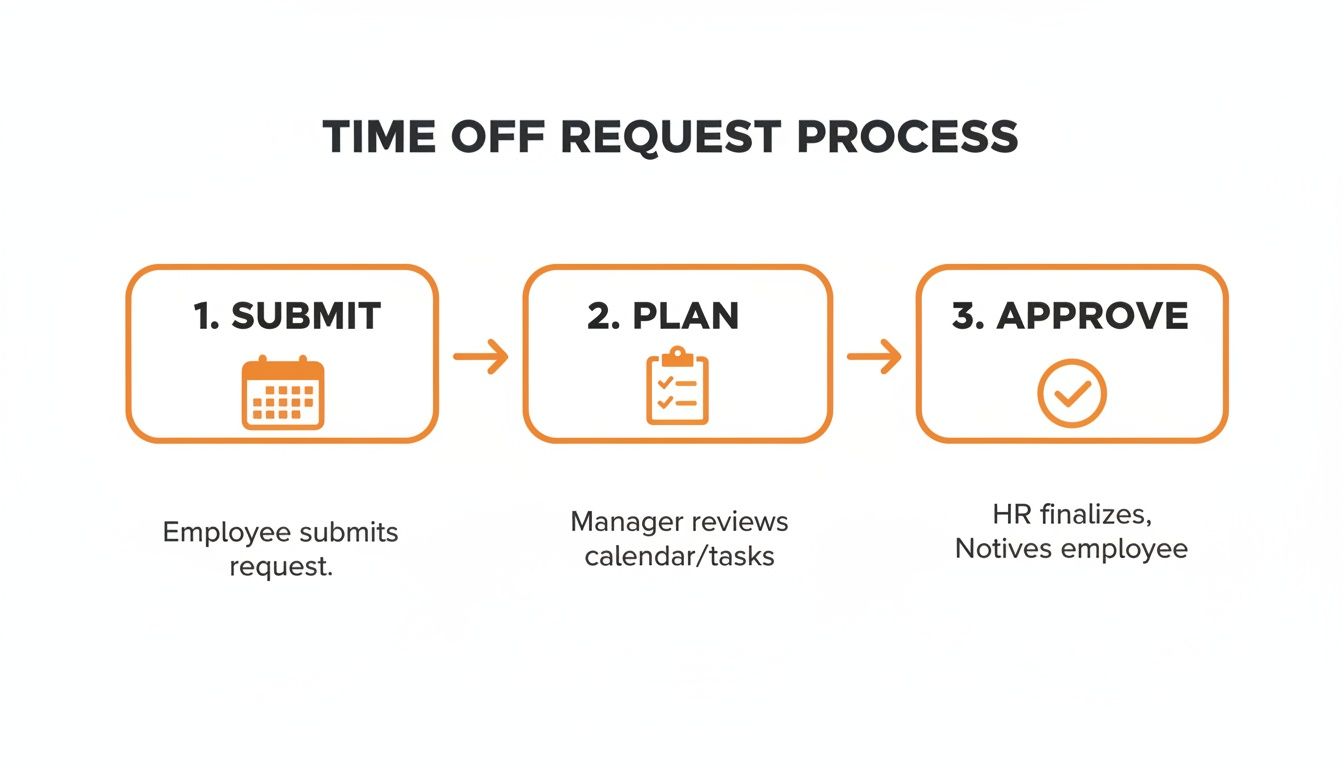
Each step is designed to remove friction and add clarity, turning a headache into a smooth process.
From Bottleneck to Proactive Planning
A good workflow begins with a single source of truth. The moment all requests live in one place, visible to the whole team, the dynamic shifts. It eliminates the "he said, she said" and replaces it with a clear, timestamped record.
This is where a tool built for the job makes all the difference. An effective tool, like Pebb, gives you a shared calendar that instantly flags potential conflicts. It’s no longer about digging through your inbox; it’s about glancing at a dashboard and seeing your team's availability in seconds.
With that clarity, you can establish a clear chain of command. Does the request go to the direct manager first? Does HR need to sign off on longer leaves? An automated workflow ensures the request follows the right path every time, without anyone chasing down signatures or forwarding emails.
A well-designed approval process isn’t about control. It's about creating a system so clear and fair that it practically runs itself. The manager's job becomes oversight, not intervention.
The Power of Automation and Transparency
Here’s the thing: nobody likes being left in limbo, wondering if their vacation is approved. Automating notifications is a small touch with a huge impact. An instant confirmation that a request was received, followed by a clear approval or denial, builds trust.
An automated system handles this effortlessly. It keeps everyone in the loop without adding a single thing to a manager’s to-do list. In fact, companies that automate their time-off process can save managers nearly a full workweek of administrative work each year.
This frees them up to focus on the human side of leadership. Instead of wrestling with schedules, they can have real conversations about workload and coverage. By using the right employee time off app, you can transform the approval process.
It’s about turning a tedious chore into a strategic advantage—one that helps you plan better, treat your people fairly, and build a culture where taking a break is a simple, stress-free part of the job.
Why Encouraging Time Off Is Smart Business

Let's be real. A time-off policy that sits in a handbook gathering dust isn't a policy. It's just words, signaling that while you offer breaks, you don't actually expect anyone to take them.
A truly great time-off policy is one that people feel comfortable using. And that only happens when taking a break is actively encouraged, starting from the top.
This goes beyond clichés about "recharging batteries." It's about a simple business truth: rested people do better work. They're more creative, they solve problems faster, and they're more likely to stick around. Time off isn't a perk; it's a critical part of a healthy, high-performing team.
When you see a culture of "work martyrdom"—where hoarding vacation days is a badge of honor—you're looking at a company on a collision course with burnout. It's a quiet problem that slowly saps your team of its energy and drive.
The Real Cost of Unused Vacation Days
We've all heard it. The person who boasts about not taking a vacation in three years. That's not dedication. It’s a red flag. It signals a deeper issue, like fear of falling behind, an unsustainable workload, or a culture that rewards presence over results.
This mindset has a hidden price. People who never disconnect are more likely to make mistakes, become disengaged, and eventually, leave. The cost of replacing a great employee is always higher than the cost of letting them take a two-week vacation.
Time off isn't a liability on the balance sheet; it's an investment in the long-term health of your team. It's a leading indicator of a sustainable company culture.
The data backs this up. Employees who take regular time off report higher job satisfaction and better performance. One analysis revealed that employees who take about 15 days of PTO annually are often the most satisfied. You can explore the numbers on PTO and job satisfaction to see just how strong that connection is.
How Leadership Sets the Tone
Here’s the thing: nobody will believe time off is important if the leaders never take any. When a founder fires off emails at 11 PM while supposedly on "vacation," the message they're really sending is, "I'm not really unplugging, and I don't expect you to, either."
Setting the right example is simple but powerful.
Take your full vacation time.
Actually disconnect when you're gone.
Talk openly about the trips you take.
These small acts give everyone else permission to do the same. It normalizes rest.
By building a system where a well-planned employee time off request is seen as responsible self-management, you do more than just boost morale. You build a more durable, creative team. Our guide on employee retention best practices dives deeper into this. The takeaway is clear: encourage your people to rest, and they'll reward you with their best work.
Common Questions About Time Off Requests
Over the years, we've seen the same questions pop up again and again. The details can feel tricky, but the principles behind the answers are usually straightforward.
Let's dive into a few of the most common ones.
How Much Notice Should We Require?
There’s no magic number, but a good rule of thumb is at least two weeks' notice for short vacations and a month for longer trips. The real key is balance. Your policy should give managers a runway for planning without being so rigid that it can't handle real life.
For teams where shift coverage is everything, it makes sense to align the notice period with your scheduling cycle. The goal isn’t to enforce a strict rule; it’s to give managers enough time to plan so one person’s break doesn't create chaos. When you explain the "why," people get it.
How to Handle Competing Time Off Requests?
This is where a transparent policy and a good system are your best friends. The fairest approach is almost always first-come, first-served. It's simple and hard to argue with. When every employee time off request is logged in a central tool, there’s an indisputable timestamp.
This simple rule removes any hint of favoritism.
A timestamp is neutral. It doesn’t have favorites. It doesn’t care about office politics. It’s the fairest tie-breaker you’ll ever find.
For predictable conflicts like major holidays, you can build on this. Maybe you set up a rotating approval system where priority shifts year to year. The most important thing is to establish the rule before a conflict arises and apply it consistently.
Should We Deny a Request If We Are Short-Staffed?
This is a tough one, but our opinion is firm: denying a request should be a last resort, reserved for a true business emergency. This is especially true if the employee followed your policy perfectly.
Let's be honest. Frequent denials aren't a sign of a busy period. They're a symptom of a deeper problem, like chronic understaffing or poor planning. Instead of just saying no, use that request as a data point.
If you’re constantly scrambling for coverage, the issue isn't the requests—it's your workforce strategy. A culture where employees trust their time off will be honored is far more valuable than the short-term fix of denying a well-earned break.
Ready to build a calmer, more transparent time-off process? Pebb unifies your scheduling, PTO tracking, and team communication into one simple app, making it easy to create a system that just works. See how Pebb can help your team.
