
Strategic Internal Communication Is Just Good Management
Discover how strategic internal communication builds resilient, aligned teams. Learn a practical framework to move beyond noise and drive real results.
Dan Robin
Most internal communication is noise. It’s a constant flood of mass emails, vague Slack updates, and that nagging feeling you’ve missed something important. This isn’t just annoying; it’s a symptom of a deep disconnect at the heart of a company.
The Disconnect We All Feel at Work
Let’s be honest. We’ve all watched a big company initiative get announced with a lot of fanfare, only to fizzle out a few months later. The idea was probably good, but the execution was a mess.
It starts with an all-hands meeting to explain the “why.” But that’s immediately followed by a wave of unread emails and conflicting directions from different managers. Before you know it, confusion turns into apathy, and the whole project just… fades.

This is what happens when companies don’t communicate; they just broadcast. They push information at their people, cross their fingers, and hope some of it sticks. That’s not a strategy. It's wishful thinking. It’s why so many of us feel like spectators in our own companies.
The Perception Gap Is Real
Here’s the thing. Most leaders think they’re doing a great job with communication. A 2025 Axios HQ report uncovered a massive perception gap that proves it. While 80% of leaders believe their internal communications are clear, a mere 50% of their employees agree.
That chasm is where good intentions go to die.
Communication isn't a soft skill—it's the central nervous system of your business. When it's messy, the whole body feels it. When it's clear and intentional, everything just works.
This is where strategic internal communication changes everything. It’s not about sending more messages. It's about sending the right messages to the right people at the right time. It’s the difference between shouting into the wind and having a real conversation.
By being intentional, you can improve workplace culture and fix the disconnects holding your teams back. You stop just informing people and start connecting them to the company's purpose, showing them exactly where they fit in. This is how you turn a group of individuals into a focused team.
What Strategic Internal Communication Actually Is
Let's get one thing straight. Strategic internal communication has nothing to do with sending more newsletters or scheduling another all-hands meeting. It's not about checking boxes.
It’s about making sure every single person in your company understands where the business is headed, why it matters, and how their work helps move the whole thing forward.
Think of the crew on a ship. A tactical crew just gets random orders shouted at them—"pull this rope," "turn that wheel." They do the tasks, but they have no clue where they're going. A strategic crew knows the destination, understands the chart, and can make smart decisions even when the captain isn't around. That’s the difference.
This approach changes communication from a series of top-down announcements into a meaningful, two-way conversation. It’s less about broadcasting and more about building trust.
From Tactical Noise to Strategic Purpose
Most companies are stuck in tactical mode. They fire off updates as they happen, reacting to events instead of shaping the story. Strategic communication flips that. It's intentional. It anticipates questions and connects what an individual does to what the team achieves.
It’s the difference between telling an engineer to “fix this bug” and explaining how fixing that bug will keep a major client from leaving. One is a task; the other is a mission. This shift is what makes people feel connected to their work.
Strategic internal communication isn’t an HR or marketing function. It’s an operational discipline that drives purposeful action and makes your entire organization smarter.
This way of thinking is catching on. A 2025 global survey from ContactMonkey found that 72% of communicators say their role has become more vital in the past year. They’re moving beyond just sending messages and are now tying their work directly to business outcomes.
The goal is to create clarity so consistently that it becomes part of your company's DNA. If you want to dig deeper into building a plan, our guide on internal communications strategy is a good place to start.
It’s a fundamental change, moving from just informing people about what happened to aligning them around what you will all achieve together.
The Four Pillars of a Communication Strategy
A strategy without a framework is just a wish. It’s a nice idea that falls apart on a busy Monday morning. To make strategic internal communication real, you need a few sturdy pillars to build on. I've found it all boils down to four simple things: Audience, Channels, Governance, and Measurement.
That's it. No complicated models required. Just four areas to get right.
Who Are You Talking To?
The first pillar is your Audience. This seems obvious, but it’s where most companies stumble. They see departments, not people. They blast a generic message to everyone from the front desk to the engineering team and then wonder why nobody feels connected to it.
Strategic communication means seeing your audience clearly. What does a warehouse worker really need to know? How is that different from what the remote sales team cares about? A message about a server update is noise to one and critical information to the other.
Treating everyone the same isn't fair; it's just lazy.
Where Are You Having the Conversation?
Next are your Channels. This is about matching the message to the medium. You wouldn’t propose over a text message, and you shouldn’t announce a major company reorg in a general Slack channel. The channel you choose sends its own message before anyone reads the words.
A quick project update? Perfect for team chat. A deep dive into quarterly goals? That probably needs an all-hands meeting or a thoughtful article. Pushing every message through every channel is the fastest way to get people to tune you out completely.
The goal isn't to be everywhere. It's to be in the right place at the right time.
This simple diagram shows how these components fit together. Your main goal should always guide your strategy, which then informs the specific tactics you use day-to-day.
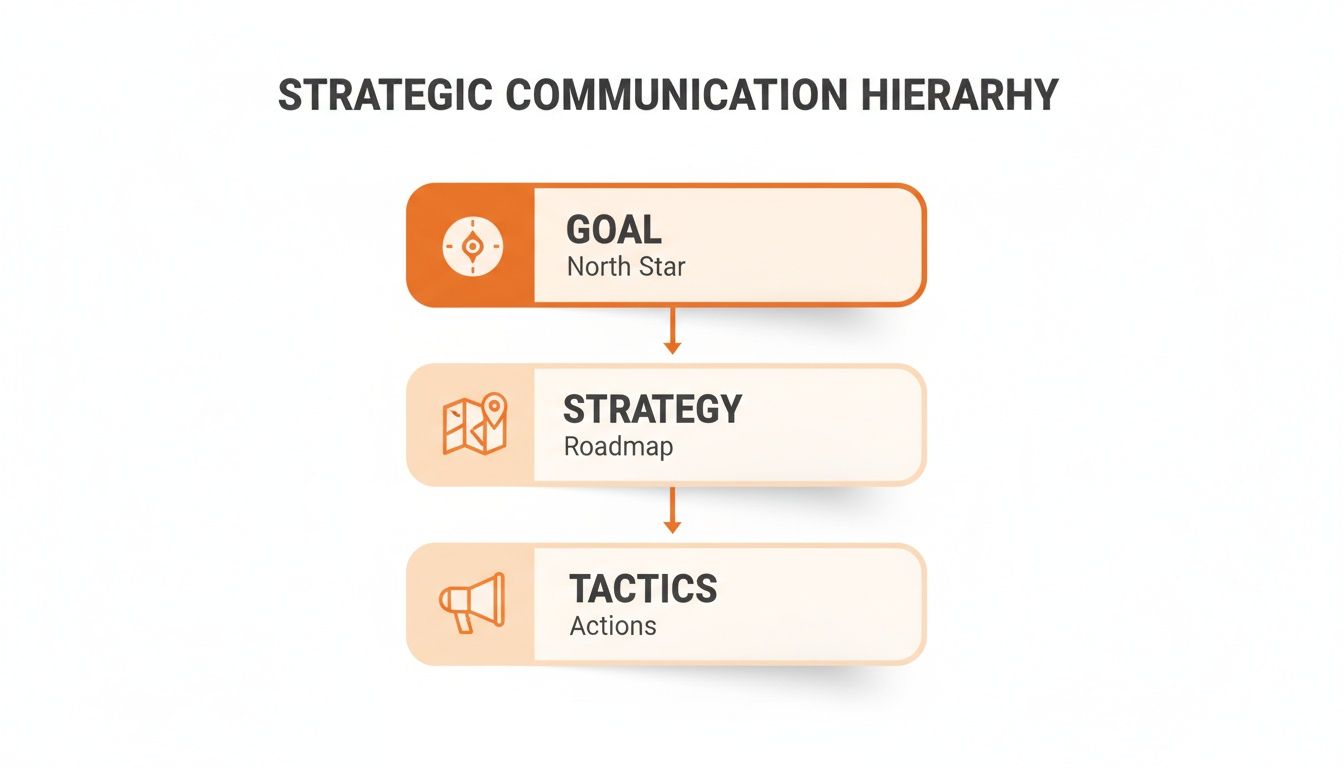
It’s a good reminder that tactics—like the channels we use—should always serve the bigger picture, not the other way around.
What Are the Rules of the Road?
Third, we have Governance. Don't let the word scare you. This isn't about bureaucracy; it's about simple, clear rules of the road. Who gets to send a company-wide email? When is something urgent enough for a push notification?
Without some light governance, you get chaos. Leaders send conflicting messages, and important updates get lost in a sea of birthday announcements. Good governance just means agreeing on a few principles to make communication predictable.
Is Any of This Actually Working?
Finally, there’s Measurement. Let’s be blunt: open rates and page views are vanity metrics. They tell you if someone clicked something, not if they understood it, cared, or changed their behavior.
Meaningful measurement looks at outcomes. After you explained the new expense policy, did questions to HR go down? After the training on the new software, did adoption rates go up? The real goal is to see a change in what people do, not just what they read.
These four pillars aren’t a checklist. They’re a constant loop. You listen to your audience to choose the right channels, apply simple governance, and measure the results to understand your audience better next time.
This strategic loop is more critical than ever. With hybrid work and constant economic pressure, the old "fire and forget" methods just don't work anymore. In fact, a recent report found that 42% of communicators say these factors have forced them to completely rethink their approach. You can discover more about these communication trends on axioshq.com.
Getting these four pillars right gives you a solid foundation for communication that doesn't just inform—it connects.
Putting Your Strategy Into Practice: A Real-World Example
All this theory is great, but what does it look like on a chaotic Tuesday? Let's walk through a common scenario. Imagine your company is rolling out new software meant to make everyone’s job easier.
The old way? Fire off a single, jargon-packed email to the entire company. The important details are buried, and it links to a user guide that’s even more confusing. What happens next is predictable: chaos. The sales team ignores it, engineers get frustrated, and the support desk is swamped.

That’s not a software failure. It's a communication failure.
Let's Re-Run That Launch with a Strategy
Okay, let's rewind and try this again—this time, using those four pillars.
First, audience segmentation. Instead of a one-size-fits-all message, we create targeted communications. The engineering team gets a technical brief in their dedicated Slack channel, highlighting integration points. Meanwhile, the sales team gets a punchy video demo showing how the tool helps them close deals faster, delivered to their team’s news feed.
Next, channel selection. We met the engineers where they already work. For the sales team, we follow that video with a live Q&A session. For everyone else, we create a simple, one-page quick-start guide—heavy on screenshots, light on text—and pin it to the company intranet.
The goal isn’t to just blast information out. It’s about delivering clarity in a way that feels genuinely helpful, not like another chore. When you respect people’s context, they’re far more likely to listen.
This brings us to governance. We map out a clear timeline. Week one is for awareness. Week two is for training. The official launch is in week three. This simple structure manages expectations and stops the rollout from feeling like a surprise. You can find more practical ways to structure your timeline with our internal communication plan template.
Finally, measurement. Instead of just looking at email open rates, we focus on adoption. Two weeks after launch, we send a quick pulse survey: “On a scale of 1-5, how much has this new tool simplified your workflow?” The answers give us real insight into what’s working and what isn't.
The Real Difference Is Connection
In both scenarios, the same software was launched. But the outcomes couldn’t be more different. One created frustration; the other built confidence and drove adoption. The only difference was a thoughtful plan that turned a potential mess into a clear win.
As you put your own strategy into motion, remember that connection is the goal. Understanding how to be engaging in a conversation can make a huge difference. This process is also becoming more data-driven. The latest trends show communication leaders using analytics to spot misalignments before they become big problems.
This is what strategic internal communication looks like in the real world. It’s not about doing more work—it’s about doing smarter work.
Why Clear Communication Matters More Than Ever
The way we work is completely different now. The lines between home and office have blurred, hybrid teams are standard, and constant change is just part of the job. This isn't temporary; it's the new normal.
And let’s be real—that kind of environment creates anxiety. When people are left in the dark, they start filling in the blanks themselves, and the stories they invent are rarely good. This uncertainty is what sparks disengagement, fuels burnout, and kills productivity.
A trusted, steady flow of communication is the only antidote. It’s what separates a team that panics at the first sign of trouble from one that bands together, confident in where they’re headed.
It's an Operational Must-Have
This isn't about making people feel good. We're talking about building a resilient organization. Clear communication helps a company stay nimble, hold onto its best people, and innovate through chaotic times instead of being frozen by them. When everyone understands the big picture, they can make smarter decisions on their own.
Too many leaders still treat communication as a "soft skill." The truth is, it’s a core operational discipline, just like finance or logistics. And smart companies are catching on.
Organizations that invest in their communication efforts see a significant payoff. A recent study found that 66% of them report gains in innovation and competitive advantage, a stark contrast to the 34% who saw similar gains with flat or reduced investment.
It doesn't stop there. Those same companies also enjoy 67% better customer retention. The link is obvious: when your team is aligned and informed, they deliver a better experience to your customers. You can read the full analysis on internal communication trends on axioshq.com.
The numbers don't lie. Companies that get this right don't just survive change—they use it to pull ahead. They know a team rowing in the same direction can handle just about anything. If you're looking to improve, it's worth reviewing the top employee communication mistakes to avoid.
In a world this unpredictable, clarity isn't a perk; it's a competitive advantage. It's time to treat it like one.
Your First Step Is Simpler Than You Think
We’ve covered a lot. I get it. Building a full strategic internal communication framework can feel overwhelming.
So let’s forget the grand plan for a moment.
Let’s be honest. You don’t need another five-year roadmap. You need a win. Something tangible you can point to.
Instead of trying to boil the ocean, focus on the single biggest communication breakdown in your company. What consistently causes headaches? Maybe it’s how leadership updates trickle down. Or perhaps cross-team projects are a total mess.
The most powerful strategies don’t start with fixing everything. They start with fixing one thing that matters. A small, intentional act of clarity can ripple through an organization.
Forget the big launch. Don't stress about getting every channel perfect. Just find one painful point of confusion and commit to making it a little clearer.
Start there.
Great communication isn’t built overnight. It’s built one conversation, one clear email, and one honest update at a time. It’s the sum of these small acts that eventually creates a culture of trust. Just fix one thing.
Frequently Asked Questions
People ask us a lot of the same questions when they start getting serious about their strategic internal communication. Here are the straightforward answers we’d give over coffee.
How Can We Measure the ROI of This Work?
Stop obsessing over vanity metrics like email open rates. They don’t tell you if anyone actually understood—or cared about—what you sent. The real return shows up in business outcomes you can actually see.
Did that new software rollout go smoothly, with fewer help desk tickets? Did employee turnover in a key department drop after you clarified that confusing new policy? Use quick pulse surveys to get a read on clarity before and after a big announcement. The true ROI is in better efficiency, faster projects, and fewer mistakes.
We’re a Small Company. Do We Really Need a Formal Strategy?
Yes, you do. But “strategy” doesn’t have to mean “complicated.” For a small team, a strategy might be as simple as agreeing on which tool to use for urgent news versus casual updates. It's about setting clear expectations to cut down on noise before it starts.
A simple communication foundation built today prevents bad habits from taking root as you grow. It's much easier to scale good practices than to fix broken ones later.
This basic groundwork becomes priceless as you expand. It ensures that new people step into a culture of clarity, not chaos.
How Do We Get Our Leaders to Buy Into This?
Speak their language. That almost always means results and risk. Frame your proposal as a way to “cut down on project delays” or “get teams aligned faster,” not just “improve communication.”
Bring them data that highlights a painful problem. Show them the gap between how they think communication is going and what employees are actually experiencing. Then, pitch a small pilot project to solve one nagging issue. A quick, measurable win is the best way to prove the value and get support for a bigger initiative.
Ready to unify your team with a platform that makes strategic communication simple? Pebb brings your people, work, and culture together in one app, helping you connect with every employee, from the front desk to the frontline.
