
The Awkward First Day Is Costing You a Fortune
Rethink your orientation for a job. This is a practical guide to welcoming new hires with a human approach that builds loyalty from day one.
Dan Robin
We’ve all been there. The forced smiles, the mountain of forms, and an information avalanche that leaves you feeling more overwhelmed than welcomed. It’s a clumsy rite of passage we’ve somehow come to accept as part of a new job.
But that awkward first impression is more than just uncomfortable. It’s a colossal waste of money and potential.

Why a Bad First Impression Is So Expensive
The damage starts quietly. A disorganized first day sends a clear, if unintentional, message: "We weren't quite ready for you." That little feeling of being an afterthought can quickly sour a new hire's excitement, turning it into anxiety and doubt. This is where the seeds of disengagement are sown.
When a new team member feels disconnected from the get-go, they’re far less likely to ask questions, share ideas, or build the relationships they need to thrive. They just go through the motions.
This isn't a hunch; the numbers are startling. In 2023, Gallup reported that only 23% of employees felt they were thriving at work. A jaw-dropping 59% were "quietly quitting"—doing the bare minimum. This disengagement costs the global economy an estimated $8.8 trillion in lost productivity. That’s a direct hit to the bottom line, and it often begins with a lackluster welcome.
We treat orientation like an administrative task to check off a list. We should treat it as the most critical moment in the employee lifecycle. It’s the first, best chance you have to prove your company is a place worth their career.
From Checklist to Connection
So, why do so many companies get this wrong? It’s simple: most orientation programs are designed around the company's needs, not the new hire's experience. They prioritize compliance over connection, process over people.
We flood newcomers with information they can’t possibly remember, all while they're just trying to figure out names and where the coffee is. We've dug into why new hires struggle to get up to speed and what to do about it. It’s a classic recipe for cognitive overload.
A chaotic first week is incredibly expensive. Using a comprehensive employee onboarding checklist is a great way to bring order to the chaos. But a checklist is just a tool; the real shift has to be in your mindset.
The goal isn't to tick boxes. The goal is to make someone feel like they've made the right decision in joining your team.
This guide isn't about adding more steps. It’s about rethinking the purpose of an orientation for a job. We’ll show you how to move from a rigid checklist to a human-first experience that turns new hires into engaged, loyal team members from day one.
Build a Connection Before Day One
Let's talk about that awkward gap. The time between a candidate signing their offer and showing up for work. Their excitement is at an all-time high, but so is their anxiety. And what do most companies do? They go silent.
This radio silence is a huge missed opportunity. It leaves your new hire twisting in the wind, second-guessing their decision. The best job orientations don't start with a welcome breakfast. They start the second the ink is dry on that contract.
This is pre-boarding, and it's your secret weapon against first-day jitters.
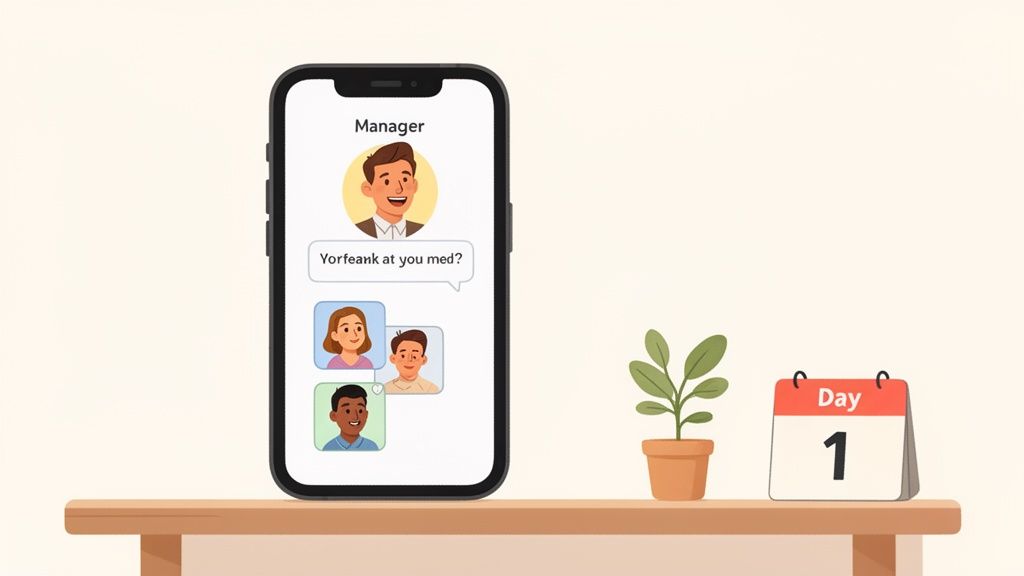
What you see here is the heart of modern pre-boarding. It’s not about paperwork; it’s about a simple, digital welcome that makes them feel like they belong before they've even found their desk.
Make the First Move Human
Please, forget the automated email from a "no-reply" address. The very first message your new hire gets after signing should be from their direct manager. A quick text or a short, personal email saying, “So excited to have you join the team!” makes all the difference.
This one small act is incredibly powerful. It does two things instantly:
It forges a human connection with the person they'll be working with most.
It positions their new manager as a helpful guide, not just a name on an org chart.
This isn’t the time for dense policy documents. It's about being thoughtful and turning a routine HR process into a human experience. To really nail this, you can learn more about what is pre-boarding and why it’s so critical for setting the right tone.
The goal of pre-boarding is simple: make your new hire feel seen, welcomed, and reassured. It’s about turning their nervous energy into genuine enthusiasm.
Let's be honest. No one wants to read a 50-page employee handbook the week before they start. It feels like homework. What they do want is to feel prepared for the little things that cause the most stress.
Create a Low-Pressure Welcome Space
Instead of cluttering their inbox with a dozen PDFs, give new hires access to one simple, central digital space. Here at Pebb, we use "Spaces" that act as a friendly home base for a new hire’s first few weeks.
This space shouldn't be a firehose of information. Think of it as a place to answer all the practical, nagging questions that keep people up the night before a new job.
What to Include in a Welcome Space:
A Casual Team Intro: Post a quick intro to the immediate team with photos and a fun, humanizing fact about each person (e.g., "Sarah is our go-to for Excel formulas and office bake-offs").
The "First Day" Essentials: Be clear about the start time, where to park, who to ask for at reception, and the dress code. These small details provide a massive sense of relief.
A Warm Welcome from the Team: Create a chat channel and encourage the team to pop in with a "hello!" or a welcome GIF. This signals that they're joining a community, not just a company.
This approach gives new hires the freedom to explore information on their own time, without pressure. It shows you respect them.
The best orientation for a job is one that feels less like a formal procedure and more like a warm welcome. By building that bridge of connection before Day One, you ensure that when your new hire walks in, they don't feel like a stranger—they feel like they’re already home.
Design Day One Around People, Not Paperwork
For far too long, we’ve treated a new hire’s first day like a bureaucratic checkpoint. It’s a blur of HR forms, IT policy read-throughs, and awkward introductions. We get the paperwork done, but we miss the bigger opportunity.
That first day is your single best chance to prove to your new team member that they made the right decision. Wasting those first eight hours on administrative tasks is a huge unforced error.
The fix is surprisingly simple: flip the script. Dedicate the morning to human connection and save the logistics for the afternoon, once your new colleague feels like part of the team.
A First-Day Agenda That Puts People First
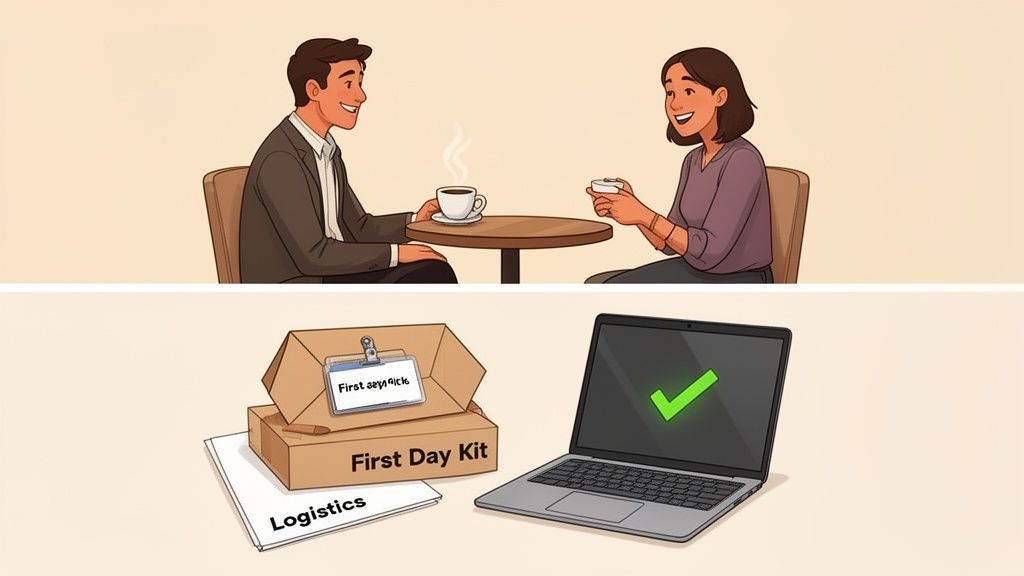
So, what does a people-first Day One look like? It starts with a relaxed coffee, not a stack of I-9s. The new hire's first real meeting isn't with HR; it's a casual one-on-one with their manager. No agenda, just conversation. This small shift immediately establishes a foundation of trust.
From there, the day should be all about weaving them into the social fabric of the company. A team lunch should be non-negotiable. It’s the easiest, most natural way to break down barriers.
Follow that with a tour that's less about the floor plan and more about the people. "This is where the marketing team has their daily huddle," or "Over there is Sarah’s desk; she's our resident expert on the best local lunch spots."
This isn't just about being nice—it's strategic. Companies with a strong onboarding process can boost new hire retention by 82%. Yet, a recent poll shows that only 64% of workers report feeling engaged, a steep drop from just a few years ago. That disconnect often starts on day one. You can dig deeper into these employee onboarding statistics to see the full picture.
The Old Way vs The Human Way: A First-Day Comparison
To see the difference, let's compare the traditional first day with a more modern, connection-focused approach. The schedule might look similar, but the feeling and the outcome are worlds apart.
Time Block | The Old Way (Process-Focused) | The Human Way (Connection-Focused) |
|---|---|---|
9:00 AM | Report to HR, fill out payroll and benefits forms. | Greeted by manager, casual coffee and chat. |
10:00 AM | IT setup: receive laptop, review security policies. | Tour the office, meet key people organically. |
11:00 AM | Awkward "round robin" introductions with the team. | Settle in at desk, unbox welcome kit, chat with a team "buddy." |
12:00 PM | Lunch alone at your desk with a provided sandwich. | Casual, relaxed lunch with the entire team. |
1:30 PM | Mandatory compliance training videos. | 1:1 with team lead to discuss the first week's plan. |
3:00 PM | Finish any remaining paperwork, read the employee handbook. | Sit with HR to handle necessary paperwork and logistics. |
4:30 PM | Sent home, feeling overwhelmed and processed. | End-of-day check-in with manager, feeling welcomed and excited. |
The "Human Way" isn't about ignoring the important stuff. It's about sequencing it intelligently to create a powerful, positive first impression.
The Welcome Kit, Reimagined
Now, the welcome kit. Too often, it’s a pile of branded swag—a mug, a pen, and a t-shirt. While it’s a nice gesture, it doesn’t actually help someone succeed. It's time to rethink the kit as a practical set of tools for a successful start.
Your goal isn't to "process" a new employee. It’s to welcome a new colleague. The welcome kit should reflect that—a toolkit for connection and clarity, not just a bag of logos.
Here’s what a truly useful First-Day Kit includes:
Pre-configured Logins: A simple, sealed sheet with their username and temporary password for every essential tool. No more frantic first-day calls to IT.
A Communication Guide: A quick one-pager explaining how your team communicates. Is Slack for urgent questions? Is email for formal requests? Clarify the unwritten rules.
Key Contacts Cheat Sheet: A "who's who" that goes beyond the org chart. Include the go-to person for IT, for HR questions, and their designated team "buddy."
A Quality Notebook and Pen: Because sometimes, the best ideas are still jotted down by hand.
These principles of clarity and connection are universal, whether your new hire is in the office or remote. Exploring remote onboarding best practices can offer more ideas for making that first day feel personal, no matter the location.
By the time the afternoon rolls around, they've met their team, shared a meal, and feel welcomed. Now, they're in a much better headspace to tackle the paperwork. They aren't an employee ID number anymore; they’re part of the team. And that changes everything.
The First Week: From Surviving to Thriving
A great first day sets the tone, but a great first week builds momentum. This is the crucial window when a new hire transitions from feeling like a visitor to feeling like part of the team. While day one is about making connections, the first week is about building confidence.
Let's be realistic: no one masters their job in five days. The real goal is to architect a series of small, meaningful wins. These early successes prove to them—and to the team—that they can succeed here. A well-thought-out plan for their first week makes all the difference.
Give Them a Map, Not a Maze
Nothing is worse for a new hire than feeling aimless. They're eager to jump in, but they have no idea where to start. The answer is a role-specific checklist, but not a laundry list of chores.
Think of it as a guided tour of their new role. Every item should be a small, achievable goal that helps them learn something tangible.
Day 1 Goal: Set up your communication tools and send a "hello" message to the team.
Day 2 Goal: Review the team's project board and find one previous project that interests you.
Day 3 Goal: Shadow a teammate for 30 minutes on a specific task.
Day 4 Goal: Find and read one document in the company knowledge base relevant to your role.
Day 5 Goal: Write down three questions you have about the team's workflow.
These aren't just tasks; they're small victories. Each checkmark sends a powerful message: "I'm learning, I'm engaging, I'm making progress." It turns "I have so much to learn" into "Okay, this is what I need to do today."
The Lifeline of Check-Ins and Buddies
All the structure in the world won't matter without human support. That’s why two relationships are non-negotiable during the first week: the one with their manager and the one with their onboarding buddy.
I’ve found that quick, 15-minute check-ins at the start and end of each day are invaluable. The morning chat sets the priority: "Today, let's focus on getting you comfortable with our customer support tool." The afternoon debrief provides closure: "How did it go? What questions popped up?"
But let’s be honest. Most new folks are hesitant to bother their new boss with the "silly" questions. Where’s the best coffee? How do you book a meeting room? Is it cool to take a walk mid-afternoon?
This is where the 'buddy' comes in. A buddy isn't a formal mentor; they're a friendly peer who serves as a safe harbor for all the small, practical questions. They are the unofficial guide to the unwritten rules.
This two-pronged support system ensures the new hire gets both formal guidance and informal support. It creates a safety net that encourages questions and dramatically speeds up learning. We've seen this have such a huge impact that we've written about how to collect onboarding feedback to keep refining this process.
Teach Them to Find Their Own Answers
The first week is also the perfect time to teach self-sufficiency. Constantly asking for information is exhausting for the new hire and for the team. This is why a well-organized, centralized knowledge base is one of the most powerful tools in your orientation arsenal.
Instead of answering the same questions over and over, you can guide new hires to a single source of truth. When someone asks about the expense policy, you can say, "Great question! You can find the full guide in our Knowledge Library under 'Finance Policies'."
This does more than save time. It empowers the new hire. It teaches them how to find information on their own, a skill that will serve them for their entire career at your company. You're helping them shift from dependency to resourcefulness.
Here’s the thing: a successful orientation program must adapt to what employees actually need. Looking ahead, a 2024 McKinsey study found that professional development is the number one driver of engagement for 71% of employees, underscoring a deep craving for growth. You can learn more about these workforce trends and see how they are shaping what employees expect.
Ultimately, that first week is a delicate balancing act. It's about providing enough structure for clarity while leaving room for independent discovery. When you get it right, your new hire doesn't just survive their first week—they start to thrive.
The 90-Day Journey to Real Integration
The first week is a blur. Your new hire has their logins, they’ve met the team, and they know where the good coffee is. It’s tempting to pat yourself on the back and call the orientation a success. That’s a mistake.
A good start is critical, but it's only the beginning. True integration—the kind that leads to long-term commitment and real contribution—is a 90-day journey, not a one-week sprint. The real work is just getting started.
When you think of job orientation as a 90-day process, it changes the game. Your goal shifts from just "getting them set up" to guiding them toward becoming a fully integrated, confident, and productive member of your team.
From Learning to Leading in Three Phases
I’ve found it’s best to break this 90-day journey into three 30-day phases. Each has a clear focus, which helps both the new employee and their manager know what to expect.
Phase 1 (Days 1-30): Listen and Learn
The first month is about absorbing information. A new hire’s main goal isn't to be a rockstar contributor; it’s to be a world-class student. They should be asking questions, listening in meetings, and learning the rhythms of the team.
Their job is to understand the people, the processes, and the unwritten rules. Your job is to create a safe space for all this learning to happen. That means regular check-ins, being available for questions, and constantly reinforcing that it's okay not to know everything yet.
This timeline highlights the building blocks for that strong start, focusing on touchpoints like check-ins, celebrating small wins, and using a buddy system.
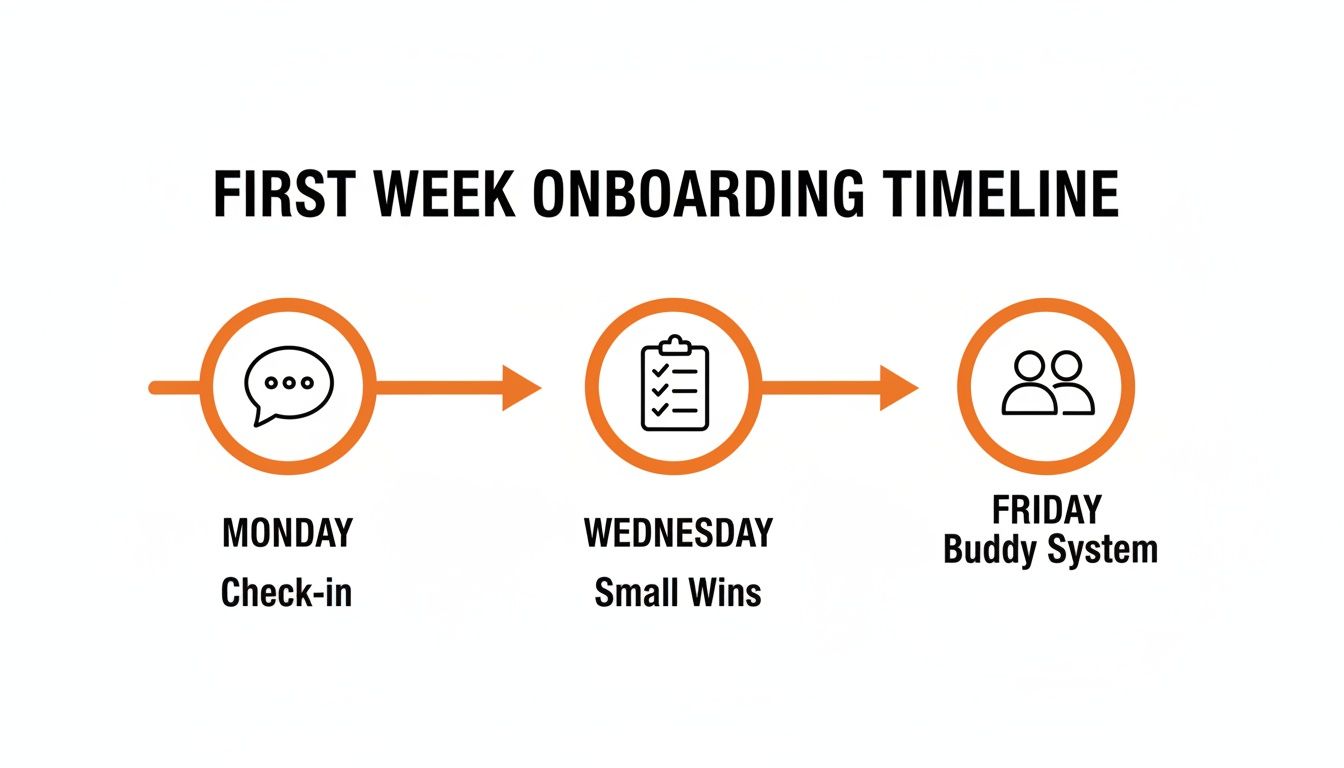
These simple, human-centered steps are what make the 90-day journey possible. They establish a rhythm of communication and support that you'll build on for the next two months.
Phase 2 (Days 31-60): Contribute and Collaborate
Alright, now it’s time to shift from learning to doing. Your new hire should have a solid grasp of the basics. This is when they can begin to contribute in more meaningful ways. They're ready to take on their first small projects, collaborate actively with teammates, and start applying what they've learned.
The focus here is on participation. It’s about moving from the sidelines into the game. As a manager, you should be providing clear, achievable projects with well-defined outcomes. This is also the perfect time to ask for their observations—fresh eyes often spot opportunities for improvement that the rest of the team has stopped seeing.
The most valuable thing you can do during this phase is give them a real problem to solve. Not a test, not busy work, but a genuine, small-scale challenge that allows them to make a tangible contribution. This is where confidence is built.
Phase 3 (Days 61-90): Initiate and Own
By the final month, the training wheels should come off. Your new team member is ready to transition from contributing to owning. This is where they start taking more initiative, managing their own projects with less supervision, and proactively looking for areas to add value.
The goal is autonomy. They should feel comfortable making decisions within their role and confident in their ability to execute. This is the payoff for the investment you’ve made over the first 60 days.
Keeping the Conversation Going
This 90-day structure isn't a rigid set of rules; it's a framework for conversation. And it only works if you support it with a continuous feedback loop. Regular, informal check-ins at the 30, 60, and 90-day marks are non-negotiable.
These aren't formal performance reviews. They're simple, human conversations. Try asking questions like:
"What's been the most surprising thing about working here so far?"
"Where do you feel like you're getting stuck?"
"What's one thing that would make your job easier right now?"
The answers you get will be invaluable. They give you insight into their experience and help you make small adjustments to ensure they succeed.
Extending the orientation for a job over 90 days isn't about creating more work; it’s about making a smarter investment. You're not just filling a role; you're building the foundation for a long, productive relationship. You're showing your new hire that you’re in this for the long haul. And that’s a message that resonates far longer than any first-day welcome gift.
Common Questions About Job Orientation
When you start to rethink your job orientation, a few practical questions always pop up. It's one thing to talk about a human approach, but it’s another to put it into action.
Here are a few of the most common questions we hear from teams ready to ditch the old model and build an orientation that actually makes people want to stay.
How does this work for remote or frontline employees?
This is probably the number one question we get. The answer is simple: the principles don't change, but how you deliver the experience has to. A sense of connection and clarity is just as vital—if not more so—when your team isn’t all in the same room.
For remote and frontline workers, a mobile-first approach is non-negotiable. Their phone is their lifeline to the company, so their orientation needs to live there. Pre-boarding can happen entirely within a simple app where you’ve set up a dedicated welcome space just for them.
The first "day" might be a virtual coffee chat with their manager over video, followed by self-paced learning modules they can tackle on their own schedule. Connection is built in team chats and a company-wide feed where they can see what’s happening across the organization.
For frontline staff—people in the warehouse, on the retail floor, or in a hospital—the content needs to be bite-sized and instantly accessible. They need to pull up safety protocols, scheduling tools, or how-to guides right from their phones, in the moment.
The magic happens when you use a single tool that works just as well on the warehouse floor as it does in a home office. This ensures everyone, regardless of role or location, gets the same feeling of clarity and belonging. It bridges the gap between different parts of your workforce.
We're a small business—isn't this too complicated?
Honestly? Not at all. In fact, a human-centric orientation is often simpler, cheaper, and more effective than a clunky, formal process. This isn't about budget; it's about mindset.
Think about it. A personal welcome text from a manager costs nothing. A team lunch is a small investment that pays off big time in morale. The most powerful parts of a great orientation—an available manager, clear communication, and simply making someone feel welcome—don’t need a big HR team or a fancy system.
They just require a little intention.
If you’re a small team, start small. Don't try to do everything at once. Focus on two things first:
Nailing the pre-boarding: Make that human connection before day one.
Redesigning the first day: Prioritize people over paperwork.
Getting those two areas right will make a huge and immediate difference in a new hire's confidence and engagement. You don't need a huge budget to show people you care.
How do we measure if our new orientation is working?
This is a fantastic question. It forces us to look beyond the shallow "Did you enjoy your orientation?" survey. That’s a happiness metric. It's nice to know, but it doesn’t tell you if the program is actually doing its job.
The metrics that matter are the ones tied to business outcomes. Let’s move past the check-the-box survey and look at what truly moves the needle.
First, look at your 90-day retention rate. This is the big one. A successful orientation for a job is one of your strongest defenses against early turnover. If more new hires are sticking around past that critical 90-day mark, you’re doing something right.
Second, observe engagement firsthand. Are new hires jumping into team chats? Are they asking thoughtful questions in meetings? Are they connecting with people outside their direct team? This qualitative data is a powerful signal of how well they're settling into your culture.
Finally, have informal 30 and 90-day check-in conversations. This isn't a formal review. Just ask simple, open-ended questions like:
"What's been the most helpful thing for you so far?"
"Where do you still feel a bit stuck or confused?"
"What's one thing we could have explained better from the start?"
This direct, honest feedback is absolute gold. It gives you actionable insights to keep improving your process for the next person who joins.
A successful orientation leads to faster ramp-up times, higher engagement, and better long-term retention. Those are the numbers that prove your investment is paying off.
Ready to build an orientation that people actually love? Pebb unifies communication, operations, and engagement into one simple app for both frontline and office teams. Create dedicated onboarding spaces, share critical information, and connect new hires to their teams from day one.
