
What Is Pre-boarding and Why Does It Matter
Struggling with new hire no-shows? We explain what is pre-boarding, how it secures talent before day one, and why it's the key to better retention.
Dan Robin
You’ve found the perfect person. They’ve accepted your offer. Everyone’s happy. The hard part’s over, right?
Not quite. Now comes the silence.
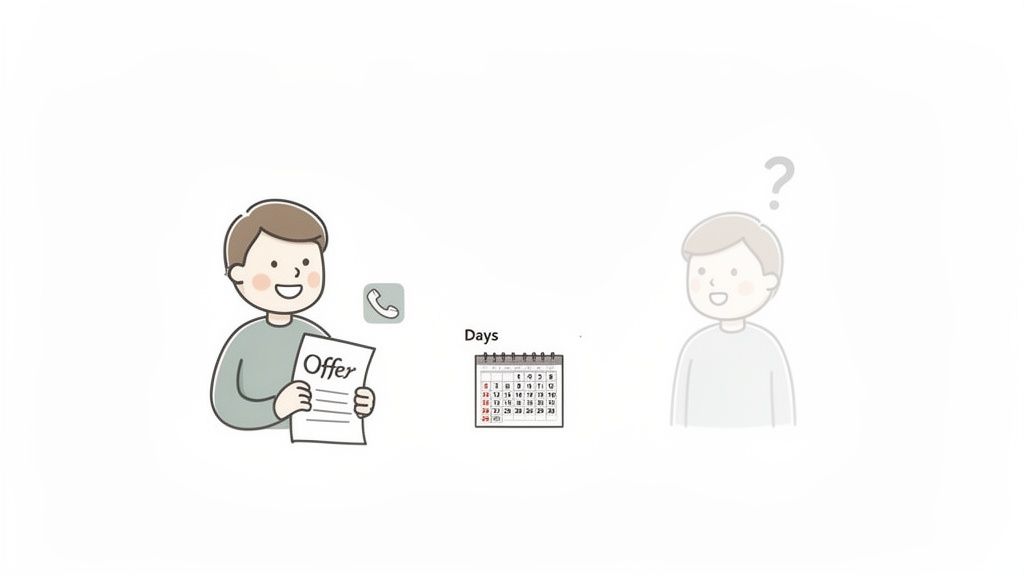
We call it the 'offer acceptance void'—that awkward period of two, three, or even four weeks where a new hire’s excitement can quietly fizzle out. For them, it's a nerve-wracking time. Doubt creeps in. They start to wonder if they made the right call. This is precisely when a competitor's offer starts to look a lot more appealing.
Let’s be honest, this isn't just a gap in the process. It's a human problem. That radio silence doesn't feel like a calm before the storm; it feels like you've already forgotten about them.
What Is Pre-boarding, Anyway?
This is where pre-boarding comes in. It’s the work you do to keep a new hire feeling excited and connected after they say “yes” but before their first day. It’s about bridging that gap, turning anxiety into genuine anticipation.
It’s not about piling on more paperwork or ticking another compliance box. Pre-boarding is simply continuing the great conversation you started during the interviews. It’s a series of small, thoughtful touchpoints that make someone feel like part of the team before they even have a company email.
Think of it this way: if a job offer is an invitation to a great party, pre-boarding is the host sending you the directions, giving you a heads-up on the dress code, and maybe mentioning a few other people who will be there. You’d show up feeling prepared and confident, not standing awkwardly in the corner.
Pre-boarding is the deliberate effort to welcome, connect, and prepare new employees between offer acceptance and their first day. Its goal is to maintain momentum and build a sense of belonging from the start.
The point is to get the tedious stuff out of the way early so you can focus on what matters: the human connection. It's your chance to:
Reassure them with a personal note from their future manager.
Prepare them by sharing a simple agenda for their first week.
Connect them with a quick, informal introduction to their new team.
An Essential for Modern Teams
For companies with frontline or distributed teams, this isn't a nice-to-have; it's a necessity. When your new retail associate, warehouse operator, or remote engineer can't just walk into a central office, these early digital touchpoints are their first impression of your culture. It's how you build connection from day one, no matter where they are.
Getting pre-boarding right is one of the most common-sense steps that too many companies get wrong. They invest thousands to find the right person, only to risk losing them to a few weeks of silence. It’s time to stop leaving that crucial first impression to chance.
What Pre-boarding Is (and What It Isn’t)
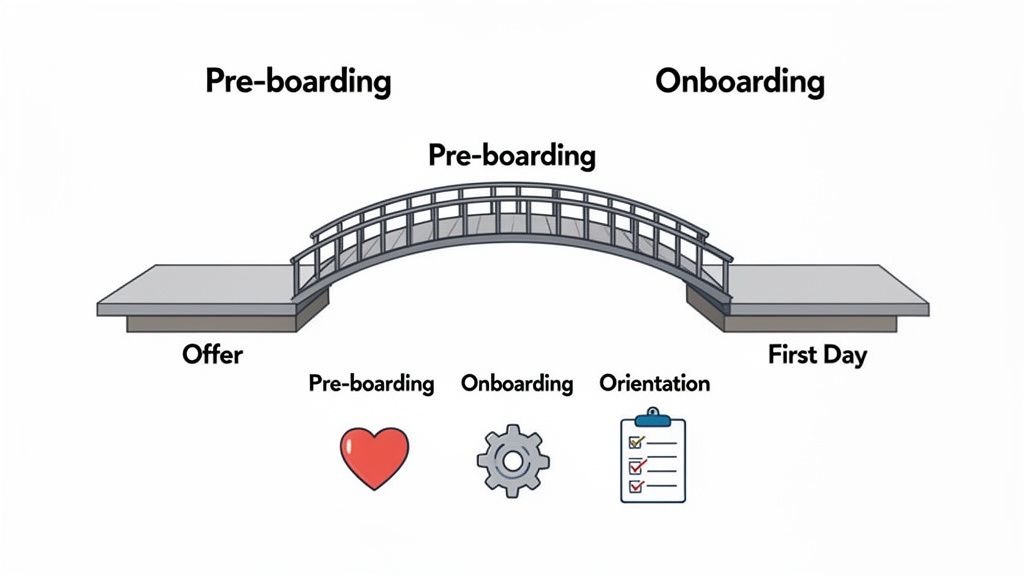
Let's clear this up first: pre-boarding is what happens between the moment a candidate says "I'm in!" and their first official day. That’s it. It’s the bridge over what can otherwise be a silent, anxious gap for your new hire.
But here’s where people get confused. Pre-boarding is not the same as onboarding, and it's definitely not orientation. They each do a completely different job.
The whole point of pre-boarding is to keep the positive energy from the interview process going. It’s your chance to handle the boring administrative stuff early so your new team member can walk in on day one feeling genuinely excited, not dreading a mountain of paperwork.
Think of it this way: getting a job offer is like getting an invitation to a great party. A good host doesn't just stop there. They send you the directions, let you know who else is coming, and give you a heads-up on the vibe. That’s pre-boarding. Your new hire shows up feeling like they’re already part of the group, not like an awkward stranger hovering by the door.
The Three Stages of a Great Welcome
Honestly, these terms get jumbled up all the time, creating a messy experience. When you lump everything together, you overwhelm new hires with compliance forms right when they’re hoping to feel a human connection. Or worse, you skip the connection part entirely.
To nail this, you have to appreciate the unique job of each phase.
Pre-boarding is all about connection and preparation. The goal is to be light, personal, and make someone feel truly welcome before they even start.
Orientation is for compliance and information. This is the necessary, nuts-and-bolts session for getting someone set up in the company’s systems.
Onboarding is for integration and performance. This is the much longer game of helping a new person get up to speed and truly thrive in their role.
Each stage meets a different need at a different time. Mixing them up is like trying to have a heart-to-heart conversation during a rock concert—the timing and setting are all wrong.
The biggest mistake we see is treating these three distinct activities as one giant administrative blob. By pulling them apart, you can give each one the focus it deserves and create a far better welcome.
Pre-boarding vs Onboarding vs Orientation
To make this crystal clear, we’ve put together a simple table breaking down the goals, timing, and activities for each stage. Use this to look at your own process. Chances are, you'll find that what you’ve been calling "onboarding" is a mix of all three, and that true pre-boarding is the piece you’ve been missing.
Here's how they compare.
Stage | Primary Goal | When It Happens | Typical Activities |
|---|---|---|---|
Pre-boarding | Maintain Connection: Keep excitement high and reduce anxiety. | After offer acceptance, before day one. | Sending a welcome video from the manager, sharing a first-week agenda, introducing a work buddy via chat, handling initial IT and equipment requests. |
Orientation | Handle Compliance: Complete essential paperwork and provide basic company information. | Typically on day one, or within the first few days. | Completing I-9 and tax forms, benefits enrollment, reviewing the employee handbook, and explaining key company policies. |
Onboarding | Enable Integration: Help the new hire become a productive and confident team member. | Starts on day one and can last from 30 days to a year. | Role-specific training, setting 30-60-90 day goals, regular check-ins with their manager, and building relationships with the team. |
When you see it laid out like this, the role of pre-boarding becomes obvious. It’s the warm-up act. It sets the stage for a fantastic first day and a smoother transition into the real work of onboarding. Without it, you’re just asking your new hire to show up cold. That's a gamble you don’t have to take.
The Hidden Costs of Skipping Pre-boarding
Thinking of pre-boarding as a "nice-to-have" is an expensive mistake. When a new hire accepts your offer but never shows up—a "non-starter" in HR speak—the costs aren't theoretical. They're real, and they add up fast.
For every person who ghosts you, you’ve likely wasted thousands on recruitment fees and countless hours of your team’s time on interviews and coordination. That investment just vanished.
But the financial sting is only half the story. The real pain is felt on the ground floor. It’s the restaurant manager scrambling to cover a weekend shift because the new cook they were counting on went silent. It’s the warehouse team falling behind on orders because a promised new hire got a better offer during two weeks of radio silence from your company.
The Domino Effect of a No-Show
When a new hire bails, it sends shockwaves through your team. It’s not just an empty desk; it's a burden that lands squarely on the shoulders of your existing employees.
They're the ones who have to pick up the slack, leading to frustration and burnout. Projects get delayed. Deadlines are missed. Customer service takes a hit. This isn't just an HR issue; it's a direct threat to your business.
We often treat pre-boarding as a soft perk, but the costs of skipping it are anything but. A single non-starter can derail a team's productivity and morale for weeks.
Think about the message this sends to your current staff. They see the frantic scramble and feel the added pressure. It quietly communicates that the company’s hiring process is unreliable, which does nothing to build confidence or loyalty.
The ROI of Staying Connected
Here’s the good news: this is an almost entirely preventable problem. Keeping a new hire warm and engaged between offer acceptance and day one doesn't require a massive budget or a complicated program. It just requires a little thought.
The data is clear on this. A solid pre-boarding process can boost new hire retention by as much as 82% and drastically reduce the number of non-starters. It’s not about sending fancy gift baskets; it’s about making sure the talent you just invested in actually shows up, excited and ready to go.
A few simple, automated touchpoints can make all the difference:
A quick welcome video or message from their direct manager.
A simple PDF explaining what to expect on their first day.
An introduction to a work buddy in the team's group chat.
These small gestures transform the waiting period from a time of uncertainty into one of genuine anticipation. You can explore more on this topic by reading our guide on why new hires struggle to get up to speed and how to solve it.
Ultimately, pre-boarding is a direct investment in your operational stability. It turns a fragile waiting game into a solid foundation for a long, productive relationship. When you look at the true costs of a no-show, the question isn’t whether you can afford to pre-board. It’s whether you can afford not to.
A Simple Pre-boarding Plan That Works
Theory is great, but let’s talk about what works on the ground. A good pre-boarding plan doesn’t need a huge budget or complicated software. It’s just a series of small, intentional steps that turn that two-week waiting game into a genuine welcome.
Here’s a simple, week-by-week blueprint any manager can adapt. Think of it as a journey, not a checklist. The goal here is connection, not just ticking boxes. Most companies have a two-to-three-week gap between offer and start date, so this timeline fits that common window.
This graphic shows exactly what we're trying to avoid: that dreaded "radio silence" period where excitement turns to doubt.
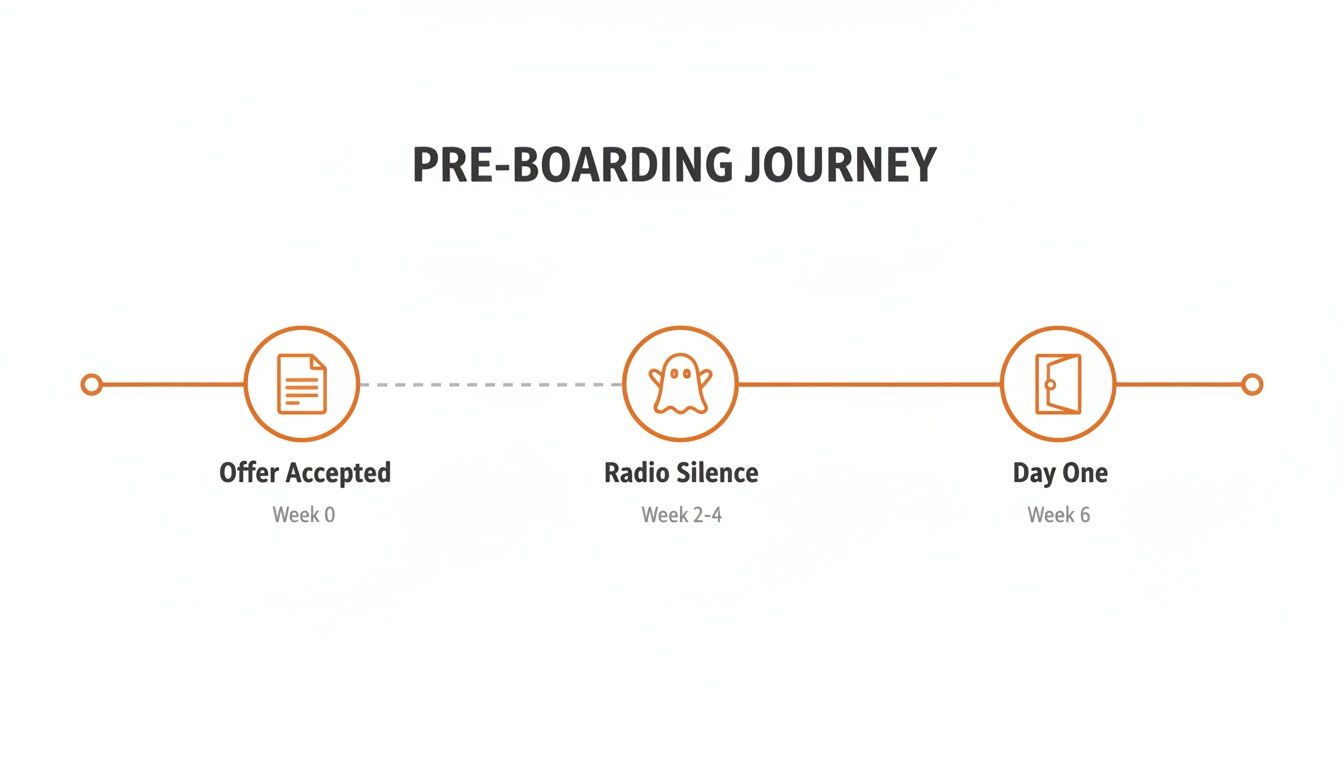
Good pre-boarding closes that gap.
Week 1: The Welcome
The moment they accept, the clock starts. This first week is all about making their decision feel real and personal. You want to reinforce that they made the right choice and shift the dynamic from a formal transaction to a human relationship.
Your focus this week is personal connection.
One of the most powerful things you can do is send a short, informal video from their direct manager. I’m not talking about a polished corporate production—just a quick "Hey, we're so excited to have you join us!" shot on a phone. It takes five minutes but has a massive impact. It immediately says, "I'm your future boss, and I'm already thinking about you."
Follow that with a welcome email that includes two key things:
A friendly, high-level rundown of what to expect in their first week.
A clear point of contact for any small questions that might pop up.
This isn’t about overwhelming them. It’s about replacing uncertainty with simple, clear information.
Week 2: The Logistics
Now it’s time to get the boring stuff out of the way so it doesn’t bog down their first day. Week two is about handling the necessary paperwork and tech setup, but the key is to make it painless.
The goal here is effortless administration.
Nobody wants to spend their first morning filling out tax forms and I-9s. Use a mobile-friendly tool to send these documents ahead of time. Letting them handle the paperwork from their couch, on their own schedule, shows you respect their time and want Day One to be about people, not paper.
This is also the perfect time to sort out equipment and swag.
Ask for their laptop preference (if you offer a choice).
Confirm their shipping address for their new gear.
Get their t-shirt size for some company swag.
Each of these small actions sends a powerful signal: We are preparing for you. It makes their arrival feel expected and valued. The less they have to worry about logistics on that first day, the more headspace they have for meeting their new colleagues.
Week 3: The Connection
In the final week before they start, the focus shifts from the company to the team. This is your chance to build the first, fragile bridges to the people they'll be working with.
The theme for this week is building bridges.
Let’s be honest, walking into a new team is intimidating. You can soften that landing by making an introduction before they even arrive.
The single best way to do this is to assign a "work buddy" or "first-day friend" and have that person reach out. A quick message like, "Hey everyone, just a heads-up that [New Hire's Name] is joining us next Monday! I'll be their go-to for the first few weeks," works wonders.
This gives the new hire a friendly face and a safe person to ask the "dumb" questions they might not want to bother their manager with. (Where do we post project updates? What’s the best place for coffee nearby?)
It’s a low-effort, high-impact gesture that makes your team feel more like a community and less like a collection of strangers. For a more detailed guide, you can find a helpful onboarding checklist for new employees that builds on these principles.
This whole plan costs next to nothing to implement. It just requires a bit of thought. It proves that a world-class welcome isn’t about the budget—it’s about making a new person feel seen, valued, and connected right from the start.
Common Pre-boarding Traps and How to Avoid Them
It’s easy to get excited about pre-boarding, map out a plan, and then, with the best of intentions, create a terrible experience for your new hire. We’ve seen it happen more times than we can count.
Let's talk about the number one mistake: overwhelming people.
The point of pre-boarding is to build confidence, not to cram a month of training into two weeks. It should feel like a light, reassuring touch—not a firehose of information aimed at their face.
The Digital Paper-Pushing Trap
One of the biggest pitfalls we see is turning pre-boarding into what we call "digital paper-pushing." This is what happens when you get so wrapped up in administrative efficiency that you forget there’s a human on the other side of the screen. You fire off a dozen forms and policy documents, patting yourself on the back for getting it all "out of the way."
But to the new hire, it just feels like homework. The excitement they felt during the interview is suddenly replaced by a pile of bureaucratic tasks. Instead of feeling welcomed, they feel like they’re already being managed. You're not reducing day-one friction; you're just front-loading it.
Let’s be honest. Nobody gets excited about filling out a W-4. If your pre-boarding is 90% forms and 10% human connection, you're doing it wrong. The paperwork is a necessary evil, not the main event.
The One-Size-Fits-All Mistake
The second major trap is assuming every new hire is the same. A one-size-fits-all approach is easy to implement, but it’s a lazy move that completely ignores a person's role. The pre-boarding for a remote corporate accountant should look very different from that of a frontline retail associate.
Think about their world and what they actually need to feel ready.
For the accountant: An invite to the finance team's Slack channel and a link to the accounting tool they'll be using might be perfect.
For the retail associate: A picture of their new team, a simple map of the stockroom, and the name of their first-day buddy is infinitely more valuable.
Personalization doesn’t have to be complicated. It's just about being thoughtful enough to ask, "What would make this person’s first day a little easier and a lot less intimidating?"
Sadly, most companies drop the ball on this. Research shows that a staggering 64% of employees report receiving no pre-boarding at all, and 40% don't even get basic information for their first day. The bar is shockingly low, which makes it incredibly easy for you to stand out by simply being considerate. You can read more about these onboarding statistics and see just how big the opportunity is.
By avoiding the temptation to drown new hires in paperwork and by taking a few minutes to tailor the experience to their role, you’re already way ahead of the game. Pre-boarding is your first, best chance to show you see your new hire as a person, not just a headcount. Don’t waste it.
Starting the Conversation Before Day One
When you get right down to it, pre-boarding is simply the start of a relationship. All the tools, checklists, and timelines are just there to support one crucial goal: making a real human connection.
We’ve covered the data, the costs, and the game plans. But the most important piece is a change in perspective. It's about treating the time between "yes" and the first day not as a quiet waiting period, but as your first chance to make someone feel like they already belong.
The Mindset of Welcome
The companies that get this right aren't the ones with the biggest budgets. It's not some secret playbook. They’ve simply decided to be more thoughtful and human in how they welcome new people.
Pre-boarding isn’t about a bigger budget; it’s about being more thoughtful. It’s the simple decision to continue the conversation after you’ve decided you want someone on your team.
This simple shift has a massive payoff. It's no accident that top-performing companies are 35% more likely to kick off their welcome process before day one. They see huge returns in engagement and how fast their new hires contribute. While many organizations let this slip by, those that prioritize it—like teams using Pebb—find their new folks hit the ground running. You can dig into more data on how pre-boarding creates a competitive edge in these recent employee onboarding statistics.
This isn't about grand, expensive gestures. It's about sending small, consistent signals that say, "We see you, we're excited, and we're getting everything ready for you."
Your First, Small Step
You don’t need to build a complex program overnight. The best pre-boarding often starts with one small, genuine action. The most important thing is to simply begin. If you're looking for inspiration on what to say, our guide on onboarding communication templates has plenty of ideas.
So, let's make this real. Think about the very next person you hire. What is one small thing you can do for them, right now, to make them feel welcome before they ever set foot in the office?
It could be a quick text from their future manager. Maybe it’s a friendly email introducing them to their "day-one buddy." Whatever it is, that single act of connection is the true start of great pre-boarding. It's about opening a conversation, and now you have everything you need to do just that.
Answering Your Top Pre-boarding Questions
Alright, the concept makes sense. But when you think about actually doing it, questions pop up. We hear them all the time from HR and operations leaders, so let's tackle the most common ones.
How Long Should Our Pre-boarding Period Be?
You're looking for the sweet spot. In our experience, that's usually one to three weeks. This gives you enough time for a few meaningful check-ins without overwhelming your new person or letting the energy fizzle out.
Think of it like this: anything shorter can feel rushed, while a longer period can feel drawn-out. A great cadence might be a personal welcome in the first week, getting logistics out of the way in week two, and then introducing them to the team the week before they start. The goal is consistent, light communication, not a giant info dump.
What Is the Single Most Important Pre-boarding Activity?
If you only have the bandwidth for one thing, make it personal. A simple, informal welcome video from the direct manager has a massive impact on a new hire's confidence and excitement.
This small gesture immediately changes the tone from a formal business transaction to a real human connection. It costs nothing, takes five minutes to shoot on a phone, and does wonders to reassure someone they've made the right decision.
If your pre-boarding is just a quick welcome video from the manager and a clear schedule for day one, you’re already ahead of the game. That human element is what makes the difference.
How Do We Measure the ROI of Pre-boarding?
What gets measured gets managed. The three most telling metrics to watch are your "non-starter rate" (people who accept an offer but ghost you on day one), your turnover within the first 90 days, and your new hire engagement scores.
Start by getting a baseline for these numbers before you roll out a pre-boarding program. Then, check those same numbers again three to six months later. When you see fewer no-shows and less early turnover, you have a clear financial and cultural win that proves your efforts. If you want to dig deeper into what makes a new hire's first few months successful, you can find a ton of great employee onboarding best practices.
Ready to turn that awkward waiting period into a genuine welcome? Pebb brings your communication, paperwork, and team engagement together in one simple app. It makes it easy to run a pre-boarding experience that connects new hires from the moment they say "yes." Learn how Pebb keeps your team in sync.
