
Your Intranet on Cloud Shouldn't Be a Digital Graveyard
Discover why an intranet on cloud is more than a tool—it's your company's digital home. A guide to benefits, migration, and choosing the right platform.
Dan Robin
Let's be honest. Your company intranet is probably where good intentions go to die. It's that dusty digital corner where old PDFs and forgotten announcements collect virtual cobwebs. It’s slow, clunky, and for anyone not chained to a desk, it might as well not exist.
This isn't just a hunch. We’ve lived this story. And we’ve seen countless companies struggle with the same thing.
Why Your Old Intranet Is Silently Costing You

We've all been there. It’s the classic tale of a tool that was supposed to connect everyone but ended up building more walls. You know the drill: jumping through VPN hoops just to find an HR policy, or dealing with load times that make you wonder if the server is powered by a hamster on a wheel.
This isn't just a technology headache; it's a culture killer. All that friction silently drains your team’s energy and focus. Every minute spent hunting for a document or wrestling with a login is a minute they aren't spending on their real jobs. This slow burn of wasted time is a huge hidden cost. It just keeps adding up.
The Disconnect for Your Frontline Teams
And let's talk about the people who get hit the hardest: your frontline employees. I’m talking about the retail staff, the warehouse crews, and the healthcare workers who are the lifeblood of your business. They don’t sit at desks. Their work happens on their feet, on the move, and almost always on their phones.
To them, an old-school, on-premise intranet is a ghost. It offers zero value because it’s totally out of reach.
They can't get crucial, real-time updates. They miss out on important company-wide announcements. And they feel completely disconnected from the organization's mission and culture.
This gap isn't just an inconvenience; it's corrosive. It sends a clear message to your most essential people that they aren't really part of the conversation. If you’ve ever wondered why engagement is low, this is a huge piece of the puzzle. You can dig deeper into this in our article about why your intranet isn't working and how to fix it.
Here’s the hard truth: a tool that only serves half your company isn't a company tool at all. It's a relic.
It's time to close the book on the digital graveyard. There's a much simpler, more human way to connect everyone, no matter their role or where they work. By moving your company’s central hub to an intranet on cloud, you can finally build a digital home that works for everyone. One that’s fast, accessible, and actually helps people do their jobs better.
What An Intranet On Cloud Actually Is
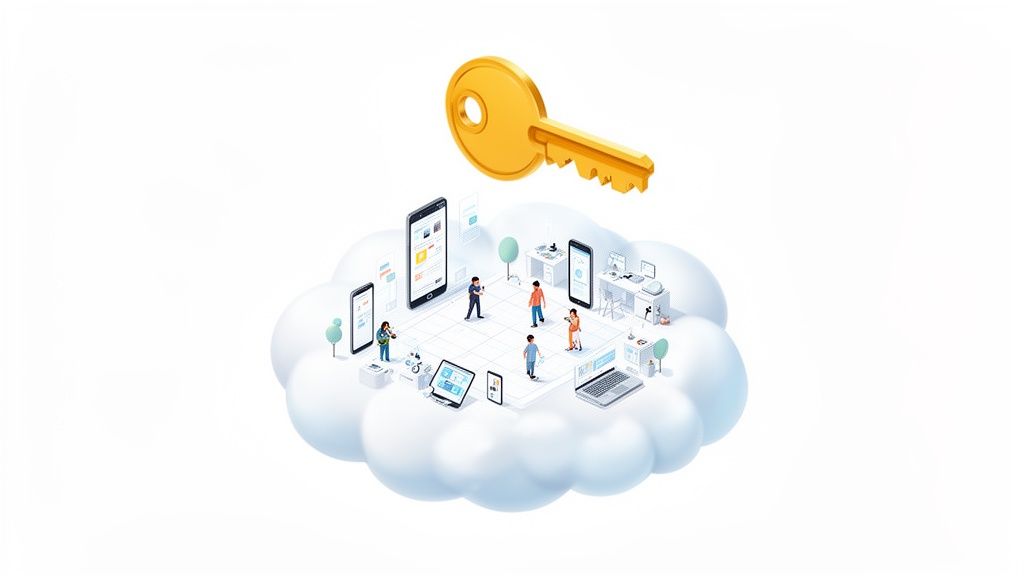
Let's clear something up. An intranet on cloud isn't some complex monster that only your IT department can understand. Forget the old days of dedicated servers, hosting contracts, and endless maintenance. At its heart, a cloud intranet is just your company’s digital home—one that’s always on and accessible from anywhere.
Think about the traditional intranet. It was like a locked file room in the office basement. To get anything, you had to be in the building, have the right key, and know which dusty box to rifle through. Secure, yes, but also a fortress.
A cloud intranet flips that idea on its head. It’s more like a bright, open workspace that everyone can enter with their own key—a phone, a tablet, or a laptop. No more clunky VPNs or being chained to a desk just to get an update. It’s a basic shift in how we give access to our people.
More Than Just Files in the Sky
But here’s the thing. This isn’t just about moving your files online. That’s old news. A modern cloud intranet is about creating a living space where your company culture can actually thrive. It's a place for connection, not just content.
When your intranet lives on the cloud and is built for people, its entire purpose changes. It stops being a static library and becomes a dynamic community hub.
For a new barista, it's a place where they can watch training videos on their phone before their first shift and feel part of the company from day one. For a CEO, it’s a direct line to every employee, letting them share a crucial update by video and see real-time questions pop up from the factory floor. For a remote team, it’s the digital water cooler where they share wins and build the real relationships that spark great work.
The real power of an intranet on cloud is that it’s built for people, not for servers. It prioritizes the human experience of work over the technical mechanics of data storage.
This changes everything because it makes your company’s central hub inclusive by design. It finally acknowledges that great work doesn’t just happen in a headquarters building between 9 and 5. It happens on a nurse's 10-minute break, on a driver’s route, and in a home office thousands of miles away. You can explore this concept further by reading about the power of an intranet for modern organizations.
By moving your company's heart to the cloud, you're not just buying another piece of software. You’re making a statement that every employee, no matter their role or location, deserves to be connected, informed, and included. That’s the real "why" behind it all.
The Real-World Benefits Beyond The Buzzwords
The tech world loves its buzzwords. "Scalability," "cost savings," "digital transformation." We hear them so often they lose all meaning. But when we talk about a cloud intranet, we’re really talking about real, day-to-day improvements for the people doing the work.
Let’s be specific. For an HR manager, this isn't about abstract cloud architecture. It's about getting an urgent benefits update to 5,000 employees across 10 countries in minutes, not waiting months for IT. For a supervisor on the factory floor, it’s not about “analytics.” It’s about pulling out a tablet and instantly seeing which team members have completed their safety training.
This is where the conversation shifts from tech theory to practical wins. We're talking about making work simpler and more connected for everyone.
From Years To Days, From Capital To Common Sense
One of the most striking changes is speed. I’ve watched organizations pour years and small fortunes into building or updating an on-premise intranet. These projects become a black hole for budgets and IT hours. By the time they launch, they’re already out of date.
With a modern cloud intranet, that timeline collapses. We're talking about deploying in days, not years. No servers to rack, no infrastructure to patch, no complicated software to install. You pick a service, send out the invites, and your teams are up and running.
This also changes your bottom line. The finance folks call it a lower total cost of ownership (TCO). In plain English, you stop sinking money into blinking lights and humming servers in a closet. Instead, you pay a predictable subscription for a service that just works and keeps getting better.
The global Intranet Packaged Solutions market is growing at a steady clip, with cloud options outpacing traditional systems. Why? Because they have a lower total cost of ownership and can be deployed in weeks instead of years—a crucial advantage as hybrid work becomes the norm. You can explore more about these market trends and their drivers.
This isn’t about being cheap; it’s about being smart with your resources. It frees up your budget and, more importantly, your people’s time to focus on work that actually grows the business.
One Place For Everything and Everyone
Beyond cost and time, the most human benefit is creating a single source of truth. Think about the hours wasted every week searching for the latest sales deck or asking three different colleagues the same question and getting three different answers.
A good cloud intranet ends that chaos. It becomes the one reliable place for everything that matters: company news, essential documents, and team knowledge.
This is about more than just getting organized; it’s about building trust and clarity. When everyone knows where to find the correct information, you slash mistakes, cut down on repetitive questions, and help your teams make decisions with confidence.
It connects the frontline employee in a remote store to the CEO at headquarters, ensuring they both read the same message at the same time. This shared context is the bedrock of a strong culture—the digital version of everyone gathering in the town square.
Making The Switch Without The Headaches
The thought of moving your company's intranet can trigger a small wave of anxiety. I get it. We’ve all sat through painful "digital transformations" that felt more like digital disasters. But shifting to a cloud intranet doesn't have to be a nightmare. When you approach it the right way, it can be surprisingly smooth.
This isn't just about moving files from Server A to Server B. It's about changing how people work and connect. That’s a human process, not a technical one. The biggest mistake I see is treating migration like a pure IT project. Companies get lost in data fields and migration scripts, and they forget about the people who will actually have to use the thing every day.
The whole point is to make things better for your team.
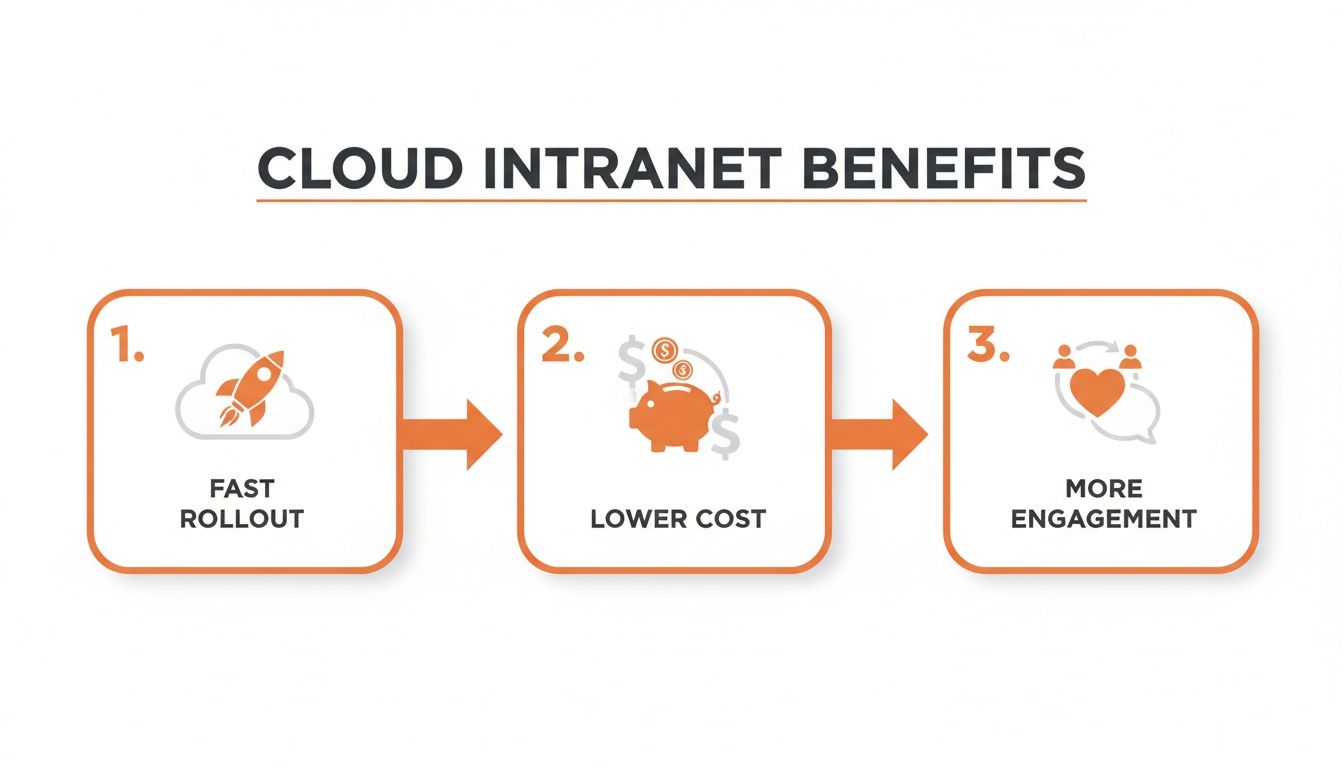
As you can see, the real advantages are about efficiency and adoption—two things old-school migrations almost always get wrong.
Start With Governance, Not Gadgets
Before you look at a single demo, your first conversation should be about governance. It might sound boring, but trust me, it’s the foundation of a successful launch. Simply put: who owns what? Who has the final say on the homepage news? Who is responsible for keeping the HR section updated?
If you don't answer these questions upfront, you're setting yourself up for chaos later. A great cloud intranet isn't a digital free-for-all; it's a well-organized workspace. Defining roles from day one ensures accountability and stops the platform from becoming another digital graveyard.
Here’s a simple way to start:
Content Ownership: Assign a clear owner for each major section (e.g., HR, Operations, Marketing). This is their turf. They keep it fresh.
Communication Cadence: Decide who can post company-wide announcements and how often. This prevents a constant firehose of noise.
User Permissions: Define roles. Not everyone needs admin rights. A good system lets you give people just enough access to do their jobs.
The Human Side of Integration and Adoption
Once you have a plan for your people, then you can think about the technology. How will your new intranet talk to your other systems? The best cloud tools integrate smoothly with platforms you already use, like your HR and payroll software. This isn't about writing custom code. Often, it’s just a few clicks.
But here’s the most important part: adoption. A successful launch isn't a "big bang" event with a memo nobody reads. It's a steady drumbeat of communication that starts weeks before you go live. You need to show people what's coming and, more importantly, why it will make their jobs easier.
Your secret weapon here is a single, simple onboarding process. The best platforms let you invite your entire organization with one link. No complicated logins, no IT tickets. Just click and go.
This simplicity is critical. It removes friction and signals that this new tool is for everyone. It respects their time and gets them engaged from the first minute. If you want to dig into the more technical side, here's a practical guide on how to migrate to cloud.
Ultimately, making the switch is less about flicking a server switch and more about guiding your people to a better way of working. For a deeper dive on the data side, check out our guide on data migration best practices. Focus on the human element, keep it simple, and you’ll avoid the headaches.
How A Cloud Intranet Unites Everyone
Let’s step back from the technical details and talk about what really matters: your people. For too long, companies have unintentionally created a two-tiered culture—the office workers who are always “in the know,” and everyone else who feels left out.
An intranet on cloud, especially one that’s brilliant on a phone, finally breaks down that barrier. It stops being just another business tool and becomes a genuine connection for your entire organization.
It’s about creating one shared experience for every single person on your payroll, no matter their role, location, or device.
A Day in the Life of a Connected Team
Instead of listing features, let’s see what this looks like in the real world.
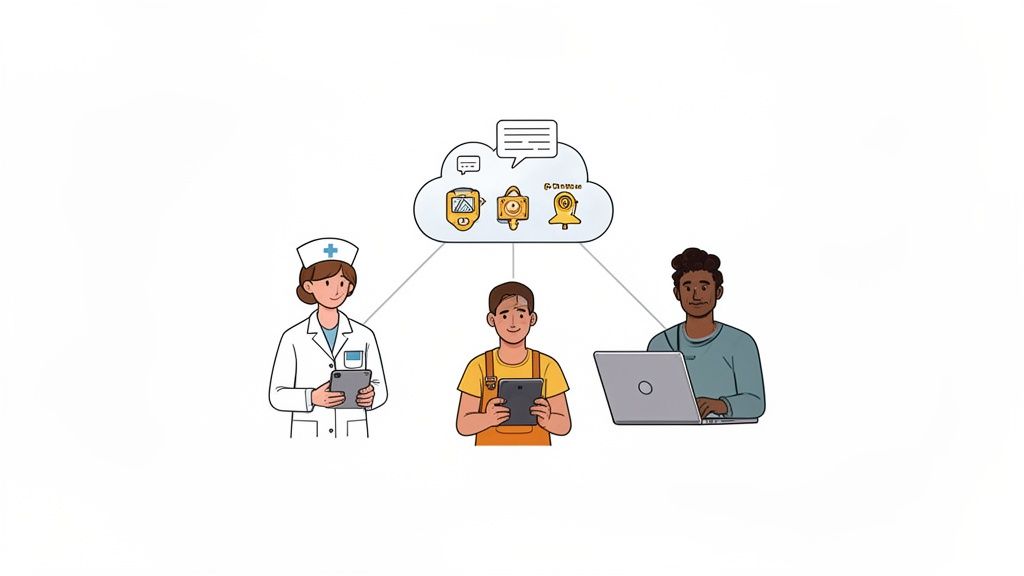
Picture Maria, a nurse finishing a long shift. Instead of scanning a cluttered noticeboard, she pulls out her phone. A clear notification pops up about a new patient protocol. It's immediate, relevant, and helps her prepare for her next shift.
Now, think of David, a retail associate on the shop floor. A customer asks a tricky question. Instead of saying, "I'll have to find out," he quickly pulls up a short training video on his phone, gets the answer, and closes the sale. He feels capable, and the customer is happy.
And what about Sarah, a developer working from home in a different time zone? She posts a question in her team's digital space before logging off. Hours later, a colleague at headquarters sees it, adds the solution, and Sarah has her answer waiting for her in the morning. No frustrating delays.
This isn't about giving people another app. It’s about giving every employee—from the front desk to the back office—the same access to the information and community they need to feel like they belong and do their best work.
Each of these small moments adds up to something massive. They build a powerful sense of shared purpose and forge a single, unified company culture where everyone feels seen, heard, and valued.
Closing the Great Divide
The gap between desk-based staff and frontline teams is one of the most persistent challenges in business. One group has instant access to company news, while the other often gets information last—if at all. This disconnect is a primary reason frontline employees feel detached from the company's mission.
A modern cloud intranet is the bridge that spans this divide. It democratizes information. It no longer matters where you are, but who you are: a member of the team.
This is crucial in a world where 94% of enterprises use cloud computing and over 60% of all corporate data is stored there. Your people's hub should be there, too. Industries like retail and media are already leading the charge, with 79% and 73% cloud usage respectively, because they know it’s the key to connecting a distributed workforce. You can learn more about the widespread adoption of cloud solutions to see the full picture.
The Foundation of Belonging
At the end of the day, people want to feel like they’re part of something bigger than themselves. They want to understand the company's vision and see how their work contributes. They want to connect with colleagues and feel a sense of community.
Old, on-premise systems were never built for this. They were products of a different era—cold, static information dumps.
A modern, mobile-first intranet on cloud is the opposite. It’s dynamic, engaging, and fundamentally human. It serves as the digital town square, the virtual water cooler, and the company bulletin board, all rolled into one easy-to-use place that fits in your pocket.
It gives every employee a voice and a seat at the table. When people feel like they belong, they don’t just work for a paycheck. They show up ready to make a real difference. Now that's a company worth building.
Choosing The Right Platform: A Simple Checklist
Picking the right tool can feel like wading through an endless sea of feature spreadsheets. Every vendor promises the moon. Soon, everything starts to sound the same. That approach is broken.
You're not just buying features; you're choosing a digital home for your company. The right intranet on cloud should feel less like a rigid piece of software and more like a great local coffee shop—welcoming, easy to navigate, and a place people actually want to be.
Instead of getting lost in a hundred checkboxes, I find it’s better to ask a few direct questions. These get to the heart of a vendor’s philosophy and reveal whether they understand how modern teams work.
Does It Feel Simple and Delightful to Use?
This is my number one. It's non-negotiable. If a tool isn’t genuinely pleasant to use, people won’t use it. End of story. Fire up a demo and trust your gut. Does it feel intuitive and fast, or clunky and confusing?
Look for a clean, uncluttered design. A platform cluttered with endless menus signals a lack of focus. A great tool has strong opinions about what matters and gets everything else out of the way.
The real test: after a 15-minute demo, do you feel energized and clear, or exhausted and overwhelmed? That feeling is your best indicator of what your employees will experience every day.
A simple user experience isn’t a "nice-to-have." It’s the foundation of adoption. Without it, even the most powerful features will just gather dust.
Is It Built for the Phone First?
Let’s be real. Your teams live on their phones. Your new intranet must be brilliant on a small screen, not just a shrunken version of the desktop site. This is especially true for your frontline workers who often don't have company laptops.
Ask the vendor to show you the mobile app—live. Can you easily read an update, chat with a colleague, and find a document? If the experience is anything less than seamless, walk away. A "mobile-friendly" design is not the same as a true mobile-first approach.
Does It Unify or Just Add Another Tool?
Your goal should be to simplify your company's tech stack, not complicate it. Does the platform bring core activities like communication and knowledge sharing into one place? Or is it just another silo people have to remember to check?
A great intranet on cloud acts as a unifying layer. It should integrate cleanly with your essential systems, like HR and payroll, without needing a team of developers. It brings your people and processes together. When considering the underlying infrastructure, it's also worth evaluating major providers to see which cloud should you choose for your specific needs.
How Seriously Do They Take Security and Data Control?
Finally, security. Your intranet holds sensitive company information, so your provider must be obsessive about protecting it. But security isn't just about preventing hacks; it's also about controlling your data's location.
With global sovereign cloud spending projected to hit $80 billion by 2026, data control is no longer a niche concern. For anyone in regulated industries like finance or healthcare, this is critical. You need to know that your chosen platform respects data residency rules, ensuring your information is stored in compliance with local laws. The fact that three-fourths of business leaders now worry about geopolitical data risks shows just how important this has become. You can read the full report on sovereign cloud trends to understand the shifting landscape.
Choosing a platform isn't just a technical decision; it's a cultural one. You're picking a partner to help you build a more connected, transparent, and engaged organization. Look past the buzzwords, focus on these fundamentals, and the right choice will become clear.
Frequently Asked Questions
It’s normal to have questions before making a big switch like moving to an intranet on the cloud. We've been through this process with countless leaders. A few key questions always come up. Let's tackle them head-on.
Is an intranet on cloud secure enough for our company data?
This is usually the first question, and for good reason. The short answer? Yes. It’s almost certainly more secure than what you’re running on-premise right now.
Here’s why: Top-tier cloud intranet providers live and breathe security. It’s their business. They have teams dedicated to monitoring threats 24/7 and invest millions in infrastructure and audits—a level of security that’s not feasible for most companies to replicate on their own. They worry about encryption, patches, and compliance with standards like GDPR so you don't have to.
Think of it like this: you can keep your cash under your mattress, or you can put it in a bank vault. A reputable cloud platform is the bank vault for your data.
Plus, you get much finer control. Modern platforms let you set specific permissions, deciding exactly who can see, edit, or share information. This is a world away from the clunky, all-or-nothing access of older systems.
Can our frontline teams use the intranet without company emails?
Absolutely. In fact, this is one of the biggest reasons to make the switch. For decades, intranets were designed for desk workers with corporate email, which left out a huge part of the workforce.
A modern, cloud-based intranet is built for everyone. You can onboard employees with just a phone number or a QR code. This means your frontline staff, seasonal workers, and contractors can get connected in minutes. They stop being the last to know and start feeling like a true part of the team.
What is the real ROI of switching to a cloud intranet?
The return on your investment comes from two places.
First, there are the hard cost savings. You ditch expensive servers, stop paying for constant maintenance, and free up your IT team from patching a system that’s always a step behind.
But the real game-changer is the "soft" ROI, the stuff that builds a better business: less turnover because people feel connected and valued; higher productivity now that finding information takes seconds, not hours; faster onboarding so new hires feel confident from day one; and fewer costly mistakes because everyone is working from the same single source of truth.
That’s the kind of value that doesn't just save you money—it creates a more resilient and humane company culture.
Ready to build a digital home that unites everyone? With Pebb, you can bring your entire team together with one simple app for communication, operations, and engagement. See how it works.
