
Operations Management Methods That Actually Work
Ditch the jargon. Learn the core operations management methods (Lean, Six Sigma, JIT) and how to apply them to your frontline team. A real-world guide.
Dan Robin

Teams often don't feel broken. They feel busy.
The café opens at 7. By 8:15, the line is out the door, one espresso machine is acting up, the new hire can't find the oat milk lids, mobile orders are piling up, and the manager is doing three jobs at once while answering a text from the owner about labor costs. Nobody in that room is thinking, “We need better operations management methods.” They're thinking, “Why is everything harder than it should be?”
That's usually where operations work starts. Not in a boardroom. In the daily drag of repeated friction.
In retail, hospitality, healthcare, and logistics, the mess is harder to see than it is on a factory floor. The waste often hides inside handoffs, delays, unclear priorities, and people waiting on each other. The product is often a service or an experience, so the breakdowns don't sit on a pallet. They show up as a late room turnover, a patient waiting too long, a missed delivery window, or a burned-out supervisor covering another shift.
The Unspoken Mess of Daily Work
A clinic can look calm from the lobby and still be operationally chaotic. Front desk staff are checking people in, nurses are hunting down supplies, a provider is waiting on one missing piece of information, and the schedule starts slipping before lunch. Nobody planned for disorder. It just crept in through dozens of small decisions.
I've seen the same pattern in restaurants and stores. The team works hard, but the work itself fights back. Items are stored in the wrong place. People interrupt each other for updates. The same question gets answered five times in one shift. Managers patch holes all day and call it leadership.
The real problem usually isn't effort
That's why operations management matters. Not as a corporate discipline with a wall of acronyms, but as the craft of making work less clumsy. It asks a plain question: Does this have to be this hard?
Good operations work doesn't begin with software or a grand redesign. It begins with noticing. Where do people stop and wait? Where do they redo work? Where does confusion force a manager to become a traffic cop?
Most operational pain comes from ordinary friction that people have learned to tolerate.
Once you start seeing that, you stop blaming individuals for problems the system keeps creating. That shift matters. A lot. It changes the conversation from “Who messed this up?” to “Why does this process keep producing the same mess?”
Calm is an operational outcome
The best-run teams I've worked with don't always look faster. They look calmer. People know what matters now. Tools are where they should be. Decisions happen closer to the work. Handoffs are clean. Problems still happen, but they don't trigger a chain reaction.
That's what effective operations management methods are really for. Not perfection. Not bureaucracy. Just a smarter way to run the day.
The Big Ideas Behind Better Operations
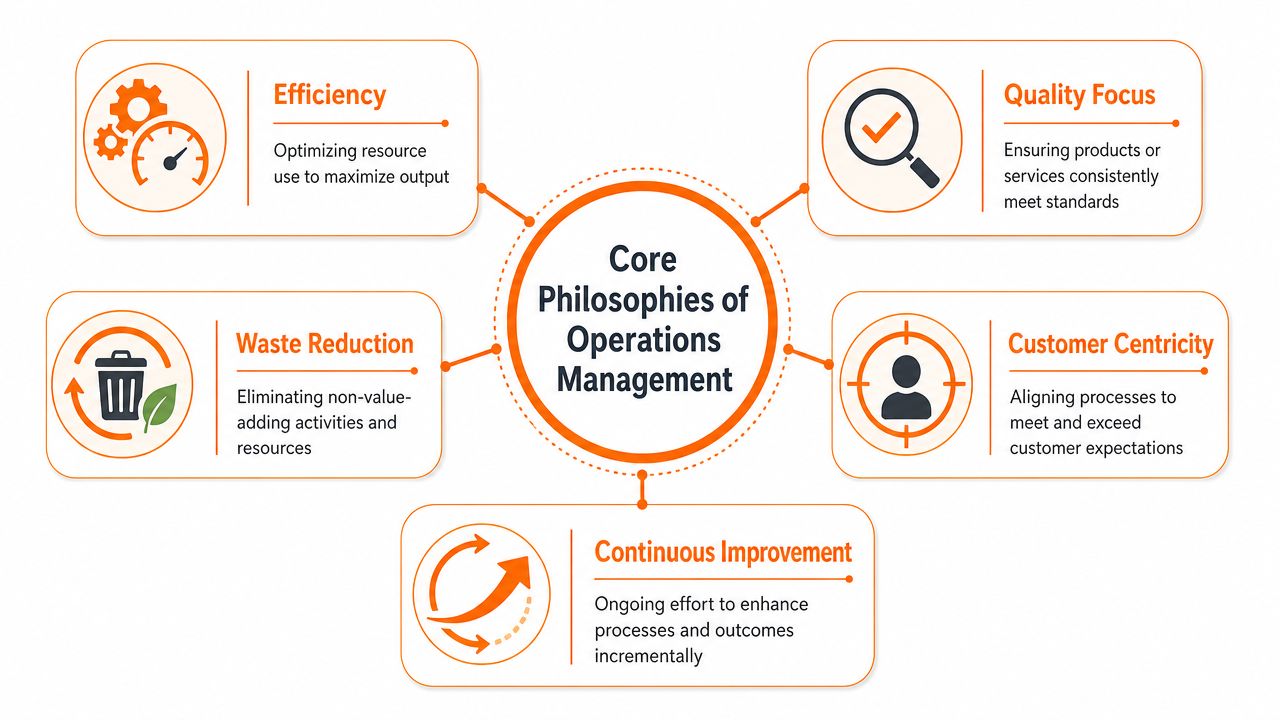
Most operations management methods are just different ways of attacking the same few problems. Waste. Variation. Bottlenecks. Drift. Methods get the headlines, but the underlying ideas perform the actual work.
A chef organizing a kitchen doesn't need to memorize theory to know that wasted motion slows service. A nurse doesn't need a consultant to know that missing supplies create delay. The names can help, but only if we remember what they're pointing to.
Cut what adds no value
The first big idea is simple. Remove waste. Lean Manufacturing is built around that principle. It's a production method used in operations management to remove waste and curb unnecessary resource usage, which reduces product costs and improves throughput across the line, as described by Henry Harvin's overview of operations management and importance.
In a service setting, waste looks different, but it's still waste. Extra walking. Waiting for approvals. Searching for information. Overstaffing one period and scrambling in the next. Work that exists only because the original task wasn't done clearly the first time.
Build quality into the work
The second idea is reduce errors and variation. Six Sigma addresses this goal. Six Sigma aims for 99.9997% of outputs to be free from defects. It was developed at Motorola, and General Electric later reported saving over $12 billion through its adoption. The method uses structured frameworks like DMAIC to improve existing processes and reduce variation, as outlined in Asana's operations management guide.
That sounds industrial, but the principle travels well. In a hotel, quality means the room is ready the same way every time. In a clinic, it means intake steps don't depend on who happens to be on shift. In a call center, it means the customer doesn't get three different answers to the same question.
A method like Total Quality Management sits in the same family. Different label. Same instinct. Don't inspect quality in at the end. Design the work so quality is more likely from the start.
Here's a simple visual for those shared principles.
Improve flow, not just effort
The third idea is protect flow. A river doesn't move better because you shout at the water. It moves better when you remove the rocks. Work behaves the same way. If one step can't keep up, everything behind it gets messy.
That's why methods like Kanban and the Theory of Constraints are so useful. They make work visible and force you to look at the blockage instead of the symptoms. When teams say they're overloaded, I often find they're not dealing with too much work in general. They're dealing with one stuck stage that starves everything downstream.
Practical rule: Don't optimize every step at once. Find the point where work piles up and start there.
Keep improving in small ways
The fourth idea is continuous improvement. This is the spirit behind kaizen. Small fixes, repeated consistently, beat heroic rescue work. Every team has recurring annoyances that people treat as normal. A smarter operation treats those annoyances as clues.
The method matters less than the habit. If your team can spot friction, talk about it without fear, test a better way, and keep what works, you're already doing the essential work.
A Practical Toolkit of Operations Methods
Methods are tools, not identities. You don't need to become “a Lean company” or “a Six Sigma shop” to use these well. You need to match the tool to the problem in front of you.
Some tools are good at reducing waste. Some help with consistency. Some are better for inventory, handoffs, or visual coordination. The mistake is reaching for the same tool every time because it's the one you already know.
Operations management methods at a glance
Method | Primary Goal | Best For... | Key Tool / Metric |
|---|---|---|---|
Lean | Remove waste and simplify work | Repetitive processes with visible friction in retail, hospitality, logistics, manufacturing | Waste identification |
Six Sigma | Reduce defects and variation | Quality-sensitive processes where consistency matters | DMAIC |
Just-In-Time | Match supply and effort closely to demand | Inventory-heavy or time-sensitive environments | Replenishment timing |
Theory of Constraints | Improve throughput by fixing the bottleneck | Teams with chronic backlog at one stage of work | Bottleneck analysis |
TQM | Build quality into everyday operations | Organizations that need shared standards across teams | Quality tools and standard work |
Kaizen | Make steady, small improvements | Teams that need practical change without a giant rollout | Continuous team feedback |
ABC analysis | Prioritize the items that matter most | Inventory control in retail, warehousing, healthcare supplies | Category prioritization |
When each one earns its keep
Lean is the first tool I reach for when the team is busy but the day feels wasteful. People are moving, but progress is uneven. Lean helps because it forces us to ask whether each step serves the customer or just serves the process.
Six Sigma is better when the issue is inconsistency. One shift gets it right, another doesn't. One site performs well, another keeps slipping. That's a variation problem, and a more disciplined method helps.
Just-In-Time gets misused a lot. On paper, it sounds elegant. In reality, it can turn brittle fast if demand swings hard or communication is weak. Used well, it helps teams avoid overstocking and overproduction. Used badly, it creates constant scrambling.
Theory of Constraints is blunt and useful. If one station, person, approval, or piece of equipment keeps slowing everything down, stop pretending the whole system needs equal attention. It doesn't. The constraint does.
If work keeps piling up in one place, that's not a staffing mystery. It's a flow problem asking to be named.
A method that deserves more attention
ABC analysis is one of the most practical operations management methods because it respects the fact that not all inventory matters equally. In this model, A items account for 70 to 80% of revenue, while C items can make up more than 50% of inventory volume but contribute little revenue. Applied well, ABC analysis can improve inventory turnover by 15 to 25%, according to Eyelit's explanation of inventory control methods.
That's useful in more places than people think. A restaurant can apply the logic to high-risk ingredients. A clinic can apply it to critical medical supplies. A field service team can apply it to van stock. Protect the high-impact items differently from the low-impact clutter.
Pick tools that fit the work on the ground
In distributed operations, the method usually lives or dies based on whether frontline teams can use it during a shift. Fancy diagrams won't help a driver, a charge nurse, or a store lead if the information is buried.
That's why I pay attention to simple execution tools too. For mobile teams, practical systems for scheduling, tasks, and exceptions matter. If you manage vehicles or field crews, this guide to data-driven fleet operations advice is useful because it stays grounded in day-to-day control rather than abstract theory. And if you're trying to connect process discipline with team communication, operational excellence strategies are often easier to sustain when work instructions, updates, and task ownership live in one place. Tools like Pebb fit that model by combining tasks, communication, scheduling, and file access in a mobile-friendly setup.
Bringing These Methods to the Frontline
A significant portion of operations advice proves ineffective. It's written for factories, then handed to teams whose work happens live in front of customers, patients, or guests.
That gap is real. 68% of service operations managers report that standard inventory and forecasting tools fail to capture real-time demand fluctuations, which is why so many service teams still struggle with “just-in-time” execution when labor and customer demand shift hour by hour. In these environments, waste often hides in employee time, missed handoffs, and reactive scheduling rather than in physical inventory.
Retail, hospitality, and healthcare don't waste time the same way factories waste material
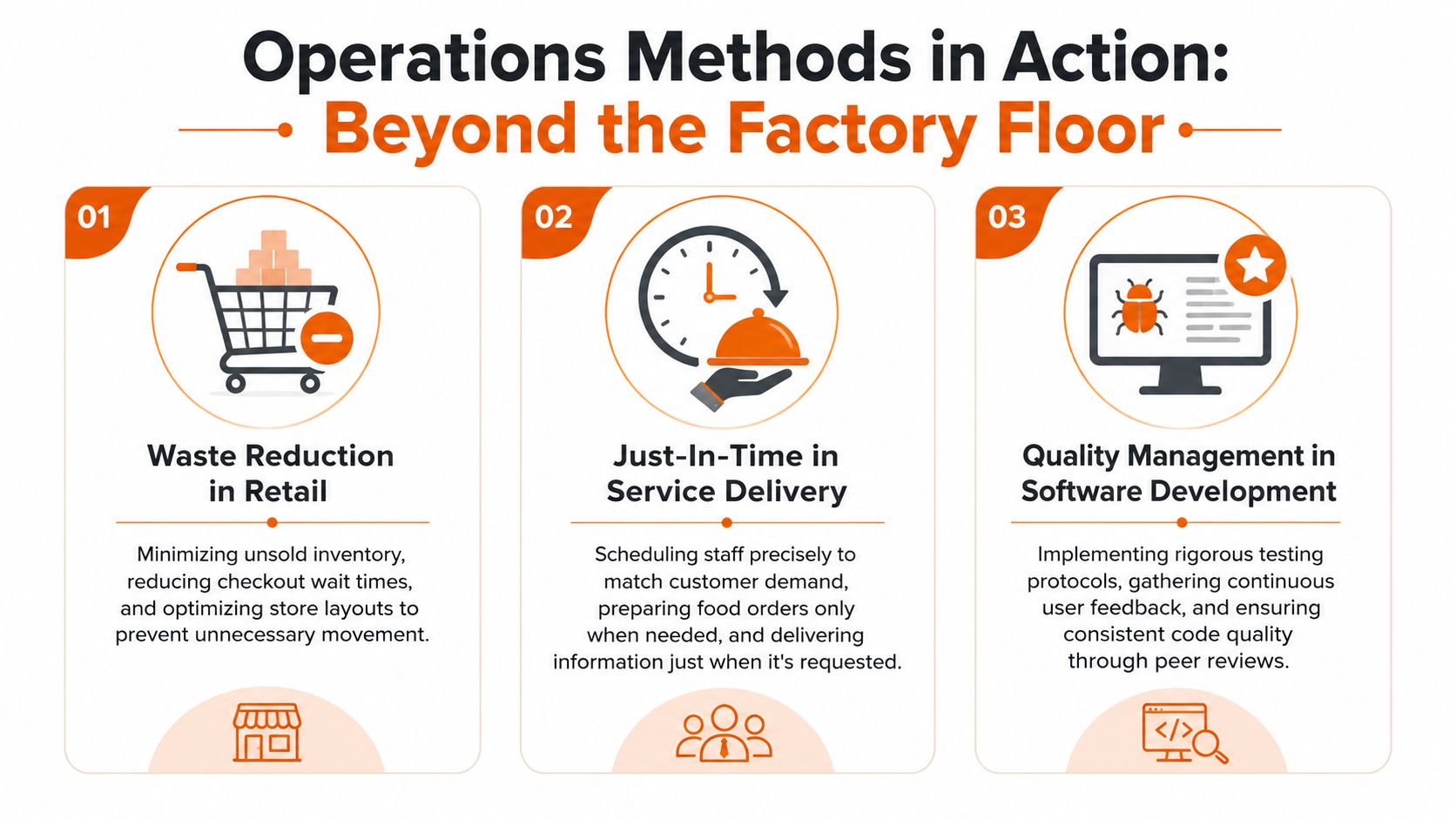
In retail, waste often shows up as unnecessary movement and poor timing. A store team keeps crossing the floor to answer the same stock question because inventory visibility is weak. A manager schedules based on last week's pattern, then a local event changes foot traffic and the whole shift gets lopsided. Lean still applies. The waste is just less visible.
In hospitality, a housekeeping cart is a process in miniature. If the cart is disorganized, room turnover slows, supervisors get pulled into status checks, and guests feel the delay before anyone writes it down in a report. A simple 5S approach works well here. Put items in a consistent place, remove what doesn't belong, and make restocking obvious.
This is a helpful reminder of how classic methods translate outside manufacturing.
Concrete examples people can actually use
A restaurant kitchen can use Kanban without calling it Kanban. Orders move visibly from received to in progress to ready. Special requests are marked clearly. The expo station becomes the signal point instead of the manager's memory.
A clinic can use the Theory of Constraints to reduce patient delays. If the bottleneck is always one exam room, one intake step, or one provider approval, that's where redesign starts. Not everywhere.
A hotel can use standard work and visual controls for room readiness. Not to turn people into robots, but to stop avoidable variation from chewing up time during the busiest hour of the day.
For more grounded examples across industries, this collection of operations management examples is useful because it shows the methods in settings where labor and service timing drive the outcome.
The frontline needs adaptive operations, not rigid theory
Service work is volatile. A lunch rush arrives early. A nurse calls out. A delayed truck changes the receiving plan. A VIP guest shows up at the desk. If your method can't bend, your team will ignore it, and they should.
Good frontline operations give people structure for the normal day and freedom for the weird one.
That's why the strongest service operations management methods are practical, visible, and easy to adjust in real time. The point isn't to import factory language. The point is to give frontline teams a clearer way to run the day they have.
How to Actually Start Improving Things
Teams often delay initiating improvements because they believe the process must be formal. It doesn't. You don't need a full program, a consultant, or a dozen dashboards. You need one problem worth fixing and a team willing to examine it carefully.
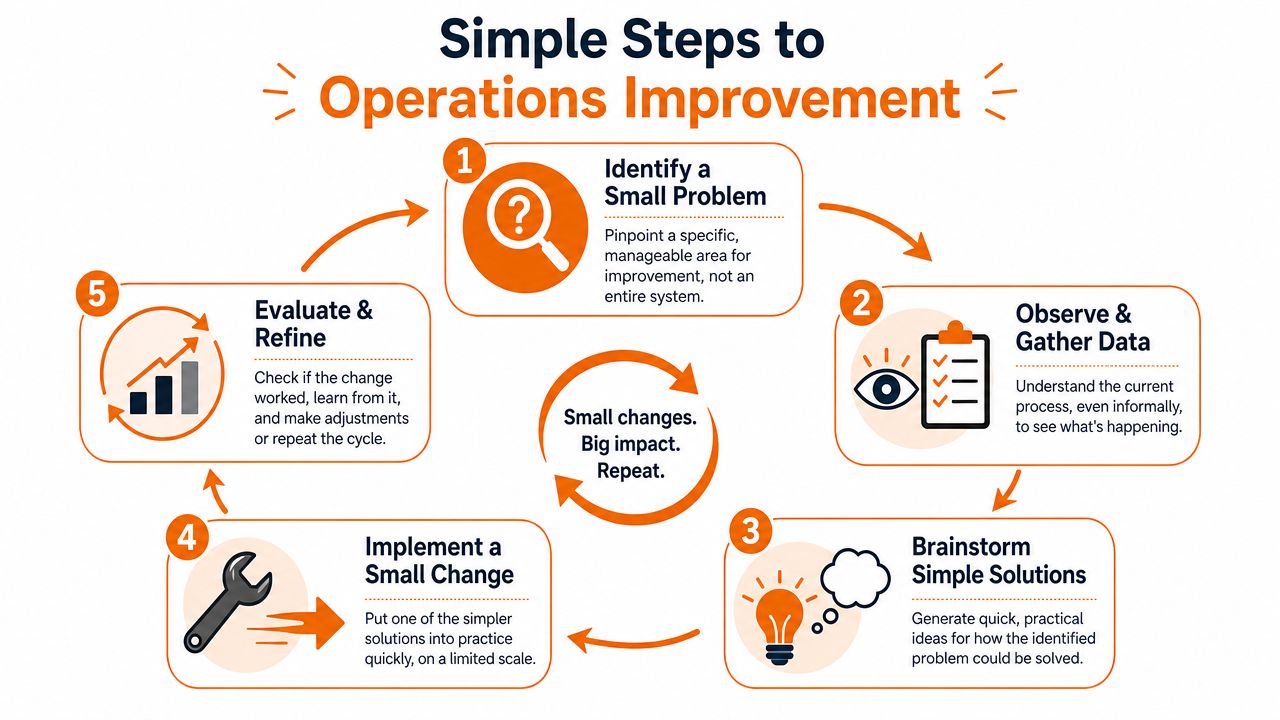
The simplest place to start is a small loop. Notice a problem. Watch it closely. Try a change. See what happened. Then adjust. That's basically the heartbeat of Plan, Do, Check, Act, even if you never put the acronym on the wall.
Start smaller than you want to
Pick one recurring issue that annoys the team and touches the customer. Late starts to the shift huddle. Too much searching for tools. Repeated delays in handing off rooms, patients, orders, or tickets. If the problem is small enough to observe in a few days, it's the right size.
Then get specific about what “better” means. Not “improve communication.” Something tighter. Fewer missing items at open. Smoother handoff between morning and evening shift. Less rework on intake forms.
This simple cycle helps.
Measure a few things that matter
A lot of teams either measure nothing or measure everything. Both approaches fail.
Overall Equipment Effectiveness, or OEE, is a good example of a useful metric because it combines system availability, cycle time efficiency, and quality rate into one view. A world-class OEE score is 85%, 60% is typical for many manufacturers, and anything below 40% points to major inefficiency, according to Wikipedia's operations management entry. Even in service settings, the thinking is useful. Your “equipment” may be a room, a shift handoff, a service lane, or a clinician's schedule.
You don't need to copy the metric perfectly. You need the discipline behind it. Is the resource available when needed? Is the work moving at the intended pace? Is the output right the first time?
Make the work visible to the people doing it
Use a whiteboard. Use a shared task board. Use a simple daily review in the team's existing workflow. Improvement dies when the information lives in a spreadsheet that only managers open.
A few practical rules help:
Track one or two indicators: If the team can't remember the measures, they won't use them.
Use basic quality tools: Pareto charts and control charts are useful because they help teams see patterns instead of guessing.
Review in the open: Talk about the process without turning the meeting into a blame session.
If you need a practical next step, this guide on how to improve operational efficiency is a sensible starting point because it keeps the focus on manageable process changes rather than giant transformations.
The first win should be boring. If the change is easy to keep, it has a chance to matter.
Common Traps That Sabotage Good Intentions
A lot of improvement work fails for familiar reasons. Not because the ideas are weak, but because teams use them in ways that create more strain than relief.
The first trap is methodology blindness. Someone discovers Lean, Six Sigma, Kaizen, or agile boards and starts forcing the label onto every problem. Soon the team spends more time “doing the method” than solving the issue that made them reach for it in the first place.
When the method becomes the job
This happens all the time. A simple stockroom problem turns into a naming exercise. A handoff issue becomes a training deck. Meetings multiply. The frontline gets new vocabulary and very little help.
Good operations management methods should make work clearer. If they make the day more ceremonial, something went wrong.
Another trap is weaponized metrics. A number is supposed to help a team learn. Too often it becomes a stick. Once that happens, people start gaming the number, hiding exceptions, or avoiding healthy risk because the metric matters more than reality.
Metrics should create curiosity. If they create fear, the data will rot.
Automation can harden a weak system
This is the modern version of an old problem. Teams install scheduling tools, forecasting engines, and workflow automation on top of messy operating habits, then act surprised when the friction gets faster instead of smaller.
Recent trends show a 42% surge in AI adoption for predictive scheduling and inventory, but 57% of frontline supervisors report that over-automated systems reduce their ability to respond to local needs, which is linked to a 23% decline in customer satisfaction. That's the case for adaptive operations. Use automation for pattern recognition and routine planning, but keep a clear human override when the day stops behaving.
Three habits that keep teams out of trouble
Stay anchored to the problem: If the original pain point isn't getting easier, the method isn't helping.
Protect local judgment: Supervisors need room to respond when customer behavior, staffing, or timing changes unexpectedly.
Respect adoption cost: Every new workflow asks people to learn, remember, and maintain something. Make sure the gain is worth the burden.
The best operators I know are skeptical in a healthy way. They'll use any tool that helps. They just won't confuse process theater with progress.
Thinking Beyond the Manual
Operations management methods aren't magic words. They're lenses. They help us see what the day is really doing to people, customers, and margins.
That's why I don't think the end goal is becoming a pure Lean shop or a textbook Six Sigma organization. The goal is a workplace that runs with less friction. A place where people don't waste energy fighting preventable problems. A place where quality is steadier, handoffs are cleaner, and managers don't have to rescue the same process every week.
Better operations should feel more human
The best systems don't turn people into robots. They remove nonsense so people can use judgment where it counts. In frontline work, that matters even more because the output is often an experience. A patient feeling informed. A guest feeling welcomed. A customer getting helped without the usual runaround.
If your operating method makes the work colder, heavier, or more rigid, it probably needs another pass. If it makes the day clearer and calmer, you're on the right track.
The next time a delay, repeat mistake, or bottleneck shows up, don't just push through it. Ask a better question. What is the system trying to tell you?
If you're trying to make frontline operations less chaotic, Pebb is worth a look. It gives teams one place for communication, tasks, file sharing, scheduling, clock-ins, and updates, which makes it easier to keep operational changes visible and usable across shifts and locations.
