
10 Real-World Operations Management Examples
Explore 10 real-world operations management examples from Toyota, Walmart, and others. Learn how they solve challenges in supply chain, quality, and more.
Dan Robin
Ever walk into a hotel, a store, or a hospital and everything just works? The right people are in the right place, shelves are stocked, and nobody seems to be scrambling. It feels effortless.
It isn't.
That smoothness comes from a lot of deliberate, often messy work behind the scenes. That's operations management. It's the part of a business most customers never see, and the part leaders usually notice only when it breaks.
I've spent enough time around operators to know the pattern. When a business is winning, people often praise the brand, the product, or the strategy. When it's losing, the actual problem is often simpler. Work isn't flowing. Handoffs are sloppy. Inventory is wrong. Schedules are brittle. Frontline teams are making decisions with half the information they need.
Operations management became a formal managerial function in large-scale industry during the 20th century, and its modern authority was shaped by measurable systems built around KPIs like OEE, on-time delivery, inventory turnover, capacity utilization, and first-pass yield, as explained in this overview of operational KPIs and what they measure. That's still the backbone today. If you can't see the work, you can't improve it.
The interesting part is that modern operations aren't just a factory story anymore. They stretch across retail floors, hospital units, driver routes, support desks, and distributed teams. Good operations management examples don't live in textbooks. They show up in the daily decisions that keep the machine from wobbling.
1. Toyota's Obsession with Lean Manufacturing
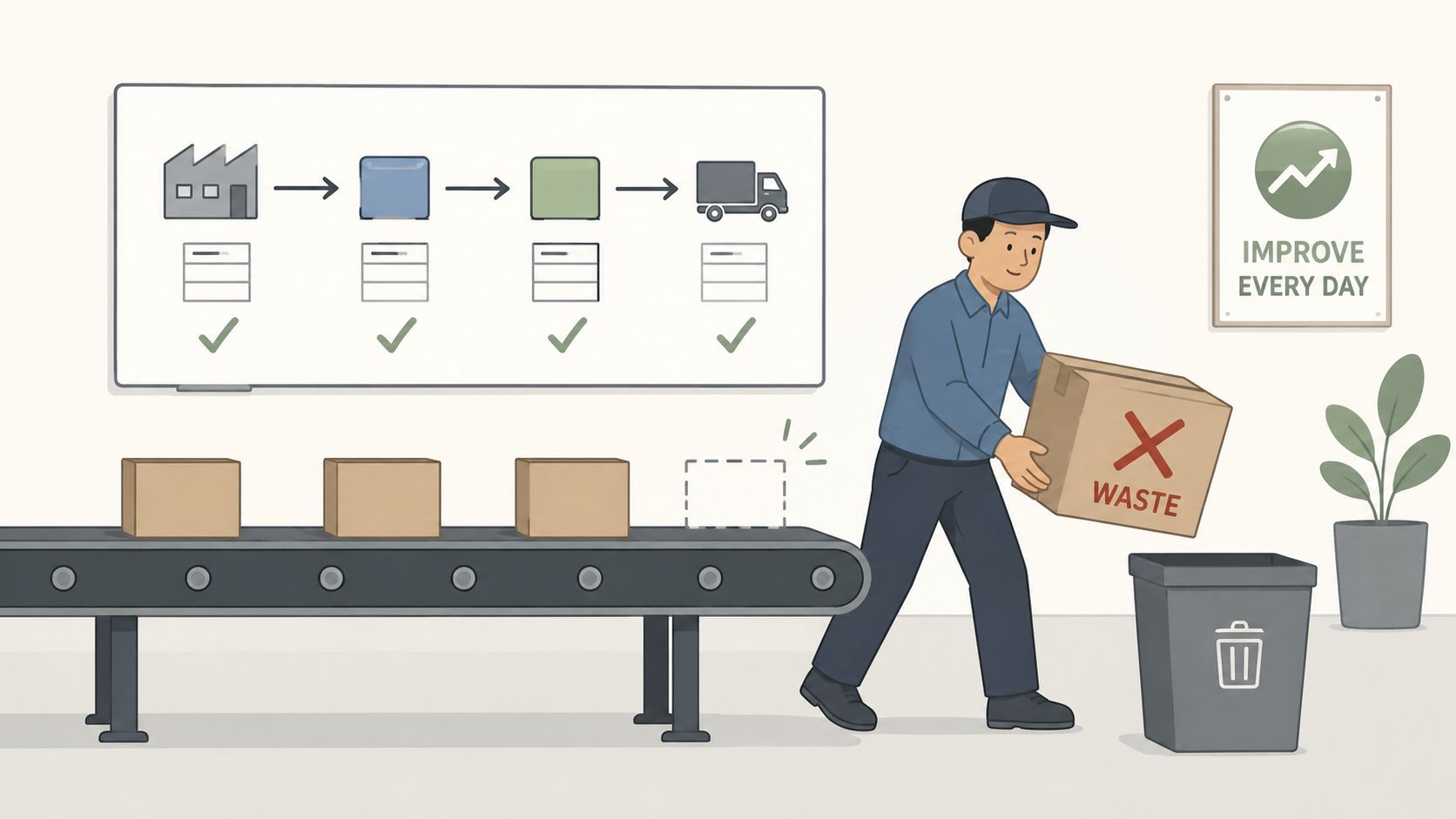
Toyota is still the reference point because Lean wasn't treated as a one-time project. It became a habit. Waste wasn't just excess material. It was waiting, rework, unnecessary movement, bad handoffs, and decisions pushed too far from the people doing the work.
That part matters more than companies often realize. A lot of companies copy the visual parts of Lean and miss its true substance. They put boards on walls, run workshops, and declare victory. Meanwhile the frontline team still can't stop a bad process, fix a recurring issue, or ask why a problem keeps coming back.
What actually transfers outside manufacturing
Lean works in warehouses, hospitals, retail backrooms, and service teams because the core question is always the same. What is making work harder than it needs to be?
In practice, that often looks like this:
Map the current flow: Follow the work from request to completion and note where people wait, search, re-enter data, or fix preventable mistakes.
Let frontline people name the friction: Managers guess. Staff know.
Track a few useful KPIs: Use metrics that show flow and quality, not vanity.
Practical rule: If your improvement plan depends on a consultant, a giant rollout, and six months of change management, it's probably too big.
The best Lean-style operations management examples are boring in the best way. A warehouse team changes the pick path. A clinic redesigns intake so patients don't repeat the same information. A retailer moves high-frequency items closer to where staff need them. Small fixes stack up.
What doesn't work
What fails is performative Lean. Teams run improvement events but don't change authority, staffing logic, or daily routines. Then the same bottlenecks come back.
Lean is only useful when it changes how people solve problems every day.
2. The Daily Puzzle of Shift and Labor Management
Scheduling looks simple until you're the one doing it. Then you realize it's part math, part negotiation, and part damage control.
Every operator in retail, hospitality, healthcare, or logistics knows the pain. Overstaff and labor costs creep up. Understaff and customers wait, employees burn out, and managers jump into coverage mode instead of doing their actual jobs.
The schedule is an operating system
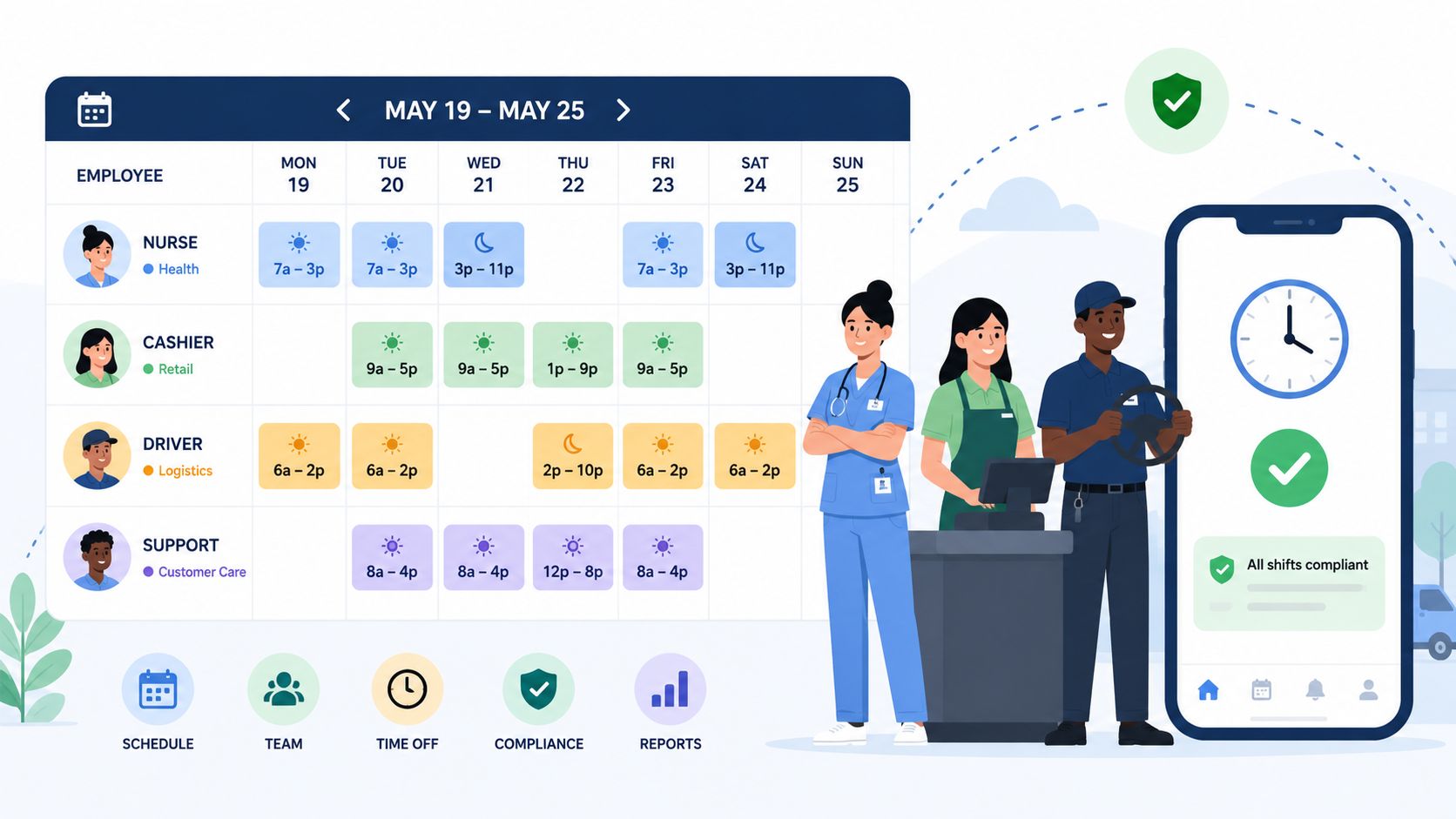
A schedule isn't just a calendar. It's a live operating model for the week ahead. The strongest teams build schedules around real demand patterns, skill coverage, and known pressure points, then make it easy for staff to see updates and request changes inside one system, not through texts and hallway favors. That's where tools built for shift scheduling software can help, especially when teams work across locations or rotating shifts.
The deeper issue is trust. If schedules come out late, change constantly, or ignore reality on the floor, people stop believing leadership knows what's happening.
A good labor plan usually includes:
Known peaks: Lunch rush, admissions spikes, delivery windows, seasonal volume.
Skill mix: Not every available person can handle every task.
Slack for reality: Call-outs happen. Trucks arrive late. Patients surge.
Schedule for the work that actually shows up, not the version of the week you'd prefer to have.
What good managers do differently
They review labor after the shift, not just before it. They ask where the plan broke and why. They don't blame the team for a bad forecast.
Some of the clearest operations management examples come from places with no room for error. A hospital emergency department has to maintain coverage around the clock. A warehouse has to line up staffing with inbound and outbound volume. A restaurant has to balance prep, service, and cleanup without loading all the pressure onto the same few reliable people.
Good scheduling protects service and people at the same time. That's harder than it sounds.
3. Keeping Everyone in Sync with Real-Time Communication
Email is too slow for frontline work. That's the plain truth.
If a safety issue shows up on a factory floor, a route changes for drivers, or a retail promotion needs to go live now, nobody wins by burying that in an inbox. Operations move fast, and information has a shelf life.
Fast communication beats perfect communication
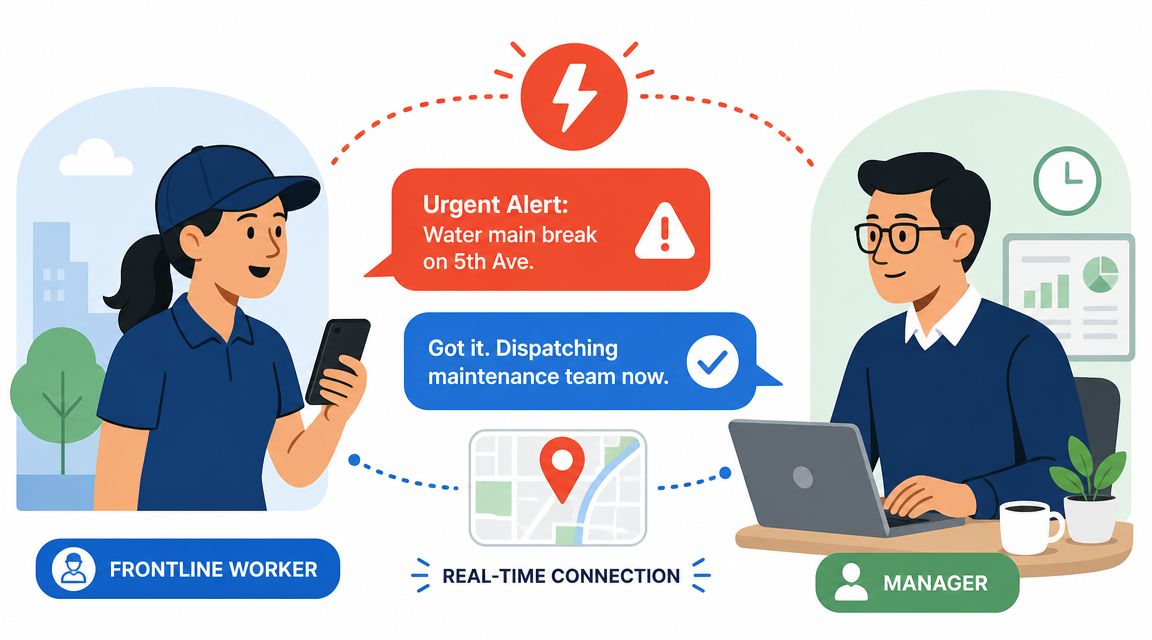
The best-run teams create one reliable path for urgent information. Not five channels. Not scattered group chats. One place where the right people can see what's changed and what they're expected to do next. For many companies, that means moving away from patchwork tools and using an internal communication platform that frontline staff can access during the day.
This sounds obvious, but plenty of operations still rely on a game of telephone. A manager tells a supervisor, who tells a lead, who remembers half of it while the shift is already moving.
More often, a better approach is:
Clear channel rules: Urgent alerts, routine updates, and reference material shouldn't live in the same stream.
Expected response times: People need to know what's urgent and what's informative.
Mobile access: If your staff isn't at a desk, desktop-first communication is a dead end.
The open-system reality
Modern operations don't stop at the company wall. The Open University materials on operations management make the point clearly by distinguishing closed and open systems, and by arguing that competitiveness improves when companies encourage communication with suppliers and customers, while also highlighting mass customisation as a growing model enabled by technology and automation in this discussion of open and closed operational systems.
That's one reason old-school communication models fail. They assume operations are internal and self-contained. They aren't. Real work depends on suppliers, customers, contractors, and teams spread across shifts and sites.
The practical lesson is simple. If people can't see the latest truth fast, the operation drifts.
4. The Art of Getting Things Done with Task Management
Ask almost any struggling team a few basic questions and the cracks show fast. Who owns this? When is it due? What does done look like? You'd be surprised how often nobody can answer cleanly.
Task management sounds basic because it is basic. That's why it matters. Strong operations make work visible, assignable, and checkable. Weak operations rely on memory, side conversations, and crossed fingers.
Visibility reduces drama
When a coffee shop opens smoothly, it's because someone handled the opening checklist. When a warehouse passes an audit, it's because cycle counts, safety checks, and replenishment tasks were assigned and completed. When a patient discharge doesn't stall, it's because people knew the next step and owned it.
The mistake I see most often is vague tasking. "Handle inventory." "Check on the client." "Make sure prep is done." Those aren't tasks. They're categories.
Better practice looks like this:
Name one owner: Shared ownership often means no ownership.
Write the acceptance criteria: What exactly needs to be true when the task is finished?
Prioritize visibly: Teams need a common language for urgency, and this guide to task prioritization techniques is useful for sorting the work that matters from the work that's merely loud.
If people spend half their day figuring out what matters, your operation is already wasting time.
Where this shows up in the real world
Retail stores use task systems for opening, closing, merchandising, and promo changes. Healthcare teams use them for patient coordination and follow-up. Logistics teams use them to assign routes, exceptions, and handoffs.
Among the most practical operations management examples, this one is easy to borrow. You don't need a dramatic transformation. You need clarity.
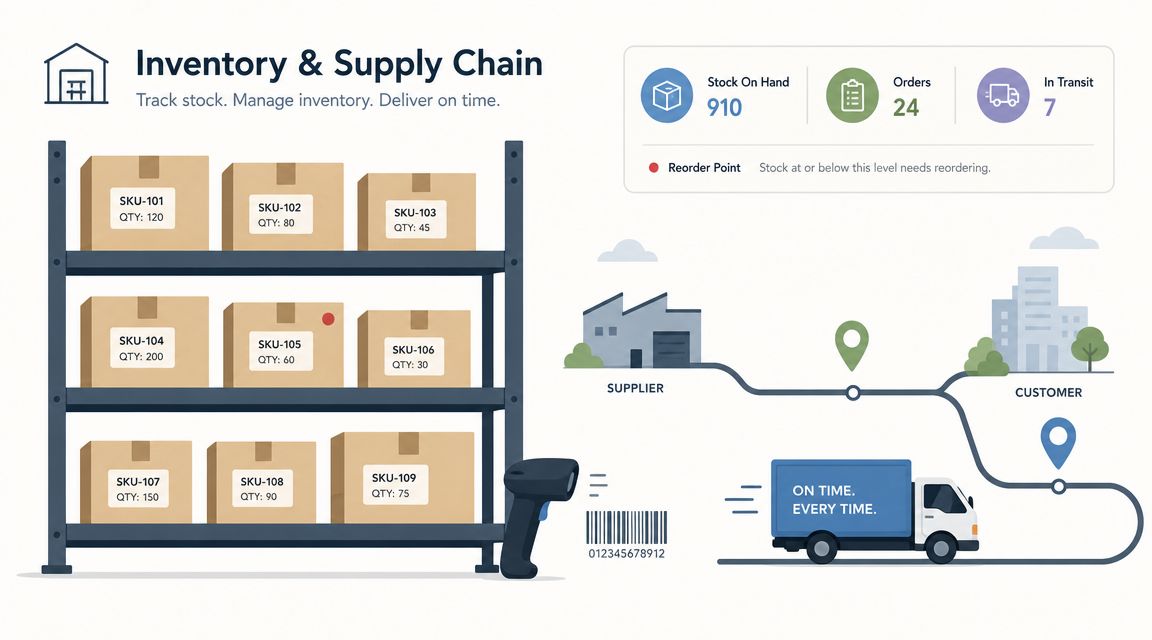
5. Walmart's Mastery of Supply Chain and Inventory
A shelf can look full and still fail the customer.
I've seen stores with plenty of inventory in the back room and empty pegs on the floor. I've seen teams blame forecasting when the underlying problem was late receiving, bad shelf discipline, or a reorder rule that no longer matched demand. That is why Walmart remains such a useful example. It treated inventory as an operating system for the business, not a pile of product to count once a week.
Retail runs on a hard promise. The right item has to be available in the right place at the right time, without carrying so much extra stock that margin disappears into storage, markdowns, and waste.
Inventory breaks when handoffs break
Supply chain work gets oversimplified. People talk about buying and storing. The actual job is more precise than that. Forecasting has to line up with replenishment. Transportation has to match store timing. Vendor performance has to support the plan. Store teams have to receive, stock, and count accurately enough for the system to stay honest.
That is the trade-off operators live with every day. Higher inventory can protect service levels, but it also ties up cash and hides process problems. Leaner inventory frees cash, but only if forecasting, replenishment, and execution are reliable enough to support it.
The teams that do this well ask more useful questions than "How much stock do we have?"
They ask which SKUs deserve close attention, where stockouts start, and whether the problem sits in demand planning, inbound flow, back-room handling, or shelf availability.
A few practices usually matter more than fancy theory:
Rank SKUs by business impact: Fast movers, high-margin items, and known traffic drivers need tighter control than low-value long-tail items.
Set reorder points from actual conditions: Lead times, variability, and local demand matter more than a generic rule.
Check physical reality often: Inventory records drift. The shelf, the bin, and the receiving dock usually expose the truth faster than a dashboard does.
One case that shows the payoff
Deere & Company gives a solid example of what better coordination can produce. In one supply chain redesign case, the company cut customer delivery lead times from 10 days to five or fewer, reduced inventory by $1 billion, and generated about 5% annual transportation cost savings, according to this Logistics Bureau case study on successful supply chain cost reduction and management.
That result matters because it was not one isolated fix. Shipment consolidation, network design, and inventory decisions moved together. Speed improved. Costs came down. Working capital improved too.
That is the lesson worth borrowing from Walmart and from operators like Deere. Inventory performance is rarely about one heroic forecast. It comes from getting the handoffs right, then checking the system often enough to catch drift before customers feel it.
6. The Non-Negotiables of Quality and Compliance
Some operations can survive a little inconsistency. Others can't.
If you're running food production, clinical care, aviation maintenance, or anything else where errors can hurt people, "close enough" isn't a management style. It's a liability. That's where quality systems and compliance discipline stop feeling administrative and start feeling essential.
Standard work builds trust
The strongest teams write down the right way to do critical work, train people on it, and then verify it happens. That sounds rigid until you've seen what happens without it. Everyone creates their own version of the process. Steps drift. Exceptions become the norm. Then someone discovers the gap at a critical moment.
Good operators don't confuse documentation with quality. A standard operating procedure only matters if people can find it, understand it, and use it under pressure.
What helps:
Short, accessible SOPs: Nobody reads a manual during a busy shift.
Visible checkpoints: Labels, sign-offs, and checklists reduce reliance on memory.
Corrective follow-through: Audits matter only if the findings change behavior.
Compliance without theater
A lot of teams build compliance systems that look impressive from a distance and collapse in real work. Too many forms. Too many approvals. Too much paperwork disconnected from the task itself.
The better pattern is tighter. Build quality into the flow of work so people don't have to stop and translate policy into action every time.
Healthcare units use safety protocols before procedures. Food service teams use prep and temperature checks. Maintenance crews use inspection routines before equipment goes back into service. These are classic operations management examples because they make quality repeatable, not aspirational.
People trust a business when the basics happen reliably. Quality management is how that trust gets earned.
7. Using Analytics to See Around Corners
A team usually feels trouble before it sees it in the monthly report.
Orders start missing promised dates. Overtime creeps up. Rework gets explained away as a rough week. By the time the numbers make it into a slide deck, the underlying problem has already been expensive for a while. Good operators use analytics to catch that drift early enough to do something useful about it.
The job is not to build a prettier dashboard. The job is to spot where flow is breaking, where quality is slipping, and where capacity is getting eaten up by avoidable work.
Pick metrics people can act on
Bad metrics create busywork. Good ones help a supervisor make a better call before the shift ends.
That usually means a small set of measures tied to real decisions. In manufacturing, OEE can help a team separate downtime, speed loss, and defects instead of arguing about output in the abstract. First-pass yield shows whether the line is producing good units the first time or hiding cost in rework. Inventory turnover helps planners see whether cash is sitting on shelves or moving through the business at a healthy pace.
Service teams need a different lens, but the discipline is the same. A hospital may watch wait times by hour, discharge bottlenecks, and bed turnover. A contact center may track first-contact resolution, queue backlog, and handle time together, because one number alone can push the wrong behavior. A restaurant may monitor ticket times, table turns, and prep delays to see whether the kitchen, floor, or staffing plan is causing the drag.
One metric rarely tells the whole story.
I have seen teams chase speed so hard that quality collapsed a week later, and I have seen teams protect quality so rigidly that throughput never recovered after demand picked up. Analytics matters because it forces those trade-offs into the open.
Use trends, not just snapshots
Single-day numbers can mislead. A good day can hide a fragile process. A bad day can trigger a fix for a problem that does not exist.
Trend lines, shift-level patterns, and exception reports are usually more useful than summary averages. If defects spike only on the night shift, the issue may be staffing, training, or handoff quality. If on-time delivery drops every Friday, the root cause may sit upstream in planning, replenishment, or carrier pickup timing. Those are the kinds of patterns operators can work with.
The best analytics habits are simple. Review the same few numbers consistently. Check them close to the work. Ask what decision each metric is supposed to support. If nobody would act differently after seeing it, it probably does not belong on the board.
The U.S. Bureau of Labor Statistics tracks this field under top executives, including general and operations managers, and its employment outlook shows steady demand rather than a short-term spike. You can review that projection directly in the BLS Occupational Outlook Handbook for top executives, including general and operations managers.
Across these operations management examples, analytics is the layer that helps teams intervene sooner, spend less on surprises, and make better calls with less guesswork.
8. Making the First 90 Days Count with Onboarding
Most onboarding failures don't look dramatic. They look ordinary.
A new hire shows up and spends the first week waiting on logins, chasing answers, and trying not to look lost. Nobody thinks of it as an operations problem, but it is. Poor onboarding is just disorganized work pointed at a new person.
New hires need a path, not a packet
The first stretch of a job should answer a few basics fast. What am I doing today? Who do I ask when something breaks? Where are the rules? What does good work look like here?
Strong onboarding treats those questions as part of operational design. Roles are prepared before day one. Training follows a sequence. Early tasks are simple enough to build confidence but real enough to create momentum.
That matters most in environments with lots of moving parts:
Retail: New staff need product, service, and POS training quickly.
Healthcare: Clinical and admin hires need role-specific procedures, not generic orientation.
Logistics: Drivers and warehouse workers need safety, routing, and exception handling early.
The operational payoff
When onboarding is structured, managers spend less time rescuing confusion. Teams get fewer avoidable errors. New people become useful faster because they know where the rails are.
A lot of companies still treat onboarding like paperwork plus a welcome email. The better operations management examples treat it as capability building. They make training visible, assign owners, and follow up before drift turns into disengagement.
The first 90 days tell people what kind of company they're in. If the operation is sloppy there, they assume it's sloppy everywhere.
9. The Starbucks Method for Consistency Across Locations
Consistency at scale is harder than it looks. One location can run on a heroic manager. Fifty locations can't.
That's why brands like Starbucks are so interesting operationally. The challenge isn't just making coffee. It's making a customer feel like the brand is familiar, reliable, and recognizable across many stores without turning local managers into robots.
Standardize the essentials
The trick is deciding what must be the same and what can flex. Recipes, core training, brand standards, and service expectations usually belong to the set of essential elements. Local staffing patterns, community relationships, and day-to-day store adjustments usually don't.
That balance matters in every multi-site operation. Restaurants need consistency in food and service. Healthcare systems need consistency in care protocols. Retail chains need consistency in promotions and execution.
A few practices hold the whole thing together:
Shared playbooks: Staff need one version of the standard.
Comparable metrics: Locations should be measured in ways that allow honest comparison.
Cross-site learning: The best stores should teach the rest.
The idea isn't to crush local judgment. It's to give local teams a stable base to work from.
For growing multi-location businesses, outside support can help when the operating model has to scale alongside the brand. That's part of the appeal of a partner for established franchisors that understands how expansion depends on repeatable systems, not just sales momentum.
What leaders often miss
They either over-centralize and make every site brittle, or they under-standardize and end up with ten different businesses sharing one logo.
The best operations management examples in multi-unit environments respect both sides. Principles stay centralized. Execution stays close to the ground.
10. Building Culture When Your Team Is Never in the Same Room
Culture is easy to talk about when everyone sits together. It's harder when your staff works different shifts, in different places, and mostly from their phones.
For frontline teams, culture isn't free snacks, office design, or a quarterly town hall. It's whether people feel informed, recognized, and connected to something bigger than their own shift.
Culture is operational work
Many companies make a category error. They treat culture as a side initiative owned by HR or leadership messaging. But if people never see updates, never hear about wins, and never have a place to ask questions or recognize each other, culture doesn't spread. It fragments.
The practical version is much simpler:
Share news where people already are: If updates live in a system nobody opens, they don't exist.
Create spaces for recognition: People stay engaged when good work gets noticed.
Make room for the human layer: Jokes, milestones, help requests, and celebrations matter.
A disconnected team doesn't usually fail from lack of effort. It fails from lack of shared context.
Why this belongs in operations
Teams that feel connected coordinate better. They escalate issues faster. They recover from rough shifts with less friction. That's not fluff. That's execution.
Some of the most overlooked operations management examples live here. A hospital celebrating staff wins across units. A logistics company recognizing drivers who rarely visit headquarters. A restaurant group helping kitchen and service teams feel part of one crew instead of separate camps.
Culture isn't separate from operations. It's one of the systems that keeps people pulling in the same direction.
10 Operations Management Examples Compared
Initiative | Implementation Complexity 🔄 | Resource Requirements ⚡ | Expected Outcomes 📊 | Ideal Use Cases 💡 | Key Advantages ⭐ |
|---|---|---|---|---|---|
Toyota's Obsession with Lean Manufacturing | High, cultural change, cross-functional process redesign | High, extensive training, time, continuous coaching | Large reductions in waste, higher quality, steady productivity gains | Manufacturing, healthcare process redesign, warehouses | ⭐ Deep cost reduction and sustained quality improvement |
The Daily Puzzle of Shift and Labor Management | Medium–High, algorithm setup & policy alignment | Medium, scheduling software, forecasting data, training | Lower labor costs, better coverage, improved employee satisfaction | Retail, hospitality, hospitals, logistics | ⭐ Optimizes labor spend and staff wellbeing |
Keeping Everyone in Sync with Real-Time Communication | Low–Medium, platform rollout and governance | Low, messaging tools, mobile access, training on use | Faster responses, clearer alerts, reduced email dependence | Frontline teams, multi-site operations, emergency response | ⭐ Rapid information flow and situational awareness |
The Art of Getting Things Done with Task Management | Low–Medium, process definition and adoption | Low, task system, mobile access, integration effort | Higher completion rates, clearer accountability, fewer bottlenecks | Retail ops, hospitals, restaurants, warehouses | ⭐ Improves clarity and execution consistency |
Walmart's Mastery of Supply Chain and Inventory | High, systems integration and supplier coordination | High, real-time tracking tech, forecasting models, supplier ties | Lower stockouts/overstock, improved cash flow, faster replenishment | Large retail chains, distribution networks, hospitals | ⭐ Scales inventory accuracy and responsiveness |
The Non-Negotiables of Quality and Compliance | Medium–High, SOP development and audit processes | Medium, documentation systems, training, audit resources | Fewer defects, regulatory compliance, stronger trust | Aviation, healthcare, food production, pharma | ⭐ Ensures safety and legal/regulatory adherence |
Using Analytics to See Around Corners | Medium, KPI design and data pipeline setup | Medium–High, dashboards, data engineering, governance | Proactive issue detection, better decisions, performance visibility | Multi-site retail, contact centers, operations leaders | ⭐ Data-driven foresight and resource allocation |
Making the First 90 Days Count with Onboarding | Medium, workflow design and content creation | Medium, LMS/content, mentors, documentation upkeep | Faster time-to-productivity, higher retention, consistent training | High-turnover retail, hospitality, healthcare, franchises | ⭐ Speeds ramp-up and improves early retention |
The Starbucks Method: Consistency Across Locations | Medium, standardization + local enablement | Medium, central systems, training, benchmarking | Uniform customer experience, scalable rollouts, best-practice spread | Franchises, chain restaurants, multi-site retail | ⭐ Balances brand consistency with local flexibility |
Building Culture When Your Team is Never in the Same Room | Low–Medium, ongoing program design and moderation | Low–Medium, communication tools, recognition programs, leadership time | Higher engagement, lower turnover, stronger team cohesion | Shift-based frontline teams, distributed workforces | ⭐ Fosters connection and retention across shifts and sites |
The Common Thread
A shift supervisor told me something I still come back to: "Nothing here is failing outright. Simple things are just harder than they should be."
That is the pattern behind a lot of operations pain.
Across these examples, the teams that perform well are usually not doing magic. They have clear priorities, clear ownership, and clear handoffs. People know what matters today, who is responsible, and what to do when something slips. That sounds obvious until a real day starts. Then schedules sit in one tool, tasks in another, updates disappear in chat, and procedures live in a folder no one checks until there is a problem.
I have seen that across retail floors, field crews, clinics, and multi-site service teams. Capable people end up spending too much energy chasing context. Managers patch the day together from memory, texts, and repeat follow-ups. The cost shows up in missed handoffs, slower decisions, avoidable rework, and teams that feel busier than they are effective.
Good operations management reduces that drag.
From the outside, it can look unremarkable. A shift starts on time. A task gets done by the right person. A quality issue gets caught before it spreads. A new hire finds the process without asking three different people. Customers notice the result even if they never see the system behind it.
That is why connected operating tools matter. Communication, scheduling, tasks, knowledge, forms, and daily coordination need to work together, or at least fit the same workflow. A platform will not fix weak management or a broken process. It can remove a lot of preventable friction.
Pebb fits that day-to-day reality. It brings communication, tasks, scheduling, clock-ins, PTO tracking, and knowledge into one place, which matches the kind of operational work these examples deal with.
The practical lesson is simple. Build a system your team can run on an ordinary Tuesday, not just on a well-planned day. That is usually what separates an operation that depends on heroics from one that holds up under pressure.
