
Master Operations Management Methods: Real-World Results
Discover effective operations management methods (Lean, Six Sigma, Kaizen) for real-world teams in retail, healthcare, and beyond.
Dan Robin

Some mornings tell you everything you need to know about your operation.
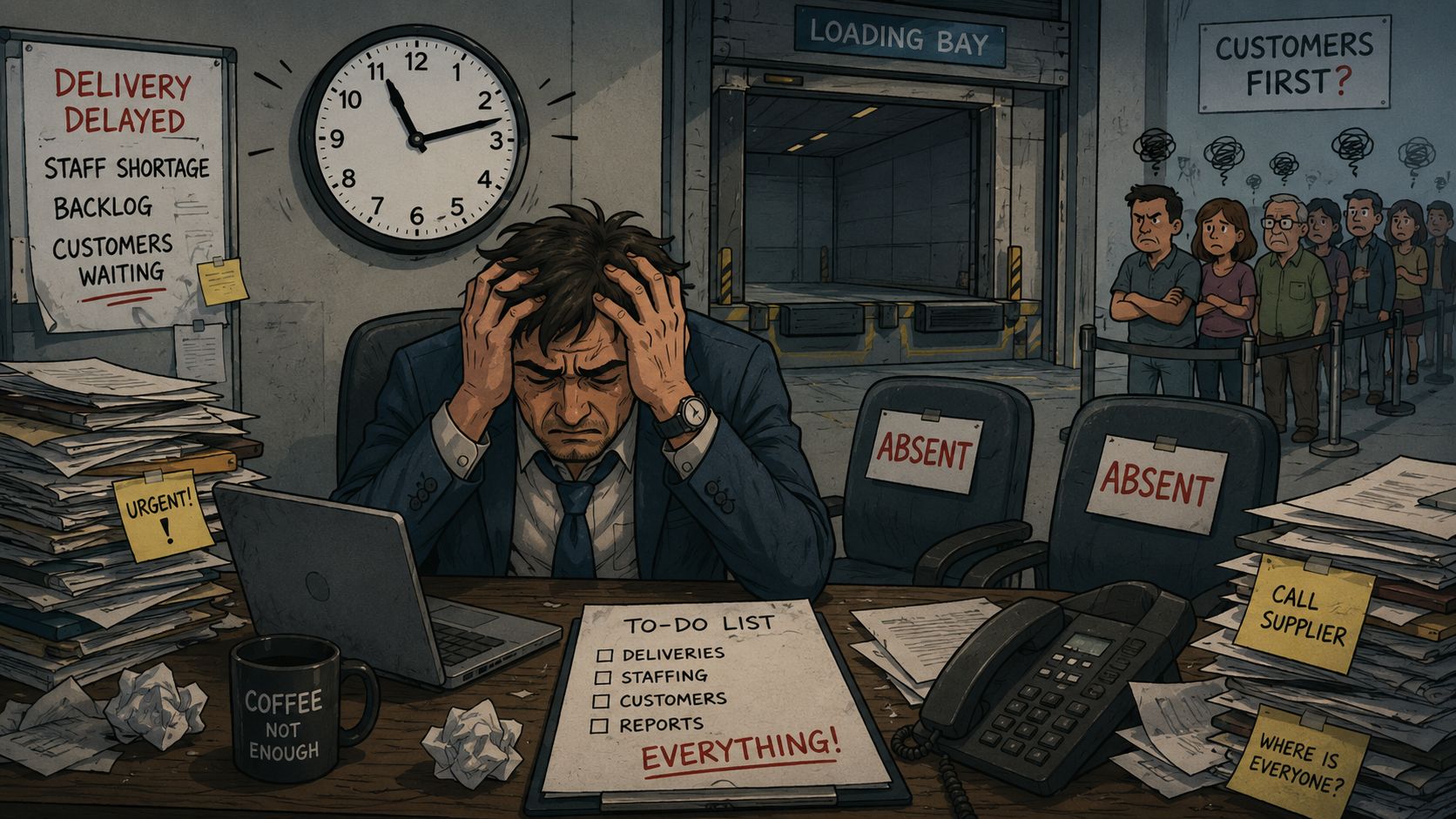
A delivery is late. Two people called out. The line is building. One customer wants a refund, another wants an exception, and your team is trying to stay polite while the whole thing starts to wobble. Nobody on that floor is thinking about “operations management methods.” They're thinking, “How do we get through the next hour without making this worse?”
That's why most writing on this topic misses the point. It treats operations like a clean diagram when most real operations feel like weather. Retail, hospitality, healthcare, logistics, field service. These are messy, human systems. Customers show up early, late, confused, frustrated, and sometimes all at once. Staff make judgment calls. Handovers get sloppy. Demand moves around.
The methods still matter. Maybe more than ever. But they only help if you can translate them from factory language into frontline reality.
Your Operation Is a Story Not a Spreadsheet
Tuesday at 9:15 a.m. is where operations gets real.
The truck hasn't arrived. A supervisor is covering the register. Someone new is opening alone for the first time. The back room looks “mostly fine” until you need the one item nobody can find. A customer sees delay. Your team feels friction. That gap between what the customer experiences and what the team is fighting through is operations.
A lot of guides still frame operations management methods through manufacturing examples. That's useful up to a point, but it leaves out the places where the work is more social, less predictable, and full of handoffs. The Open University's discussion of operations management in service settings makes that gap clear. Service businesses face variable demand, customer participation, and process variability, so they need methods adapted for real service environments, including service blueprinting, lean service, and agile practices.
The work is happening between people
In a cafe, the machine isn't the espresso machine. It's the team working around it.
In a clinic, the bottleneck usually isn't “production capacity.” It's intake, room turnover, paperwork, missing information, or a handoff nobody owns. In retail, the stockroom might be full, but if the shift can't find what they need fast enough, the inventory may as well be invisible.
That's why I don't start with definitions anymore. I start with scenes. Where does the day jam up? Where do customers wait? Where do employees improvise because the process isn't doing its job?
Practical rule: If your people need heroics to deliver a normal day, the method hasn't reached the floor yet.
Why the textbook version falls short
Traditional operations language tends to assume repeatability. Same demand. Same sequence. Same conditions. That's not how frontline businesses work. Customer behavior changes the process while the process is still happening.
A hotel check-in line isn't just a queue. It's tired travelers, unusual requests, payment issues, room readiness, and one desk agent trying to keep the lobby calm. A hospital ward doesn't run on neat averages. It runs on interruptions, urgency, and constant reprioritizing.
So yes, operations management methods matter. Lean matters. Six Sigma matters. Constraint thinking matters. But if you apply them like they came laminated from a textbook, you'll get compliance theater. Posters on the wall. Binders on the shelf. Nothing better at 9:15 a.m.
The useful version is simpler. Use these methods to make work easier to do well.
See Your Business as a System
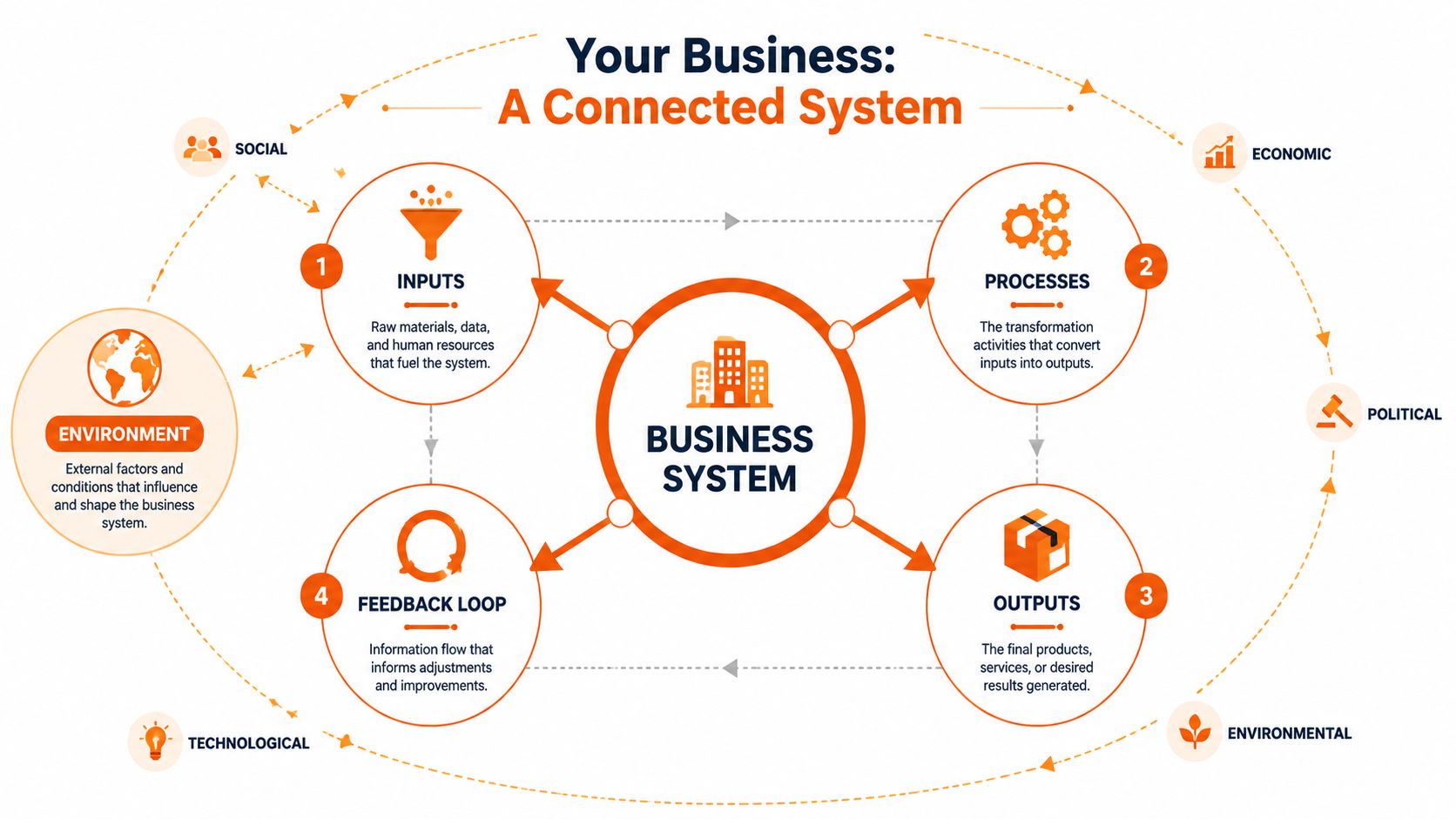
Organizations often try to fix operations one incident at a time. A late order. A missed handoff. A bad shift. That's understandable, but it keeps you trapped in reaction mode. The better move is to see the whole business as a system.
A coffee shop is a simple example. Inputs are beans, milk, cups, labor, recipes, equipment, and customer demand. Processes are taking orders, making drinks, calling names, cleaning stations, restocking, and closing out. Outputs are drinks served, wait times, mistakes, waste, and customer mood. Feedback is the line getting longer, espresso shots timing out, or the team getting backed up on mobile orders.
Stop treating symptoms as separate problems
If drinks are late, the issue may not be the barista. It may be menu complexity, order batching, layout, understaffing at the register, poor prep, or delivery orders landing at the wrong time. The point is that visible problems are often downstream effects.
That's where a closed-loop view of operations helps. As Airtable's explanation of operations management puts it, operations works best when you define measurable objectives, track KPIs like cycle time and quality rates, and use that information to keep rebalancing capacity and workflow. It also stresses pairing standard work with transparent dashboards so teams can spot bottlenecks before customers feel them.
If you're building this discipline from scratch, a simple business management system manual can help you document how work is supposed to flow before you start changing it.
What to actually look at
You don't need a giant dashboard to begin. You need a few signals that tell the truth.
What to watch | What it reveals |
|---|---|
Cycle time | How long work actually takes from start to finish |
Quality rate | Where errors, rework, or missed steps are creeping in |
Resource use | Whether labor or equipment is overloaded or underused |
Inventory level | Whether materials are available when the team needs them |
Cost per unit | Whether the process is becoming harder to deliver profitably |
The important part isn't the spreadsheet. It's the feedback loop. See what's happening. Adjust. Watch again.
A process you can't see clearly is a process you'll manage with guesswork.
Why standardization helps more than people think
People hear “standardize” and picture rigid scripts. Good standardization isn't that. It's a shared starting point. It reduces avoidable variation so real problems stand out faster.
When every shift handles the opening routine differently, you can't tell whether the issue is staffing, layout, training, or demand. Once the basic work is consistent, exceptions become visible. Then you can improve something real.
That's when operations management methods stop feeling academic. They become a way to get a little calmer, a little earlier.
The Three Big Philosophies Lean Six Sigma and TOC
Most of the big operations methods are really just different ways of asking one hard question.
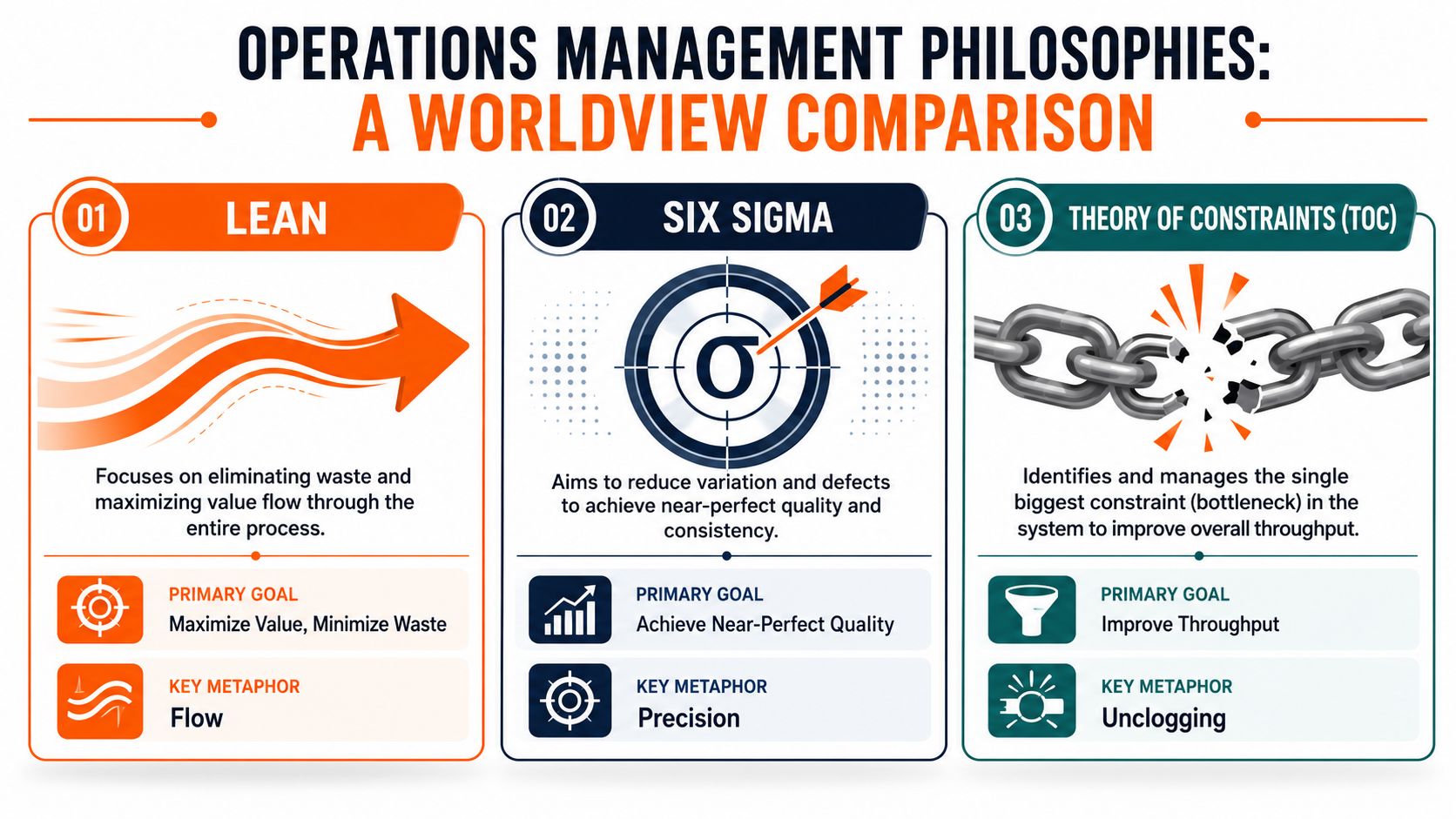
Lean asks what's wasteful.
Six Sigma asks what's inconsistent.
Theory of Constraints asks what's limiting the whole system.
Lean is about flow
Lean works best when work keeps getting stuck, doubled, delayed, or done in a way customers don't value.
In a restaurant, that can be extra movement in the kitchen, ingredients stored in the wrong place, duplicate prep, or too many approvals for simple fixes. In an office team, it might be chasing updates in five tools, waiting for signoff, or rebuilding the same file every week. Lean says: remove what doesn't help the work move cleanly.
The mistake people make with Lean is turning it into a cost-cutting religion. That's too small. Lean is about making value flow with less friction. Sometimes that means removing steps. Sometimes it means adding a checklist, moving equipment, or changing the sequence of work.
Six Sigma is about consistency
Six Sigma came to prominence in the 1980s, when Motorola is widely credited with formalizing it as a way to attack variation and defects. Its best-known target is 3.4 defects per million opportunities, which corresponds to 99.99966% defect-free output, a benchmark that helped define data-driven quality work in both manufacturing and services, as summarized in Asana's operations management overview.
That sounds abstract until you put it on the floor. Six Sigma is what you use when one shift performs well and the next one makes the same mistake three times. It's what you use when patient intake is smooth on Monday and chaotic on Tuesday for no obvious reason. It cares less about average performance and more about repeatable performance.
The customer rarely cares about your best day. They experience your normal day.
Six Sigma can be powerful, but I've seen teams overdo it. If every small issue becomes a formal analysis exercise, the work slows down and people tune out. Use it where variation hurts customers, safety, quality, or reliability.
TOC is about the one thing holding everything back
The Theory of Constraints has a blunt view of operations. Your system is only moving as fast as its current bottleneck.
That bottleneck might be a person, a station, a policy, a room, a supplier, a machine, or even a meeting that delays every decision. The value of TOC is that it stops teams from “improving” parts of the business that don't change overall throughput.
A simple comparison helps:
Lean is useful when the process is cluttered.
Six Sigma is useful when outcomes vary too much.
TOC is useful when one choke point is throttling the whole operation.
Which one should you use
Usually, not just one.
Lean clears the path. Six Sigma steadies the path. TOC tells you where the path is blocked. Those aren't competing religions. They're lenses.
If I had to give one rule, it's this: don't start with the method you admire. Start with the problem you can name in one sentence.
A Practical Toolkit for Daily Improvement
Big philosophies are useful. Daily work needs tools.
Most operations management methods become practical when you reduce them to the problem they solve. Not the certification. Not the workshop. Just the job they do on a live floor, during a real shift, with real people who are already busy.
Start with the tools that reveal the work
Kanban is one of the simplest. It makes work visible. That's it. In a clinic, it can show where paperwork is waiting. In housekeeping, it can show room status clearly. In a retail back office, it can show what's pending, blocked, or done instead of leaving all that in someone's head.
5S helps when problems hide in clutter. Sort what belongs. Set things in order. Clean the workspace. Standardize it. Sustain it. The reason it works isn't aesthetic. It exposes friction. When tools, labels, supplies, and documents have a clear home, teams stop wasting energy on search and recovery.
Standard work matters for the same reason. It doesn't mean robotic work. It means the team agrees on the best current way to do a recurring task, so the process doesn't reset every time a different person is on shift.
Field note: If every strong employee has their own “little system,” you don't have a stable process yet.
Use small loops instead of giant rollouts
The most useful improvement tool I know is still PDCA. Plan, Do, Check, Act.
It's humble. That's why it lasts.
You try a small change. You watch what happens. You keep what works and drop what doesn't. A clinic can test a new intake sequence for one provider. A warehouse can try a different pick path on one zone. A front desk can test a revised check-in script on one shift. You don't need a reorg to improve a process. You need a controlled way to learn.
Kaizen fits here too. Not as an event with snacks and posters. As a habit of making small, steady fixes close to the work. Teams usually know what's broken. They just need permission, rhythm, and a way to capture changes.
Match the tool to the failure
Often, teams go sideways. They pick the shiny tool, then force the problem to fit it.
A better way is to ask:
Can't see the work clearly? Use Kanban or a simple task board.
Losing time to clutter or searching? Use 5S.
Trying changes without learning from them? Use PDCA.
Want frontline improvement to become normal? Build a Kaizen habit.
Seeing recurring breakdowns tied to equipment or handoffs? Pay attention to reliability in operations and maintenance, because many “people problems” start as weak upkeep, unclear ownership, or preventable interruptions.
A practical guide to operational excellence strategies can help connect these tools into a repeatable management rhythm rather than a collection of isolated fixes.
Keep the toolkit light
You do not need ten methods at once.
A shared task system, a visible board, a documented routine, and a weekly improvement loop will take organizations further than a thick playbook nobody reads. Tools should reduce cognitive load. If your method creates more admin than clarity, it's probably serving the manager's need to feel organized, not the team's need to do the work.
One operational tool that fits this reality is Pebb, because it combines chat, tasks, file sharing, knowledge access, and shift-related coordination in one place. For frontline teams, that matters. A method only helps if people can use it mid-shift.
The test is simple. Can your team find the right information, see the current work, and flag the next issue without leaving the flow of the day? If not, simplify.
How These Methods Look in the Real World
The fastest way to understand operations management methods is to watch them in ordinary places.
Not in a plant tour. In a stockroom. At a host stand. In intake. On a morning loading dock.
Retail and hospitality
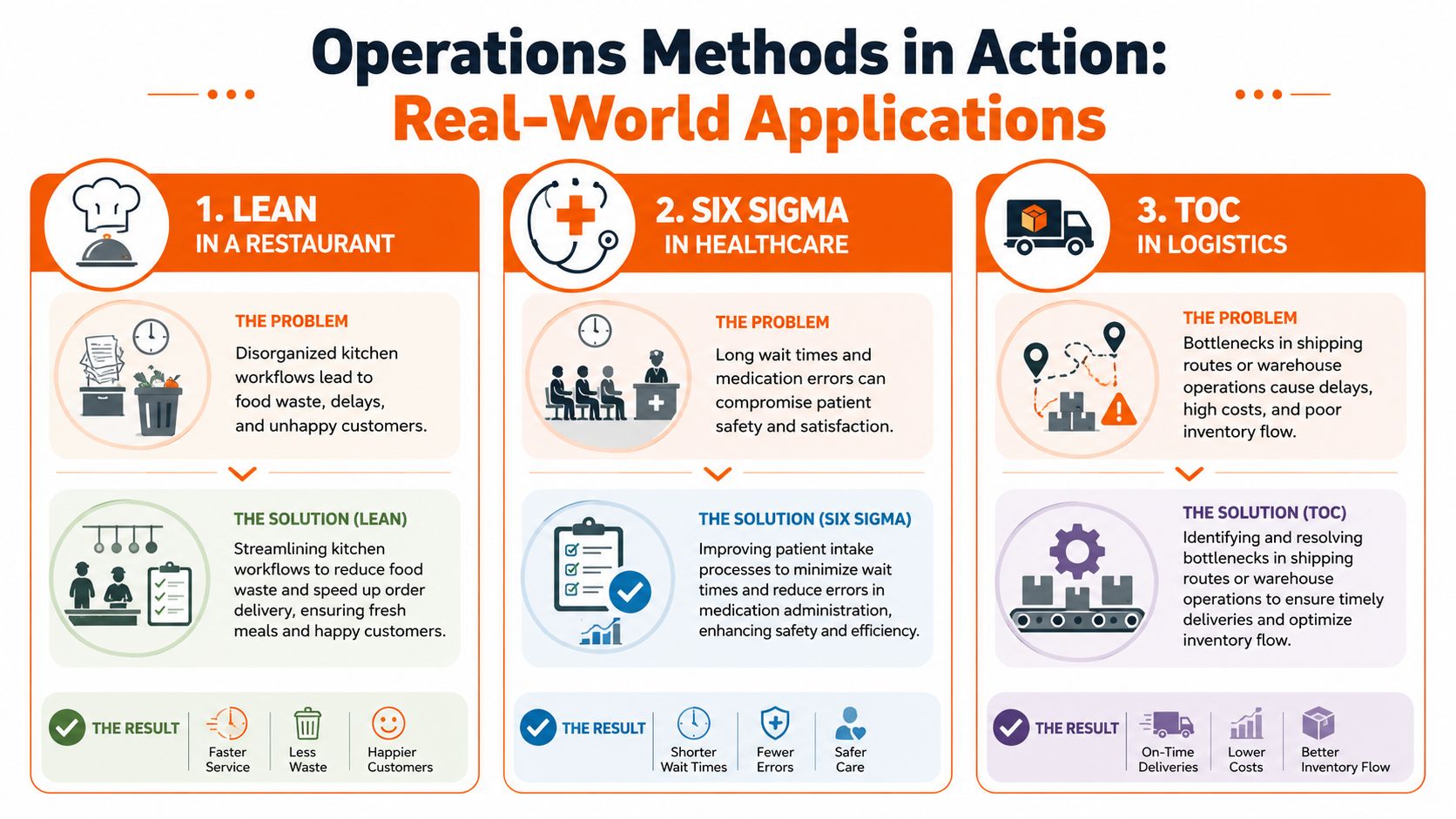
A retail team with a messy stockroom doesn't need a seminar on waste. They need 5S.
Fast-moving items go closest to the floor. Labels become readable. Returns stop mixing with sellable stock. Damaged goods get a clear holding area. Suddenly the team isn't disappearing into the back room for long stretches while customers wait at the front. The customer sees faster service. The staff feels less frantic. That's Lean in plain clothes.
Hotels often run into a different problem at check-in. The desk gets flooded at a predictable time, but the line still stalls. Theory of Constraints helps because it forces one honest question: what is the actual choke point? Sometimes it's room readiness. Sometimes it's payment exceptions. Sometimes it's one staff member who has the authority to resolve special cases. Once the underlying bottleneck is visible, the team can redesign the handoff instead of just “working harder.”
If you run a food business, this practical guide on how to improve restaurant operations is worth a read because it stays close to service reality rather than drifting into theory.
Healthcare and logistics
A clinic dealing with long waits can use PDCA without calling it that. Change the intake sequence for one provider. Check what slowed down and what moved faster. Keep the parts that helped. Try again. Healthcare teams live with variation all day, so the value isn't in pretending variability will disappear. It's in reducing the avoidable kind.
Six Sigma thinking is useful here when the same administrative or medication-related errors keep resurfacing. The point isn't perfection theater. It's making critical work more consistent when inconsistency carries real consequences.
Logistics teams often learn Kaizen the hard way. The morning sort starts with everyone improvising around late arrivals, unclear lanes, and awkward staging. Small changes compound well here. Tape lines on the floor. Reassign staging positions. Move the scanner station. Shift one handoff point. None of that sounds dramatic. It changes the morning anyway.
Good operations work often looks boring from the outside. That's a compliment.
A broader set of operations management examples can help if you want to see how these methods map across different frontline settings.
What these examples have in common
They don't begin with ideology. They begin with irritation.
Something keeps tripping the team. Someone keeps waiting. A process keeps wobbling in the same place. The method gives you a disciplined way to respond, but the signal usually comes from the floor first.
That's what makes these methods durable. They aren't really about factories. They're about friction.
Where Good Intentions Go Wrong
Most failed improvement work doesn't fail because the method was bad. It fails because the rollout was detached from reality.
The first mistake is method as identity. A leader reads about Lean or Six Sigma and starts treating it like a belief system. Soon every issue gets pushed through the same lens, whether it fits or not. Creative work gets over-standardized. Fast-moving service work gets buried in analysis. Teams stop solving problems and start performing the method.
The common traps
Tool obsession: A Kanban board goes up, but nobody uses it to have better conversations. The board becomes decor.
Top-down redesign: Leaders rewrite a process without the people who perform it. The result looks tidy on paper and falls apart on shift two.
Documentation overload: Teams get new SOPs, binders, and checklists without removing any old clutter. Complexity rises. Compliance falls.
Confusing activity with improvement: More meetings, more templates, more reporting. The customer experience stays exactly the same.
What works is plainer. Watch the work. Involve the operators. Fix one pain point. Keep score in a way the team can understand.
What to do instead
Ask the people closest to the process two questions: what slows you down, and what causes avoidable rework? You'll usually get better answers there than in a steering committee.
Then test small. Don't announce transformation when you mean experiment.
If the frontline didn't help shape the change, don't be surprised when the change doesn't survive contact with the frontline.
The goal isn't to look disciplined. It's to become more reliable, less wasteful, and easier to work in. Those are not the same thing.
The Future of Operations Is Simpler Not More Complex
A lot of people assume the future of operations is more dashboards, more automation, more layers, more math. I don't think so. I think the future is simpler systems with better visibility.
Modern operations is becoming more data-led, and AI can improve forecasting and resource allocation. But digitization on its own doesn't remove waste. As NetSuite's overview of operations management notes, organizations still need decision tools that combine human judgment, workflow redesign, and automation. Some methods that cut cost can also reduce resilience when conditions turn volatile.
That trade-off matters on the ground. The cheapest staffing pattern isn't always the one that survives a callout. The fastest process isn't always the one that handles exceptions well. The most automated workflow isn't always the one staff can recover when something breaks.
Keep it human
Good tools should make old ideas easier to apply. Better visibility. Cleaner handoffs. Faster learning. Less spreadsheet archaeology.
That's the future I'd bet on. Not more jargon. Better signal.
If you want to improve your operation tomorrow, don't start with a grand program. Pick one nagging problem. Watch it closely. See where the work bends. That's where operations management methods begin to earn their keep.
If your team is spread across shifts, sites, or departments, Pebb is worth a look. It gives operations and people teams one place for communication, tasks, knowledge, files, and shift coordination, which makes it easier to keep frontline work visible and consistent without adding another pile of disconnected tools.
