
Onboarding in HR: Boost Retention & Productivity
Stop messy paperwork & forgotten logins. Learn how effective onboarding in HR retains staff, accelerates productivity, and works for all, from office to
Dan Robin
Most onboarding advice is too polite. It tells you to prepare a checklist, schedule orientation, send a welcome email, and assign a buddy. Fine. Do that if you want the bare minimum.
But let's not confuse motion with progress.
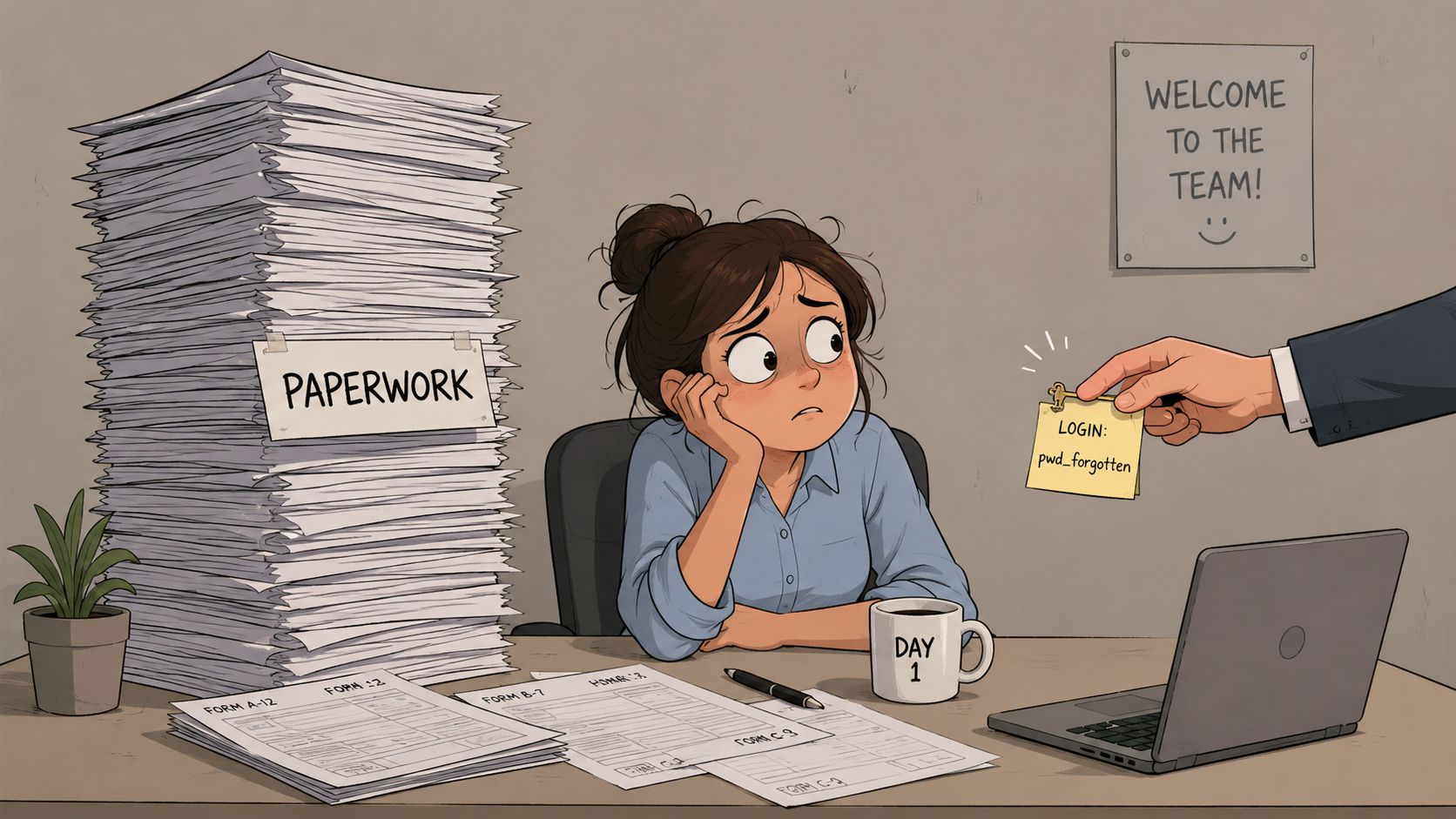
In real companies, onboarding in HR often gets reduced to forms, logins, policy PDFs, and a first-day calendar invite. That isn't onboarding. That's administration. New hires can feel the difference immediately. They know when a company has thought through their first weeks, and they know when everyone is winging it.
I've seen both. The messy version creates doubt fast. People wonder who they report to, where to find answers, how work gets done, and whether anyone is paying attention. The better version does something simpler and harder. It makes people feel expected, useful, and connected before confusion has time to set in.
Onboarding Is More Than a Welcome Packet
The most common mistake in onboarding in HR is treating it like a day-one event. Someone gets a laptop, signs documents, sits through a presentation, and HR calls it done. That's not a process. That's a handoff.
The problem is visible in the gap between what companies think they're doing and what employees experience. Gallup-referenced onboarding data summarized by Insight Global shows only 12% of employees strongly believe their organization does a great job onboarding new hires. The same summary notes that 86% of new hires decide how long they will stay within their first six months. That should stop every HR leader in their tracks.
The first impression isn't cosmetic
A lot of teams still talk about onboarding as if it's mostly about culture. Snacks. Swag. Introductions. A welcome deck with the company values on slide three.
That's not enough.
Onboarding is the first hard proof of how your company operates. If systems are disorganized, if managers are absent, if IT is late, if the schedule is vague, the new hire doesn't just see a rough first week. They see a preview of daily life at your company.
Good onboarding says, without saying it, "We know you're here, we prepared for you, and we know how to help you succeed."
Paperwork matters, but it isn't the point
Forms need to be done. Compliance matters. Access matters. Payroll matters. None of that is optional. But when paperwork becomes the center of the experience, you've lost the plot.
New hires need a few basic things fast:
Clarity: What am I here to do this week?
Access: What tools, people, and information do I need right now?
Connection: Who can I ask when I get stuck?
Confidence: How will I know I'm doing okay?
If your onboarding process can't answer those questions, the welcome packet won't save you.
What Good Onboarding Actually Does
Strong onboarding does three things at once. It reduces uncertainty, shortens the ramp to useful work, and gives people a reason to believe they made the right decision.
That isn't just an HR ideal. It's a business issue. A widely cited Brandon Hall Group benchmark referenced by StrongDM found that a strong onboarding process can improve new-hire retention by 82% and productivity by over 70%. That's the clearest argument I know for taking onboarding seriously.
Orientation is a moment. Onboarding is a system.
Most companies mix these up.
Orientation is the event. It's the meeting, the paperwork, the policy walk-through, the first introductions. Necessary, but limited. Onboarding is the longer stretch where someone learns the work, the people, the rhythm, and the unwritten rules.
If you compress all of that into day one, people leave with a full calendar and an empty sense of direction.
Confidence is the real output
The best onboarding programs don't just transfer information. They build capability. A new hire should leave the early stage knowing where to go, what matters first, and how to move without waiting for constant rescue.
I look for signs like these:
They can start real work: Not perfect work. Real work.
They know where answers live: They aren't hunting through inboxes or asking five people the same question.
They understand who matters: Manager, team lead, buddy, HR contact, IT help.
They feel safe asking basic questions: This matters more than most leaders think.
Practical rule: If a new hire spends the first week guessing, the onboarding process failed.
The payoff reaches beyond HR
Leaders sometimes treat onboarding as a soft concern because HR usually owns the process. That's a mistake. Every delay in role clarity, every missing system login, every silent manager, and every vague expectation slows down performance.
Good onboarding in HR doesn't exist to impress people. It exists to help them contribute sooner and stay longer. That's why operations, IT, managers, and HR all need to treat it like shared work.
A clean first month tells people your company is serious. A chaotic one tells them your internal promises are optional.
The Four Stages of Effective Onboarding
Most onboarding programs break because they treat every task as equally urgent. They aren't. New hires need different things at different moments. That's why I prefer a simple four-stage model.
The point isn't to create a perfect framework. The point is to stop dumping everything on day one.
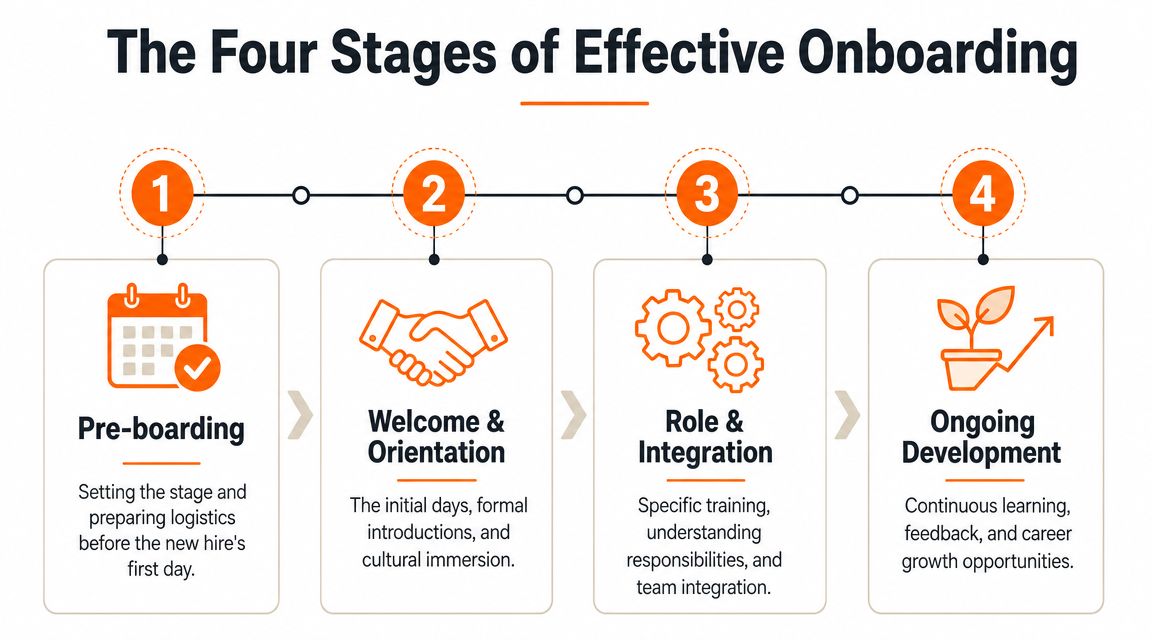
Pre-boarding
This starts after the offer is signed, not on the first morning.
Silence during this window creates anxiety. People don't know what to expect, what to prepare, or whether anyone has set things up. Pre-boarding should remove that uncertainty. Send the schedule. Confirm equipment or uniform details. Share where to show up, who they'll meet, and what the first week looks like.
Keep it human. A note from the manager matters more than another auto-generated workflow email.
Welcome and orientation
This is the first few days. Keep it focused.
Don't drown people in every policy, every tool, and every edge case. Give them what they need to get grounded. Introduce the team. Explain how communication works. Show them where key information lives. Walk through the basics of pay, time, systems, and support.
A good first week feels structured, not stuffed.
Role and integration
At this stage, real onboarding begins. The person is no longer just arriving. They're trying to do the job.
That means role-specific training, shadowing, practice, and feedback. It also means helping them understand team norms. How are decisions made? What counts as good work? When should they ask for help? What should they own without waiting?
This stage is where many companies disappear. HR steps back. Managers get busy. The new hire is left with a vague "reach out if you need anything." That's weak management dressed up as trust.
Ongoing development
Eventually, onboarding should shift into growth. The person knows the basics. Now they need reinforcement, coaching, and a path toward stronger performance.
This doesn't require a massive program. It requires follow-through.
A simple structure works:
Early feedback: Tell people what's going well and what's still unclear.
Skill support: Give them the job aids, training, and examples that match the actual work.
Progress check-ins: Ask whether they can do the job, not just whether they completed assigned items.
Social connection: Help them build relationships beyond the first introduction round.
The handoff from onboarding to development shouldn't feel like a drop-off. It should feel like continuity.
If these four stages are present, people settle in faster. If one is missing, the cracks show early.
How to Know If Your Onboarding Is Working
Most companies measure onboarding by completion. Did the forms get signed? Did the training get assigned? Did the manager hold the welcome meeting?
Those checks matter, but they don't tell you whether the process worked.
A better approach is to treat onboarding like an operating system you can inspect and improve. TechClass's summary of onboarding analytics points to a practical set of measures: new-hire retention, 90-day attrition, time-to-productivity, and training completion rates. The value isn't in collecting numbers for a dashboard. The value is in finding the breakpoints by role, manager, or location.
Stop asking only if tasks were completed
You need to know where people stall.
Maybe one department has clean paperwork completion but poor early retention. Maybe one site gets people productive quickly while another site drags because access and training aren't coordinated. Maybe one manager finishes every required step but still leaves new hires confused.
That's why I like combining operational metrics with direct feedback from new hires. Good onboarding survey questions for new hires can reveal the parts your dashboard won't catch, especially around clarity, confidence, and support.
Key onboarding performance indicators
KPI | What It Measures | How to Track It |
|---|---|---|
New-hire retention | Whether people stay through the early employment period | Review retention by role, location, hiring cohort, and manager |
90-day attrition | Early exits that signal onboarding or role-fit problems | Track departures in the first 90 days and look for patterns |
Time-to-productivity | How quickly a new hire can perform expected work | Define role-specific readiness markers with managers |
Training completion rates | Whether required learning was actually finished | Monitor assigned learning by cohort, team, and deadline |
Satisfaction scores | How the experience felt to the new hire | Use short pulse surveys at defined points in the process |
Measure for diagnosis, not vanity
Some teams avoid measurement because they think it will turn onboarding into a cold compliance exercise. It doesn't have to.
Use the data to ask better questions. Which manager groups need support? Which locations create friction? Which roles need more pre-boarding, more shadowing, or better job aids? That's useful. That's how onboarding in HR gets better instead of just busier.
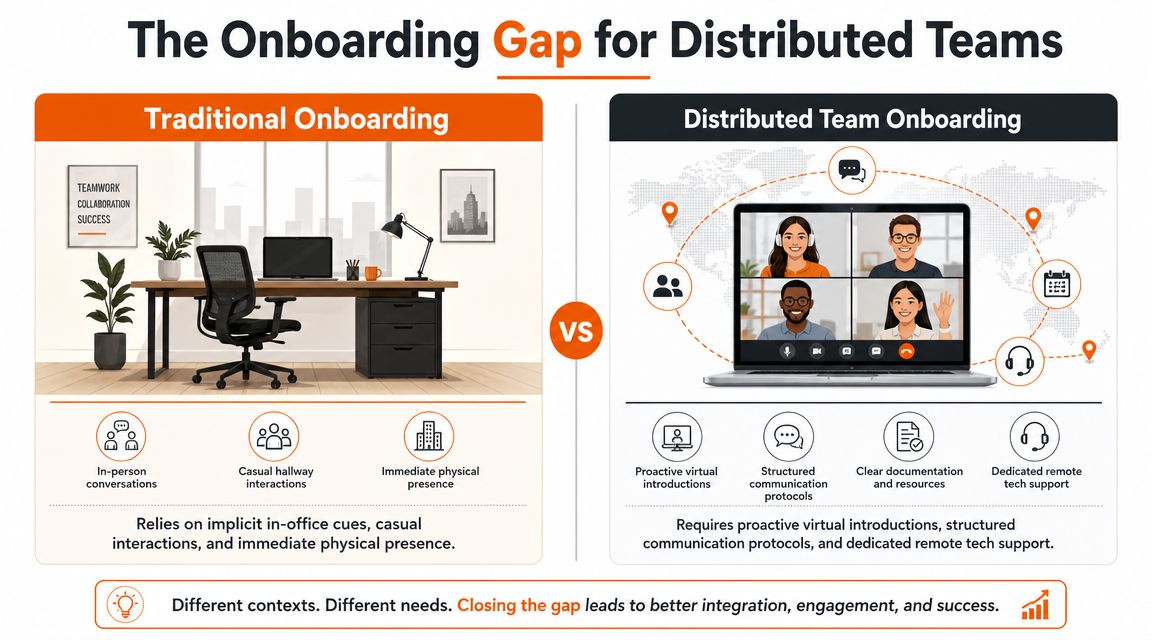
The Onboarding Gap for Distributed Teams
A lot of onboarding advice assumes the new hire has a desk, a laptop, and a manager nearby. That assumption breaks the moment you're dealing with a retail chain, a hospital unit, a warehouse crew, a field team, or a restaurant group.
That's where most onboarding programs get exposed.
SHRM's onboarding guidance reflects a broad process, but one major blind spot remains. Many frameworks still assume an office-friendly 30/60/90-day rhythm and don't deal well with frontline and deskless workers who have variable shifts and limited computer access. That's not a small edge case. For many employers, it's the actual workforce.
Traditional onboarding falls apart off the desk
If your onboarding lives in email, desktop portals, slide decks, and calendar invites, you've already excluded a big part of your workforce.
Frontline employees need something different. They need mobile access. They need short, clear instructions. They need schedules, policies, task guidance, and people information in one place they can use during a shift. They also need consistency across locations, because local workarounds create uneven experiences fast.
Read this if you're refining your approach to onboarding remote employees. The same principle applies to deskless teams. If people aren't sitting in the same room, onboarding has to be more intentional, not less.
Mobile-first isn't a perk
For distributed teams, mobile-first onboarding is basic infrastructure.
That means a new hire can do things like these without chasing three departments:
Find policies quickly: Safety steps, attendance rules, role expectations.
See who people are: Manager, trainer, team contacts, support staff.
Complete assigned tasks: Not from a back-office computer they rarely use, but from their phone.
Access updates in one stream: Shift changes, announcements, reminders, and training prompts.
A unified employee app offers valuable assistance. Tools such as Microsoft Teams, Workvivo, and Pebb can centralize communication, task follow-up, files, and people information so onboarding doesn't get split across disconnected systems. The point isn't the brand. The point is reducing friction for people who don't live in email all day.
Distributed onboarding works when the company brings the system to the employee, not when the employee has to hunt for the system.
Always-on beats one-and-done
For frontline teams, onboarding shouldn't feel like a classroom event followed by radio silence. It should feel like a steady flow of useful support inside the same place people already go for work updates.
That's the shift many HR teams still need to make. Less ceremony. More access. Less binder. More usable workflow.
Onboarding as a System Not a Project
The most useful shift in onboarding in HR is philosophical. Stop treating it like a project with a start date, an end date, and a folder of completed tasks.
Treat it like an operating system.
That idea is captured well in Niche Academy's argument for onboarding as an operational system with telemetry. The standard isn't whether paperwork got completed. The standard is whether new hires can perform tasks, find answers, and build social connection quickly.
Ask a harder question
Most onboarding reviews ask, "Did we do the steps?"
A better question is, "What did the experience teach the new hire about working here?" Did it teach them that your company is calm, prepared, and clear? Or did it teach them that everyone improvises, information is scattered, and support depends on luck?
That answer matters more than any values slide in your orientation deck.
Build something people can trust
The strongest onboarding systems share a few traits. They connect HR, IT, managers, and operations. They carry people from pre-boarding into real role readiness. They make information easy to find. They create visible accountability. And they keep running after day one.
If you're evaluating employee onboarding software, don't start with feature lists. Start with the lived experience you want a new hire to have. Then choose tools that support that experience across devices, roles, and locations.
Onboarding tells the truth about a company faster than almost anything else. Not the mission statement. Not the careers page. Not the welcome email.
The first weeks do.
If your onboarding still lives in spreadsheets, inboxes, and scattered documents, Pebb is one way to bring it into a single place. Teams can use chat, tasks, a knowledge library, files, forms, and a people directory to give new hires clear guidance from their phones or desktops, especially across frontline and distributed environments.
