
How We Onboard Remote Employees (Without the Chaos)
Learn how to onboard remote employees with a human-first playbook. Our guide covers preboarding, 30/60/90-day plans, and building culture from day one.
Dan Robin
The secret to great remote onboarding is surprisingly simple: treat new hires like people, not another task on your to-do list. It’s about ditching the soul-crushing avalanche of PDFs and replacing it with a thoughtful, human experience. The goal is to build connection from the moment they say "yes."
We've All Seen This Before: Why Old Onboarding Fails Remote Teams
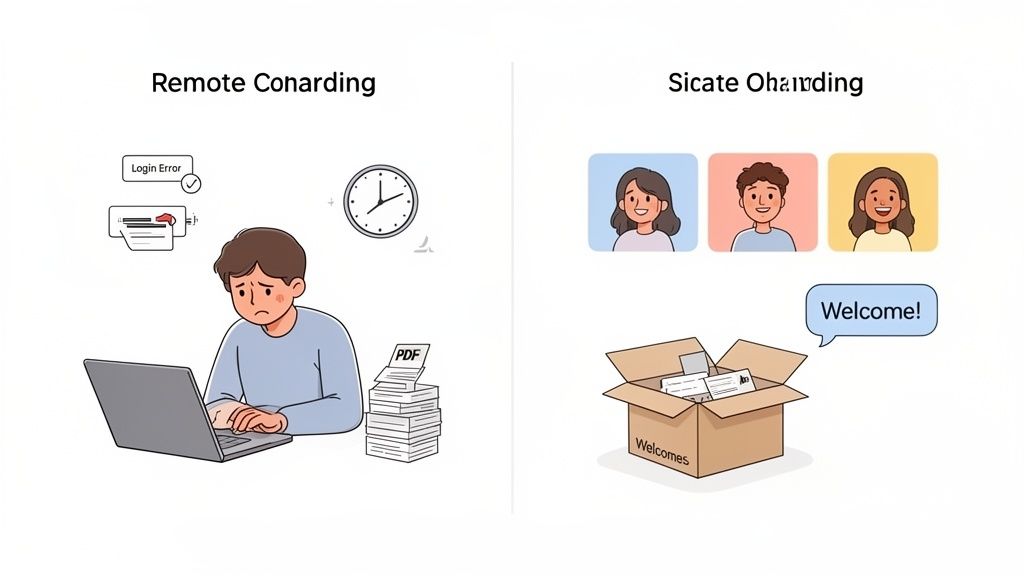
Let’s be honest. Most onboarding processes are a mess. They’re a clunky relic of the in-office world, awkwardly shoehorned into a digital format.
Think about the classic bad first day. A new hire, buzzing with excitement, logs on to… crickets. An email eventually lands with a dozen attachments—handbooks, compliance forms, and policies. Then another one arrives with login credentials that, of course, don’t work. Their calendar is a ghost town, and their manager is MIA in back-to-back meetings.
By lunchtime, that first-day energy has soured. It's been replaced by a nasty cocktail of confusion, frustration, and isolation. This isn’t just a rough start; it's a broken promise. You're accidentally telling your new hire that your company is disorganized and doesn't really care.
The Staggering Cost of a Bad First Impression
This isn't just about warm feelings. The consequences are real and they are expensive.
With 98% of workers wanting to stay remote in some form, nailing this experience is no longer optional. Yet the data shows a huge gap between our intentions and reality. A staggering 63% of remote workers feel undertrained, and 60% feel disoriented after their onboarding.
This feeling of being disconnected is stark. Compare that to hybrid onboarding, where 75% of employees report feeling satisfied, versus just 63% for fully remote new hires. Get it right, and the rewards are huge: effective onboarding can boost retention by 82% and productivity by over 70%.
Onboarding isn't a logistical hoop to jump through. It's the bedrock of your team's culture. If you get it wrong, you’re encouraging your best new talent to keep their LinkedIn profile up-to-date.
Now, picture a different first day. Your new hire logs in and finds a personalized welcome message from the team. Their laptop is ready to go, their calendar has a few casual coffee chats already scheduled, and a simple, clear guide to their first week is waiting for them. They feel seen, prepared, and genuinely welcome.
Shifting from Logistics to Human Connection
The difference between these two scenarios isn't about fancy software or expensive welcome packages. It's about a fundamental mindset shift—moving from a process-driven checklist to a human-centered journey.
There's a significant disconnect between what we think we're providing and what new hires actually experience.
The Remote Onboarding Gap: What We Assume vs. What Really Happens
Common Assumption | The Reality (Based on Research) | A Human-First Approach |
|---|---|---|
"They have all the documents they need." | They feel overwhelmed by a "document dump" and don't know where to start. | Provide a curated, guided path through essential information, not a file library. |
"IT has their access sorted." | Login issues are a top Day 1 complaint, leading to immediate frustration. | Test all accounts and hardware before Day 1. Provide a single point of contact for tech help. |
"Their manager will check in on them." | Managers are often too busy, leaving the new hire feeling isolated and adrift. | Schedule intentional, structured check-ins and social introductions in the first week. |
"They'll pick up the culture eventually." | Without proactive effort, remote hires feel disconnected from team culture and social norms. | Build culture from Day 1 with welcome rituals, virtual coffees, and an onboarding buddy. |
This isn't about perfectly replicating the office environment online. It's about embracing modern ways of working designed for distributed teams. It all starts by asking one simple question:
How can we make this person feel like they truly belong here, right from the very beginning?
The answer is the foundation of a better onboarding experience. When you realize that a little thoughtfulness goes a long way, you’re not just training an employee—you’re earning their trust and loyalty from day one. This guide will show you exactly how we do it.
The Preboarding Phase: Building Connection Before Day One
The best remote onboarding doesn’t kick off on day one. It begins the moment a new hire signs their offer letter. That period—usually two weeks or so—is often filled with radio silence from the company, which can stir up anxiety for the new person. It’s a huge missed opportunity.
We've learned to treat preboarding like the opening act for a great concert. It's all about setting the stage, building anticipation, and reassuring your new teammate they've made the right choice. This is your first real shot to demonstrate your company culture in action, not just as words on a careers page.
Think about it. That quiet period before starting a new job is awkward. You’ve mentally moved on from your last role but haven’t quite plugged into the next. This is where a thoughtful approach to preboarding changes everything, turning that strange waiting game into a welcoming runway.
Turning Silence Into Connection
Our goal here isn't to overwhelm people with paperwork or pre-work. It's much simpler: focus on connection. We rely on a few human touches that have a surprisingly big impact.
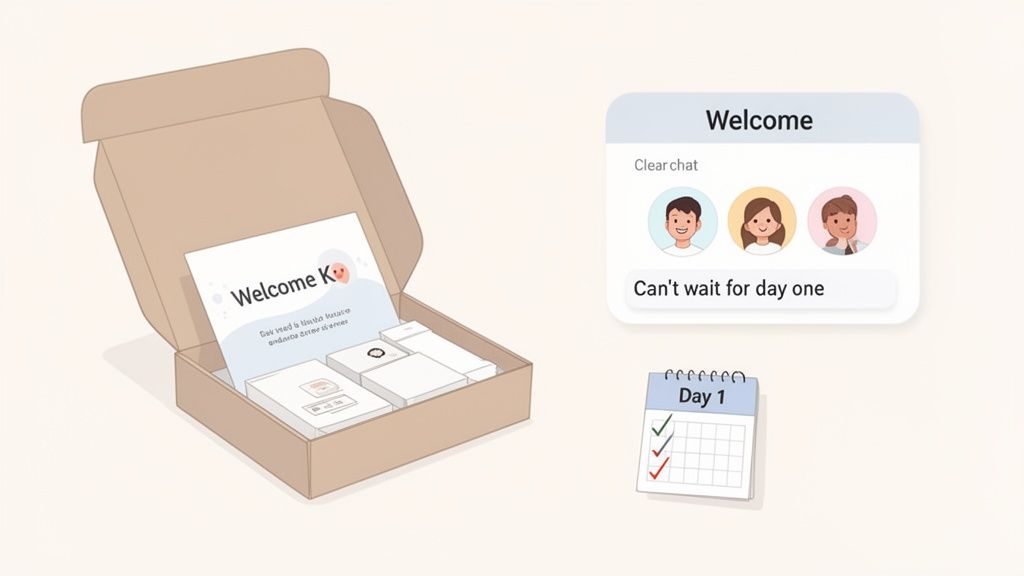
First up, the welcome kit. And I don’t mean a box of random branded swag. We send things people will actually use—a nice coffee mug, a high-quality notebook, maybe a gift card for a local lunch spot. It’s a physical handshake in a digital world. The message is clear: "We're genuinely excited for you to join, and we're already thinking about you."
Next, we open up a space for casual chatter. A few days before their start date, we add the new hire to a dedicated "Welcome" channel in our team chat. Teammates can pop in to say hello, share a funny GIF, or just introduce themselves without any pressure.
It’s just people being people. This simple gesture helps demystify the team, turning a list of names on an org chart into real, friendly colleagues. By the time Monday rolls around, they're not logging on to meet a bunch of strangers; they’re greeting a team they've already started to get to know.
The point of preboarding isn't to get work done. It's to close the emotional distance between 'candidate' and 'teammate' before their official first day.
Providing Clarity, Not Complexity
Finally, a couple of days before they start, we send over a simple guide for their first week. This isn't some dense agenda packed with compliance training. Instead, it’s a clean one-pager that answers their most immediate questions:
What does my first day look like? (e.g., "9:30 AM: Kick-off call with your manager, 11:00 AM: Virtual coffee with your onboarding buddy.")
Who will I be meeting? (A quick look at the key people they'll chat with during the week.)
What’s the most important thing to focus on? (e.g., "Just get your bearings, ask lots of questions, and get to know the team. That's it.")
This isn’t about piling on tasks. It's about managing expectations and calming those first-day jitters. Giving them a clear picture helps them show up on Monday feeling prepared and confident, not stressed and guessing. If you're looking to build out your own strategy, it's worth reading up on what effective pre-boarding looks like.
This whole process—the thoughtful gift, the warm introductions, the clear guide—takes very little effort but pays off in a big way. It replaces uncertainty with real human connection and lays a solid foundation for success. Your new hire arrives feeling like part of the team, not just a new name on the payroll.
A Blueprint for a Meaningful First Week
That first week on the job sets the tone for everything that follows. All too often, we see it treated as a mad dash through compliance training and HR paperwork. A massive missed opportunity.
The goal isn't to drown your new hire in a sea of information. It's about grounding them in the three things that truly matter for long-term success: People, Purpose, and Process.
We’ve seen companies dump a week’s worth of policy videos on someone and call it onboarding. Frankly, it's lazy. It sends a clear message: “Your time isn’t as valuable as ours.” A great first week isn't about checking boxes; it’s about building a solid foundation of confidence and belonging. Here’s how we do it right.
People First, Always
Before a new hire can truly invest in your company's goals, they need to feel connected to the people they'll be working with every day. That's why we deliberately keep the first few days light on tasks and heavy on human connection.
This isn’t about forced fun or awkward icebreakers. It’s about creating low-pressure opportunities for real conversation. We schedule a series of brief, informal 1:1 video calls so the new hire can meet their direct manager, their onboarding buddy, and a handful of key collaborators.
The instructions for these chats are simple:
No agendas. This is not a project kickoff meeting.
Keep it short. 15-20 minutes is the sweet spot.
Just talk. Like actual humans. Ask about their weekend, what they’re excited to work on, or what they’re watching on Netflix.
The whole point is to replace intimidating titles on an org chart with friendly faces. This helps the new person start building a mental map of who's who and, more importantly, makes them feel seen as an individual from day one.
Connect Work to a Clear Purpose
Once someone feels a sense of connection, they need to understand why their work matters. This is the "Purpose" pillar. It's the manager’s job to draw a straight line from the company's grand vision right down to the new hire's daily tasks.
I’ve seen managers just send a link to a folder of strategy documents. That’s not guidance; it’s a homework assignment.
A much better way is to walk them through it personally. The manager should block out an hour to share their screen and walk the new hire through the team's corner of the world. Pull up the team’s high-level goals and show them the key documents in your shared knowledge base. Explain why these things exist and how they all connect.
Your goal isn't to have them memorize the company strategy on day three. It's to show them where to find the answers and to make it clear that their role is a meaningful piece of a larger puzzle.
Introduce Process Through Early Wins
Finally, we get to "Process." This isn't just about setting up their tech. It's about giving them an early taste of real accomplishment. We use a simple but powerful concept called the “First Week Wins” list.
This isn’t a daunting list of deliverables. It’s a short, curated set of small, meaningful tasks designed to get them comfortable with your tools and workflows. Each task provides a tangible sense of progress. For this to work smoothly, having well-defined personnel processes is key to guide every step.
Here’s a sample of what that might look like:
First Week Wins Template
Setup & Login: Log into Slack, email, and our project management tool.
Introduce Yourself: Post a short intro in our team's #welcome channel.
Explore: Find the marketing team’s project dashboard and leave a comment on one card.
Small Contribution: Review a short document from your onboarding buddy and add one suggestion.
Feedback: Share one piece of feedback on your onboarding experience so far.
Each item is small, scannable, and moves the needle just a little bit. By Friday, they haven't just completed IT setup; they've participated in a conversation, contributed to a real piece of work, and given valuable feedback. They’ve started acting like a teammate.
This People, Purpose, and Process approach transforms the first week from a passive, overwhelming info-dump into an active, empowering experience. You’re not just telling them about your culture; you’re letting them live it from their very first day.
The First 90 Days: Turning a New Hire Into a Teammate
A great first week is a fantastic start, but it’s just that—a start. The real magic happens over the next three months. We've all learned the hard way that onboarding isn't a checklist you finish on Friday. It's a journey that truly shapes whether a new hire sinks or swims.
Those first 90 days are where they find their footing, start to build real momentum, and begin to feel like a genuine part of the team. If you just leave them to figure it all out after week one, you’re missing a huge opportunity to set them up for long-term success.
The key isn't to micromanage. It's about providing a clear, supportive roadmap for both the new hire and their manager. We’ve found a simple 30/60/90-day framework works wonders. Think of it less as a rigid corporate plan and more as a series of evolving milestones.
The First 30 Days: Become a Sponge
The entire first month can be summed up in one word: learning. A new hire’s only real job at this point is to be a sponge. They should be absorbing everything they can about the team, the company's mission, the product, and most importantly, the customers we serve.
Productivity isn't the goal here. Pushing for major output in the first 30 days is a surefire way to cause anxiety and burnout. Instead, the manager’s job is to create a safe space for curiosity—point them to the right documents, introduce them to the right people, and encourage them to ask a ton of questions.
Here’s what you’re aiming for in this phase:
The Goal: Get a solid handle on the team’s purpose, its processes, and who's who.
The Manager’s Role: Act as a guide. Make introductions, clarify expectations, and answer every question without judgment.
Key Activities: Shadowing calls, digging into past projects, setting up 1:1s with teammates, and getting comfortable with the daily flow of communication.
By the end of the first month, success is simple: your new hire understands the landscape and knows exactly who to go to for help.
The Next 30 Days: Start Making an Impact
As you roll into month two, the focus starts to shift from absorbing to contributing. Your new hire has the lay of the land, and now it’s time to start putting that knowledge to work. This is where they start building confidence and getting that first real taste of accomplishment.
We’ve found the best way to do this is by giving them ownership of a small, well-defined project. It shouldn't be some high-stakes, mission-critical task. Pick something that lets them get their hands dirty, collaborate with a couple of colleagues, and see a project through from start to finish.
A new hire's confidence snowballs with every small win. The 60-day mark is all about creating the opportunity for that first meaningful contribution.
For instance, a new marketing hire could analyze a recent campaign and pitch a few ideas for a follow-up. A developer could tackle a low-priority but noticeable bug. The goal is to give them a task with a clear beginning, middle, and end. By day 60, they’re not just learning anymore—they're doing.
By Day 90: Find Your Groove and Drive
By the time the 90-day mark is on the horizon, your new hire should be operating with much more autonomy. They’ve learned the ropes and made their first contributions. Now, they should feel confident enough to start driving small initiatives on their own.
This is the moment they transition from being a student to a true peer. It's where they begin to own their role. A new designer, for example, might not just wait for an assignment but proactively flag an inconsistent UX in the app and sketch out a potential solution.
This visual shows how we structure that initial ramp-up, weaving together the core pillars of People, Purpose, and Process.
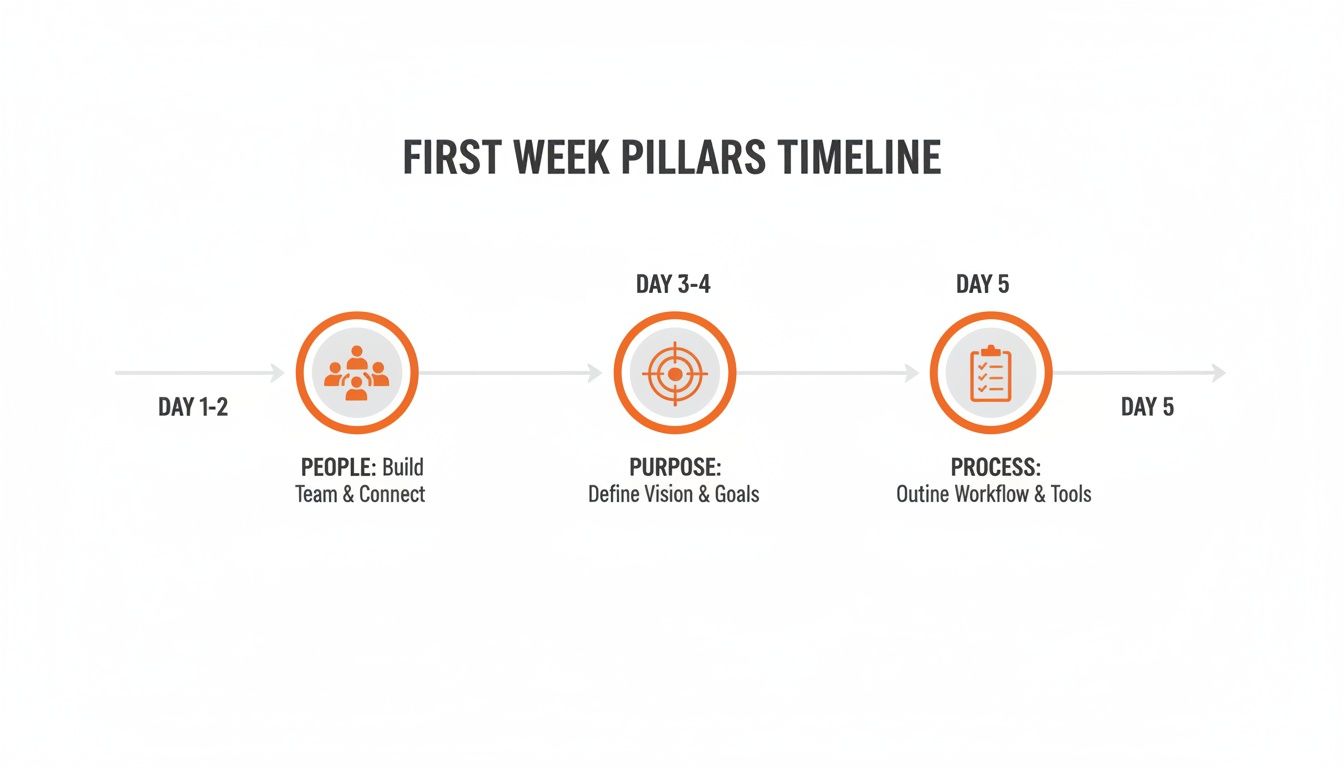
These pillars aren't just for week one; they’re the common thread that runs through the entire 90-day journey, helping everything stick.
Let's be real, even with a great plan, this can be tough. The data is sobering: a landmark study by the Brandon Hall Group found that a strong onboarding process improves new hire retention by a whopping 82%. Yet, research from Gallup shows that only 29% of new hires feel fully supported and prepared to excel in their role after their initial onboarding ends. For remote folks, this is even more critical, as they are 20% more likely to feel satisfied in their job with a thought-out program. You can see more on these onboarding statistics and why getting this right matters so much.
Ultimately, a 30/60/90-day plan isn't a performance review in disguise. It's a support system. For managers, it’s about consistent, low-pressure check-ins to see how things are going and what roadblocks they can clear. For the new hire, it’s a clear path from feeling like an outsider to knowing they’re a valued, contributing member of the team.
Building Culture When You Are Not in the Same Room
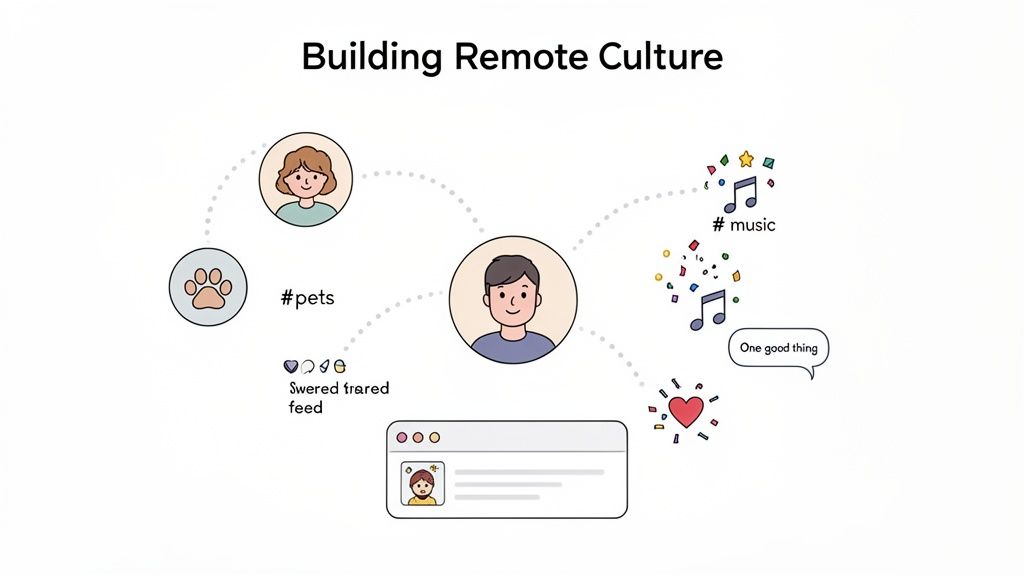
It’s the question we get all the time: how do you possibly build a strong company culture when your team is spread out everywhere? How can you create that sense of belonging through a screen?
My honest answer? You don’t by trying to copy what you did in the office.
Shipping everyone a pizza for a forced virtual happy hour or trying to recreate "watercooler" chats on a clunky platform just doesn't work. It feels awkward because it is awkward. Instead of trying to replicate the past, the key is to build something new—a culture that’s intentionally digital and genuinely human.
After all, culture was never about the ping-pong table or the free snacks. It's built on a foundation of consistent, authentic moments of connection. It’s the little interactions that happen every day that make people feel like they belong.
Stop Trying to Replicate the Office
Let's face it: those spontaneous chats that happened in the office kitchen are a thing of the past. Trying to force them into a scheduled video call just makes everyone feel uncomfortable.
Instead of fighting the medium, lean into what makes digital communication great. It’s often asynchronous, it’s driven by shared interests, and it can feel incredibly personal when you create the right environment. True culture emerges in the spaces between the meetings and project updates.
Your job is to create those spaces with intention.
Culture isn't a program you roll out. It's the natural result of creating an environment where people feel safe and encouraged to be themselves, both as professionals and as people.
When a new hire sees this happening from day one, it sends a powerful message. It shows them they’ve joined a team of actual humans, not just a list of job titles on an org chart.
Create Spaces for Shared Interests
One of the easiest wins is to create dedicated channels in your communication tool (like Slack or Microsoft Teams) for non-work topics. This is a game-changer.
At our company, we have channels for just about everything:
#pets: A never-ending stream of adorable dog and cat pictures.#cooking: Where foodies share their latest kitchen masterpieces (and failures!).#music: A place to trade new discoveries and favorite artists.
These channels give people a low-pressure way to connect over things they’re passionate about. It’s where you learn that your new designer is also a fantastic baker or that the lead engineer is secretly a huge fan of 80s pop.
For a new employee, this is an instant window into the company's personality. It makes the team feel approachable and shows that it’s okay to have a life outside of work—and to talk about it. For more practical ideas, check out our guide on how to engage remote employees.
Build Rituals Around Recognition and Reflection
Another powerful method is to establish simple, consistent rituals that bring the team together without needing another meeting. The simpler they are, the more likely they are to stick.
Celebrate the Wins: We use a company-wide feed where anyone can post a "win." It could be a teammate helping out on a tough problem or a salesperson closing a major deal. These public shout-outs create a huge sense of shared momentum and appreciation.
Weekly Reflections: Every Friday, we have an automated post that asks, "What’s one good thing from your week?" It can be work-related or a personal win, like planning a weekend hike.
These little rituals provide a steady, asynchronous rhythm to the week. They quietly reinforce community and give everyone a chance to feel connected to the bigger picture.
Ultimately, building a great remote culture isn't about grand, expensive gestures. It’s about the small, intentional, and consistently human things you do every single day. It's about showing your team—especially the new folks—that you see them as people first.
Measuring What Actually Matters in Onboarding
Over the years, I've seen countless HR teams get lost in a sea of onboarding metrics. We’re taught to track things like training completion rates or hours spent in orientation. But do those numbers really tell you anything important?
Honestly, they’re just noise. A 100% completion rate on a compliance video doesn't mean the new hire feels confident or connected. It just means they learned how to click "next." We've learned to tune out those vanity metrics and focus on just two things that truly signal a successful onboarding: new hire engagement and long-term retention.
So, how do you actually get a pulse on whether a new remote hire is settling in for the long haul?
Reading the Digital Body Language
One of the toughest parts of leading a remote team is losing those casual, in-person cues. You can't see the new hire chatting by the coffee machine or pulling up a chair to join a brainstorming session. Remotely, you have to learn to spot the digital equivalent of these interactions.
We call it digital body language. These are the small, everyday signals that show someone is becoming an active part of the team culture, not just a name on an org chart. These are the clues that predict whether they'll thrive and stick around.
What does this look like in practice? Simple things, really:
Are they jumping into team chats with ideas, or just lurking?
Do they react to company-wide posts with a quick thumbs-up or a comment?
Are they asking questions in public channels, showing they feel safe enough to be vulnerable?
These aren't just data points for a spreadsheet; they're human signals. An emoji reaction is the remote version of a friendly nod in the hallway. Seeing this kind of activity is a fantastic sign. Radio silence, on the other hand, is a major red flag that someone might be feeling lost or disconnected.
Connecting Engagement to Retention
These small signals of engagement are breadcrumbs that lead directly to the one metric that matters most to the business: retention. It's that simple. When your onboarding works, people stay. We track retention at the six-month and twelve-month marks. If we see a dip, we know something in our process is broken, and those early engagement signals often tell us exactly where to look.
But you can't afford to wait a year to find out you have a problem. You need feedback much sooner. That's why we rely on a simple 90-day feedback survey.
The goal of a feedback survey isn't to generate a report that sits in a folder. It’s to open a conversation. It’s about getting honest feedback you can act on, right now.
Our survey isn't some 50-question corporate behemoth. It’s short, direct, and focuses on what genuinely matters to a new hire's experience. You can dig deeper into different approaches by exploring various methods for measuring employee engagement to see what fits your team's unique culture.
A Simple 90-Day Check-in
Right around the three-month mark, we send out a brief survey with just a few core questions. We ask new hires to rate their agreement on a simple scale and, more importantly, give them space for open-ended thoughts.
The questions are designed to get straight to the heart of their experience:
Role Clarity: "I have a clear understanding of what is expected of me in my role."
Team Connection: "I feel like a valued member of my team."
Sense of Belonging: "I feel a sense of belonging at this company."
Manager Support: "My manager provides the support I need to be successful."
The rating gives you a quick signal, but the real gold is in the comment boxes. That's where someone will tell you, "I'm still not sure who to ask about X," or, "My weekly 1:1s with my manager have been a huge help."
This isn’t about judging the new hire. It’s a referendum on our onboarding process. It tells us what’s working and what’s not, directly from the person living it. And that feedback—raw, honest, and human—is the only metric that truly helps you get better.
At Pebb, we believe great work starts with great connection. Our platform unifies communication, operations, and engagement to help you build a culture where every employee, remote or not, feels like they belong from day one. See how Pebb can transform your onboarding at https://pebb.io.
