
The Onboarding Questions We Were Afraid to Ask
Ditch generic surveys - discover onboarding survey questions for new hires that reveal honest feedback, boost retention, and create a warm welcome in 2026.
Dan Robin
We’ve all been there. You sign the offer letter, full of excitement. Day one is a blur of paperwork, forced smiles, and a firehose of information. By week two, you’re not sure who to ask for help or if you’ve made a huge mistake. The silence that follows is deafening. Most companies send an onboarding survey, but let’s be honest—it’s usually corporate fluff. ‘Rate your experience from 1 to 5.’ It's a checkbox, not a conversation. It tells you nothing.
The first few weeks are a fragile, critical window. It’s your only chance to learn what’s really happening—to see your company through fresh eyes before they become part of the system. Asking the right onboarding survey questions for new hires isn’t just good HR practice; it’s the most honest mirror you can hold up to your culture, your processes, and your management. It’s where you find the truth.
We stopped asking generic questions and started asking pointed ones. The answers were sometimes uncomfortable, but they were always useful. They showed us exactly where our process was broken, which managers needed more support, and why good people were struggling. This isn't about collecting data to feel good. It's about having a real conversation to get better.
This article shares the questions we found that actually matter. We’ll cover what to ask, when to ask it, and how to turn those honest answers into real change. Here are the questions that will tell you what’s truly going on with your new hires.
1. How well did your onboarding prepare you for your role?
This is the place to start. You can have the best training materials and the most detailed plan, but if new hires don’t feel ready to do their jobs, something is broken. This question cuts straight to the point: did we give you what you need to succeed? It’s a direct measure of your onboarding program's purpose.

This matters most in jobs where speed is everything. Think of a hospital that needs a new nurse to be confident on the floor quickly, or a retail chain that can’t afford a long ramp-up time for store associates. A healthcare system we know used feedback from this single question to find specific gaps in their new nurse orientation. By fixing those areas, they cut total onboarding time by nearly a third.
How to make this question work
Getting an answer is just the first step. The real value comes from what you do next.
Ask a follow-up: Don’t just stop at a rating. Immediately ask an open-ended question like, “What was one thing that was unclear?” or “What additional resource would have been most helpful?” This gives you the why behind the score.
Segment your data: Compare responses across departments, locations, and roles. If your tech hires in Austin feel less prepared than those in Boston, you’ve just found a big inconsistency in your process.
Close the loop: Share the anonymized results with managers. It’s not about pointing fingers; it’s about showing them how they can help new hires get up to speed faster. Exploring modern AI Survey Builder tools can help streamline how you ask these questions.
By consistently tracking this score, you create a baseline to measure the impact of any changes you make. It's one of the most honest onboarding survey questions for new hires you can ask.
2. How easy was it to find the tools and information you needed?
A new hire’s first day is a blur. If they spend hours just trying to find the employee handbook or figure out which software to log into, frustration builds fast. This question gets right to it: did we make it simple for you to find what you need, or did we send you on a digital scavenger hunt?
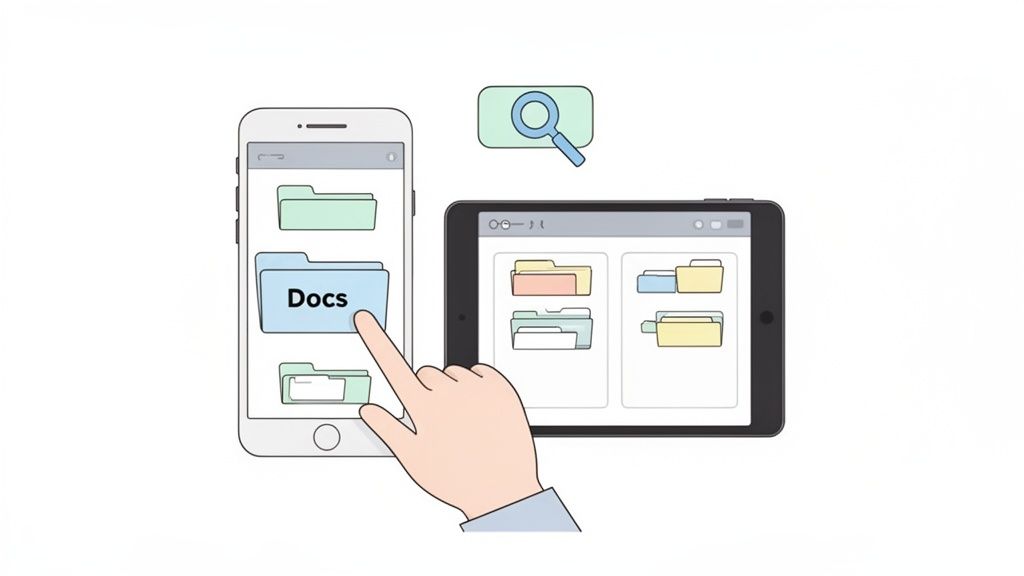
This is especially critical for remote teams and frontline workers who rely on their phones. We saw a warehouse operation that used a central knowledge library to cut first-day resource lookup time by 45%. When everything is organized and one tap away, people can focus on their actual job, not on searching for information.
How to make this question work
A low score here is a clear sign that your information is a mess. The good news is that it’s often a straightforward problem to fix.
Audit your resources: Ask a current employee to pretend it’s their first day and try to find key documents. Watch where they get stuck. This simple test reveals friction points you’ve probably overlooked.
Centralize and organize: Use one tool to create a single source of truth. Create role-specific folders with pre-populated onboarding materials, checklists, and guides. The goal is zero guesswork.
Optimize for mobile: Ensure every critical document, from schedules to policy manuals, is easy to read on a phone. If your team is on their feet, their primary access point is in their pocket. If your team still can't find what they need, it might be time to rethink your whole approach; learn more about why your team can't find the information they need and how to change that.
This question gives you a direct report on the efficiency of your digital workplace. A high score means your new hires can get to work faster, which is the entire point.
3. Did you feel welcomed by the team?
You can nail the logistics and training, but if a new hire feels like an outsider, you’ve already lost them. This question gets to the social and cultural heart of onboarding. It asks if people feel a sense of belonging. A "yes" here means you're building a team, not just filling a role.

This feeling of connection is especially fragile for remote and frontline teams. When people aren't sharing an office, creating that bond requires deliberate effort. For instance, companies using an app to create shared digital spaces for team celebrations and introductions have seen a 22% improvement in onboarding satisfaction scores. It’s about making culture something you do, not just something you talk about.
How to make this question work
A great culture doesn't happen by accident. You have to build it, one new hire at a time.
Ask a follow-up: Get specific. Ask, "Who on the team made you feel most welcome?" or "What was one team tradition or moment that made you feel part of the group?" This helps you identify your culture champions and the small rituals that make a big difference.
Assign a buddy: Don't leave connection to chance. Formally assign an onboarding buddy to each new hire. Make it easy for them to find each other and connect for questions or a quick virtual coffee.
Create dedicated spaces: A 'New Hires' digital channel lets recent joiners connect and share experiences from day one. You can also use team-specific spaces to host welcome events and share culture-building content, helping you figure out how to create a culture of belonging even when your team is spread out.
This is one of the most powerful onboarding survey questions for new hires because it measures the human element. Tracking it shows you whether you're successfully turning a group of individuals into a cohesive, supportive team.
4. Are your job responsibilities and expectations clear?
A new hire can love the team and feel prepared by training, but if they don’t know what they’re supposed to do, they’re adrift. This question directly measures role clarity. It asks if people understand their specific tasks and what success in their position actually looks like. Vague expectations are a fast track to anxiety and poor performance.
This is especially true for frontline teams where consistency is key. A retail chain, for example, used feedback from this question to find that new store associates were confused about closing procedures. By documenting clear, step-by-step responsibilities in their company app, they reduced new hire questions to managers by 40%.
How to make this question work
A low score here is a major red flag. The goal is to make expectations crystal clear from day one.
Ask a follow-up: If an employee signals a lack of clarity, ask, “What specific part of your role feels the most confusing right now?” or “What one question about your responsibilities do you still have?” This helps you pinpoint the exact confusion.
Segment your data: Are new hires in one department consistently more confused than others? This often points to a manager who needs coaching on setting expectations, or a lack of documented processes for that team.
Document and distribute: Use a central, accessible place to house role descriptions and task templates. This creates a single source of truth that new hires can reference anytime.
This is one of the most fundamental onboarding survey questions for new hires because it ties directly to a person’s ability to contribute. Without role clarity, even the most motivated new hire will struggle.
5. How satisfied are you with your manager's support?
No matter how great your company-wide orientation is, a new hire’s world shrinks to the size of their team and their direct manager. A manager can make or break the entire experience. This question gets right to that relationship, asking if managers are providing guidance, being accessible, and creating a safe space for questions.
A disengaged manager leads to a disengaged employee. This is particularly true for remote and frontline teams, where the manager is often the primary human connection to the company. We've seen a hospitality group use structured manager checklists in their company app, Pebb, and see a 26% improvement in their manager support scores because it gave managers a clear, repeatable playbook.
How to make this question work
A low score here isn't just an HR problem; it's an operational risk. Here’s how to act on it.
Create a manager playbook: Don't assume every manager knows how to onboard well. Build a simple onboarding guide in your company's knowledge base with checklists for day 1, week 1, and month 1. Providing this structure can improve new hire satisfaction by over 30%.
Segment by manager and team: Look for patterns. Is one manager consistently getting low scores? It might signal a need for coaching. Is one team feeling particularly unsupported? It could be a workload issue, not a manager issue. This data helps you diagnose problems with precision.
Enable easy communication: Give new hires a direct, informal line to their manager. A private chat channel is perfect for this. It lowers the barrier to asking "silly" questions that might otherwise go unasked.
Share what works: When you find managers who are knocking it out of the park, don't keep their methods a secret. Share their tips and best practices with everyone. This builds a culture of peer-to-peer learning.
This is one of the most powerful onboarding survey questions for new hires because it shines a light on the single most influential relationship in an employee's early days. Getting it right has an outsized impact on retention and performance.
6. How adequate was the training you received for your job?
General orientation is one thing, but this question gets to the heart of day-to-day competence. It asks if we gave the new hire the specific technical knowledge and process training needed to actually do the job. This moves beyond company values and focuses on practical, role-based skills. A new hire who feels confident with their specific tasks is a new hire who will contribute faster.
This question is essential for specialized roles where doing things correctly isn't a preference, it's a requirement. Think of a logistics company where one wrong step can cause major delays, or a healthcare facility where understanding protocols is a matter of patient safety. Logistics companies that created task-based training modules for warehouse staff saw first-month productivity jump by nearly 85% because training was directly tied to real-world duties.
How to make this question work
A simple score gives you a temperature check. The real improvements come from digging into the details.
Follow up with specifics: After the rating, ask, “Which part of the training was most helpful?” and “What one skill or system do you wish we had covered in more detail?” This tells you what to keep and what to fix.
Segment your training feedback: Analyze responses by role and team. If customer service agents feel their systems training is weak but the sales team feels great about theirs, you’ve found a training gap, not a program-wide failure.
Use feedback to refine training content: Track which training materials are used and which are ignored. If everyone skips the PDF but watches the video demo, it’s a clear signal to invest more in video. This is one of the most effective ways to use feedback from onboarding survey questions for new hires.
Create dedicated channels for questions: A dedicated "Training Q&A" channel allows new hires to get answers quickly and lets you see where your documentation is unclear.
7. How well did we prepare you for your first customer interaction?
For any customer-facing role, this is the moment of truth. A new hire’s first conversation with a customer is a direct reflection of your brand, your training, and your values. This question isolates that specific, critical experience to see if you're creating confident brand ambassadors or uncertain employees.
This is vital in industries like retail, hospitality, and healthcare, where every interaction counts. Some retail stores using scenario-based training videos have reported up to 34% higher customer readiness scores. This question moves beyond general readiness to measure preparedness for the core function of the job.
How to make this question work
Knowing if a new hire feels ready is good. Giving them the tools to feel confident is better.
Create realistic training scenarios: Don't just talk about customer service, show it. Build a library of short, scenario-based videos that demonstrate how to handle common interactions. Role-plays and shadowing also make a huge difference.
Document and centralize knowledge: Build a resource of customer service standards, protocols, and frequently asked questions. When a new hire faces a question they can’t answer, they should have a single, reliable place to find the solution quickly.
Build a support community: Use a dedicated channel for your customer-facing teams to discuss challenging situations. Encourage experienced team members to share tips. Seeing how others successfully resolved an issue is a massive confidence booster.
By focusing on this specific interaction, you’re not just asking another of your onboarding survey questions for new hires; you’re investing in the quality of your customer experience from day one.
8. How clear were the technology systems you needed to learn?
Nothing kills a new hire’s momentum like a technology roadblock. Being locked out of an account or feeling lost in a sea of software is frustrating and inefficient. This question pinpoints how well you introduce the digital side of the job. It’s a direct check on whether your tech stack is a help or a hindrance from day one.
A confusing tech setup creates immediate friction. Organizations that consolidated their communication, scheduling, and task management into a single platform like Pebb saw first-week, system-related support tickets drop by 61%. That’s a massive reduction in wasted time for both the new hire and the support team.
How to make this question work
A low score here is a clear signal that your tech onboarding needs an overhaul. The goal is to make your tools feel intuitive, not intimidating.
Ask a follow-up: Get specific details with a follow-up like, “Which tool was the most confusing to set up or use?” or “What one piece of information about our technology would have saved you the most time?” This tells you exactly where to focus your efforts.
Create guided learning paths: Don't just hand over a list of logins. Build a "Getting Started with Our Tools" guide. Create task checklists to walk new hires through key features in each system, turning a chore into a guided, interactive experience.
Establish a clear support channel: Confusion will happen, so make getting help easy. Create a dedicated ‘Tech Support’ space where new hires can ask questions without feeling embarrassed. This approach to asking onboarding survey questions for new hires helps you find and fix the hidden technical hurdles that often trip up newcomers.
9. How well did you understand your pay, benefits, and time off?
Let’s be honest. Few things cause more anxiety for a new hire than confusion around pay and benefits. If someone doesn’t understand how they get paid, what their insurance covers, or how to request a day off, their first few weeks will be filled with stress instead of focus. This question is a direct check on your administrative clarity.
Getting this right matters. Misunderstandings lead to payroll errors, missed enrollment deadlines, and a general feeling of being unsupported. We’ve seen organizations that centralized benefits documentation in an accessible knowledge library reduce related HR support tickets by over 40%. It’s a clear win, freeing up HR to focus on more strategic work while giving employees the confidence they need.
How to make this question work
A simple rating tells you if there’s a problem. The details tell you where to fix it.
Ask a follow-up: After the rating, ask a specific question like, “What part of your compensation or benefits package was the most confusing?” This pinpoints if the issue is with the 401(k) match, the health savings account, or the PTO rules.
Segment your data: Are hourly employees more confused than salaried ones? Do remote workers have less clarity than in-office staff? Analyzing responses by role or location can reveal systemic gaps in how you communicate.
Close the loop: Don’t just collect data, act on it. If multiple new hires are confused about PTO, create a one-page guide or a short video explaining the policy and share it. This proactive step shows you’re listening.
This is one of the most practical onboarding survey questions for new hires because it addresses the tangible concerns that directly impact an employee’s well-being. A clear, well-communicated benefits package builds a foundation of trust from the very beginning.
10. How confident do you feel about succeeding here in your first 90 days?
This question goes beyond skills and training. It’s a gut check on a new hire's optimism and a powerful predictor of retention. If someone feels confident, they're more likely to be engaged, proactive, and stick around. Low confidence is an early warning sign that something is amiss.
Confidence is the result of every part of your onboarding working together. It tells you if the welcome, training, and managerial support have combined to create a sense of belonging and competence. For industries with high turnover, like retail and logistics, this metric is gold. We've found that using structured onboarding can improve new hire confidence by 15-20%, a crucial buffer against early attrition.
How to make this question work
A confidence score is a forecast of future success. Your job is to listen to that forecast and act.
Correlate with performance: Track confidence scores against actual 30, 60, and 90-day performance. This validates the question’s predictive power and proves the ROI of your onboarding efforts.
Segment your data: Break down the responses by manager, department, and role. If new hires under one manager consistently report low confidence, it’s a signal for a targeted coaching conversation.
Create an action plan: Don't let a low score just sit in a report. Use it as a trigger. For any employee reporting low confidence, schedule a follow-up to understand their specific concerns. This intervention can be the difference between a struggling new hire and a future top performer. Tracking these onboarding survey questions for new hires over time allows you to measure your program's impact directly.
10-Item Onboarding Survey Comparison
Item | 🔄 Implementation complexity | ⚡ Resource requirements | 📊 Expected outcomes | 💡 Ideal use cases | ⭐ Key advantage |
|---|---|---|---|---|---|
How well did your onboarding prepare you for your role? | Medium — simple survey + targeted follow-ups | Low — survey platform and analytics | Identify content gaps; track onboarding quality over time (e.g., reduced onboarding time) | Frontline workers; cross-department benchmarking | Direct, actionable feedback on program effectiveness |
How easy was it to access the tools and information you needed on your first day? | Medium — requires IA testing and centralization | Medium — mobile optimization, Knowledge Library curation | Faster time-to-productivity; fewer lookup incidents (examples show large reductions) | Distributed/mobile-first teams; frontline staff | Reveals technical and documentation barriers early |
Did you feel welcomed and integrated into the team culture? | Medium — social programs, buddy assignment | Medium — events, mentorship time, communication tools | Higher belonging and retention; improved engagement scores | Remote/hybrid teams; high-turnover frontline roles | Strong predictor of retention and inclusion |
How clear were your job responsibilities and expectations? | Low — documentation + manager alignment | Low — role briefs, manager time for briefings | Reduced errors and questions; clearer performance outcomes | Shift-based operations, manufacturing, retail | Directly improves performance and reduces rework |
How satisfied are you with your manager's onboarding support? | Medium — requires manager training and monitoring | Medium — coaching resources, check-in schedules | Improved onboarding satisfaction and retention | Distributed teams; multi-shift environments | High-impact lever — targets managers who influence success |
How adequate was the training you received for your specific role? | High — role-specific curricula and assessments | High — content creation (video, modules), task tracking | Better performance and safety; role-based skill improvements | Specialized roles: healthcare, manufacturing, technical ops | Provides specific, actionable insights on training gaps |
How well did onboarding prepare you to handle your first customer/client interaction? | Medium — scenario-based training design | Medium — videos, role-plays, shadowing logistics | Increased customer readiness and satisfaction on first contact | Retail, hospitality, customer service, healthcare | Predicts customer-facing performance and confidence |
How clear were the technology systems and tools you needed to learn? | Medium–High — consolidation and tutorials needed | Medium — short tutorials, support channels; may be high if migrating | Reduced support tickets; faster tool adoption (notable improvements when consolidated) | Organizations with multiple legacy tools; mobile-first teams | Identifies tech adoption friction and justifies consolidation |
How well did you understand your compensation, benefits, and PTO policy? | Low–Medium — requires HR coordination and clear docs | Medium — HR time, integrations, localized materials | Fewer HR inquiries; compliance and satisfaction improvements | Companies with varied benefits by role/location | Prevents misunderstandings and legal/compliance issues |
How confident do you feel in your ability to succeed in this role within your first 90 days? | Low — single holistic survey item but needs follow-up | Low — analytics tracking and targeted interventions | Strong predictor of 90-day retention and performance; enables triggers for support | All new-hire cohorts as a capstone measure | Holistic, actionable metric that summarizes onboarding effectiveness |
The Conversation Is Just Beginning
We've walked through a lot of onboarding survey questions for new hires. You have a catalog of questions, scales, and templates. It’s a great start. But let's be honest, the questions themselves are not the point.
A survey is not a report card. It’s an invitation to a conversation. The real goal isn’t to get a perfect score; it’s to learn something you didn’t know yesterday. It's about finding the gaps between the onboarding you designed and the one your new hire actually lived.
Think about it this way. A low score on manager support isn't a failure. It’s a signal, a quiet flag waving in the distance, suggesting your managers need more coaching or better resources. Confusion about technology isn't your new hire’s fault; it’s a design problem you now have the clarity to go and solve. We've found, time and again, that the most valuable feedback comes directly from these moments of friction.
From Data Points to Human Stories
The real work begins after the responses start trickling in. Data is cold. It's the "what." Your job is to find the "why." A number tells you that a new hire felt their training was inadequate. A follow-up conversation reveals why they felt that way. Maybe the training content was outdated, or the trainer was rushed, or it was all theory with no chance to practice.
This is where you graduate from collecting feedback to truly listening.
The purpose of an onboarding survey isn't to measure success. It's to find opportunities to be better. Each piece of critical feedback is a gift, a roadmap showing you exactly where to focus your energy.
What do you do when a new hire says they didn't feel welcomed? Don't just make a note to "improve culture." Talk to them. Ask what a welcoming first day would have looked like. Maybe it was as simple as having their team lead's name before they walked in the door, or having a scheduled lunch on their first day so they didn't have to eat alone. These are small, human details that aggregated data will never show you.
Your Next Steps: From Listening to Acting
So, what should you do with all this? The answer is simple: something. Anything. Start small.
Identify one theme: Look at your first batch of survey results. Is there one area that consistently gets low scores? Pick that one thing.
Talk to the people: Find the new hires who gave that feedback. Schedule a 15-minute chat. Say, "I read your feedback, and I'd love to understand it better. Can you tell me more?"
Make one small, visible change: Based on those conversations, make a single improvement. Update a document. Clarify a process. Then, communicate that change back to the people who suggested it. Let them know they were heard.
This cycle of listening, understanding, and acting builds trust faster than any company-wide memo ever could. It shows your people, from their very first week, that their voice matters here. It proves that you’re a company that learns, adapts, and cares. The list of onboarding survey questions for new hires we’ve provided is just a tool to open that door. Your real job is to walk through it and start the conversation.
Running these surveys and having these conversations is so much simpler when it all happens in one place. Pebb brings your communication, surveys, and employee feedback together in a single, easy-to-use app. Stop chasing down responses and start having meaningful conversations with your new hires from day one by visiting Pebb.
