
Multi Site Management That Actually Works
A practical guide to multi site management for distributed teams. Learn governance, rollout checklists, KPIs, and industry use cases that keep every location
Dan Robin

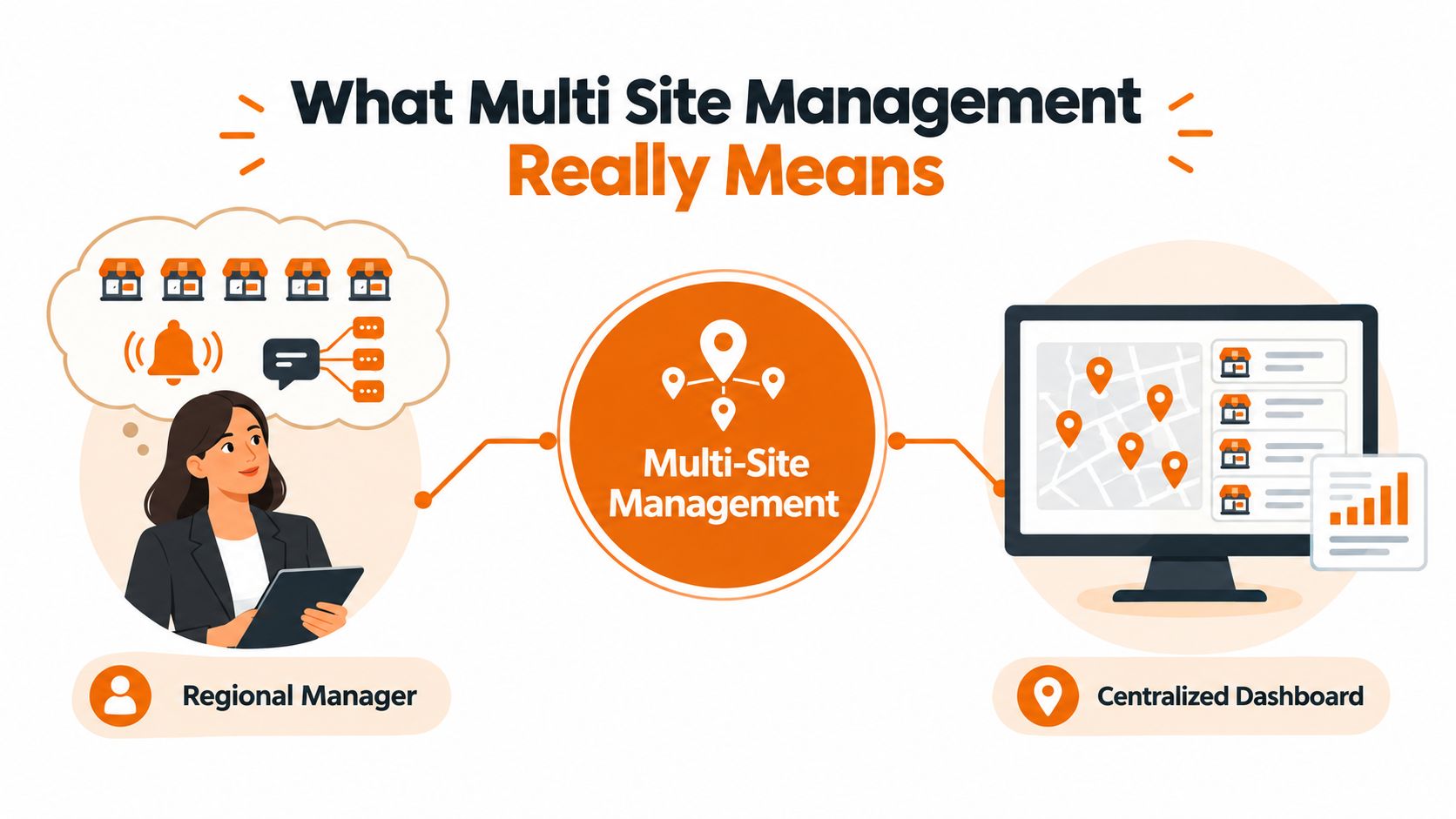
Tuesday, 7:42 a.m. A regional manager is watching five stores, chasing a missing cooler alarm, and trying to follow a chat thread that has split into three separate conversations. One store says the alarm is fixed. Another says it never happened. The third has posted a photo nobody can find again.
That manager is already doing multi site management. She just doesn't have a system that supports the job.
The core discipline is broader than opening several locations and giving each manager the same handbook. It means running multiple physical sites under one operating logic while leaving enough room for local judgment. The strongest programs connect governance, scheduling, maintenance, communication, and frontline execution without pretending every location has the same people, systems, or maturity.
I've seen advanced sites work from clean dashboards and current SOPs while nearby locations depend on memory, spreadsheets, and WhatsApp. Treating both as if they're ready for the same rollout is a reliable way to frustrate everyone. A durable program works more like a tiered operating system, with a common core, local flexibility, and a deliberate path for manual sites to catch up.
What Multi Site Management Really Means
A single location can hide operational weakness. The manager knows who to call, where spare parts sit, which form matters, and how the morning usually runs. That knowledge may never be documented, yet the site works because one person carries the operating system in their head.
Add locations and that arrangement fails. A regional leader cannot remember every exception, approve every absence, compare every maintenance issue, or reconstruct decisions from scattered messages. Multi site management replaces personal memory with shared rules, visible information, and clear authority across the network.
Scale creates coordination work, not just more tasks. Multi-unit franchising often centers on owner economics, territory results, and franchise relationships. Multi site management focuses on daily execution across corporate stores, clinics, hotels, warehouses, and branches.
The portfolio is only as strong as its weakest operating loop
Consistency does not mean forcing every site to perform every task identically. Headquarters may prefer that model, but field conditions expose its limits quickly.
Separate the core from the periphery. The core covers safety rules, required approvals, escalation paths, critical SOPs, data definitions, and reporting expectations. The periphery covers staffing patterns, customer needs, building constraints, and practical local adjustments.
The maturity gap determines how much structure each site needs. One location may use structured work orders, mobile checklists, and reliable reporting. Another may depend on paper, memory, and a group chat. Give the advanced site room to test improvements. Give the manual site stronger scaffolding, fewer choices, and a clear path toward better tools.
That tiered approach prevents site drift. Governance sets the boundaries, a regular operating cadence exposes exceptions, and frontline tooling makes the approved process usable during a busy shift. Leaders building governance for multi site estates should define all three rather than treating software as the whole program.
Practical rule: Standardize decisions that protect the business. Let local leaders adapt decisions that help their site serve its community.
A useful workforce management foundation also clarifies how staffing, attendance, scheduling, and operational execution connect. See this guide to what workforce management includes for the broader operating context.
Why Distributed Operations Need It Now
Site drift starts subtly. One location changes a checklist because the original version feels impractical. Another stores spare parts locally because nobody can see inventory elsewhere. A third handles urgent maintenance through a personal phone. Each decision may look reasonable in isolation. Across a portfolio, those decisions create different standards, different costs, and different levels of risk.
The maintenance numbers make the problem hard to ignore. A 2026 guide reports that 67% of multi-site organizations experience inconsistent maintenance standards, and connects those inconsistencies with an average of $412,000 per year in excess downtime, duplicated inventory, and compliance gaps. The same guide says emergency repairs cost 4.8 times more than planned repairs, while spare-parts duplication averages 38% across portfolios. These figures are from Anexee's multi-site monitoring guide.
Those are not abstract software problems. They show up as a clinic taking equipment out of service, a hotel waiting for a part that another property already has, or a retail manager discovering that an inspection was never documented.
Metric | Independent Sites | Coordinated Program |
|---|---|---|
Maintenance standards | Local interpretation and uneven documentation | Shared procedures with controlled local exceptions |
Repairs | More reactive work and limited cross-site visibility | Planned work, visible escalations, and portfolio benchmarking |
Inventory | Duplicate parts held at multiple locations | Shared visibility and deliberate stocking decisions |
Compliance | Records scattered across sites | Central records with local execution and audit trails |
Scheduling | Gaps found after coverage is missed | One view of availability, absences, and cross-site capacity |
Growth exposes these weaknesses faster. An acquisition brings different systems, habits, vendors, and definitions of “done.” New locations inherit the brand but not always the operating discipline. Experienced site managers carry institutional knowledge until they leave, and then the organization discovers that the process was never in the SOP.
Large organizations now manage an average of 268 customer-facing websites, according to a 2026 industry guide from OpsSense. That figure concerns digital properties, but the operating lesson applies to physical portfolios too. Once the network becomes large enough, coordination itself becomes a management discipline.
Core Capabilities and the Governance Model
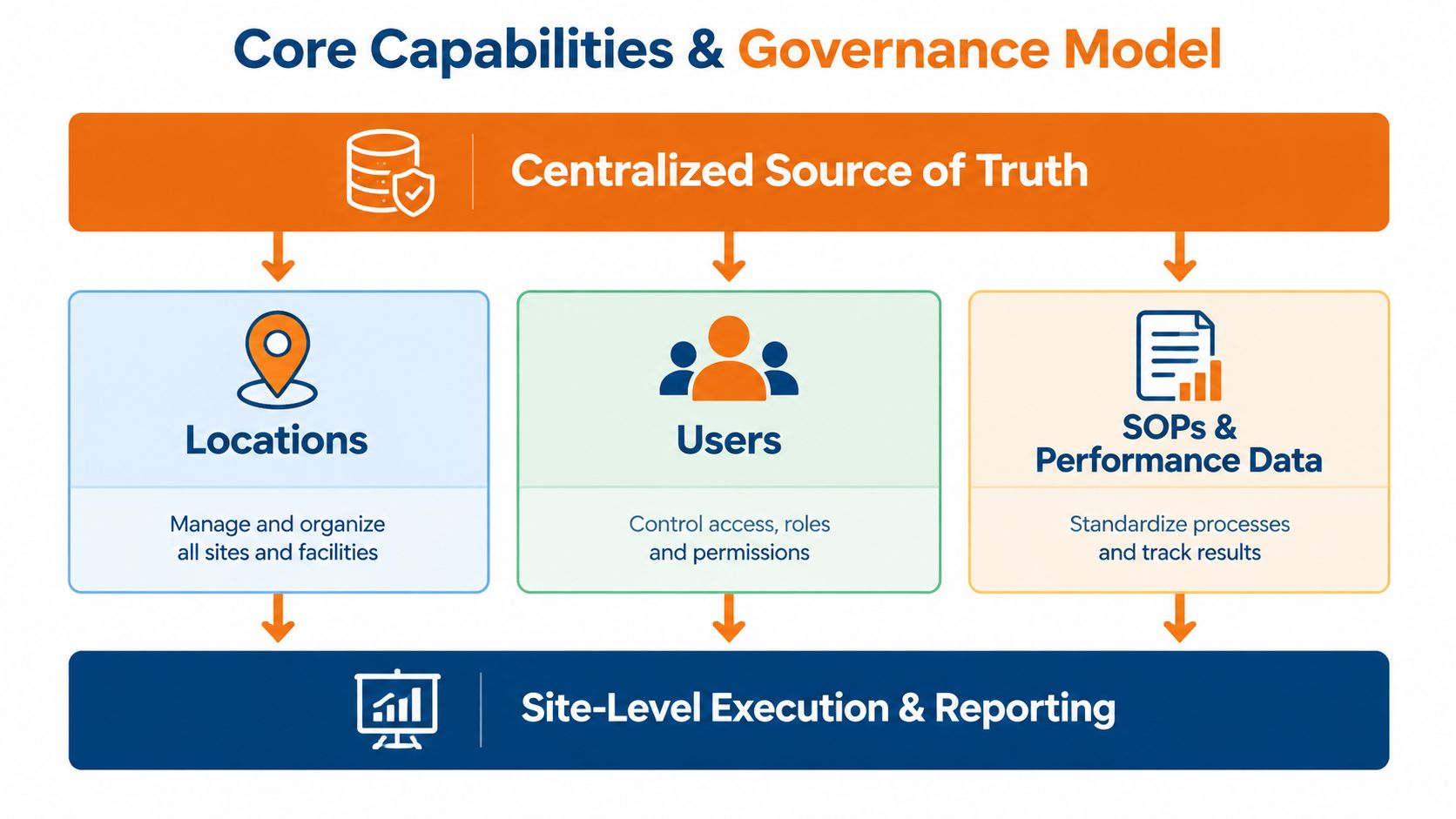
Start with one source of truth. Not one shared drive with folders nobody trusts. A real operating record for locations, users, SOPs, assets, tasks, decisions, and performance data.
The structure should let a corporate operator view the full portfolio, a regional leader see their assigned locations, and a site manager act within their own scope. Permissions should follow the location hierarchy rather than mirror an org chart that changes every time someone moves roles. Clear escalation paths matter just as much. A site manager needs to know what they can resolve, what requires regional approval, and what goes directly to a central response team.
Build the common layer first
The governance model I use has four connected parts:
Location hierarchy: Regions, sites, departments, shifts, and operational zones should have stable names and owners.
Role-based access: People should see and change what their work requires, no more and no less. A practical guide to role-based access control best practices can help teams make this concrete.
Controlled content: Policies, urgent announcements, knowledge articles, checklists, and SOPs need version control and visible ownership.
Audit trail: The system should show who changed a procedure, acknowledged it, completed a task, or escalated an exception.
The tiered approach prevents governance from becoming a fight between headquarters and the field. Advanced sites can pilot a new workflow under controlled conditions. Manual sites can receive templates, guided checklists, and more frequent review until they're ready for greater flexibility. The standard is shared. The path to the standard isn't identical.
Cadence keeps the model alive. A practical rhythm includes weekly all-site calls, bi-weekly site-manager check-ins, and monthly or quarterly performance reviews, as outlined in guidance on managing across multiple locations. I'd add a monthly dashboard review and a quarterly governance retrospective. Without those rituals, even a well-designed system becomes a neglected folder and local workarounds return.
A Practical Rollout and Adoption Checklist
Rollout should follow one sequence. Teams often split the work into parallel projects, launch a platform before the data is clean, and then blame adoption when managers can't trust what they see.
Begin with the data model and integrations. Connect the systems that define people, locations, work, and time, such as the HRIS, POS, CMMS, scheduling tool, and LMS. Agree on location names, user ownership, job roles, and reporting definitions before asking frontline teams to use the new workflow.
Move from structure to daily behavior
Onboard sites one at a time, using one source of truth for SOPs and playbooks. Tie permissions to location hierarchies, not informal reporting relationships. Build role templates for corporate, regional, site, and frontline users, then document which settings are centrally controlled and which local leaders can adjust.
Location overrides deserve special attention. If every local exception is allowed, the network has no standard. If none are allowed, managers create unofficial workarounds. Make each override deliberate, visible, owned, and reviewable.
Training needs two tracks:
Site-manager track: Dashboards, exception handling, approvals, escalations, and local reporting.
Frontline track: Mobile checklists, task updates, schedule actions, announcements, and evidence capture.
Adoption starts in the first week, not after the launch presentation. Track weekly active site managers, SOP read-and-acknowledge rates, ticket resolution cycle time, and the percentage of sites publishing schedules through the platform. These measures tell you whether the system has entered daily work or merely been installed.
Pilot in two contrasting locations, one advanced and one manual. Don't choose two easy sites that already agree with the program. Use the contrast to improve the playbook, then expand in waves tied to operational risk. The rollout guidance in this implementation timeline is useful for keeping the sequence visible.
Industry Use Cases Across Retail, Hospitality, Healthcare, and Logistics
The operating pattern changes by industry, but the management problem stays familiar. A retail district needs fast communication around promotions and labor. A clinic needs controlled clinical protocols and evidence for audits. A warehouse needs site updates to travel downstream before a delayed dock becomes a late delivery.
In retail, I'd anchor the week around visual merchandising checks, promotional resets, and labor aligned with expected demand. Store managers need mobile access because they're walking the floor, not sitting at a workstation. The central team sets the standard and reviews exceptions. Local managers explain what happened and what they'll do next.
Hospitality depends on coverage, property standards, and the ability to move qualified staff when occupancy changes. A certified pool manager may be useful at more than one property, but the schedule needs to show the movement clearly. Healthcare adds protocol versioning, accreditation preparation, equipment uptime, and audit trails. In that environment, “we usually do it this way” is not a control.
Logistics brings another kind of dependency. Dock scheduling, safety reporting, yard flow, and handoffs must stay synchronized because one missed update can affect deliveries beyond the original site. Physical design matters too. Teams reviewing warehouse layout for retail DCs can connect the operating model with the flow of people, inventory, and vehicles.
Industry | Primary Cadence | Frontline Tool Anchor | Governance Priority |
|---|---|---|---|
Retail | Weekly execution review | Mobile task and schedule workflow | Brand standards and promotion control |
Hospitality | Daily shift and property checks | Mobile coverage and audit tools | Guest experience and staffing flexibility |
Healthcare | Protocol and compliance review | Secure mobile documentation | Version control, auditability, and equipment uptime |
Logistics | Shift, dock, and handoff rhythm | Mobile incident and task reporting | Safety, throughput, and cross-site dependencies |
The details differ, but each network needs the same three habits: a dependable cadence, frontline tools that fit the work, and one playbook that local teams can use.
KPIs and the Frontline Collaboration Habit
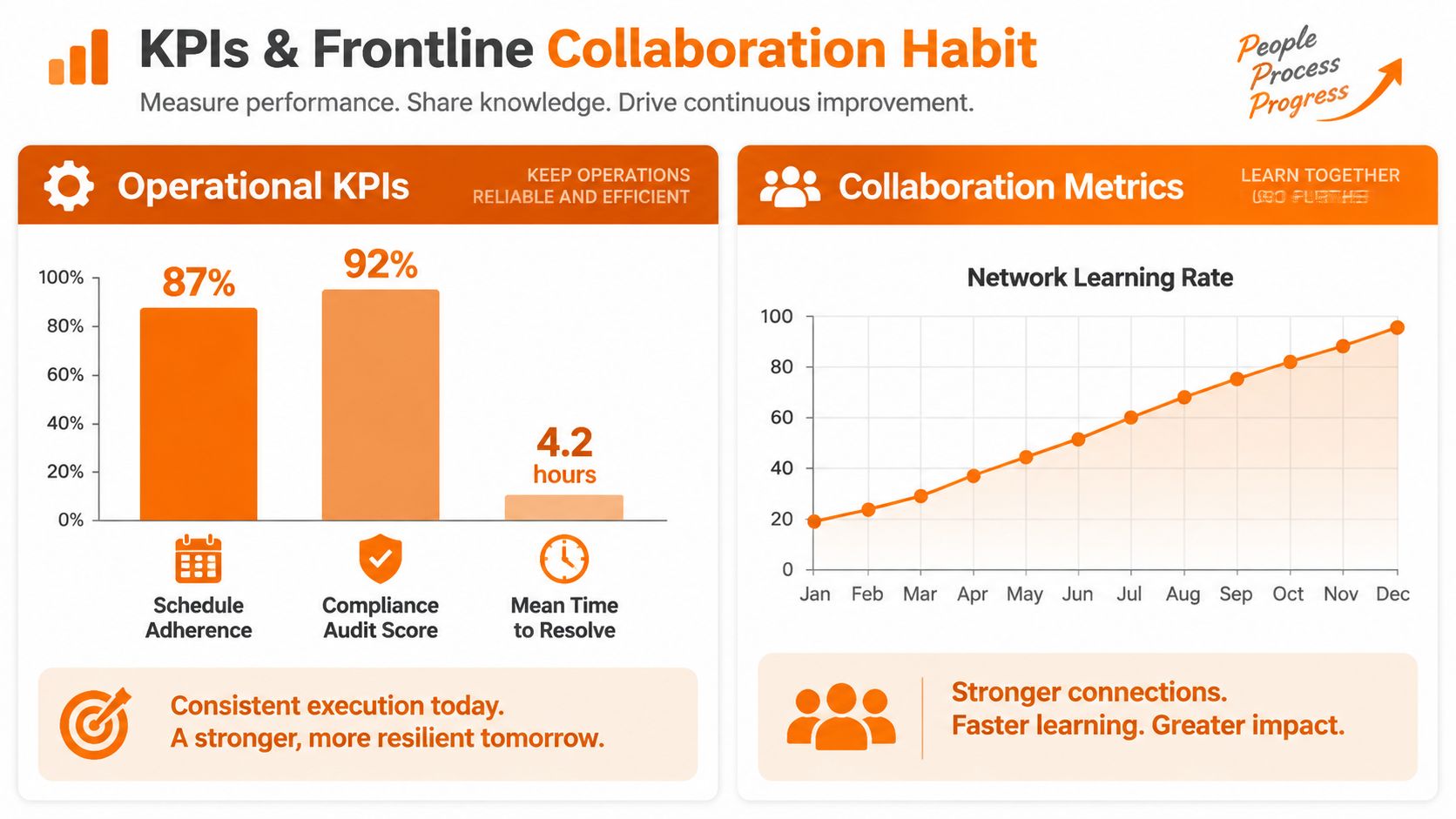
Operational KPIs show whether the network is performing. Collaboration measures show whether it can learn and correct site drift.
Track schedule adherence, compliance audit scores, mean time to resolve, labor cost per unit, planned versus unplanned work, and equipment uptime where each measure fits the operation. Put communication and knowledge-transfer signals beside those results. Monitor monthly active contributors by site, the time from an issue being raised to a playbook update, and the share of site managers providing useful answers in official channels.
Message volume is a poor target. A busy channel can still produce little improvement. The useful signal is whether people share information that changes work at another location.
Turn local knowledge into network capability
A district manager may post a workaround that keeps a product issue from reaching other stores. That contribution reduces repeated investigation and gives the central team a practical improvement to formalize. The resulting playbook should record the source of the idea, the process change, and the sites that adopted it.
Research on distributed work connects transparent communication with stronger employee voice, loyalty, positive work behaviors, and community. The practical lesson is direct: frontline teams raise problems more readily when leaders respond and close the loop.
A network that shares problems early can improve. A network that hides them can only look healthy until the failures become expensive.
Use the dashboard to connect collaboration with operating outcomes. Compare active contributors with recurring issue rates. Check whether playbook updates follow frontline feedback, and record recognition for cross-site sharing. Recognition is not a popularity contest. It signals that teaching another location belongs in the operating model.
The operating model should also reflect different site maturity levels. Advanced locations can test improvements and document evidence. Manual locations need clearer prompts, assigned owners, and simpler frontline tools before they can contribute at the same pace. Governance sets the minimum standard, cadence keeps attention on it, and usable tools make participation possible during a shift.
Communication tools alone will not fix fragmentation. Leaders need routines, searchable knowledge, clear ownership, and a reliable return to the person who raised an issue. Those practices turn separate locations into a learning network.
Building a Multi Site Program That Lasts
A multi site program isn't finished when the platform launches or when every manager attends training. It lasts when the operating habits survive leadership changes, new openings, acquisitions, and the departure of the person who used to know everything.
The durable programs make ownership plain. Headquarters owns the essential standards, data definitions, and change control. Regional leaders compare performance, remove barriers, and coach sites. Local managers run the work, explain exceptions, and contribute improvements. When those boundaries are unclear, corporate either micromanages or disappears.
Use a quarterly governance review to ask whether the standards still fit the work. Use monthly site audits to find drift before it becomes normal. Document decisions in the same place as the playbooks, so a new site inherits reasoning rather than just a folder full of old files.
Close the loop in public
Site managers need a fast way to raise an exception. Leaders need to respond visibly, even when the answer is no. If someone reports a broken process and never hears what happened, they'll stop reporting. The system then loses its most valuable source of operational truth.
I'm wary of scaling beyond twenty or thirty sites without these habits. At that point, informal relationships stop carrying the network, and every missing owner or undocumented decision creates another pocket of local interpretation. The number itself isn't a law. It's a warning that personal coordination has limits.
The best leaders don't treat frontline operators as recipients of mandates. They involve them in designing checklists, testing mobile workflows, and deciding which local exceptions deserve to become network standards. Central control gives the program consistency. Local knowledge gives it a chance of working.
If your locations are drifting, start with one shared location model, one visible cadence, and one honest maturity assessment. Then give every site a practical next step instead of demanding that all of them pretend to be ready at once.
Pebb can give each location its own Space for updates, tasks, files, events, knowledge, shifts, clock-ins, and local workflows while keeping teams connected through one mobile and web app. Visit Pebb to see how it can support communication, scheduling, frontline execution, and governance across your sites.
