
Leadership and communication styles: Leadership & Communicat
Discover leadership and communication styles to build trust in frontline and distributed teams. Learn to adapt and improve alignment with practical examples.
Dan Robin
The store manager said, “Just make sure aisle four is fixed before lunch.” By 12:15, the endcap had been rebuilt, the overstock was untouched, and two people were irritated for completely different reasons.
The manager thought the instruction was obvious. The employee thought they’d done exactly what was asked. Nobody was lazy. Nobody was trying to be difficult. They were just speaking different languages inside the same workplace.
The Misunderstanding on Aisle Four
At 11:40 on a busy Saturday, a supervisor called across the floor, “Fix aisle four before lunch.”
By 12:15, the endcap looked sharp. The overstock still sat in the back room. Price tags were half-checked. The supervisor was frustrated because the aisle was not finished. The employee was frustrated because they had done the part that seemed urgent. Both thought the other person was being difficult.
That kind of miss happens every day on frontline teams.
What actually went wrong
“Fix aisle four” is not one instruction. It is a bundle of assumptions.
For one employee, it means clean it up and make it customer-ready. For another, it means work the whole bay, check counts, rotate product, replace tags, and flag anything off-plan. A fast-moving manager often assumes the rest is obvious. A literal or detail-driven employee hears the words and completes exactly those words.
Then the conversation gets more expensive. The manager sees a lack of ownership. The employee hears criticism for following directions.
Communication breaks down faster when context stays in the leader’s head.
On a corporate team, people often get another shot. They can send a follow-up message, jump on Zoom, or clean up the confusion in a meeting later. Frontline teams work with less margin. They deal with noise, customer interruptions, shift changes, spotty device use, and people grabbing messages between tasks instead of sitting down to process them.
Why this hits harder on frontline teams
Distributed and shift-based teams pay for vague communication immediately.
A missed detail on a desk team may create a longer email thread. A missed detail on a store floor, in a warehouse, or across field crews can create rework, customer complaints, late handoffs, and tension between shifts. Add high turnover and mobile-first communication, and small wording gaps start behaving like operating problems.
I have seen this play out with new hires, veteran associates, and strong workers using a second language. Same instruction. Three different interpretations. The issue was not attitude. The issue was that the leader sent a message in one style and expected everyone to decode it the same way.
That expectation does not hold up in real operations.
Research from Gallup found that employees who strongly agree their manager keeps them informed are more likely to be engaged at work, a point Gallup makes in its reporting on the link between manager communication and employee experience: Gallup on how managers shape employee engagement. On frontline teams, where messages are short and timing matters, that gap between “said” and “understood” gets exposed fast.
A leader's core responsibility
Leadership communication is not just sending a clear message. It is checking whether the message was understood the way the work requires.
Sometimes that means being brief. Sometimes it means adding one extra sentence of context. Sometimes it means asking for a read-back before a shift handoff. Sometimes it means noticing that your tone is creating resistance before the task even starts.
Experienced leaders learn this after enough preventable friction. The work gets smoother once they stop asking, “Why didn’t they get it?” and start asking, “What did my instruction leave open to interpretation?”
The Four Styles You See Every Day
Most style frameworks get overcomplicated. In practice, you only need a simple lens that helps you read people faster and adjust without turning every conversation into a personality workshop.
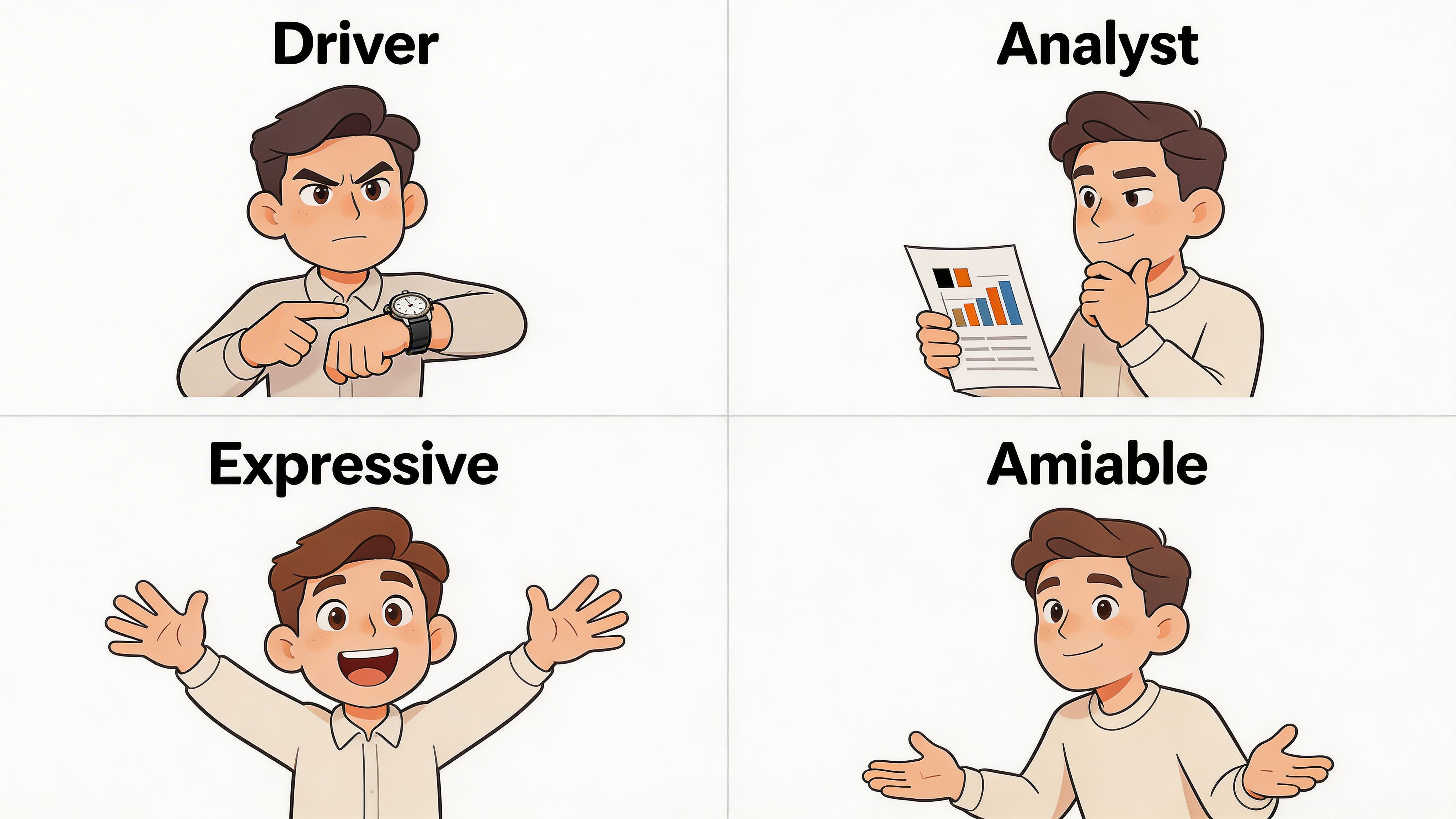
The four styles I see most often are easy to recognize. You already know these people.
The person who wants the point first
This is the Driver.
They want the bottom line. They don’t need a scenic route. If you send them five paragraphs when two sentences would do, they’ll skim or ignore it. They care about movement, decisions, deadlines, and who owns what.
You’ll hear things like:
“What’s the call?”
“What do you need from me?”
“Can we decide this now?”
Drivers are useful in messy environments because they don’t freeze. But if you lead every conversation like a Driver, people can experience you as rushed or dismissive.
The person who wants proof
This is the Analytical style.
They don’t resist action. They resist fuzzy thinking. They want details, sequence, and logic. If a policy changes, they want to know what changed, why it changed, and what exactly they’re supposed to do differently on the next shift.
Their questions sound like this:
Style | What they usually ask | What they need from you |
|---|---|---|
Driver | “What’s the decision?” | A clear next step |
Analytical | “What’s the evidence?” | Detail and structure |
Expressive | “What could we do?” | Room to discuss ideas |
Amiable | “How will this affect people?” | Reassurance and clarity |
Analytical communicators often get mislabeled as slow. Usually they’re just trying to prevent rework.
The person who brings energy into the room
This is the Expressive style.
They think out loud. They connect dots quickly. They’ll jump from problem to idea to possibility in one breath. On a good day, they lift the whole team. On a bad day, they create three new projects before the first one is finished.
They respond well to vision, momentum, and open discussion. They shut down when communication is dry, rigid, or purely transactional.
Practical rule: If someone processes by talking, don’t mistake unfinished thoughts for confusion. They may be thinking in real time.
The person who reads the room first
This is the Amiable style.
They pay attention to how people are doing, not just what they’re doing. They tend to be steady, cooperative, and loyal. They often carry more emotional load than anyone notices. They’re the ones who know when morale is slipping before the dashboard tells you.
They prefer communication that feels respectful and human. If you push too hard or correct too bluntly, they may agree in the moment and disengage later.
Why style mismatch creates friction
None of these styles is the problem. The problem is mismatch.
A Driver manager can sound harsh to an Amiable employee. An Analytical employee can sound resistant to an Expressive leader. A big-picture leader can leave a detail-oriented team member feeling stranded.
That mismatch is expensive. Frameworks built around these four styles show why adaptation matters. According to HBS Online’s summary of leadership communication research, different communication styles are a top cause of poor communication, and misalignment can reduce organizational efficiency by 20% to 30%.
You don’t need to become someone else. You do need range.
Why Most Advice on Styles Fails Frontline Teams
A lot of leadership advice assumes a quiet room, a shared calendar, and people who spend most of the day near a laptop.
That’s not real life for a restaurant shift lead, a charge nurse, a warehouse supervisor, or a retail manager trying to hand off tasks while unloading a delivery and answering customer questions. In those settings, the usual advice sounds nice and breaks on contact.
The office version of communication
Traditional guidance says things like “coach more,” “ask open-ended questions,” and “create space for reflection.”
Fine. Useful even. But not when someone has three minutes between tasks, half the team is mobile-only, and the message has to work across shifts. Frontline communication is often short by necessity. That doesn’t mean it should be careless.
The problem is that many leaders confuse brevity with clarity.
What the floor actually looks like
Frontline teams deal with a harder mix:
Noise and interruption: A message competes with customers, machines, alarms, and constant movement.
Shift fragmentation: One team starts the job. Another inherits it hours later.
Language gaps: Even good employees may miss nuance, slang, or implied expectations.
High turnover: Leaders repeat instructions often, but not always consistently.
Mobile-first reality: Many workers get updates on a phone, not at a desk.
That last point matters more than many leaders realize. There’s a documented disconnect between how non-desk workers prefer to receive information and how leadership communicates. According to this frontline communication analysis from Personos, 85% of frontline workers prefer mobile apps for updates, but only 40% feel their leaders communicate effectively through them.
The trade-off nobody likes to admit
Supportive communication helps. So does empathy. But in time-sensitive operations, endless softness can create drift.
The same Personos analysis points to a real tension. Verbal aggressiveness hurts leadership outcomes, while supportive, human-oriented communication drives better results. But overly supportive styles can also risk a 15% to 20% productivity loss in time-sensitive environments. That’s why frontline leaders need something more disciplined than generic “be more empathetic” advice.
They need a style I’d call precise-supportive.
That means clear expectations, direct language, and real respect. Not barking. Not sugarcoating. Not a wall of explanation. Just enough context, delivered in a way people can use.
What precise-supportive sounds like
It sounds like:
“The priority is receiving. Finish bay two first, then message me before you move to returns.”
“I know the handoff was messy. Here’s the correction for tonight’s shift.”
“Tell me what’s blocking you in one sentence, then we’ll sort it.”
That style works because it respects both the clock and the person.
If you’re trying to build that muscle with supervisors, this guide to supervisor communication skills training is worth a look. The practical challenge isn’t teaching people to care. It’s teaching them to communicate clearly when the day is already on fire.
The Leadership and Communication Style Matrix
A night supervisor in a warehouse can sound calm, respectful, and still leave people confused. A store manager can be blunt, even abrupt, and still earn trust if the team knows exactly what to do and why. That gap matters more on frontline teams than it does in office settings, because confusion shows up fast. Missed handoffs, duplicated work, late breaks, the wrong pallet moved to the wrong bay.
Leadership style and communication style are connected, but they are not interchangeable.
A leadership style shapes how a manager makes decisions, uses authority, supports the team, and holds people accountable. A communication style shapes how those choices get delivered in a shift brief, a chat message, a coaching moment, or a rushed call between locations. Together, they create the day-to-day operating climate.
Why the combination matters
Two managers can make the same call and get completely different results.
One says, “We’re changing the pickup flow. Start now.” The other says, “We’re changing the pickup flow because wait times spiked after lunch. Start with register two, then update me in twenty minutes.” Same authority. Different communication. Different level of buy-in, speed, and error risk.
That distinction gets ignored in a lot of leadership advice written for people with long meetings, stable teams, and time to clarify later. Frontline teams rarely get that luxury. Shift workers are often reading messages on the move. New hires may be on day three. Half the team may never be in the same room at the same time. If a leader’s style creates hesitation, the cost shows up in operations first.
For teams trying to standardize that across locations, this guide to accommodating employee communication styles is a practical companion.
Four combinations that show up everywhere
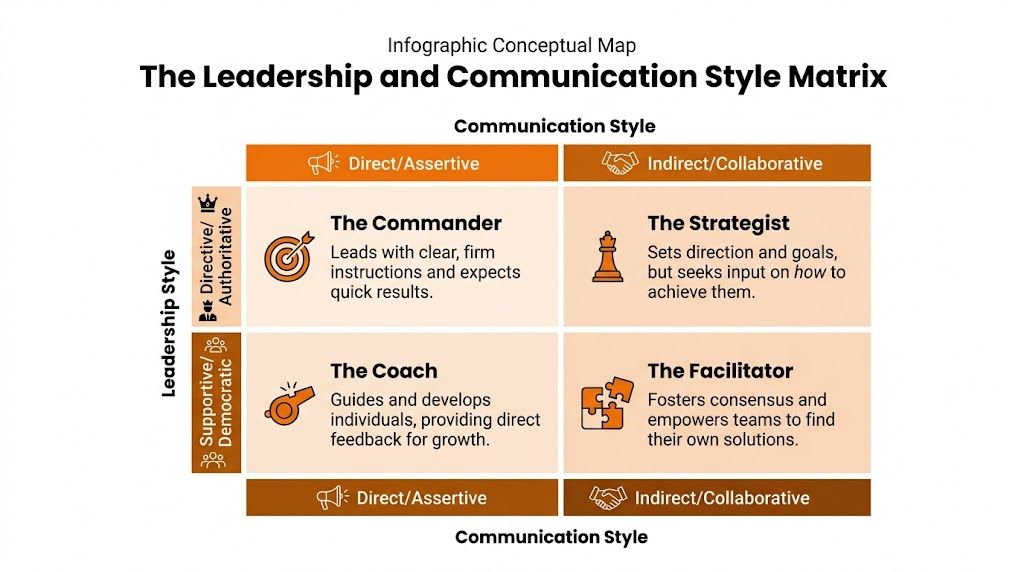
I use a simple matrix because it holds up under pressure. It does not explain every personality or every culture. It gives managers a fast read on how they tend to lead, how they tend to speak, and where the mismatch is hurting the work.
The Commander
This is directive leadership paired with direct, assertive communication.
The Commander works in urgency. Safety issues, service failures, late shipments, callouts before a busy shift. In those moments, teams need clear decisions and short instructions.
Good Commander language is specific:
“Stop line three and move the team to packing.”
“I need the incident report before end of shift.”
The trade-off is real. Used too often, this style trains people to wait for orders and keep useful information to themselves. On distributed teams, it can also sound harsher in chat than it would in person.
The Strategist
This is directive leadership with collaborative communication.
The Strategist still sets direction. The difference is that execution gets discussed. This style works well when the target is fixed but local conditions vary by store, route, shift, or site.
A good Strategist message sounds like this: “The goal is to cut handoff delays tonight. Tell me what will slow that down on your side before we lock the plan.”
That keeps decision rights clear while using the team’s firsthand knowledge. The risk is pace. In a genuine time crunch, too much discussion slows action.
The Coach
This is supportive leadership with direct communication.
Strong frontline managers often do their best work here. They do not dodge hard conversations. They correct performance clearly, explain the standard, and stay engaged long enough to help the person improve.
Say the hard thing plainly. Then help fix it.
The Coach style works especially well in onboarding, skills development, and recovery after mistakes. It can be demanding for the manager, though. Direct feedback takes judgment, repetition, and emotional control, especially on high-turnover teams where the same issues keep resurfacing.
The Facilitator
This is supportive leadership with indirect or collaborative communication.
The Facilitator builds trust and invites participation. Teams often respond well to this style during problem-solving, retrospectives, and culture repair after a rough period. People speak up more. Tension drops. Ownership spreads.
The failure mode is weak closure. If nobody names the decision, the owner, and the deadline, the meeting feels productive and the work still stalls.
A quick working table
Matrix style | Strength | Risk | Best use |
|---|---|---|---|
Commander | Fast decisions and clear direction | Low input and rising dependence | Urgent execution |
Strategist | Direction with floor-level insight | Slower decisions if overused | Cross-team planning |
Coach | Clear feedback with real support | High management effort | Onboarding and performance improvement |
Facilitator | Trust and shared ownership | Unclear next steps | Team problem-solving |
No box wins every time. Good leadership on frontline and distributed teams depends on range.
A manager may need to start as a Commander during a safety incident, shift into Strategist mode for the next day’s plan, use Coach language with the employee who missed the standard, and rely on Facilitation to surface what broke in the process. The mistake is not having a preferred style. The mistake is using one style for every problem.
Teams do not judge leaders by intent alone. They judge the pattern they live with every shift.
Recognizing and Adapting Your Style in Minutes
Most leaders don’t need another assessment. They need to get better at reading the signals already in front of them.
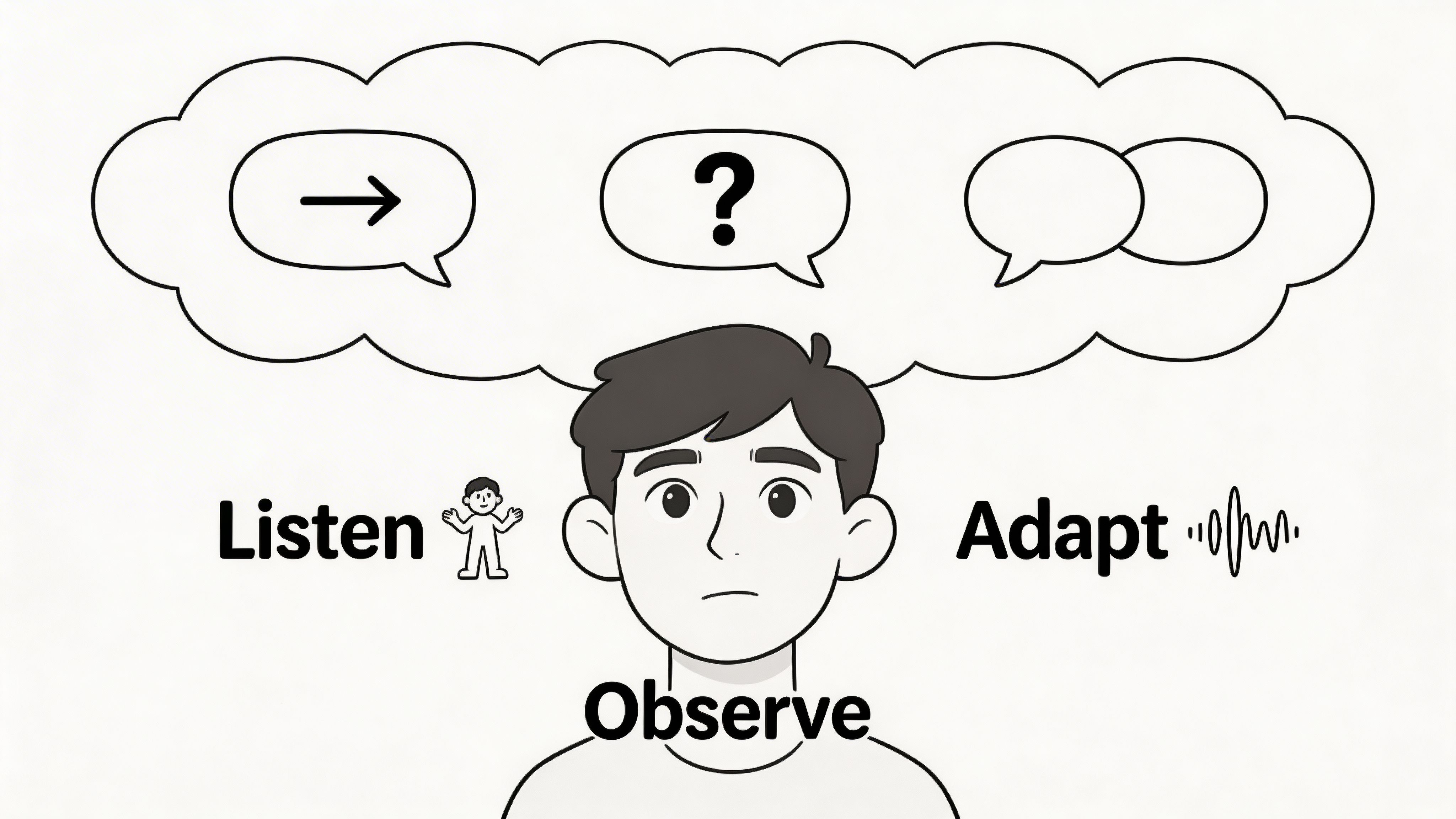
You can usually spot someone’s communication preference in the first minute of a chat, check-in, or shift handoff. Watch what they ask for, what they skip, and what seems to irritate them.
Listen for the first question
The first question usually tells you what kind of information they trust.
If they ask, “What’s the deadline?” they may be more Driver than Analytical. If they ask, “What changed from last time?” they’re probably looking for structure. If they ask, “Who else is involved?” they may be orienting around people and coordination. If they start throwing out possibilities before you finish the brief, you’re likely dealing with an Expressive style.
That matters because leaders often answer the question they wish they’d been asked, not the one in front of them.
Watch the shape of their messages
Chat habits tell the truth quickly.
A Driver sends short messages, often one line at a time. An Analytical person writes in sequence, often with qualifiers, details, or numbered points. An Expressive person jumps between ideas, uses broad language, and may brainstorm inside the message. An Amiable communicator often opens with relationship cues and softens directives.
Try this simple read-and-adjust table:
If you notice this | They may prefer | Try this response |
|---|---|---|
Short, urgent messages | Driver | Lead with conclusion, then action |
Detailed questions | Analytical | Give structure, specifics, and order |
Big-picture enthusiasm | Expressive | Start with vision, then narrow to next step |
Careful, people-aware wording | Amiable | Acknowledge impact, then explain expectations |
Adapt without sounding fake
Some leaders overcorrect. They think adapting means performing.
It doesn’t. It means removing friction.
If you’re talking to a Driver, don’t start with background. Start with the answer. If you’re talking to an Analytical employee, don’t say “trust me.” Show the steps. If someone is Amiable, don’t dump a blunt correction and walk away. Stay for the follow-up. If someone is Expressive, give them room to react before steering back to the task.
Leadership surveys show why this matters. According to global leadership survey results from Niagara Institute, 46.9% of leaders identify as democratic, yet 62% say communication breakdowns are a leading cause of workplace conflict. Nearly half of employees report that ineffective communication hurts job satisfaction, and 49% say miscommunication affects performance. A style that feels collaborative to the leader may still land as confusing to the team.
Three moves that help immediately
Mirror the needed level of detail. Don’t drown a concise person in context. Don’t starve a detailed person of it.
Check understanding without sounding parental. Ask, “What’s your read on the next step?” It works better than “Do you understand?”
Use the medium that fits the moment. Some conversations need voice. Some need a written task. Some need both.
If you want a practical framework for this in day-to-day management, this guide to accommodating employee communication styles gives a useful operational lens.
Adaptation isn’t manipulation. It’s respect in action.
Building Alignment with the Right Tools
Style awareness is useful in a one-on-one conversation. It gets much harder when your team is split across locations, roles, and shifts.
At that point, leadership and communication styles can’t live only in your head. They need a system around them. Otherwise the careful conversation you had at 9 a.m. gets lost by the 3 p.m. handoff.

What good tools actually do
A good communication tool doesn’t just broadcast. It supports different ways of receiving and responding.
One person needs a crisp task assignment. Another needs the policy file attached. Another wants to ask a follow-up in chat. Another will miss the post entirely unless a manager mentions it in a shift huddle. The tool has to support all of that without scattering the truth across six places.
That’s where a unified setup helps. A platform like Pebb’s internal communication software can combine chat, posts, voice notes, tasks, file sharing, directory information, and analytics in one place, which matters when teams are mobile-first and managers need one operating rhythm instead of several disconnected ones.
A simple example from the floor
Say you’re launching a new receiving process across multiple sites.
A practical setup looks like this:
For Drivers: Post the core change in plain language with task ownership and due times.
For Analytical people: Add the SOP, policy notes, and a short FAQ in the same space.
For Expressive team members: Keep a chat thread open for suggestions and on-the-ground issues.
For Amiable communicators: Acknowledge the workload change and explain how support will work during rollout.
Now everyone gets the same direction. They just don’t have to force themselves through the same entry point.
Tools can reinforce better leadership habits
The communication behavior that scales best is assertive and respectful. Clear enough to reduce confusion. Open enough to invite useful input.
That’s consistent with Axios HQ’s write-up on workplace communication styles, which notes that assertive communication creates healthier organizations and points to guidance from the Center for Creative Leadership that leaders should listen for 70% of their interactions. The same source also states that tools supporting multi-channel communication and feedback can help leaders practice this approach, with reported gains of 20% to 40% in team cohesion and up to 30% retention in frontline sectors.
Those numbers matter, but the day-to-day behavior matters more. The right tool should make these habits easier:
One source of truth: The latest task, file, and update live together.
Fast clarification: People can ask, answer, and resolve without hunting across apps.
Visible patterns: Leaders can see where engagement drops and which teams may need a different communication approach.
What doesn’t work
A pile of disconnected tools.
One app for chat. One for schedules. One for files. One for announcements. A supervisor’s memory filling the gaps. That setup rewards the people who already know the unwritten rules and punishes everyone else.
The best communication systems don’t replace leadership. They make good leadership repeatable.
It Is Not About Being Perfect It Is About Being Aware
You won’t get this right every day.
You’ll still send a message that sounded clearer in your head. You’ll still catch yourself giving too much detail to one person and not enough to another. You’ll still have mornings where your stress leaks into your tone before you even notice it.
That doesn’t mean the work isn’t worth doing. It means the work is real.
Awareness beats performance
The point of understanding leadership and communication styles isn’t to label people and call it insight. It isn’t to become some polished, hyper-adaptable manager who never misses.
It’s to notice faster.
Notice when someone needs structure, not motivation. Notice when your urgency is reading as hostility. Notice when a team isn’t resisting the plan. They’re reacting to how the plan was delivered.
The best adjustment is often a small one. One clearer sentence. One follow-up question. One less assumption.
What better leadership usually looks like
It usually looks ordinary.
A manager pauses before replying. A supervisor asks for a read-back instead of assuming alignment. A leader stops blaming attitude for what is really ambiguity. Over time, those small corrections change the whole feel of a team.
That’s enough. More than enough, really.
If you lead people across shifts, screens, languages, and stress, awareness is not a soft extra. It’s part of the craft. You learn it by paying attention, staying honest, and trying again tomorrow a little better than you did today.
If your team is spread across shifts, sites, or screens, Pebb gives you one place for chat, tasks, updates, files, directory info, and engagement visibility so different communication styles can still land in a consistent way. It’s a practical fit for leaders who need clearer handoffs, less tool sprawl, and a better way to keep frontline and office teams aligned.
