
Master Your Leadership Communication Style
Find your leadership communication style and adapt it. This guide helps frontline & office leaders build trust, clarity, & better teams.
Dan Robin
You finish a meeting convinced you were clear.
The priorities were obvious. The deadline was obvious. The trade-offs were obvious. Then the week unfolds and you learn that one person heard urgency, another heard flexibility, and someone else decided the whole thing could wait until next Tuesday.
That gap is where most leadership trouble starts.
I’ve seen it in offices, on warehouse floors, in restaurants before a rush, and in remote teams spread across time zones. The words themselves usually aren’t the main problem. The problem is how those words land. Tone. timing. confidence. warmth. specificity. Whether people feel invited into the work or pushed at it.
A leader can say, “We need to move faster,” in a way that sharpens focus. The same sentence can also make people clam up, hide mistakes, and start covering themselves instead of helping each other.
That’s why leadership communication style matters more than most leaders admit. People don’t just respond to your instructions. They respond to your pattern. They learn what kind of truth is safe to tell you. They learn whether “urgent” really means urgent. They learn whether your praise is real, whether your criticism is useful, and whether silence from you means trust or neglect.
For frontline and distributed teams, this gets even harder. You don’t always get body language. You don’t always get a second chance to correct a bad message. A rushed update at the wrong time can ripple across a shift, a site, or an entire region.
The good news is that communication style isn’t a mystery trait you either have or don’t. It’s a set of habits. Habits can be noticed. They can be changed. And when leaders change them on purpose, teams feel it fast.
The Silence After You Speak
A lot of leaders know this moment.
You explain the plan in a meeting. Nobody pushes back. A few people nod. Someone says, “Got it.” Then the call ends and the silence feels heavy instead of clean. You can tell, even before the first mistake shows up, that people aren’t aligned.

What leaders think they said
Most of us assume that if the message was spoken, the message was delivered.
That’s not how teams work. People hear through pressure, history, trust, and role. A store supervisor hears “fix this today” differently than a new server on their third shift. A veteran nurse hears “use your judgment” differently than a brand-new remote coordinator who’s still figuring out who approves what.
The sentence might be the same. The meaning won’t be.
I’ve watched managers give calm, reasonable updates that still created confusion because the tone was too soft for an urgent situation. I’ve also watched leaders give direct instructions that should have helped, but came out with enough edge that nobody wanted to ask the obvious follow-up question.
Practical rule: If people leave your message with different levels of certainty, you weren’t clear enough.
What the team actually hears
People are always decoding more than the words.
They’re asking themselves a few quiet questions:
Is this a command or a discussion
Can I ask a dumb question without getting burned
Does this deadline matter, or is it one more “urgent” thing
If I see a problem, does this leader want the truth or just compliance
That’s your leadership communication style in action. Not the script. The pattern.
For frontline teams, the consequences are more immediate because the feedback loop is short. A misunderstanding in a corporate office can waste a meeting. A misunderstanding on a shift can delay handoff, frustrate customers, or create safety issues. In distributed teams, the problem is different but just as real. People fill in gaps with assumptions because they can’t catch you in the hallway.
Why this moment matters
Silence after you speak can mean agreement. It can also mean hesitation, confusion, or quiet self-protection.
Good leaders learn to tell the difference.
If your team regularly leaves conversations without asking useful questions, that’s not always a sign of strong execution. Sometimes it means they’ve learned that speaking up costs more than staying quiet. And once a team learns that lesson, the leader becomes the last person to hear what’s really going on.
That’s where style stops being a personality issue and becomes an operating issue.
Your Communication Style Is Your Real Job
For years, people have treated communication like a soft skill. Something nice to improve after the budget review, the staffing plan, the rollout, the board deck.
That’s backward.
Your leadership communication style is not decoration around the core work. It is the core work. You use it to set direction, correct mistakes, calm a tense shift, explain a change, coach a struggling employee, and keep good people from checking out.
Clarity is not a side issue
A global leadership survey found that 79% of employees link their leader’s communication quality directly to their understanding of company goals, yet only 45% feel they clearly know expectations. The same summary notes that weekly meaningful feedback makes employees 80% more likely to be fully engaged (communication and leadership statistics).
That’s not a soft-skill footnote. That’s operating reality.
When leaders communicate poorly, teams don’t only feel annoyed. They lose the thread. Priorities blur. Good people make avoidable mistakes. Average performers drift. Strong performers start doing private interpretation work just to keep the place running.
If you want a grounded look at how these breakdowns show up day to day, this piece on poor communication in the workplace is worth your time. It gets at the practical mess, not the polished version.
Every interaction trains the team
People don’t judge your communication style from your all-hands meeting alone.
They judge it from the rushed message before opening. The way you answer a hard question. The way you react when someone tells you a deadline will slip. The tone you use when a frontline employee makes the same mistake twice.
That repeated behavior teaches the team what kind of workplace they’re in.
A leader who says “my door is open” but punishes bad news has already closed the door.
This is why communication style shapes culture faster than mission statements ever will. Culture isn’t built by the phrases on the wall. It’s built by what people expect will happen when they speak.
The work behind the work
A lot of managers still think their main job is planning, staffing, and reporting. Those matter. But they only work if people understand the plan, trust the message, and know what to do next.
Communication is how that happens.
A scheduling change can be handled in a way that keeps people steady, or in a way that causes resentment. A policy change can land as clear and fair, or as cold and arbitrary. A hard target can feel motivating, or pointless and punishing.
If you want to sharpen this part of your own practice, this guide on how to improve communication skills in the workplace is a useful place to start: https://pebb.io/insights/how-to-improve-communication-skills-in-the-workplace
Leaders often look for better outcomes while protecting the very habits that create the confusion. That rarely works. If your team is unclear, cautious, or disengaged, your communication style is not separate from the result. It’s part of the cause.
Four Leadership Communication Styles You Already Use
Most leaders don’t stick to one style. They rotate, often without noticing.
That’s normal. The problem starts when a leader has only one gear and uses it everywhere. A calm coaching moment gets handled like a fire drill. An actual fire drill gets handled like a workshop. Both go badly.
A useful way to think about leadership communication style is through four practical patterns: directive, supportive, expressive, and precise.
A 2010 study of leadership communication found these patterns matter. Supportive communication had a strong correlation with team commitment and satisfaction (r = .87), expressive communication was strongly tied to charismatic leadership (r = .72), task-oriented leadership relied on assuredness and preciseness (r = .48 and r = .35), and verbal aggressiveness hurt every positive outcome measured (study details here).
A quick guide you can actually use
Style | Core Focus | Best For | Watch Out For |
|---|---|---|---|
Directive | Action and speed | Urgent decisions, safety issues, shift execution | Can shut people down if used too often |
Supportive | Trust and confidence | Coaching, feedback, onboarding, morale recovery | Can get vague if you avoid hard edges |
Expressive | Energy and meaning | Rallying teams, change moments, culture building | Can confuse people if details are thin |
Precise | Clarity and accuracy | Policy changes, handoffs, compliance, remote work | Can feel cold or rigid without context |
Directive when speed matters
Directive leaders sound clear, firm, and unambiguous.
They say things like, “Close lane three, move two people to pickup, and call me in ten minutes with an update.” In the right moment, that’s exactly what a team needs. No workshop. No group processing. Just clarity.
This style works well when the cost of delay is high. A customer escalation. A safety issue. A stock problem before a busy hour. A handoff failure in healthcare. In those moments, people need less framing and more direction.
But directive leadership communication style becomes damaging when leaders use it for everything. If every message comes out as an order, the team stops thinking out loud. They wait. They comply. They hide uncertainty.
That kind of silence looks efficient for a while. Then it gets expensive.
Supportive when the person matters as much as the task
Supportive communication is not soft in the weak sense. It’s strong in a steadier way.
A supportive leader asks, “What part of this process is still unclear?” They notice confidence gaps. They explain the why. They correct without making people feel small.
For new hires, struggling employees, and burned-out teams, this style does real work. It lowers defensiveness and increases the odds that people will tell the truth early, when it is still useful.
Used badly, though, supportive communication can get mushy. Some leaders become so careful about tone that they never say the hard part plainly. Then people leave the conversation feeling understood but not guided.
You need both.
Support without direction feels kind in the moment and frustrating later.
Expressive when people need belief
Expressive leaders bring energy. They tell stories. They connect the task to a bigger point. They make the room feel awake.
This style is useful when the team needs more than instructions. During change, after a hard quarter, or when morale is flat, expressive communication helps people remember why the work matters. It can make routine effort feel connected to something larger.
Frontline teams need this more than many leaders realize. Repetitive work drains meaning fast. A leader who can explain the purpose behind the grind often gets more commitment than one who repeats the standard.
The risk is obvious. Expressive leaders can inspire without clarifying. People leave feeling fired up but unsure what to do at 2:15 p.m. on a Wednesday. Inspiration without specifics creates drift.
Precise when ambiguity will cost you
Precise communication is underrated.
This is the style that defines terms, names owners, confirms dates, and removes wiggle room. In hybrid and distributed teams, it’s often the difference between alignment and a week of crossed wires.
Precise leaders say, “Starting Monday, all returns over this threshold need supervisor sign-off. If you’re on the early shift, log them before handoff. If you’re remote, send the form by end of day.” Nothing glamorous. Very effective.
When leaders skip precision, teams create their own versions of the process. That may feel harmless until a customer, patient, or manager finds the inconsistency.
The downside is that precision without humanity can feel mechanical. If every message is detailed but emotionally tone-deaf, people follow the process while disengaging from the work.
The style that poisons all the others
There’s one pattern that deserves blunt language: verbal aggressiveness.
Not directness. Not firmness. Aggressiveness.
Sarcasm, humiliation, contempt, snapping at people in public, using pressure as your default. That style doesn’t make standards stronger. It makes honesty disappear. The study above found verbal aggressiveness hurt outcomes across the board. Most experienced operators don’t need a paper to confirm that. They’ve watched it happen.
A tough standard can build respect. A hostile pattern destroys it.
How to Read the Room and Adapt Your Approach
Knowing the styles is useful. Choosing the right one in the moment is the actual skill.
Most communication misses don’t happen because a leader is careless. They happen because the leader uses yesterday’s tone in today’s situation. They coach when they should direct. They direct when they should listen. They go broad when people need specifics.
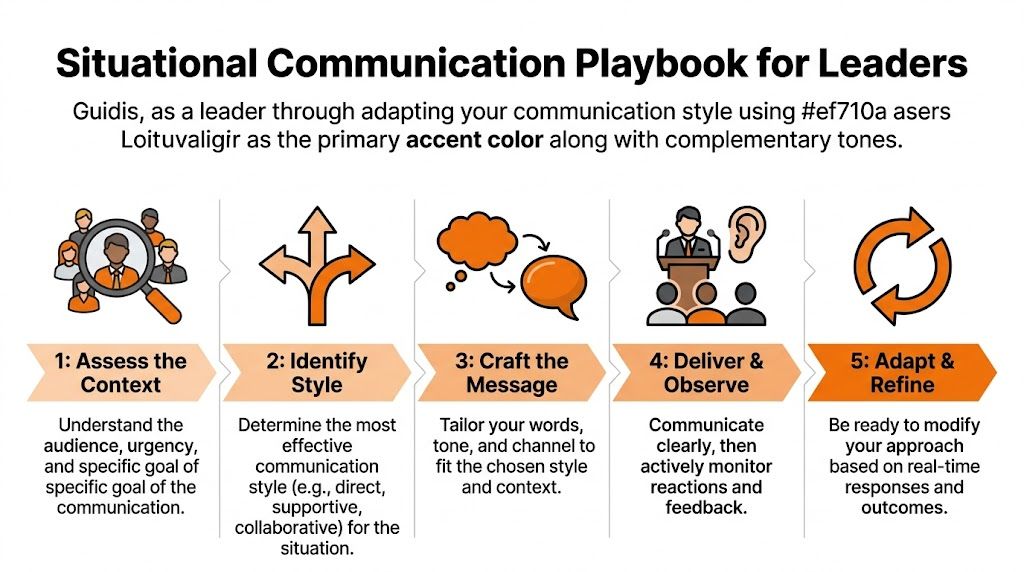
Use a simple three-part read
The fastest way I know to read the room is to check three things first.
The task
Is this urgent or not? Simple or complex? Reversible or costly if done wrong?The person
Are they new, steady, overloaded, defensive, confident, or already unclear?The context
Is this a crisis, a coaching moment, a policy update, a team huddle, or a private correction?
That’s enough to make a much better choice than defaulting to habit.
According to the Economist Intelligence Unit, failing to adapt communication style is a top cause of workplace stress and unclear priorities. The same Harvard Business School Online summary notes that leaders with higher emotional intelligence can switch between more direct communication for task-focused people and more discussion-based communication for relationship-focused people, which strengthens trust and collaboration (leadership communication and emotional intelligence).
Match the style to the moment
A few examples make this concrete.
Retail stockout on a busy shift
A truck is late. Key items are missing. Customers are already asking.
This is not the time for a long discussion. Use directive language. Assign owners. Confirm the sequence. Keep the tone calm and firm.
Say this: “Move the substitutes to the endcap. One person handles customer questions. One person updates the floor team.”
Avoid this: A vague speech about teamwork and flexibility.
New hospitality hire who keeps freezing under pressure
A new team member is making slow decisions and apologizing too much.
This needs supportive communication with enough precision to help them improve. If you only reassure them, they won’t learn. If you only correct them, they’ll tighten up more.
Say this: “You’re doing the right first step. Next time, greet, confirm, then move straight to the table update.”
Avoid this: “You need to be more confident.”
Remote policy change across multiple sites
A policy is changing and different managers will interpret it differently unless the message is tight.
This calls for precise communication first. Not inspirational phrasing. Not loose summary language. Define the rule, who it affects, when it starts, and what people should do if they hit an exception.
If the change carries emotional weight, add supportive follow-up in one-to-ones or team leads’ check-ins.
The room isn’t always physical. In distributed teams, the “room” is the mix of urgency, role, and uncertainty on the other side of a screen.
In a crisis, reduce interpretation
Under stress, teams don’t need more words. They need fewer choices.
That doesn’t mean becoming harsh. It means stripping the message down to the action. If you lead in healthcare, logistics, or field operations, this matters a lot. In urgent moments, ambiguity spreads faster than bad news.
If your team handles high-pressure situations, these crisis communication best practices are a solid companion read. The core idea is simple. Say what matters first, make ownership obvious, and cut room for guesswork.
For a more people-centered approach to adapting message style across different employees, this guide is useful: https://pebb.io/articles/guide-to-accommodating-employee-communication-styles
Watch for the signal after the message
The best leaders don’t just deliver. They observe.
Look for signs that your style fit the moment:
Better questions instead of blank agreement
Faster execution without repeated clarification
Less side chatter after the message
More honest feedback when something won’t work
When your style is wrong, the team usually tells you indirectly. They hesitate. They over-confirm. They go quiet. Or they do exactly what you said and not what you meant.
That’s not failure. It’s feedback.
Building Your Communication Muscle with Pebb
Intent matters. Tools matter too.
A leader can have the right instinct and still communicate badly if the channels are messy. Important updates get buried in chat. Coaching happens in public when it should happen in private. Shift changes live in one app, tasks in another, documents in a third, and nobody is fully sure which message is current.
That setup pushes leaders toward bad habits. Usually more bluntness, more repetition, and more confusion.

Frontline teams need more than announcements
The communication gap is sharpest on the frontline. A 2025 Gallup report found 78% of frontline staff in retail and hospitality feel disengaged because of rigid, one-way leadership communication, and that pattern was linked to 2.5x higher quit rates (communication styles in leadership).
That tracks with what many operators already know. Frontline employees don’t just need information. They need communication that fits the reality of shifts, handoffs, limited desk time, and fast decisions.
A good tool should help leaders vary their style without creating extra friction.
Match the channel to the style
One connected workplace app can help. Pebb combines chat, voice and video calls, updates, Spaces, tasks, file sharing, a people directory, scheduling support, and analytics in one place. That matters because different leadership communication styles need different channels.
A few examples:
Directive communication works best in clear updates, team announcements, or shift-specific task posts where ownership and timing are obvious.
Supportive communication needs private space. One-to-one chat, voice notes, or quick video check-ins work better than public threads.
Expressive communication fits team Spaces, stories, and culture posts where context and energy matter.
Precise communication belongs in pinned updates, policy documents, task workflows, and searchable knowledge so people can confirm details later.
If you’re sorting through what this kind of internal communication setup should do, this overview is useful: https://pebb.io/insights/a-simpler-way-to-work-with-internal-communication-software
Use the tool to build habits, not just send messages
The trap with any platform is using it like a louder bulletin board.
That misses the point. The value comes from building repeatable communication habits.
Try a rhythm like this:
Start the week with a precise update that names priorities, owners, and deadlines.
Use team Spaces during the week for progress, obstacles, and local context.
Handle coaching privately so support feels safe and specific.
Close the loop publicly when a team responds well, solves a problem, or catches an issue early.
That mix helps leaders avoid two common mistakes. First, treating every message like a broadcast. Second, making every conversation private and losing shared clarity.
Tools don’t fix weak leadership. They do make it easier for disciplined leaders to stay consistent.
Look at the signals, then adjust
One useful feature in a unified app is analytics. Not because dashboards are magic, but because they show patterns a busy manager can miss.
If important updates consistently get little response from one location or shift, the problem may not be the team. It may be the timing, format, or tone. If coaching conversations increase but tasks still stall, the leader may be too supportive and not precise enough. If people read announcements but never ask questions, the environment may still feel too one-way.
That’s the muscle-building part. Communicate. Observe. Adjust. Repeat.
For frontline and distributed teams, that feedback loop is hard to create with scattered tools. With one system, leaders can see whether their style is producing understanding or just activity.
It Is Not About Being Liked It Is About Being Understood
A lot of leaders carry the wrong goal into communication.
Some want to sound polished. Some want to sound strong. Some want to sound nice. None of those are the actual target.
The primary target is understanding.
If people understand what matters, what happens next, what good looks like, and what they can safely say back to you, your communication is doing its job. If they leave impressed but confused, it isn’t. If they leave reassured but directionless, it isn’t. If they leave obedient and afraid to speak, it definitely isn’t.
What good communication looks like in real life
You usually won’t measure this by charisma.
You’ll see it in the daily signals:
People ask sharper questions
Mistakes get raised earlier
Shift handoffs sound cleaner
Managers spend less time re-explaining basic decisions
There’s less gossip and more direct conversation
Those are better signs than whether a meeting felt smooth.
The best leadership communication style isn’t the most charming one. It’s the one that helps people act with confidence and tell the truth quickly.
The trade-off most leaders have to accept
Being understood sometimes means being more direct than feels comfortable.
It also means being warmer than some leaders think they need to be. Especially in high-turnover, frontline environments, people can spot fake concern instantly. They can also spot leaders who hide behind “efficiency” when what they really mean is distance.
Strong communication sits in the middle. Clear enough to guide. Human enough to earn trust.
You don’t need a performance voice. You need a pattern your team can rely on.
Start with observation
If you want to improve your leadership communication style, don’t begin with a personality test or a list of speaking tips.
Start by watching what happens after you talk.
Do people move, ask, clarify, challenge, freeze, or nod and disappear? Do your messages reduce confusion or spread it out? Do your one-to-ones produce honesty or carefully edited updates?
That’s where the truth is.
The useful question isn’t “Did I say it well?” It’s “What did my team feel safe enough to hear, and safe enough to say back?”
If your teams are split across shifts, sites, or screens, the toolset matters almost as much as the message. Pebb gives leaders one place for updates, chat, calls, tasks, documents, and engagement signals, which makes it easier to communicate with the right tone in the right channel and see how that communication is landing over time.
