
Labor Laws in CT: A Practical Guide for HR Leaders
A practical 2026 guide to labor laws in CT for HR and operations leaders covering wages, leave, breaks, and posting rules.
Dan Robin

If you run locations in Connecticut, the law doesn't arrive as one clean memo. It shows up in the schedule, the pay grid, the job post, the break rota, and the manager who thought “we'll fix it next week” was good enough. That's usually where trouble starts, not in the statute book.
I've lived this from the operations side. A regional manager changes a shift template in one store, a supervisor hires a tipped bartender in another, and suddenly HR is cleaning up three different compliance problems before lunch. Labor laws in CT are really an internal communications test. If the message doesn't land cleanly with managers, payroll, and frontline staff, the business pays for it later.
The right way to think about Connecticut is simple. We need a rollout plan, not just a policy. Wages, time, leave, and posting are the four anchors, and each one needs a manager-facing version, an employee-facing version, and a payroll check. If you want a useful outside reference for the mechanics of payroll discipline, how to manage payroll compliance is worth a read before you start fixing templates.
One more practical note. If your policies live in a PDF no one opens, they're not compliance tools. They're decoration. The cleaner approach is to keep the policy manual current, then push the change through the systems people use, like your handbook, ATS, chat channels, and store-level manager scripts. A living manual helps, and a stale one creates false confidence. If you're tightening that backbone, start with your policy and procedure manual.
Why Connecticut Compliance Is an Operations Problem
Connecticut is a good example of why labor law is never just a legal department issue. A manager in Stamford can approve a schedule that looks harmless on paper, while a supervisor in New Haven posts a tipped role with the wrong wage language and both mistakes turn into work for HR, payroll, and the store leader. The rule itself matters, but the bigger question is whether your team can carry it into daily practice without dropping it.
That's the part most companies miss. They write a policy, announce it once, and assume the job is done. It isn't. Connecticut's rules hit the places where frontline work happens, which means the control points are job postings, shift templates, timekeeping, and manager instructions. If those four things aren't aligned, the business ends up paying for cleanup instead of prevention.
Practical rule: if a Connecticut rule affects the way a manager schedules, posts, pays, or communicates, treat it as an operating change, not an HR memo.
That's why I push leaders to think in rollout terms. One update should flow through payroll, store managers, recruiting, and internal comms at the same time. That's especially true in multi-site operations, where one location can drift away from the standard and create a different risk profile.
The right cadence is straightforward. First, inventory the rule. Then, update the template. Then, train the manager. Then, verify the record. That sequence keeps the issue from getting buried in inboxes, and it makes audits much easier when questions come up later.
Connecticut Minimum Wage and Tipped-Worker Rules
A Connecticut pay policy that looks current in January can drift out of compliance by the next payroll cycle if no one owns the update. The state's wage floor has moved in a clear sequence, from $14.00 on July 1, 2022, to $15.00 on June 1, 2023, then to $15.69 on January 1, 2024, $16.35 on January 1, 2025, and $16.94 on January 1, 2026 (Connecticut Department of Labor wage and workplace standards). That matters because the business has to update payroll rules, manager talking points, and posted wage guidance together. If those pieces do not change at the same time, frontline supervisors start giving employees outdated answers.
For operations, the headline rate is only part of the picture. Connecticut also uses special cash wage floors for tipped roles, which is where restaurants, hotels, and other service-heavy sites usually get tripped up. A general manager who budgets around the standard minimum alone is already working from the wrong assumption.
Connecticut Minimum Wage Reference for 2026 | Cash Wage (Jan 1, 2026) |
|---|---|
Standard minimum wage | $16.94 |
Most tipped restaurant and hotel service employees | $6.38 |
Most tipped bartenders | $8.23 |
Use that table as a manager briefing tool, not as a footnote. It shows the gap between the public wage floor and the payroll floor for tipped work, which is the number that matters when you are approving offers, reviewing timecards, or answering pay questions on the floor. Connecticut's future annual increases are tied to the federal Employment Cost Index, so leaders should build annual wage review into the operating calendar instead of treating it as an exception project.
The right move is to audit every location's pay grid now. Check job titles, tip pools, and payroll codes against the actual role being performed. A wrong wage bucket in a hospitality site does not stay contained. It shows up in hiring, in scheduling, and in the way managers explain why one employee's rate does not match another's.
A manager also needs a clean answer when an employee asks how a payout is calculated, especially during separation or a role change. Use a clear internal reference such as how to calculate PTO payout so the answer is consistent across sites and not left to improvisation.
The mistake I see most often is simple. Someone knows the minimum wage number, but they do not know the effective floor for the role they are hiring tomorrow.
Overtime and Meal Breaks as Scheduling Discipline
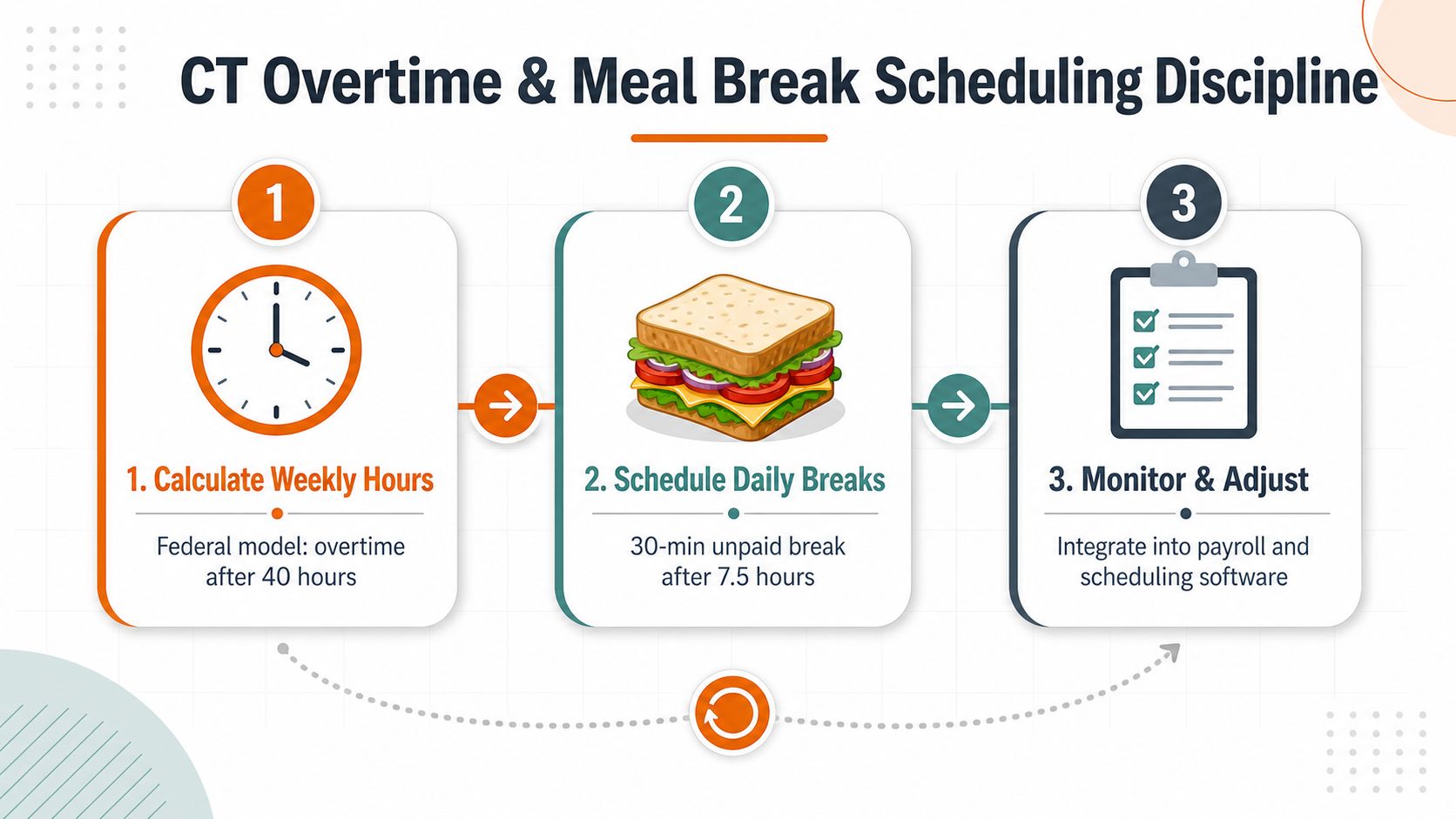
Connecticut overtime is a weekly calculation, not a daily one. Non-exempt employees must be paid 1.5 times their regular rate for hours worked over 40 in a workweek (Deputy compliance hub on Connecticut). That means the control point is the weekly schedule, not the individual long day that feels manageable in the moment.
Build the shift around the rule, not around hope
Connecticut also requires a 30-minute unpaid meal period for shifts of 7.5 or more consecutive hours, and the break has to fall after the first two hours and before the last two hours of the shift (MyShyft Connecticut labor rules). That's a timing rule. It's not enough to tell managers to “make sure people get a lunch.”
Scheduling discipline pays for itself. If a retail shift runs nine hours and the meal lands too late, the manager hasn't just annoyed the employee. They've created a recordkeeping and wage problem that payroll may need to correct. The cost pressure shows up fast in frontline operations because the break has to be designed into the day from the start.
Keep the time system honest
The cleanest fix is to wire the rule into scheduling software and payroll review. A manager should see the overtime threshold before the roster is published, and the system should flag meal breaks that miss the required window. I'd also have every district leader spot-check time records weekly, because bad habits in one location tend to spread.
If you want a straightforward reference point for break policy language, pa-break-laws is useful as a comparison tool when you're tightening manager training and internal reminders.
Paid Sick Leave and the Path to 2027 Coverage
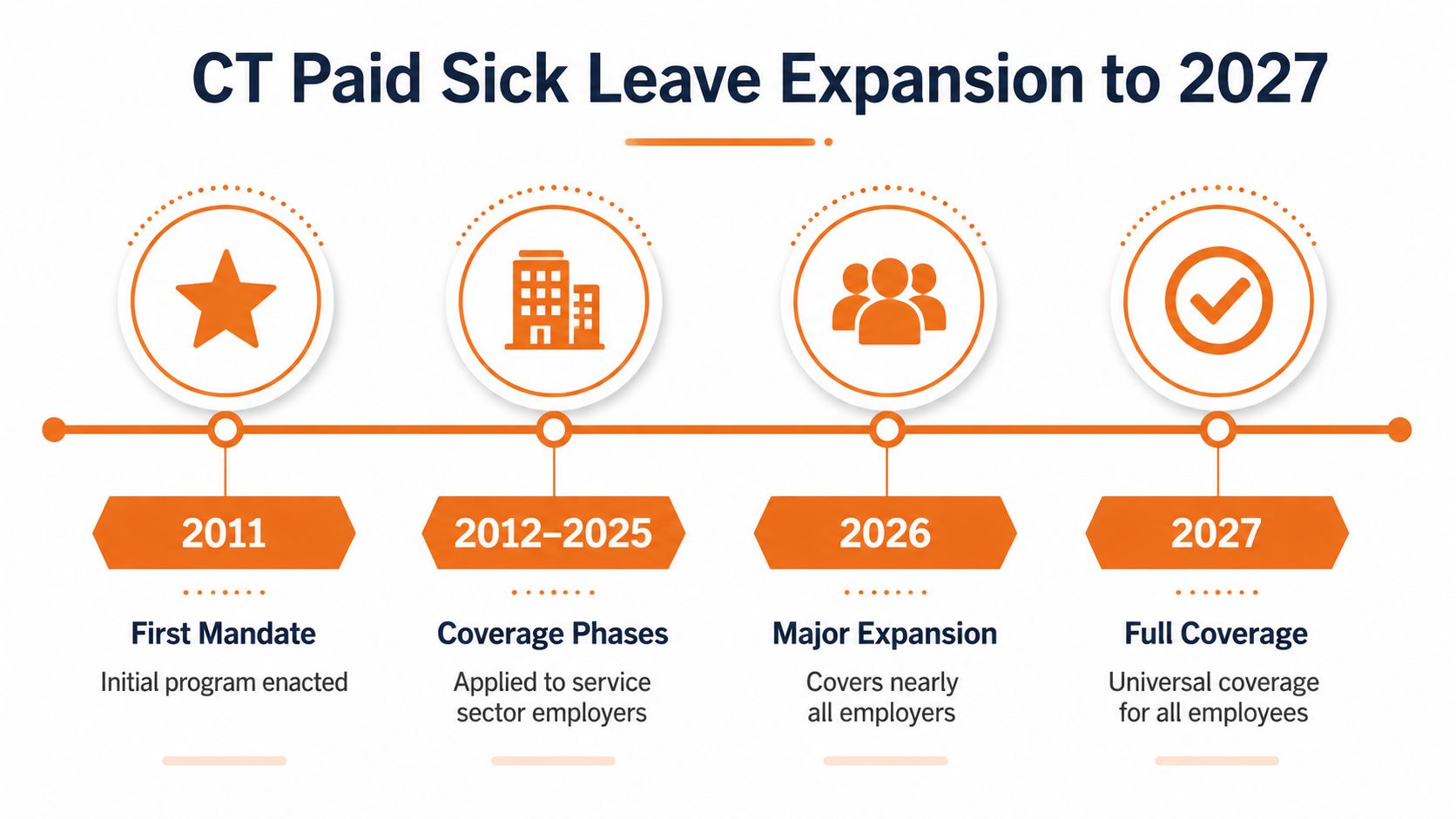
Connecticut paid sick leave is a rollout problem as much as a policy problem. The state was the first to require mandatory paid sick leave, starting in 2011 for employers with 50 or more employees and service workers (Statelawnow Connecticut employment law overview). That history matters because it shows a pattern operations leaders need to respect: the rules expand, and internal communication has to keep pace with the law.
As of January 1, 2026, the law applies to employers with 11 or more employees. The law is scheduled to expand on January 1, 2027, to cover employers with at least one employee (A timeline graphic showing the expansion of Connecticut's paid sick leave law from 2011 through 2027.). HR should not wait for that date to arrive. Update the policy, the posting, and the manager talking points now so every location is using the same rule set before coverage widens again.
The accrual rule is simple, the rollout is not
Employees accrue 1 hour of paid sick leave for every 30 hours worked, capped at 40 hours per year (Statelawnow Connecticut employment law overview). That is the number set managers have to work from. If your handbook or PTO language says something different, fix it and train to the state rule, because mixed messages turn into payroll corrections and employee complaints.
The task is operational. Update the handbook, the accrual setup, and the manager message together, then post the change where frontline teams see it. Supervisors do not need a legal memo, they need a clear script that explains who qualifies, how leave accrues, and what happens when someone calls out. If that message is not consistent, each location will invent its own version, and that is how compliance drifts.
Keep sick leave separate from broader PTO language in employee communications so payroll and supervisors do not blur the rules. If your team also has to clean up unused time or explain payout treatment, calculate PTO payout is a useful reference for separating payout logic from earned-time policy. For higher-risk policy language, use a review process that can safeguard your business with a cleaner employment agreement draft before the next round of updates.
Pay Transparency and Posting Compliance
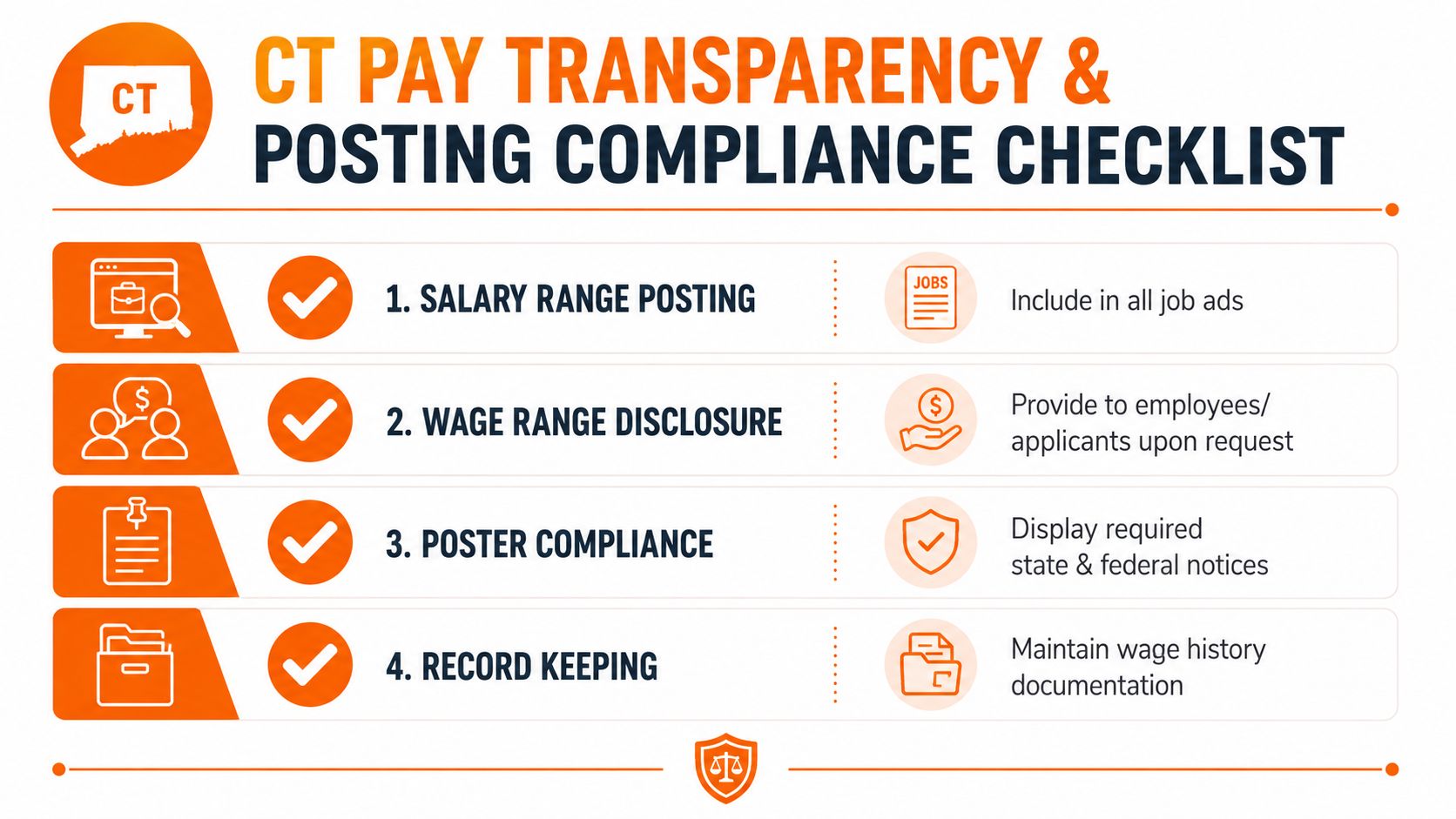
Pay transparency is no longer a recruiting side note in Connecticut. The 2026 law requires job postings to include a wage range and a general description of benefits, and employers with 100 or more employees must keep a written overtime pay-code guide that covers differentials like on-call, call-back, and holiday pay (Connecticut governor's office release on worker-rights legislation). That is an operations problem, not just a legal one.
Fix the posting workflow, not just the wording
A single missing wage range in a job ad creates more than a drafting issue. It exposes inconsistency in the approval chain. If one manager posts with the range and another skips it, applicants notice, internal candidates notice, and HR has to explain why the company's own process isn't stable.
That's why this belongs in the ATS, not just the handbook. Build the wage range and benefits fields into every template, then require sign-off before a posting goes live. Don't rely on memory. Managers are busy, and busy managers reuse old language.
Make pay language consistent across roles
The other point I'd stress is consistency. When office roles, field roles, and frontline roles use different posting language, employees assume the company is hiding something even when it isn't. Consistent wording builds trust, especially in shift-based environments where internal mobility matters and people compare notes across locations.
The written overtime pay-code guide matters for the same reason. Employees should be able to understand how differentials work without chasing three people for an answer. A clean guide reduces disputes and keeps payroll from becoming the place where every confusion lands.
Wage Payment, Discrimination, and Retaliation Protections
A lot of compliance pain starts after the hire, not before it. Final wages, wage statements, discrimination rules, and retaliation protections all become real the moment an employee leaves, complains, or challenges a pay issue. That's where managers often create problems without meaning to.
For a useful legal-services reference on reviewing employment paperwork before a problem grows, safeguard your business with a careful review of agreement language and related obligations. That kind of review is dull work, and dull work prevents flashy problems.
Tighten the separation checklist
Final pay needs to be handled on time, and wage statements need to be clear enough that employees can see hours, rates, and deductions without decoding them. If the offboarding process is loose, the company usually sees two problems at once, a wage complaint and a trust problem. Those two tend to travel together.
I'd put final-pay verification on the same checklist as badge return, access removal, and benefit notices. That keeps the process clean and gives payroll one place to confirm the numbers before the employee walks out the door.
Train managers on retaliation before it starts
The hardest part is usually the informal stuff. A supervisor cuts someone's hours, stops assigning good shifts, or gives them a colder tone after a complaint. That's the kind of behavior that turns a routine issue into a claim.
Managers need direct language here. No sarcasm, no side comments, no pay talk in the break room, and no punishment for asking questions about wages or leave. If a supervisor can't explain the rule in plain English, they shouldn't be the one enforcing it.
A One-Week Rollout Plan for Posting and Policy Updates
Day one is inventory. Pull every job template, notice, handbook page, and manager script against the current Connecticut rules, then mark anything missing wage ranges, benefits language, or sick-leave threshold updates. Day two is editing. Fix the ATS templates, update the handbook, and refresh the leave language so the 2026 and 2027 thresholds are both visible.
Day three is physical posting. Every site needs the right notices in the right place, and the team should confirm that each location can prove it. Day four is manager communication. Send a short briefing through a chat Space, add a quick video walkthrough, and keep a Q&A thread open so supervisors can ask the questions they're going to ask.
Day five is the employee note. Keep it short, plain, and useful.
Manager message: “Starting now, every Connecticut posting needs a wage range and benefits description. Sick leave accrual, meal breaks, and overtime rules are being updated in the handbook, and payroll is checking every location for consistency.”
Employee note: “We've updated our Connecticut policies so our pay, leave, and break practices match current state rules. If you have questions about your schedule, pay rate, or sick time, your manager and HR team are ready to help.”
That's the whole point. A good rollout doesn't feel like a campaign. It feels like a routine update that people can understand on the first read.
Building a 30/60/90 Compliance Rhythm
In the first 30 days, I'd run a baseline audit. Check wage floors, sick-leave thresholds, and a sample of recent job postings for the right wage range and benefits language. In the next 60 days, train managers on overtime, meal breaks, and retaliation, then make sure completion is visible.
By 90 days, shift to records. Review payroll files, time-and-attendance logs, and acknowledgment forms for gaps, then build a watchlist for the January 1, 2027 sick-leave expansion to employers with at least one employee (Statelawnow Connecticut employment law overview). That date will sneak up on small teams that think they're too small to worry yet.
The teams that stay out of trouble aren't the ones who read every statute. They're the ones who build a simple rhythm and keep it alive. Audit, train, record. Repeat.
If you want this kind of rollout to feel less like a scramble and more like a system, Pebb gives you one place to push policy updates, manager messages, and employee notices across every Connecticut location. It helps HR and operations keep the same message moving through chat, news, tasks, and files, which is exactly what labor laws in CT demand.

