
Invoice and Quotation: Getting Paid Without the Confusion
Confused about an invoice and quotation? This simple guide explains the real difference, what to include, and how to manage them without the usual headaches.
Dan Robin

You're probably dealing with this right now. A customer said yes. Your team did the work. You sent the document. Then the reply came back: “Thanks, but we thought this was still an estimate.”
That small mix-up can slow payment, sour the relationship, and make your staff look disorganized when the actual problem is the paperwork. Most businesses don't have a selling problem here. They have a handoff problem. The gap between “we discussed it” and “you owe this” is where the friction lives.
For small businesses and distributed teams, invoice and quotation mistakes don't stay on paper. They show up in the field. A technician arrives without the latest approved scope. A manager approves a price in chat but nobody saves it. A back-office clerk sends an invoice that the client treats like a draft. Then everyone spends Friday afternoon reconstructing what was agreed.
The Promise That Is Not a Bill
I've seen the same awkward moment play out in different industries. A client receives a document with services, prices, and terms, and assumes the conversation is still open. Meanwhile, the business owner assumes payment should be on the way. Both sides feel justified. Both sides are frustrated.
That's why the difference between a quotation and an invoice matters so much. A quotation is the promise of work at an estimated price. An invoice is the bill for work that has already been delivered. If those two documents blur together, cash flow gets fuzzy too.
Where the confusion starts
Part of the problem is that these documents can look similar. They both list items, pricing, and business details. To a customer moving quickly, they can feel interchangeable. They aren't.
A quotation belongs in the decision stage. It helps the customer say yes or ask for changes. An invoice belongs after delivery. It tells the customer the work is done and payment is now due.
Practical rule: If the client can still negotiate the scope or price, you're not looking at an invoice yet.
There's also a third document that causes confusion in some workflows. A pro forma invoice often sits between a quote and a final invoice, especially when a buyer wants a more formal pre-billing document before payment or internal approval. If that part of the process feels murky, Snyp explains pro forma invoices in a way that's refreshingly clear.
Why this matters in the real world
When teams use the wrong document, the damage isn't abstract. Work starts too early. Approval gets assumed instead of recorded. Payment gets delayed because the buyer's finance team can't process what they received.
That's not an accounting problem. It's an operations problem wearing an accounting hat.
Quote vs Invoice The Fundamental Difference
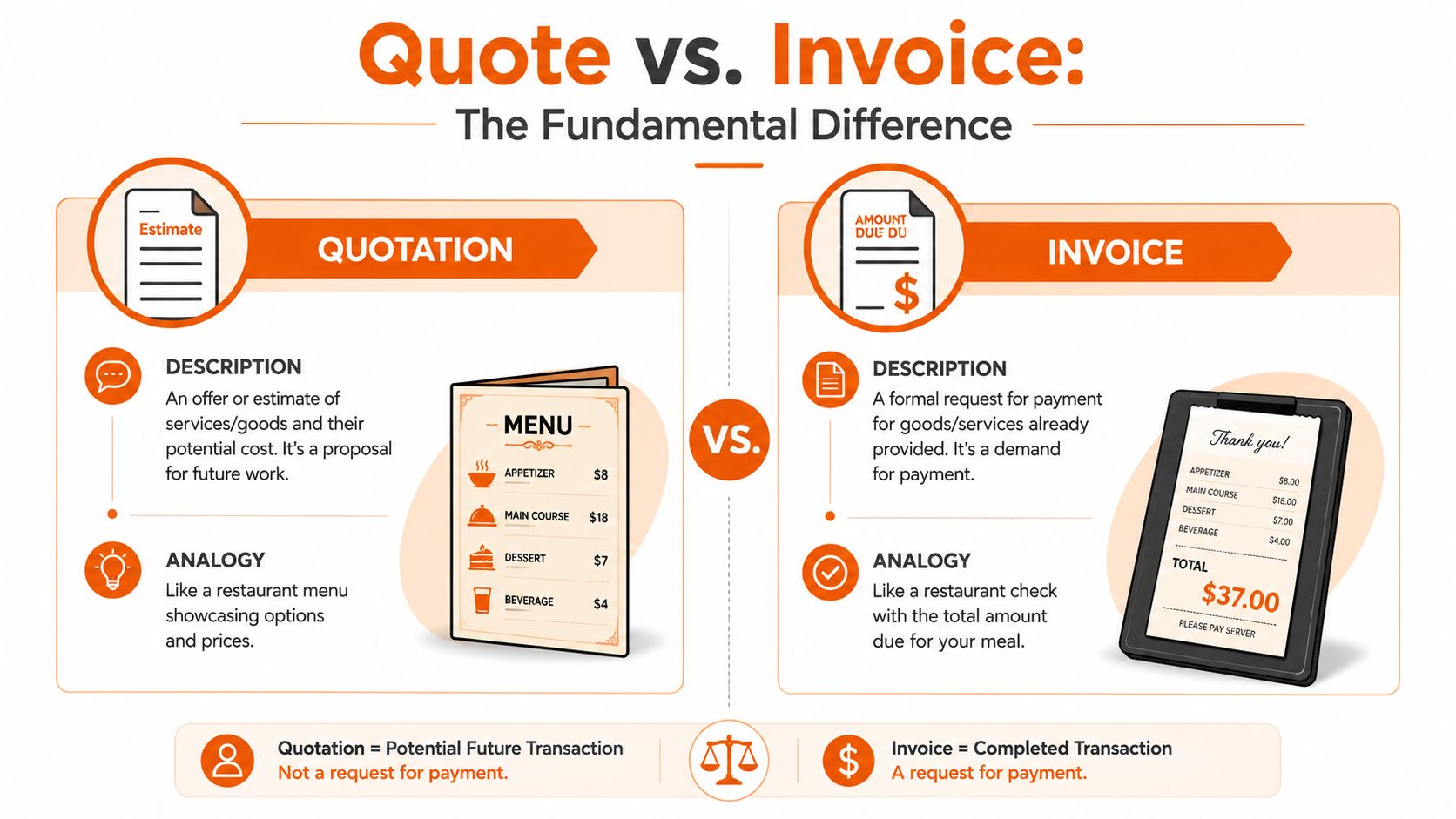
The simplest way to explain it is this. A quote is the menu. An invoice is the check.
The menu tells you what's available and what it should cost. The check tells you what you ordered, what you received, and what you now owe. Nobody wants a restaurant to hand over the check before they've agreed to the meal. The reverse is also true. Once dinner is done, the menu isn't the payment document.
The same logic applies to invoice and quotation workflows in business.
The clean distinction
The clearest definition I've found is this: “The core distinction between a quote and an invoice is timing: a quote is issued before work begins to detail projected costs, while an invoice is sent after goods or services are delivered to request payment for accrued costs. This timing difference dictates their legal status: a quote is a non-binding offer that can change with negotiation until accepted, while an invoice is a legally binding, enforceable request for payment.” That wording comes from Tipalti's explanation of quote vs invoice.
That timing difference changes everything. It affects the conversation with the customer, the accounting entry, and the legal footing you stand on if the customer pushes back.
Side by side
Document | Quote | Invoice |
|---|---|---|
When it's used | Before work begins | After goods or services are delivered |
Main purpose | Offer pricing, scope, and terms | Request payment |
Status | Negotiable until accepted | Final demand for payment |
Accounting impact | Usually no immediate ledger effect | Creates receivable and triggers the accounting process |
Customer mindset | “Should we proceed?” | “How and when do we pay?” |
That's the clean version. But daily operations are rarely clean.
Where teams trip up
Frontline teams often work faster than office systems. Someone gets a verbal okay on the phone. A supervisor texts “approved.” A field worker starts the job because delaying service would make things worse. Then the invoice arrives later and the customer disputes a line item no one bothered to pin down.
That's why invoice and quotation discipline matters more in service businesses than people admit. In product businesses, the item sold is usually easier to define. In services, the edges move. Time expands. Materials change. “One more thing” slips into the work.
A quote starts the agreement. An invoice closes it. Treating them like the same document leaves a hole right in the middle.
One more legal point
An invoice isn't just a prettier version of a quote. It carries different weight. In many workflows, it also has different consequences for your books and tax handling. A quote helps the client decide. An invoice tells your systems, and theirs, that the transaction is now real.
That's why sending an invoice too early is risky, and sending a quote too late is weak. One asks too much. The other asks too little.
What Goes Into a Good Quote and a Clear Invoice
A lot of billing headaches come from documents that are technically sent, but badly built. They have prices, but no scope. They have totals, but no terms. They have urgency, but no clarity.
Good invoice and quotation practices are boring in the best way. They leave little room for interpretation.
What a strong quote needs
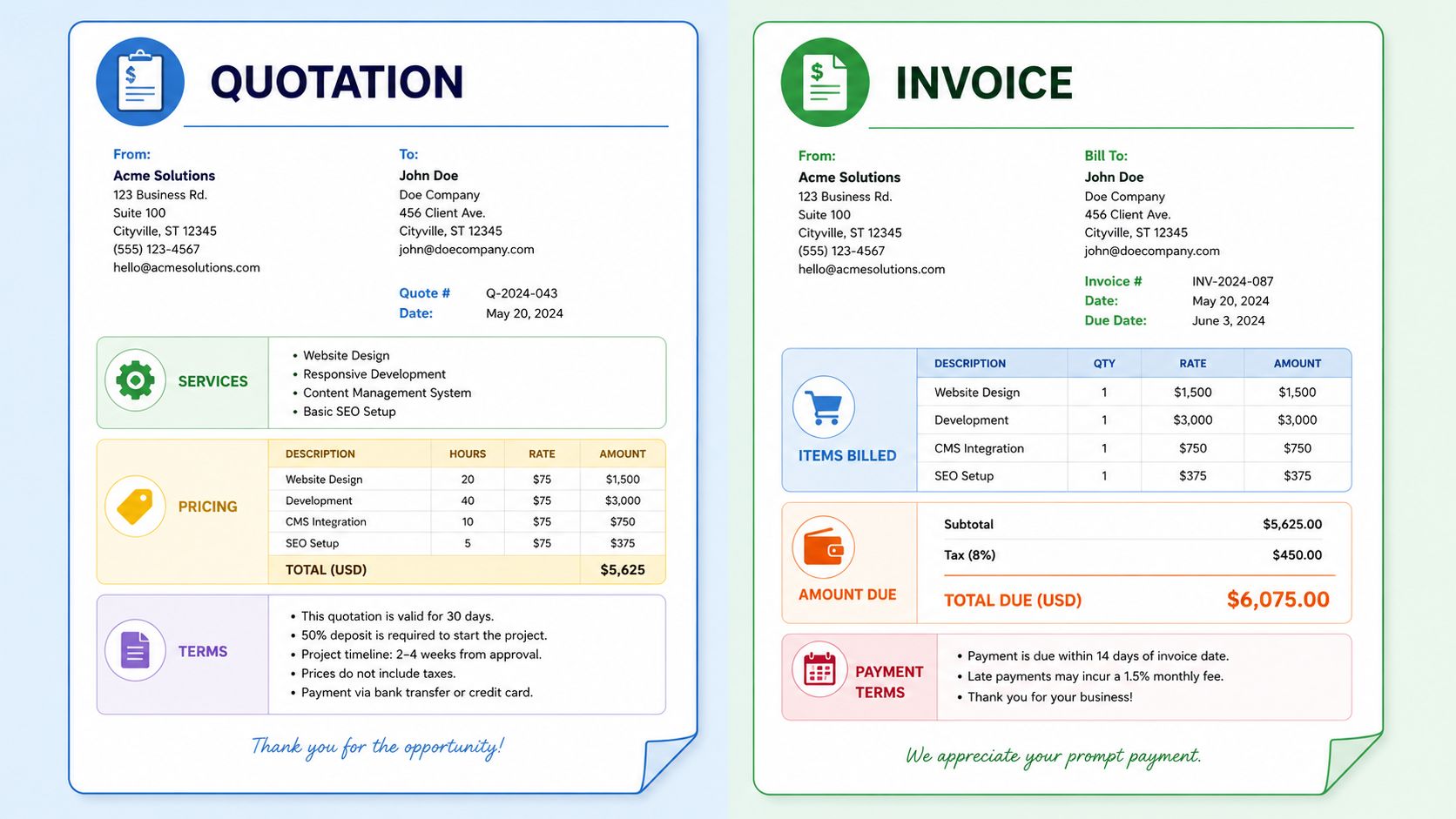
A quote should make it easy for the customer to say yes, ask a smart question, or decline. It should not leave them guessing what's included.
At minimum, your quote should spell out the work, the expected price, the terms, and the limits. If materials, labor, travel, or revisions are part of the job, say so plainly. If they aren't, say that too.
A practical quote usually works best when it includes:
Scope in plain language: What you'll do, what you'll deliver, and what the customer should not assume is included.
Estimated pricing: Enough detail that the customer can understand the cost, not just stare at a lump sum.
Validity period: Prices change. Supplier costs move. Your quote shouldn't stay open forever.
Approval path: A clear place for the customer to accept, whether that's a signature, an email confirmation, or a purchase order reference.
If you want a simple starting point, this sales quote form template is a useful example of the kind of structure that keeps details from slipping through.
What a usable invoice needs
An invoice has a different job. It has to be precise enough for your customer to pay it and for their finance team to process it without a side conversation.
PandaDoc's breakdown of invoice vs quote puts it well: an invoice is a formal financial document that includes specific mandatory fields like an invoice number, total amount due, payment terms, and a due date. In contrast, a quote generally includes estimated costs and work details to start the conversation, setting the stage for the binding invoice to come.
That sounds basic, but these details do real work.
Invoice field | Why it matters |
|---|---|
Invoice number | Gives both teams a shared reference point |
Total amount due | Removes ambiguity about what must be paid |
Payment terms | Sets expectations on timing |
Due date | Tells accounts payable when action is required |
Line items | Helps defend the total if questions come up |
Small details that prevent bigger fights
Your quote and invoice should also speak to each other. The line items should line up. The wording should be recognizable. The client shouldn't feel like they approved one thing and got billed for another.
Overhead often gets people into trouble. If your pricing includes indirect costs, you need to understand your own math before you send anything out. A lot of businesses underquote because they haven't worked through labor burden, admin time, or equipment costs. This guide on how to calculate overhead rate is a good reminder that pricing discipline starts long before the invoice.
Clear documents don't just speed up payment. They reduce the number of awkward explanations your team has to give later.
From Handshake to Paid The Quote to Cash Workflow
Most businesses don't lose money because they can't create a PDF. They lose money in the handoffs. Somebody asks. Somebody quotes. Somebody approves. Somebody does the work. Somebody bills it. Those “somebodies” are often in different places, on different devices, and working different shifts.
That's why the quote-to-cash path needs to be treated like an operating system, not a stack of separate documents.
The actual path
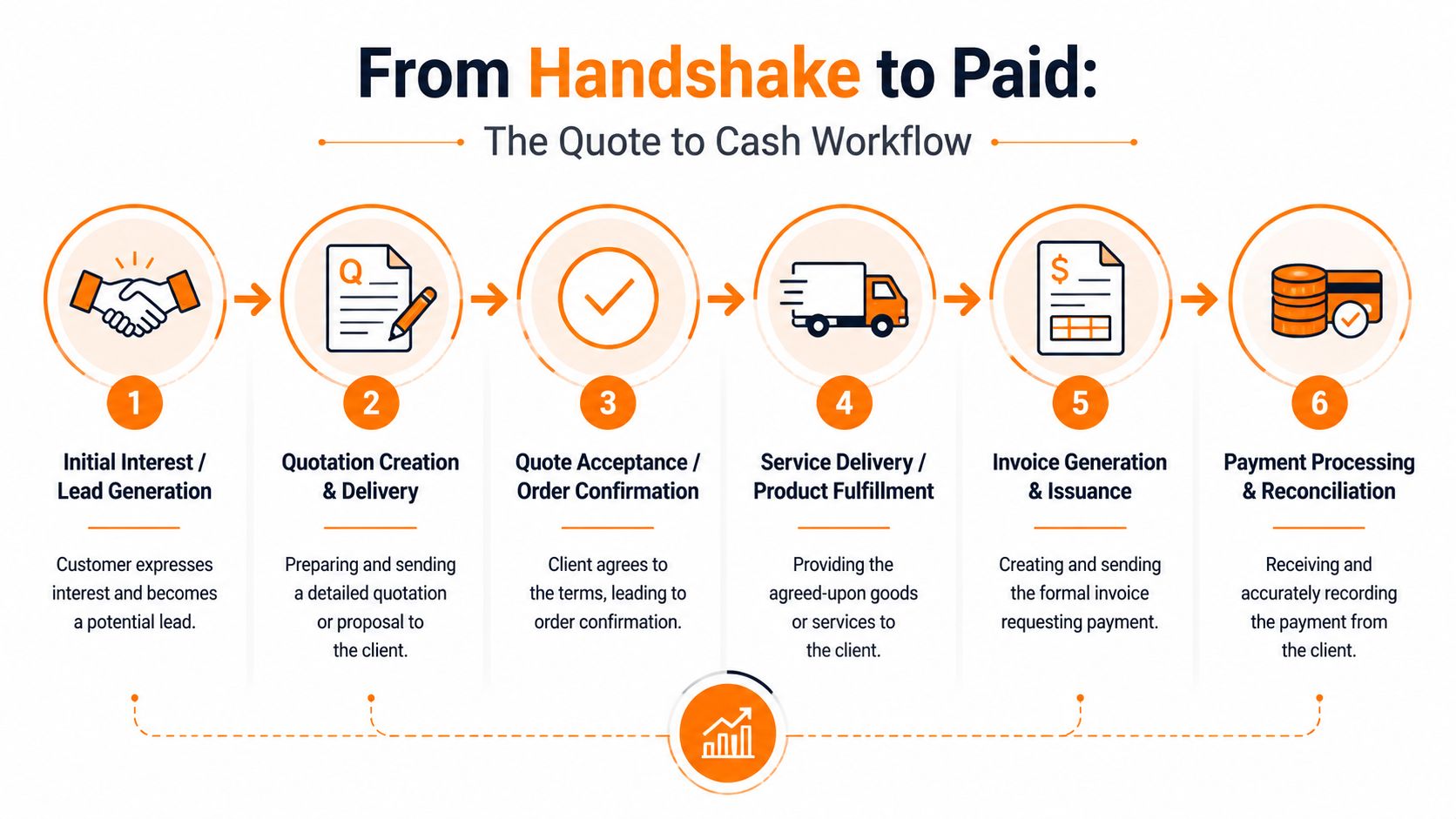
In a healthy workflow, the movement is simple:
Customer interest appears. A lead, inquiry, call, or walk-in starts the process.
A quote gets created and sent. It defines the proposed work and price.
The client accepts it. This is the pivot point.
The team delivers the service or product.
The invoice goes out.
Payment gets received and matched back.
That sequence sounds obvious. It isn't always followed.
The approval step is where the business is made
A lot of teams rush past acceptance because they're trying to be responsive. That instinct is understandable. But a quote without a clear approval trail is a weak bridge between sales and billing.
This matters even more for field teams. A service contractor, clinic coordinator, hospitality manager, or warehouse lead often doesn't sit at a desk with the full document trail in front of them. They need one answer before work starts: what exactly did the client approve?
That answer can't live in somebody's memory.
If the approved scope only exists in a text thread, it doesn't really exist for operations.
For service businesses trying to tighten this up, it helps to study clean finance flows outside your own industry. OilGasFactoring.com's simple process is a useful example of how straightforward handoffs can reduce confusion, even when cash collection and back-office processing are involved.
Why automation helps when teams are busy
The more manual the workflow, the more likely it is that someone copies the wrong amount, forgets an attachment, or invoices before the paperwork is settled. According to the FedPayments Improvement electronic invoice standards catalog, automating the five core steps of invoice processing can reduce processing time by up to 70% and cut error rates from 15% in manual systems to under 2% in automated workflows.
That's not just about speed. It's about fewer preventable mistakes.
For contractors and service operators, workflow discipline also ties directly to staffing, scheduling, and communication. The businesses that keep this smooth usually don't treat billing as a back-office island. They connect it to dispatch, job status, approvals, and the people doing the work. This is why tools designed for business management software for service contractors tend to matter most when the team is spread out.
Where It All Goes Wrong
The most expensive billing mistakes usually sound harmless when they happen.
“Go ahead and start.”
“We'll sort the paperwork later.”
“It's basically the same scope.”
“Just send the invoice.”
Those lines have cost businesses a lot of money.
Verbal approval isn't enough
When work starts on a nod, a phone call, or a half-clear message, you're trusting memory to carry legal and financial weight. That rarely ends well. The client remembers one thing. Your team remembers another. The invoice shows up and suddenly everyone becomes a historian.
The biggest trap is scope creep without proof. A job starts with one expectation, then expands in little increments. Extra labor gets added. Materials change. A second visit becomes necessary. By the end, the invoice is higher than the original quote, but nobody can point to the exact moment the customer approved the change.
The enforceability gap
This is the part most simple guides skip. According to Emagia's explanation of the invoice vs quote gap, without a clear “acceptance” timestamp or signature linking the quote to the final invoice, disputes over scope changes often lack legal backing. This is a critical nuance for frontline teams in industries like construction or services where scope creep is common but documentation is often informal, leading to revenue loss.
That one sentence explains a lot of unpaid work.
If you can't show when the customer accepted the original terms, or when they approved the change, your invoice may be correct in spirit and weak in practice. The work was done. The value was delivered. But the record is too soft to defend.
Another mistake people miss
Sending an invoice creates consequences on your side too. Once you issue it, your books and tax handling may need to reflect it. That's why “I'll just invoice now and fix it later” is a bad habit. If the underlying approval is shaky, the invoice can make the mess more official, not less.
A few practical habits make a big difference:
Capture acceptance clearly: Signed quote, written approval, or documented order confirmation.
Record scope changes when they happen: Not after the job is finished.
Match invoice line items to approved work: Surprises invite disputes.
Train field teams on documentation: They don't need legal theory. They need simple habits.
The point isn't to become rigid. It's to become provable.
Keeping It All Straight in One Place
The deeper problem with invoice and quotation confusion isn't really the documents. It's fragmentation. Approval is in email. Scope changes are in chat. Photos are on a phone. The latest quote is buried in someone's downloads folder. Finance only sees the invoice at the end and wonders why the client is pushing back.
That setup works right up until it doesn't.
One shared record changes the whole flow
When teams keep the quote, the approval trail, the job updates, and the supporting files in one place, the process gets calmer. Office staff can see what the field team saw. Supervisors can confirm the approved scope before work begins. Finance can trace the invoice back to the actual agreement instead of chasing people for screenshots.
That kind of discipline matters because the old way is still common. Globally, roughly 78% of the 560 billion invoices sent in 2024 were still issued in non-digital formats, which leaves a huge opening to improve how the whole quote-to-invoice process is handled, as noted by Billed's 2024 e-invoicing statistics.
What better looks like
A better setup gives each job or client interaction a clear home. The quote lives there. The approval is visible. Files are attached. Team communication stays tied to the work instead of drifting across apps.
If you're trying to build that kind of consistency, it helps to think in terms of a formal document workflow software process rather than a collection of disconnected tools. That shift sounds small, but it changes how people behave. They stop improvising around missing information because the information is where it should be.
And that's really the whole game. Getting paid shouldn't depend on who remembers the last phone call best.
If your team handles quotes, approvals, field updates, and billing across shifts or locations, Pebb gives you one place to keep it all together. You can organize work in Spaces, keep conversations tied to the job, share files, and make sure the people in the office and the people on the ground are looking at the same record. That doesn't just reduce confusion. It makes the path from quote to payment a lot easier to trust.
