
How to Manage Hybrid Teams Without the Chaos
A no-nonsense guide on how to manage hybrid teams. Learn the systems, policies, and tools you need to keep everyone in sync, productive, and engaged.
Dan Robin
The worst hybrid advice is also the most popular. It tells managers to focus on culture first. Plan a few nice offsites. Add more check-ins. Maybe throw in a virtual coffee chat and hope the distance problem softens.
That's backward.
Hybrid work usually doesn't fail because people don't care about each other. It fails because nobody wrote down how work is supposed to happen. The team doesn't share one operating manual. Meetings mean different things to different people. Decisions get made in hallways, then dribble out later. Some updates live in chat, some in email, some in somebody's head.
I've rolled out hybrid models enough times to know this much. Hybrid is not a vibe problem. It's a systems problem. If you want to learn how to manage hybrid teams well, stop hunting for morale hacks and start building rules, rhythms, and shared tools that make work legible to everyone.
Stop Treating Hybrid Like a Perk
Most companies still talk about hybrid work like it's a concession. A nice benefit. A recruiting line. A flexible arrangement that sits beside the “real” business.
That thinking creates chaos.
When leaders treat hybrid as a perk, they keep the old office system intact and bolt flexibility onto the side. Then they wonder why communication gets messy, why remote people feel out of the loop, and why managers start over-indexing on who they can physically see.
Gallup's hybrid work indicator makes the point clearly. Six in 10 employees with remote-capable jobs want a hybrid work arrangement, about one-third prefer fully remote work, and less than 10% prefer on-site work. That's not a fringe preference. That's the shape of the market.
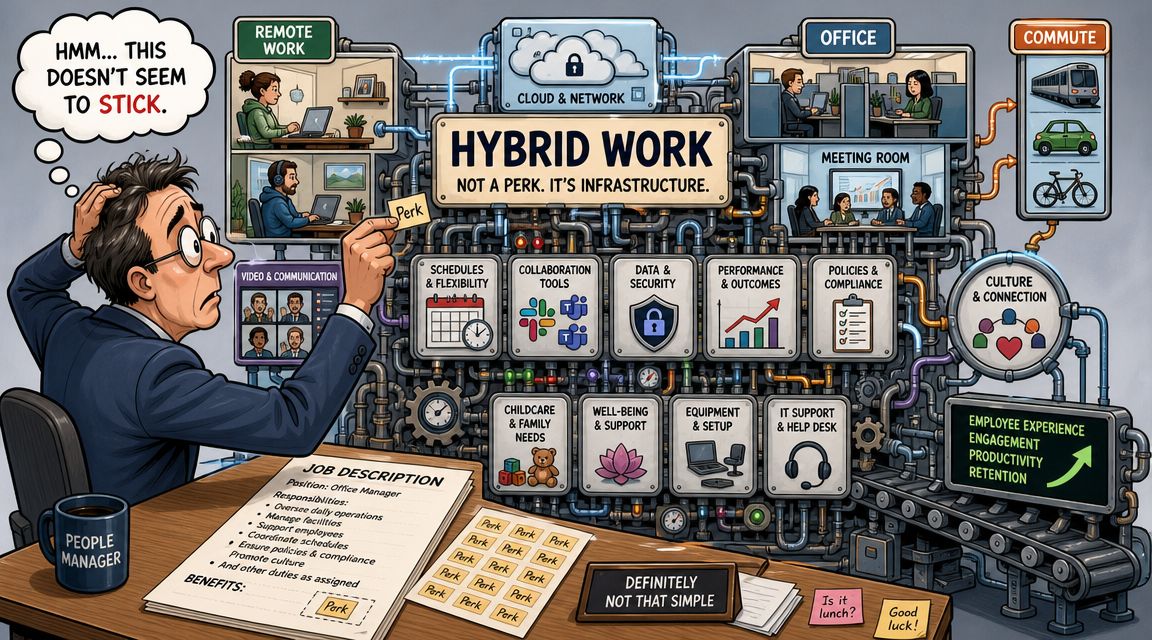
Architecture beats accommodation
If most remote-capable employees want some form of flexibility, then hybrid isn't something you “allow.” It's something you design.
That changes the manager's job. You're no longer coordinating where people sit. You're deciding how information moves, how decisions get recorded, how meetings include absent people, and how performance stays visible without constant observation.
Hybrid breaks down when the office remains the real headquarters for information and everyone else gets the recap.
I've seen this pattern again and again. A company says it supports hybrid work, but the important conversation still happens after the meeting, on the walk back to desks, or over lunch with whoever happened to be nearby. That's not hybrid. That's office work with remote leftovers.
The real shift
The shift is from presence-based management to system-based management.
A simple comparison makes it obvious:
Old office habit | Hybrid operating reality |
|---|---|
Information spreads through proximity | Information must be published intentionally |
Managers judge effort by visibility | Managers judge work by clarity and outcomes |
Meetings are the default coordination layer | Shared docs, channels, and routines carry the load |
Office attendance creates access | Access has to be designed for every location |
If you want to know how to manage hybrid teams without the daily friction, start with that mindset. Build for both presence and distance from day one. Don't make remote people adapt to an office-first machine.
That machine won't hold.
Write the Rules of the Game
If you don't define the rules, your team will invent them. Unofficially. Inconsistently. Usually badly.
One manager expects instant replies in chat. Another is fine with a slower rhythm. One team stores updates in project boards. Another buries them in meetings. One person thinks being in the office means they can pull coworkers into ad hoc decisions. Another assumes every decision will be written down somewhere.
That isn't flexibility. It's ambiguity.
The fix is simple. Write a short working agreement. Not an HR booklet. Not a values poster. A plain-language document your team can use.
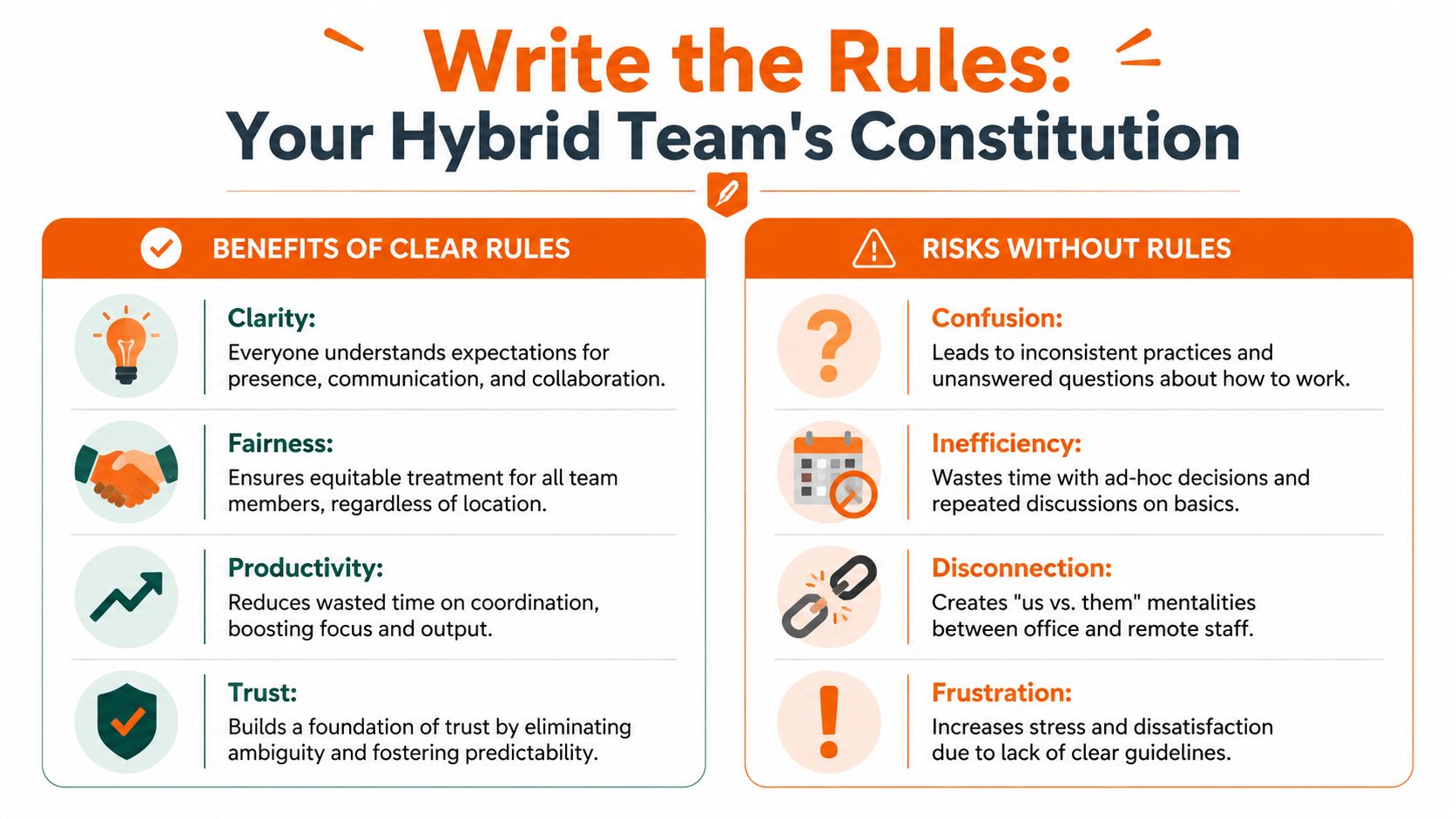
What your team constitution should answer
A good rulebook handles the questions people ask every week, even when they stop asking them out loud.
It should cover things like:
Where work lives: Pick one primary place for project status, decisions, and task ownership.
How urgent communication works: Define when to use chat, email, comments in docs, or a call.
What response times people can expect: Not every message deserves an instant answer.
When people need to be available together: Set shared hours if the work requires them.
How meetings happen: Decide what deserves a meeting and what should stay async.
How decisions get recorded: If a decision matters, it must be written somewhere searchable.
What office days are for: Collaboration, onboarding, workshops, relationship building. Not just sitting in a different chair while doing solo work.
I'd also include a short section called “What we don't do.” That's often more useful than the positive rules. We don't make project decisions in private chat. We don't announce policy changes in passing. We don't treat hallway conversations as official communication.
If you need a practical way to roll those expectations out, this guide on how to communicate policy changes to employees is worth a look.
Write principles, not legal clauses
A common mistake for teams is evident here. They write too much. Then nobody reads it.
Keep it tight. Aim for a document that a new employee can read once and immediately understand how your team works. Use examples. Use normal language. If a sentence sounds like a policy memo, rewrite it.
Practical rule: if someone joins your team and still has to ask where decisions are documented after their first week, your system is unclear.
A rulebook should remove anxiety, not create it. People work better when invisible expectations become visible. They stop wasting energy on guessing what good looks like.
The office should not be the exception handler
One more point, because it matters. Don't let the office become the place where unclear issues get “sorted out.” That creates two systems. The written system and the actual one.
Your job is to keep those from splitting apart.
So when someone resolves something in person, move it back into the shared channel, doc, or task board. Close the loop where everyone can see it. That's the discipline hybrid teams need. Not more slogans. Better rules.
Design Your Communication Cadence
A strong hybrid team doesn't communicate constantly. It communicates predictably.
That's a big difference. Constant communication creates noise. Predictable communication creates trust. People know when they'll get context, when they can focus, and where to look when they miss something.
Most hybrid teams feel messy because every day runs on improvisation. Meetings pop up without warning. Questions arrive in the wrong channels. Managers overcompensate with pings because they're nervous about silence. Everyone feels busy, but not especially aligned.
A good cadence fixes that.
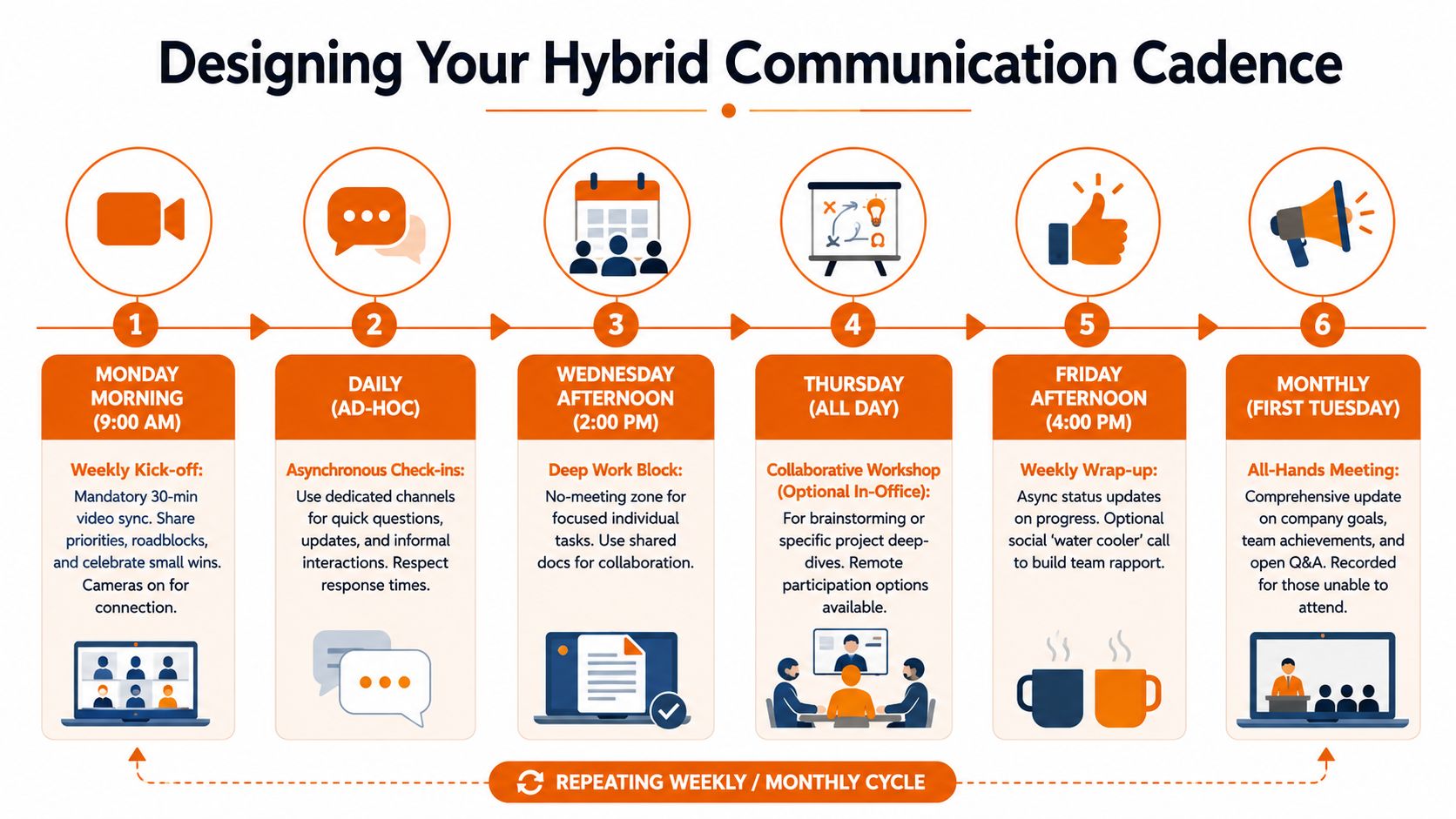
Build a rhythm people can count on
Carnegie Mellon's hybrid management best practices recommend regular 1:1s and starting meetings with round-robin input so remote voices aren't crowded out. I agree with that because it turns inclusion into an operating habit, not a good intention.
My preference is a simple recurring pattern:
A weekly team sync for priorities, blockers, and decisions that need live discussion
Recurring 1:1s with every direct report, held consistently and not skipped because the week got busy
Async daily updates in a shared channel or project tool for progress, questions, and handoffs
A written weekly wrap-up so people can review status without chasing coworkers
Dedicated focus blocks where meetings are off-limits unless something is time-sensitive
That cadence gives people enough contact to stay coordinated without turning the calendar into a landfill.
If your team is still fuzzy about which tool handles which kind of message, this piece on how to define digital communication can help sharpen the boundaries.
Meetings need stricter design in hybrid teams
Hybrid meetings don't fail because video is awkward. They fail because managers let the room dominate.
If some people are together physically and others are dialing in, the in-room group automatically has an advantage. They can read body language, jump in faster, and keep talking after the formal meeting ends. That's normal human behavior. Which is exactly why you need rules.
I'd start with these:
Meeting rule | Why it matters |
|---|---|
Everyone joins with equal access to the agenda and notes | Nobody relies on side explanations |
The meeting starts with round-robin input | Remote people speak before the room sets the tone |
Decisions are captured in writing before the meeting ends | No hidden follow-up track |
Someone owns the recap | Memory is not a system |
If participation depends on confidence, speed, or physical proximity, your meeting design is broken.
Don't confuse social connection with sloppy communication
You still need some human warmth. I'm not arguing for a sterile machine.
But social connection works better when it sits inside a clear rhythm. Short check-ins. Space for informal conversation. A few recurring rituals people enjoy. Fine. Good, even. What doesn't work is using “culture” as an excuse for unstructured communication and undocumented decisions.
That's how teams drift.
If you want to know how to manage hybrid teams well, think like an operator. Put connection on the calendar. Put information in writing. Make recurring communication boring enough to be reliable. Then let people do good work.
Make Fairness Your Default Setting
Hybrid teams don't become unfair because managers are evil. They become unfair because humans notice what's near them.
That's the whole problem. The person you see after a meeting feels more top of mind. The employee who speaks to you in the hallway feels more engaged. The person who is physically present gets extra context without anyone planning it that way.
Then a year passes, and the same people keep getting stretch work, praise, and promotion momentum.
Owl Labs and Hays, as summarized in Owl Labs' guidance on building stronger hybrid teams, recommend clear promotion benchmarks and keeping follow-up conversations online instead of in office-only “watercooler” settings. That advice gets to the heart of it. Fairness in hybrid work is not a feelings issue. It's a design issue.
Visibility should be structured
If visibility depends on who happened to be around, your team will drift toward proximity bias every time.
The fix is to make contribution visible in the same place for everyone. Project updates go in the board, not in passing conversation. Recognition happens in shared channels, not just in a room. Development conversations get documented. Stretch assignments are discussed openly enough that people know how opportunities are handed out.
Here's where many managers resist. They say this feels less natural.
It is less natural. It's also more fair.
The office is full of accidental advantages. A good hybrid manager removes as many of them as possible.
Promotion rules need daylight
A surprising number of teams still handle advancement like a private art form. People are told to “show leadership” or “have more presence” without being told what those words mean.
That's lazy management in any setting. In hybrid teams, it becomes dangerous.
Use explicit benchmarks. Spell out what stronger performance looks like at each level. Explain how scope, ownership, communication, judgment, and consistency are evaluated. Then use the same framework for people in the office and people working elsewhere.
A few questions are worth asking regularly:
Who gets the visible work: Are the same office-based people always presenting, leading, or representing the team?
Where feedback happens: Are useful coaching conversations showing up in writing and in scheduled 1:1s, or mostly in spontaneous office moments?
How onboarding works: Does every new hire get the same access to tools, context, and relationship-building, regardless of location?
What gets remembered: Are promotions based on documented contribution or whoever feels most familiar?
Small habits create big gaps
Managers often look for fairness problems in dramatic places. They're usually hidden in tiny routines. The extra five-minute debrief after a conference room meeting. The quick lunch recap. The assumption that someone who isn't physically there can catch up later.
That's where inequity starts.
If a conversation matters, bring it back to the shared system. If a decision affects someone's work, document it where they can find it. If advancement matters, define the path in plain language.
Fairness doesn't happen because your intent is good. It happens because your operating system leaves less room for bias.
Measure Outcomes Not Keystrokes
Nothing reveals a manager's insecurity faster than activity tracking.
When leaders don't know how to manage hybrid teams, they start staring at green dots, response times, meeting attendance, and message volume. It looks like oversight. It's really just anxiety wearing a dashboard.
Those signals tell you almost nothing useful. A person can answer chat in seconds and still move no meaningful work forward. Another can disappear for a few focused hours and solve the problem everyone else has been circling all week.
Workday's guide to managing hybrid teams cites Robert Half research showing that nearly 9 in 10 employers are offering some form of hybrid work arrangements in 2026. Their advice is the right one. Measure true outcomes, not proxy metrics like active hours or response times.
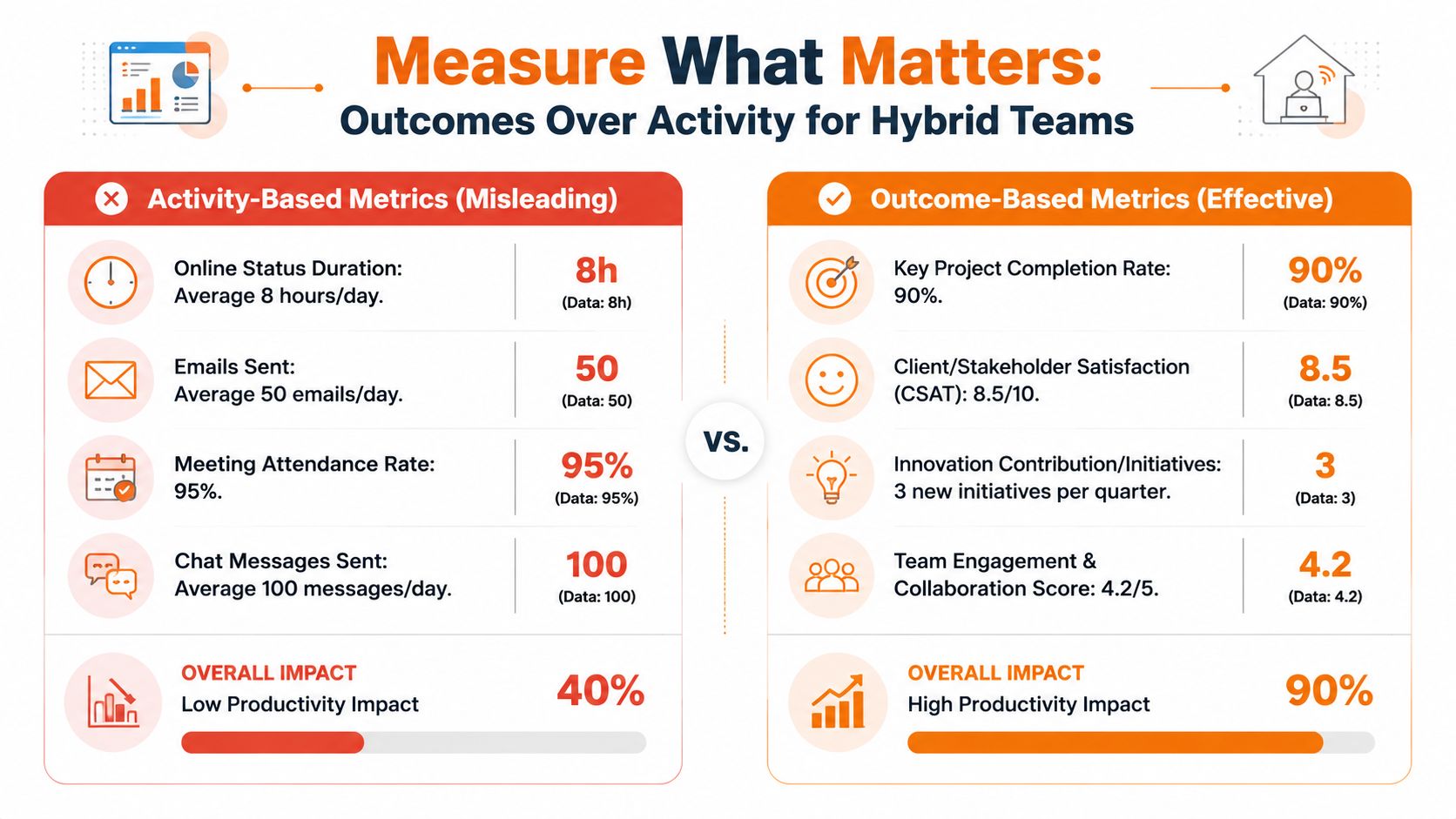
Activity is easy to count and useless to trust
Teams get themselves in trouble. They pick metrics because they're available, not because they matter.
Look at the difference:
Activity metric | Better question |
|---|---|
Time online | What meaningful work shipped this week |
Fast replies | Were blockers resolved in time |
Meeting attendance | Did the meeting produce a decision or move the project |
Number of messages | Did the team stay aligned without confusion or rework |
If you manage to the left side of that table, people will optimize for appearing busy. They'll answer everything immediately, sit in unnecessary meetings, and narrate work instead of doing it.
If you manage to the right side, they'll optimize for delivery.
What managers should actually watch
You don't need surveillance software. You need a cleaner view of work.
That means looking at output, bottlenecks, capacity, and consistency. Are projects moving? Where do approvals stall? Which teams are overloaded? Where does handoff friction keep showing up? Which goals are clear, and which are muddy enough to create churn?
A useful system usually includes:
Team goals with visible owners
Project status tracked in one place
Decision logs for important calls
Regular reviews of blockers and workload
Lightweight engagement signals, especially when communication quality starts slipping
If you're building that measurement layer, it helps to think about employee engagement measurement as one part of the picture, not the whole picture. Engagement matters. It just shouldn't replace operational visibility.
A better test: ask whether your measurement system helps a manager remove obstacles, rebalance work, and coach performance. If it only helps them monitor people, it's the wrong system.
Trust gets stronger when expectations get sharper
Some leaders think outcome-based management means being hands-off. It doesn't. It means being precise.
Clear goals. Clear deadlines. Clear ownership. Clear standards. Then enough visibility to know when something is drifting.
That's how trust works in practice. Not by pretending structure is oppressive. Not by assuming adults need no guidance. Trust grows when people know what they're responsible for and believe they'll be judged on the work itself, not on whether they looked busy at the right times.
That's the real upgrade hybrid work demands.
The Real Work Is Never Finished
The tempting mistake is to think hybrid management has an end state. Write the playbook. Set the meeting rhythm. Clean up the tools. Done.
It doesn't work like that.
Every hybrid team changes. New people join. Managers develop habits. Projects get more complex. What felt crisp six months ago starts fraying at the edges. A communication rule that worked at one stage becomes too heavy or too loose at another.
The teams that stay healthy are the ones that keep tuning the system.
Keep listening in ways that produce action
I've had the best results when feedback lives in more than one place. Regular 1:1s catch the personal friction. Team discussions surface process problems. Short listening loops help spot patterns before they harden into resentment.
The important part is visible follow-through.
Ask what's unclear. Ask where people lose context. Ask which meetings waste time. Ask whether office days are useful or ceremonial. Then change something concrete and tell people what changed. That closes the loop and teaches the team that speaking up is worth the effort.
One digital home lowers the friction
Hybrid teams struggle when work is scattered across too many tools and too many unofficial channels. Communication goes one place, tasks another, files somewhere else, and policy updates get buried wherever they happen to land.
A more unified setup makes iteration easier because everyone knows where to look. Tools like Slack, Microsoft Teams, Asana, Notion, and Pebb each cover different parts of that stack. Pebb, for example, combines chat, voice and video calls, news feeds, tasks, file sharing, and a knowledge library in one place, which can make it easier for mixed office and frontline teams to keep communication and operations together.
That kind of setup doesn't solve hybrid management by itself. Nothing does. But it gives you a stable surface to build on.
Managing hybrid teams well is a practice. You write the rules, watch where they break, and fix what reality exposes. Then you do it again. That's not a flaw in the model. That is the model.
If you're trying to make hybrid work less chaotic, Pebb is worth a look. It gives teams one place for communication, updates, tasks, knowledge, files, and engagement, which is exactly what most hybrid setups are missing. When your rules, rhythms, and daily work live in the same system, it gets much easier to manage fairly and consistently across office, remote, and frontline teams.
