
How to Communicate Policy Changes to Employees
Learn how to communicate policy changes to employees with a modern framework. Our guide covers planning, delivery, and feedback for office and frontline teams.
Dan Robin
Most policy changes don’t fail because the policy is wrong. They fail because the announcement is lazy.
You’ve probably seen it. Someone in HR or legal sends a company-wide email with a subject line like “Important Policy Update.” It’s long, dense, and written like it was designed to avoid liability, not help humans understand anything. Office staff skim it. Frontline staff don’t see it until a supervisor mentions it three days later. Then the questions start. Do I need to do anything? When does this start? Does this apply to my team? Why are we changing this now?
That confusion is avoidable. I’ve rolled out enough policy changes to know the pattern. If employees hear about a change late, vaguely, or secondhand, they fill in the gaps themselves. Usually with the worst possible assumptions. What could have been a routine rollout turns into a trust problem.
If you want to know how to communicate policy changes to employees, start with one simple rule. Treat policy communication like operational work, not admin cleanup. It needs planning, timing, repetition, listening, and a format people can use in the middle of a workday.
The Anatomy of a Failed Announcement
The classic failed announcement looks polished from the sender’s side.
The policy has been reviewed. Leadership signed off. The email is technically accurate. A PDF is attached. Someone posts it on the intranet. Job done.
Except it isn’t.
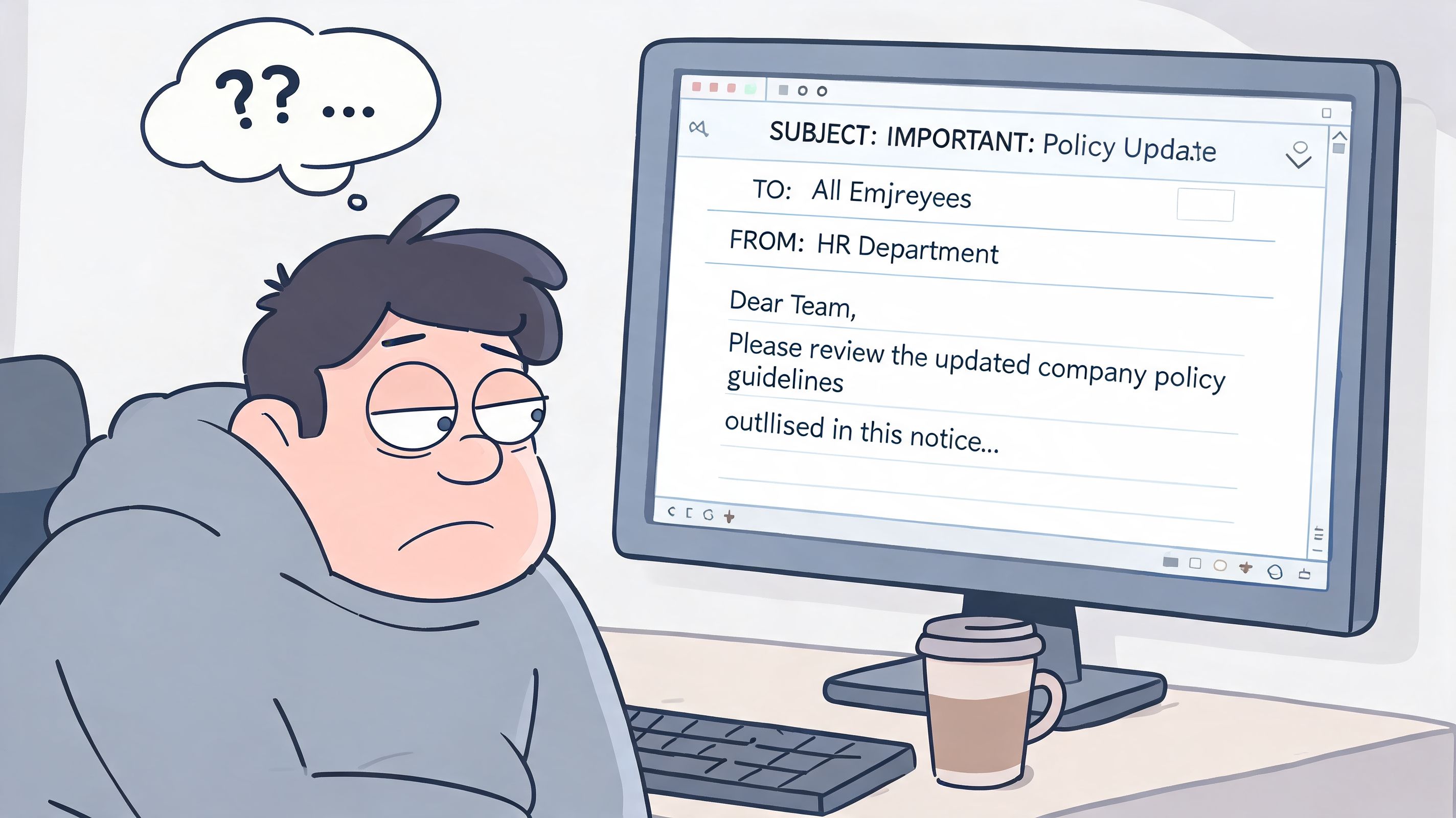
Why the message falls flat
Employees don’t read policy updates the way HR writes them. They read them through the filter of their own day. A nurse on a busy shift wants to know what changes tonight. A warehouse lead wants to know whether the new rule slows down dispatch. A restaurant manager wants to know what to tell the opening crew at 6 a.m.
If the message doesn’t answer those questions quickly, people tune out.
One-time announcements also assume attention is sitting there waiting for you. It isn’t. Work is noisy. People are busy. Some are on a laptop all day. Others are nowhere near email. When the communication plan is “send and hope,” the rollout is already in trouble.
A lot of teams make these mistakes repeatedly. If that sounds familiar, this breakdown of employee communication mistakes to avoid is worth reading because the same patterns show up in policy rollouts again and again.
What employees hear when leadership is vague
Poor policy communication creates three reactions fast:
Confusion: People don’t know what changed, when it starts, or what they need to do.
Suspicion: If the language feels slippery, employees assume the company is concealing its actual reasons.
Drift: Teams interpret the policy differently, so every manager starts running their own version.
That last one is brutal. You end up with five versions of the same policy and a lot of unnecessary friction.
Most employees won’t say, “This communication lacked clarity and respect.” They’ll just ignore it, resist it, or ask their manager for the real version.
The real cost is trust
I’m less worried about whether a policy memo gets opened than whether people believe leadership is being straight with them.
When employees get a stiff, last-minute announcement with no room for questions, they don’t just dislike the message. They remember how they were treated. That memory sticks to the next change too.
This is why calm, repeatable communication matters. Not because it’s nicer. Because it keeps normal operational changes from turning into cultural damage.
Before You Write a Word Your Communication Blueprint
Good policy communication starts before anyone opens a blank document.
If you’re still figuring out who’s affected, why the change matters, and what people need to do after they read it, you’re not ready to announce anything. Writing too early is how teams end up polishing the wrong message.
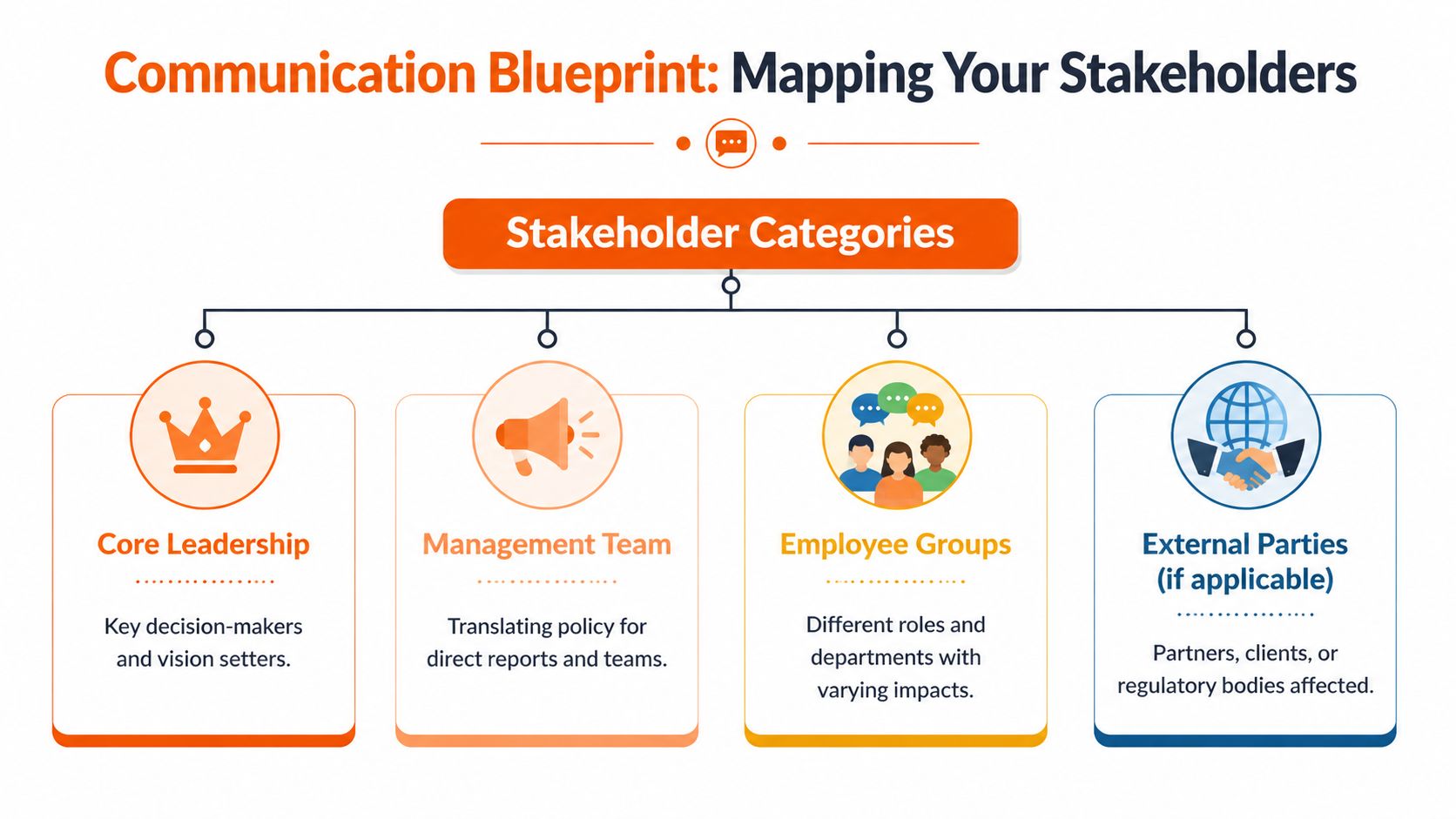
Start with who gets hit first
Don’t group people only by department. Group them by impact.
A travel reimbursement change affects frequent travelers differently from finance approvers. A dress code update may be minor for office staff and a daily issue for retail teams. A security policy might sound administrative until you realize it changes how clinicians, drivers, or temp staff log in during a shift.
I usually map people into four buckets:
Group | What you need to know |
|---|---|
Core decision-makers | Who approved the change and can explain the business reason |
Managers | Who will translate the policy in daily team conversations |
Directly affected employees | Who must change behavior right away |
Indirectly affected teams | Who need awareness so they don’t spread the wrong version |
This sounds basic. It isn’t. Teams skip this and then wonder why the message lands unevenly.
A simple kickoff helps. According to a benchmarked rollout framework, a 5-step communication plan can yield 85% stakeholder alignment, and the first move is a kickoff meeting to align on vision and mutual benefits. That matters because initial resistance is common in 60% of changes (IANS Research guidance on communicating policy changes).
Get the why into one honest sentence
If your explanation needs a paragraph of legal language, employees won’t trust it.
Write the reason for the change in one sentence, in plain English, with no cushion words. Not “to support our evolving strategic priorities.” Say what is happening. Maybe regulations changed. Maybe the old process created safety risk. Maybe payroll errors kept happening. Maybe customer data handling was too loose.
Practical rule: If a frontline supervisor can’t explain the change clearly in under a minute, the message isn’t ready.
When teams need help getting that logic straight, a practical primer like the Wisely change management resource is useful because it forces you to connect the business reason to the human impact instead of hiding behind policy language.
Decide what success looks like
The goal is not “inform employees.”
That’s admin thinking. Real communication goals describe what people should understand, do, and stop doing. If you can’t name the behavior change, you’re sending information without direction.
Use a short planning frame like this:
What must employees know The rule itself, the start date, who it applies to, and where the full policy lives.
What must employees feel Usually clarity, fairness, and confidence that they won’t be punished for asking questions.
What must employees do Acknowledge, complete training, change a habit, use a new process, or stop using an old one.
A working template helps here. If you need one, use an internal communication plan template and adapt it to policy work instead of campaign work.
Build around friction, not hope
Before rollout, list the questions people are likely to ask when they’re tired, rushed, or skeptical. That’s the ultimate test.
Ask yourself:
What will people misunderstand first
Which teams will hear this secondhand unless we reach them directly
Which manager is likely to explain it badly
What part of this policy will feel unfair, even if it’s necessary
That’s your blueprint. Not the final wording. Not the approval chain. The friction map.
Once you have that, writing gets much easier.
Crafting the Message for Everyone
A policy message should sound like a person trying to help, not a committee trying to protect itself.
That means short sentences. Clear verbs. Real examples. It also means accepting that one message format won’t work for everyone. What makes sense to someone at a desk often misses the people moving through stores, wards, kitchens, trucks, and warehouse aisles all day.
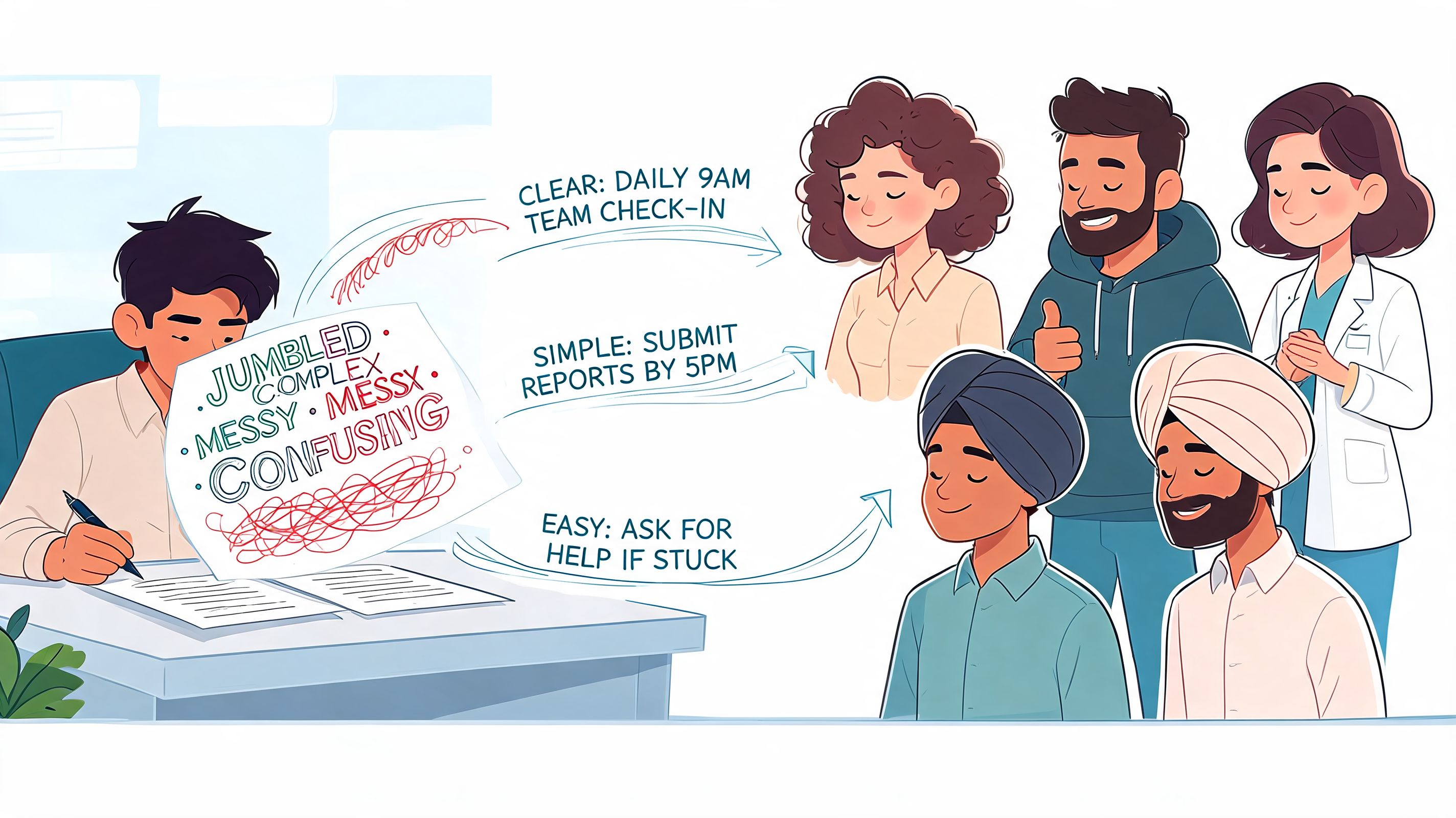
Write the plain version first
Before legal review, write the version you’d say out loud.
Strip out every sentence that exists only to sound official. Keep what an employee needs: what’s changing, why now, what they need to do, when it starts, and where to ask questions.
A simple structure works well:
We’re updating our attendance policy starting Monday.
The current process is inconsistent across locations, and managers are handling exceptions differently.
The new policy sets one standard for all teams.
Here’s what changes for you.
Here’s what stays the same.
Here’s where to ask questions before it goes live.
That beats a two-page memo every time.
Don’t send one message to five different realities
At this point, most organizations lose people.
Existing guidance often fails deskless workers. Frontline employees make up 80% of the global workforce, yet a 2025 Deloitte survey found 67% miss policy updates due to email overload and language barriers. The same research cited by Cornerstone also notes that direct, app-integrated announcements boost understanding by 40% in hybrid teams (Cornerstone frontline communication article).
That tracks with what many of us have seen firsthand. Email is fine for record-keeping. It is not a reliable primary channel for a distributed workforce.
So tailor the format to the audience:
Office teams can handle a written summary with links to the full policy.
Frontline teams often need a short mobile post, a quick video, visual examples, or a voice note from a trusted leader.
Managers need talking points, not just the employee version.
Multilingual teams need translation that respects plain language, not formal jargon.
Say what to do, not just what changed
A policy update should answer the employee’s next move.
Bad version:
“We have revised our time-off procedures to better align with operational requirements.”
Better version:
“Starting next month, request PTO through the scheduling app before the posted weekly deadline. Verbal requests won’t hold a shift.”
That second version gives people a clear action. It may feel blunt. Good. Policy communication should be clear enough to act on during a busy day.
Here are two message patterns I’ve used often.
For all employees
Starting next week, we’re changing how shift swaps are approved. You’ll still be able to swap shifts, but both employees must submit the request in the app before the posted cutoff. We’re making this change because last-minute verbal swaps have created payroll and coverage issues. If you already have a shift swap planned for this week, the old process still applies.
For managers
Your team will ask whether this removes flexibility. It doesn’t. The change sets one approval process so coverage, payroll, and accountability stay clear. Your job is to explain the reason, show the cutoff time, and direct exceptions to HR instead of making side agreements.
Use one home for the message in multiple formats
A unified employee app proves beneficial. One option is Pebb, which lets teams publish updates, use Spaces for team discussion, store policy documents in a Knowledge Library, and reach both office and frontline employees on web and mobile. That’s useful when the same policy needs a written summary, a short explainer video, and a place for follow-up questions without scattering the rollout across five tools.
The principle matters more than the platform. Keep the message, discussion, and source document connected.
Build empathy into the wording
Employees don’t need fake warmth. They need signs that you’ve thought about their reality.
Use language like this:
Acknowledge disruption: “This will change a routine many of you know well.”
Name the pressure point: “The biggest difference is the deadline.”
Respect the question: “If you’re unsure how this applies to your role, ask before the effective date.”
If a policy is likely to annoy people, say so plainly. Trying to sell an unpopular change with cheerful language makes it worse.
A good message doesn’t overperform. It just tells the truth clearly, in a form people can use.
Delivering the News and Managing the Rollout
Writing the message is half the job. Delivery is where good plans go to die.
A rollout works when people receive the message in the right place, in the right order, with enough repetition to remember it. Research cited by McKinsey found that organizations using regular, frequent communication during change achieve significantly better employee engagement and understanding, which is why one-off announcements rarely stick (U.S. Chamber summary of McKinsey communication findings).
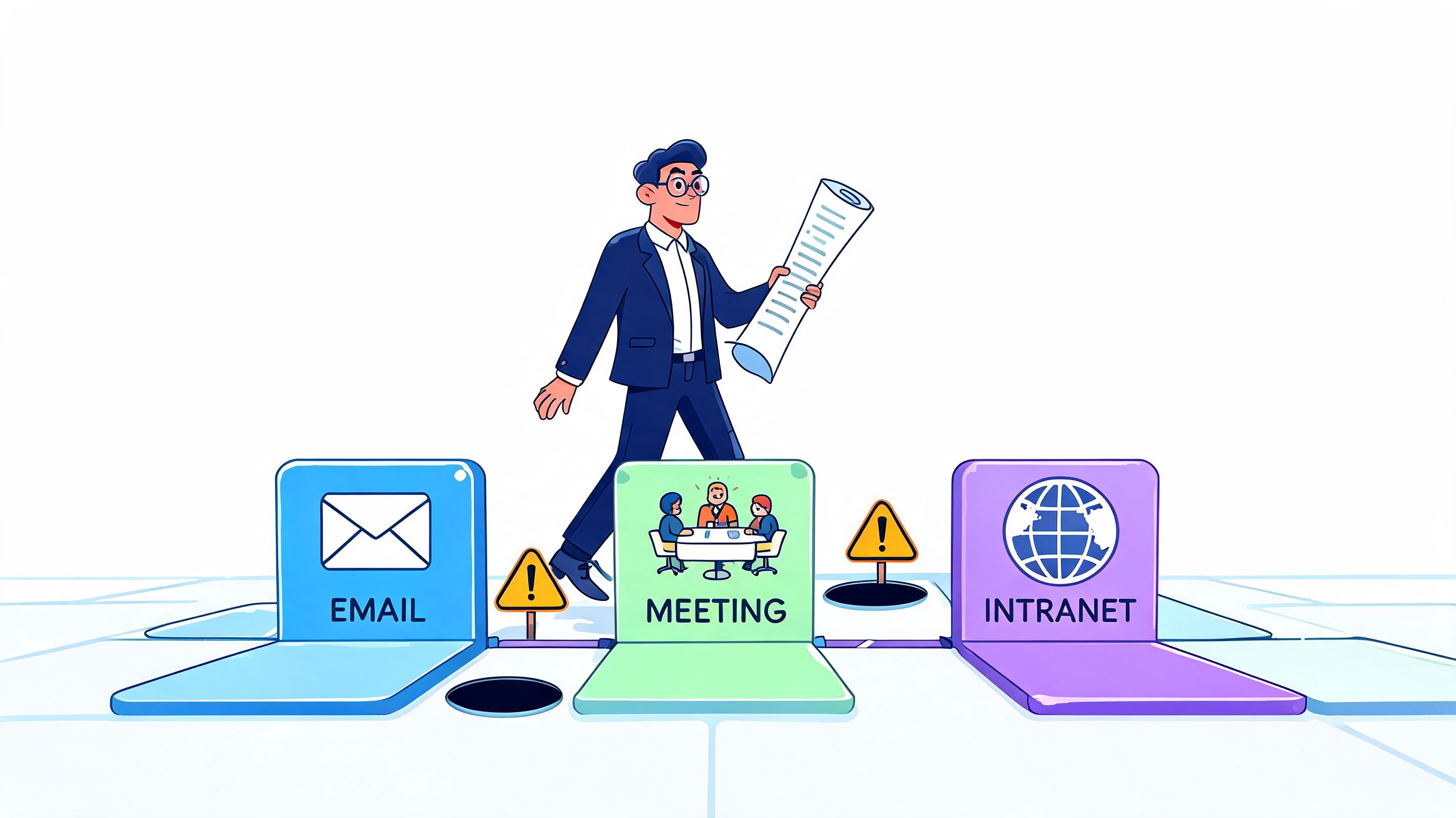
Match the channel to the job
Every channel has a role. Stop asking one tool to do everything.
Use this split:
Channel | Best use |
|---|---|
Official record, detailed summary, policy link | |
Team meeting or huddle | Context, tone, manager explanation |
Mobile post or employee app | Fast reach, reminders, frontline visibility |
Knowledge base or policy library | Current version of the policy |
Private manager channel | Questions before they brief their teams |
If you’re still relying on “manager cascade plus email,” tighten that up with a more deliberate communication cascade that reaches everyone. Cascades work only when managers are prepared and employees also have a direct path to the source.
Use a sequence, not a blast
A single launch email is a firecracker. A rollout sequence is a drumbeat.
I like a simple rhythm:
Manager pre-brief Managers hear first, get context, and ask their own questions before employees do.
Company announcement Employees get the core message in plain language, with a clear effective date and next steps.
Team-level reinforcement Supervisors discuss the policy in huddles, standups, or location meetings with examples relevant to the work.
Follow-up reminder A shorter reminder lands close to the go-live date.
Post-launch clarification Common questions get answered publicly so confusion doesn’t spread privately.
That cadence respects how people actually absorb change. Nobody remembers a policy because they once received a PDF.
Give managers a real toolkit
Managers are the most important communication layer in any policy rollout. They are also often underprepared.
Don’t just forward them the employee memo. Give them a kit they can use in five minutes:
A short brief with the reason for the change
Three talking points in plain language
A short FAQ with likely objections
A clear escalation path for edge cases they shouldn’t improvise
The exact link to the current policy
That last part matters more than people think. If managers pull old attachments from old emails, you’ll have version chaos by noon.
A manager shouldn’t need to translate the policy from scratch. If they do, you’ve shifted communication work onto the least supported part of the chain.
Keep one source of truth
Policies drift when documents live everywhere.
Store the current version in one obvious place. Make sure the announcement, manager brief, and follow-up reminders all point back to the same source. If the policy changes again, update the source document first, then communicate the change to that version.
This sounds boring. It’s not. It’s the difference between “I thought we were using the old form” and “everyone knows where the live policy is.”
Plan for repeat exposure
People need reminders in different formats because workdays aren’t uniform. A warehouse worker on an early shift won’t absorb information the same way as a finance analyst at 2 p.m. A nurse catching up after three days off needs a different touchpoint than a remote employee in Slack all morning.
That’s why I prefer a rollout plan that includes the official message, manager discussion, and at least one follow-up after launch. Not endless reminders. Just enough repetition to make the change real.
The Conversation Does Not End at Send
Sending the announcement is not the finish line. It’s the start of the part that tells you whether the communication worked.
Most policy rollouts fizzle out after launch. The message goes out, leadership moves on, and employees are left to sort it out in side conversations. That’s where rumors, resentment, and homemade interpretations take over.
Make it easy to ask questions
Employees need a visible place to ask, “Does this apply to me?” without feeling like they’re being difficult.
Research shows that organizations using two-way communication channels such as Q&A sessions, surveys, and comment threads outperform one-way announcements. Employees who can ask questions and raise concerns feel more respected, and they show stronger adoption and better morale during policy transitions (Sparrow Connected on two-way policy communication).
That means you need a real feedback path, not a symbolic one.
Good feedback loops are specific
“Reach out if you have questions” is too vague. People often won’t.
Use something more concrete:
A dedicated Q&A thread for public questions that others are likely to share
A private inbox or alias for sensitive issues involving pay, benefits, or personal circumstances
A quick pulse poll to test whether employees understand the change
Manager check-ins during the first week after launch
Each channel should have an owner. If nobody is responsible for answering, the channel becomes a black hole.
Employees don’t need instant answers to everything. They do need to know someone read the question and is working on it.
Measure understanding, not just distribution
Too many teams stop at send metrics. An email was delivered. A post was published. Great. That tells you nothing about comprehension.
I look for signs that the message landed:
Signal | What it tells you |
|---|---|
Common questions | Where the message was unclear |
Repeated manager escalations | Which parts of the policy are hard to apply |
Acknowledgement patterns | Which teams may not have seen the update |
Comment themes | Whether employees see the policy as fair, confusing, or disruptive |
Communication and training start to overlap. If a policy requires behavior change, reinforcement matters. These LearnStream compliance training insights are useful because they treat policy adoption as an ongoing learning problem, not a one-and-done announcement.
Adjust while the rollout is live
If the same question comes up five times, change the message. Don’t keep admiring the original wording.
Add a clarifying example. Record a short video. Update the FAQ. Have managers cover the issue in their next huddle. Good communicators aren’t precious about version one.
Essential work is responsive. You watch where confusion gathers, then you close the gap quickly.
That’s how policy communication becomes credible. Employees see that the company isn’t just broadcasting. It’s paying attention.
Putting It All Together Real World Examples
Theory is tidy. Operations aren’t. Here’s what this looks like when real teams have to put a policy into motion.
Retail chain and a shift-swapping policy
A retail group updates its shift-swapping process because store managers are handling swaps differently and payroll keeps getting messy.
The core message is simple: employees can still swap shifts, but both people must submit the request through the approved workflow before the cutoff. Store associates get a short mobile-friendly update and a quick visual walkthrough. Managers get a one-page brief with examples of valid and invalid swaps.
Questions come in through a team thread and store huddles. Success looks like fewer exceptions and fewer “my manager said it was fine” disputes.
Hospital and a stricter data security rule
A hospital tightens access rules for patient data. This is the kind of change people can resent if it feels like admin friction layered onto clinical work.
So the message can’t sound abstract. It has to explain what changes on shift, when access checks happen, and what staff should do if the process slows urgent work. Clinical leaders discuss it in team meetings. Staff get a written summary plus a short scenario-based explainer.
The key metric isn’t whether the memo was posted. It’s whether staff know the new steps well enough to follow them without guessing.
Restaurant group and a tipping policy update
A restaurant group changes how tips and service charges are explained and processed across locations.
This one is emotional. Anything touching pay is emotional. So leadership should be direct and early. The message needs to explain what’s changing, what isn’t, when it starts, and who employees can talk to privately if they think their situation is different.
Managers get talking points because casual improvisation will make this worse fast. Team members should get a short written explainer in plain language, plus an open Q&A path for private concerns. If people feel they had to hear about a pay-related policy from rumor, the rollout is already damaged.
Logistics company and warehouse automation rules
A logistics firm introduces a new warehouse automation process that changes movement patterns, device use, and safety rules on the floor.
Email won’t cut it here. The workforce is moving, spread across shifts, and not sitting at computers. So the communication needs to be visual and immediate: a brief mobile announcement, supervisor huddles, and a short video showing the new process in action.
The most useful follow-up is usually not another memo. It’s a sharp FAQ based on the first week of confusion. What lane do I use now? Who resets the device? What happens on the night shift? Those questions tell you whether the rollout is real or just documented.
Across all four examples, the pattern is the same. Clear reason. Customized format. Manager prep. Open questions. One source of truth. That’s the work.
Frequently Asked Questions
Question | Answer |
|---|---|
How do I announce a policy employees probably won’t like? | Say the hard part plainly. Don’t dress it up. Explain why the change is happening, what it affects, what stays the same, and where people can ask questions. Respect beats spin. |
Should employees sign that they received the policy? | Use the acknowledgement method your legal and HR teams require. But don’t confuse acknowledgement with understanding. Receipt is administrative. Adoption is operational. You need both. |
When should managers hear about the change? | Before employees do. Always. Managers need time to understand the policy, ask their own questions, and prepare for team conversations. |
What if different teams need different explanations? | That’s normal. Keep the policy itself consistent, then tailor the examples, format, and talking points by audience. |
How long should communication continue after launch? | Until the change feels routine. That usually means follow-up reminders, visible Q&A, and a short burst of reinforcement after go-live. Stop when confusion drops, not when the email is sent. |
If your policy updates still live in scattered emails, PDFs, chat threads, and manager guesswork, it’s worth cleaning that up. Pebb gives teams one place for updates, discussions, policy documents, and mobile access, which makes policy communication a lot easier to run without losing frontline employees along the way.
