
Employee Rights Texas: Your Guide to Fair Treatment
Understand your employee rights texas. A human guide covering at-will, wages, overtime, leave, and how to file a complaint. No jargon, just straight talk.
Dan Robin
You don't usually start Googling employee rights texas on a good day.
It's usually after something went sideways. A paycheck is short. A manager says, "that's just how we do it here." Someone gets fired and nobody will explain why. Or you're the manager, sitting in your car before work, trying to figure out whether your company is about to make a very expensive mistake.
I've worked with enough Texas employers and employees to tell you this plainly. Texas is friendly to business. It is not a free pass to do whatever you want. A lot of people confuse those two things, and that's where trouble starts.
The law in Texas gives employers broad room to run the business. It also draws some bright lines around pay, discrimination, retaliation, and basic workplace protections. Those lines matter. If you're an employee, they tell you when to push back. If you're an employer, they tell you where casual sloppiness turns into real liability.
It’s Not Just About a Paycheck
A warehouse supervisor lets someone go on a Tuesday afternoon. No screaming. No dramatic scene. Just a quick meeting, a badge turned in, and a sentence nobody likes hearing: "We're moving in a different direction."
The employee walks out confused. The supervisor walks out uneasy. HR gets the follow-up questions. Can they fire me without a reason? Do I still get paid? Was this because I complained last month? Did we handle this the right way?
That's Texas work life in a nutshell. Fast decisions, lean explanations, and a lot of people trying to sort out what was legal, what was fair, and what was just bad management.

Why this gets messy so fast
Texas has a strong at-will culture. That makes people assume employee rights are thin. They aren't. They're just different from what many people expect.
You can lose a job for a blunt reason, a vague reason, or no stated reason at all. What you can't do is fire someone for an illegal reason, withhold earned pay, ignore overtime rules, or punish someone for asserting a protected right. That's where a routine business decision turns into a claim.
Most workplace fights in Texas don't start with a dramatic violation. They start with someone cutting a corner and assuming nobody will call it out.
The ground is also shifting. Recent changes matter, even for private employers who think state-level updates only affect government offices. Recent shifts in Texas law, such as the 2025 mandate for "color-blind" hiring in state agencies and amendments to workers' comp calculations for seasonal workers show how quickly compliance expectations can move around anti-discrimination and worker classification issues.
What actually matters
If you're an employee, your rights aren't just about a paycheck landing on time. They're about whether you can report a problem without getting punished, whether you're paid correctly for your hours, and whether your employer treats legal protections like rules instead of suggestions.
If you're an employer, this isn't about memorizing statutes. It's about building habits that keep your managers from freelancing their way into a mess. Good policy helps. Clear records help more. Calm, consistent judgment helps most.
The Foundation At-Will Work and Fair Pay
Let's clear up the biggest misunderstanding first. At-will employment does not mean "anything goes."
It means the job relationship works a bit like a subscription either side can end. The employer can end it. The employee can end it. No long explanation required in most situations. That's the broad rule in Texas.
But subscriptions still have terms. In employment, those terms come from wage laws, discrimination laws, retaliation rules, and a handful of protected leave rights. So yes, an employer can usually fire someone without cause. No, they can't do it for an illegal reason.
What at-will actually protects and what it doesn't
At-will gives companies flexibility. It does not erase accountability.
An employer can usually make a bad decision. It cannot make a discriminatory one. It can decide an employee isn't the right fit. It cannot punish that employee for reporting harassment, raising a wage complaint, or using a protected leave right.
For employees, that distinction matters because many people focus on whether a decision felt unfair. Fairness and legality overlap sometimes, but not always. Texas law often asks a narrower question. Was the reason illegal?
Practical rule: In Texas, don't ask only "Was this unfair?" Ask "Was this tied to a protected right, protected status, or unpaid wages?"
Pay rules are less flexible than firing rules
A lot of employers get sloppy. They know Texas is at-will, so they assume payroll rules are equally loose. They aren't.
Texas employment law requires most nonexempt employees to be paid at least twice a month, sets the federal minimum wage at $7.25 per hour, and requires a final paycheck within 6 calendar days after termination. If the employee quits, final pay is due on the next scheduled payday.
That means an employer may have wide discretion about ending employment, but very little discretion about when wages must be paid.
The payroll mistakes I see most often
These are the ones that keep coming back:
Late final checks: Someone gets fired late in the week, payroll shrugs, and says they'll catch it next cycle. That's how companies walk into avoidable claims.
Messy off-cycle pay: Commissions, bonuses, and unused PTO often create confusion. If your policy isn't clear and your records are weak, the argument starts immediately.
Treating payroll like an admin detail: It isn't. In Texas, pay timing is a compliance issue.
A simple way to think about it is this:
Issue | Texas reality |
|---|---|
Ending employment | Usually flexible under at-will rules |
Paying earned wages | Not flexible |
Final paycheck timing | Strict |
Minimum wage floor | Set by law |
My advice to employers
Don't let a line manager improvise around terminations. Use a checklist. Confirm the final pay date before the meeting happens. Lock down who communicates what. If there is any dispute over hours, incentive pay, or deductions, get payroll and HR in the room before the separation, not after.
My advice to employees
Keep your pay stubs. Save your offer letter. Take screenshots of schedules, hours, and messages that affect pay. If you leave or get fired, check the final paycheck carefully. Most pay disputes aren't complicated. They're undocumented.
Getting Overtime and Breaks Right
The most expensive wage mistake in Texas isn't usually some evil plot. It's a manager deciding that salaried means exempt and moving on.
That's wrong. Salary by itself doesn't settle anything.
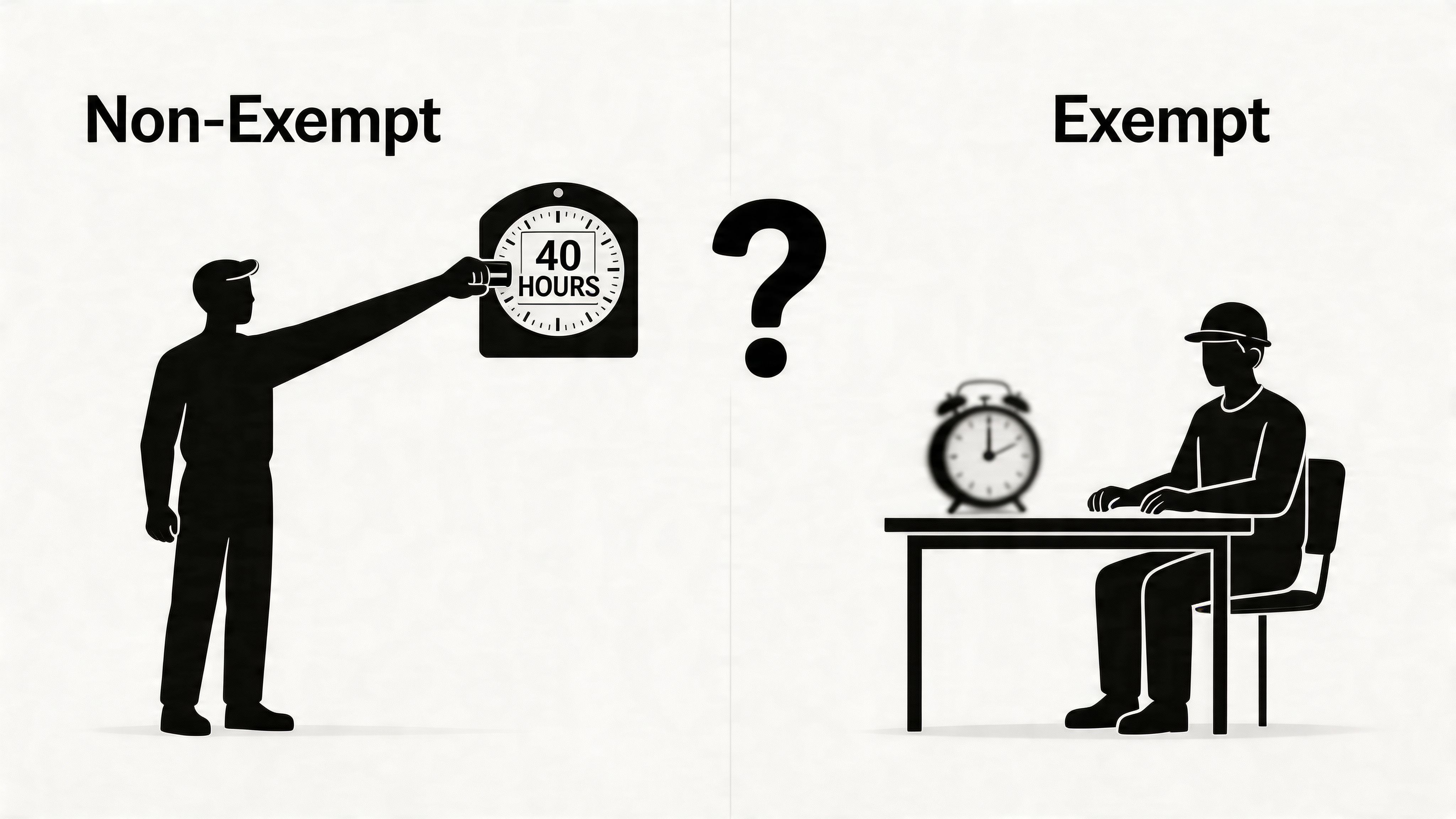
Texas follows the federal overtime framework. Nonexempt employees must receive overtime at 1.5 times their regular rate for hours worked over 40 in a workweek, and misclassification often leads to Texas Workforce Commission back pay awards averaging $5,000 to $10,000 per claim.
Salary is not the test
I see this in restaurants, clinics, warehouses, retail, and small office teams. Someone gets a salary title bump. Maybe "assistant manager." Maybe "team lead." Everybody assumes overtime is gone.
Not so fast.
What matters is what the person does. If the job is still mostly hands-on production work, routine support, or following set procedures, a fancy title won't rescue the classification. The law cares about duties, not ego.
A simple example helps. A line cook who spends the week cooking, cleaning stations, and covering shifts is usually in a very different legal position from a head chef who directs the kitchen, makes higher-level decisions, and has real authority over operations. Same kitchen. Different primary duties.
What employers should check
If you're sorting out exempt versus nonexempt status, don't get cute. Review the job as it is lived, not the job description somebody wrote three years ago.
Actual daily work: What fills the person's week?
Decision-making authority: Do they really make meaningful calls, or just relay instructions?
Time spent on exempt tasks: If the "manager" mostly stocks shelves and runs a register, calling them exempt is asking for trouble.
Good time records matter here. If your team needs a cleaner process, tracking employee hours with a clear system is a practical place to start. What matters is consistency. If hours live in texts, memory, and handwritten notes, you're already behind.
If your defense is "we thought salary covered it," you don't have much of a defense.
The break question people always ask
Texas surprises people here. Most adult employees assume meal breaks or rest breaks are legally required because they are in some other states. In Texas, that assumption can create confusion fast.
For most adult workers, Texas does not generally require meal or rest breaks by state law. That doesn't mean breaks are a bad idea. It means they are often a matter of company policy, operational common sense, and safety practice rather than a broad state mandate.
That distinction matters on both sides.
If you're an employee
Read the handbook. If your employer promises breaks in policy, schedule, or practice, that still matters. A company can create obligations for itself through its own rules, even when state law doesn't impose the same baseline.
If you're an employer
Don't rely on "the law doesn't require it" as a management philosophy. In physically demanding environments, skipped breaks create mistakes, injuries, attendance problems, and turnover. Even where the law is silent, bad scheduling still costs you.
Overtime discipline beats overtime drama
The best employers don't wait for a wage complaint. They audit classifications, train managers not to pressure off-the-clock work, and shut down the little phrases that cause big problems, such as "just answer a few texts after clock-out" or "finish this before you log the time."
Those habits create liability. Unnoticed. Repeatedly. Then one former employee files a claim, and the whole pay practice gets dragged into daylight.
The Lines You Cannot Cross Discrimination and Harassment
A lot of Texas employers understand at-will work and still trip over the same trap. They think broad firing discretion protects them from scrutiny. It doesn't.
You can fire someone for a poor fit. You cannot fire someone because of race, sex, disability, religion, age, or another protected characteristic. You also cannot punish someone for objecting to discrimination, reporting harassment, or participating in an investigation.
And that second part, retaliation, is where many employers fall apart.
Retaliation is the real flashpoint
Texas accounts for about 10% of all EEOC discrimination charges nationwide, and retaliation appears in 57.9% of Texas filings, compared with 36.6% for disability and 31.8% for race claims. That should get every Texas employer's attention.
Why is retaliation so common? Because managers often stay calm about the original complaint and then blow up over the inconvenience of it. The employee raises a concern. Suddenly the schedule changes. The write-ups begin. The tone gets colder. Promotion discussions disappear.
That's retaliation territory.
What this looks like in real life
A worker reports harassment. A week later, the boss says they're "not a team player."
An employee asks about missing overtime. The manager cuts their hours.
Someone participates in an internal investigation. Leadership starts excluding them from meetings or treating them like a problem.
None of those examples automatically prove a legal claim. But they are exactly the kind of facts that make agencies and lawyers look closer.
A lot of companies don't lose because the first bad thing happened. They lose because they punished the person who spoke up.
Tough management is not always illegal
This part matters too. Not every rude boss is breaking the law.
A manager can be unfair, moody, disorganized, or plain unpleasant without creating a discrimination case. The legal issue usually turns on whether the conduct is tied to a protected characteristic or whether the response to a complaint crosses into retaliation.
That means employees should be precise when they report concerns. "My manager is mean" is weak. "My manager made repeated comments about my disability and cut my shifts after I reported it" is a very different issue.
Harassment has a legal threshold
People often use "hostile work environment" to describe any workplace that feels tense. Legally, the standard is narrower. The conduct must be serious enough, or repeated enough, to change the conditions of employment.
That doesn't mean employees should wait until things become unbearable before reporting them. It means employers should take patterns seriously before they harden into evidence.
A few plain rules help:
Investigate quickly: Delays send the message that nobody cares.
Separate complaint from performance management: If there are real performance problems, document them carefully and don't blur them with the complaint.
Train front-line managers: Most retaliation problems begin with a supervisor who takes a complaint personally.
My blunt view
If you're an employer in Texas, retaliation should worry you more than the dramatic misconduct everybody imagines. It's more common. It's easier for managers to stumble into. And it often grows out of normal workplace friction after someone asserts a right.
If you're an employee, don't just say you were treated badly. Write down what happened, when it happened, who was involved, and what protected issue came before it. Specific facts beat broad outrage every time.
When You Need Time Off Your Rights to Leave
Time off fights are rarely about one day. They're about whether an absence is treated as protected leave, ordinary attendance, or a favor from a manager. Those are very different things.
Employees often assume all leave is protected. Employers often assume all leave is policy-based and optional. Both assumptions cause headaches. Some leave rights come from law. Others come from the handbook. If you mix them up, you create avoidable conflict.
The cleanest way to think about leave
Start with one question. Is the time off legally protected, or is it just a company benefit?
Vacation and general sick time are often policy questions. Protected leave is different. If the law covers the absence, the employer has less room to improvise.
Texas employers also need to remember that some leave rights exist even in workplaces that don't think of themselves as highly regulated. Jury duty, military service, court attendance, voting, and some emergency-related absences are not exotic edge cases. They show up in ordinary operations.
Texas protected leave at a glance
Leave Type | Governing Law | Applies to Employers With | Is it Paid? |
|---|---|---|---|
Family and medical leave | Federal FMLA | Covered employers under federal law | Generally unpaid |
Jury duty leave | Texas law | Employers covered by Texas rules | Generally unpaid unless company policy says otherwise |
Court attendance leave | Texas law | Employers covered by Texas rules | Generally unpaid unless company policy says otherwise |
Military service leave | Texas law and federal law | Employers covered by applicable law | Often unpaid, subject to applicable protections |
Voting leave | Texas law | Employers covered by Texas rules | Depends on circumstances and policy |
Emergency evacuation leave | Texas law | Employers covered by Texas rules | Depends on circumstances and policy |
Political activities leave | Texas law | Employers covered by Texas rules | Depends on circumstances and policy |
Where employers get into trouble
The common mistake is treating every absence as an attendance problem first and a legal issue second. That backwards approach creates risk.
The better approach is to pause and sort the request before acting. What is the reason for leave? Is there a law attached to it? What paperwork do you need? Who makes the decision? If three different supervisors answer those questions three different ways, your policy isn't a policy.
A practical fix is to centralize requests and documentation. If your team is still handling time-off decisions through hallway conversations and text messages, a structured employee time-off request process can reduce confusion and leave a record behind.
What employees should do
Ask for clarity in writing. If the leave might be protected, say why. Keep copies of your request, any medical or court-related documentation you provide, and the employer's response.
You don't need to become a lawyer to protect yourself. You just need a paper trail and a clear description of why you need the time off.
The Rights of Every Worker Including the Undocumented
This part makes some employers uncomfortable. Good. It needs to.
Undocumented workers in Texas are entitled to the same fundamental labor protections as any other employee, including minimum wage, overtime, and safe working conditions under the FLSA and Texas Labor Code. Denying those rights is illegal and creates liability.
That means an employer cannot decide that immigration status wipes out wage laws, safety rules, or anti-discrimination protections. It doesn't.
Why this matters beyond the law
When employers exploit undocumented workers, they don't just harm those workers. They distort the market for everyone else. Honest businesses get undercut by operators who think fear will keep people quiet. That isn't smart business. It's cheating with a payroll mask on.
Industries with heavy frontline labor know this problem well. Hospitality, construction, agriculture, warehousing, janitorial work, food service. The risk isn't abstract. It's built into the places where workers often feel the least safe speaking up.
If a company thinks a worker's immigration status gives it permission to steal wages or ignore safety, that company has confused vulnerability with legality.
What employers should do instead
Keep the rule simple. If someone is working, treat wage, hour, and safety obligations as real. Train managers not to make threats. Don't let supervisors hint that raising concerns will trigger immigration consequences. That's reckless, and it can become evidence fast.
What workers should know
Basic labor rights do not disappear because a worker is undocumented. People often stay silent because they're afraid. That fear is real. So is the employer's legal exposure when it abuses that fear.
A decent workplace doesn't sort human beings into "protected enough" and "easy to exploit." It follows the law and pays people correctly. That's the floor.
When Things Go Wrong How to Take Action
Knowing your rights is useful. Using them is harder.
Individuals often wait too long because they hope the problem will settle down on its own. Sometimes it does. Often it doesn't. The manager gets bolder. The records get thinner. The story gets harder to prove.
Start with records, not speeches
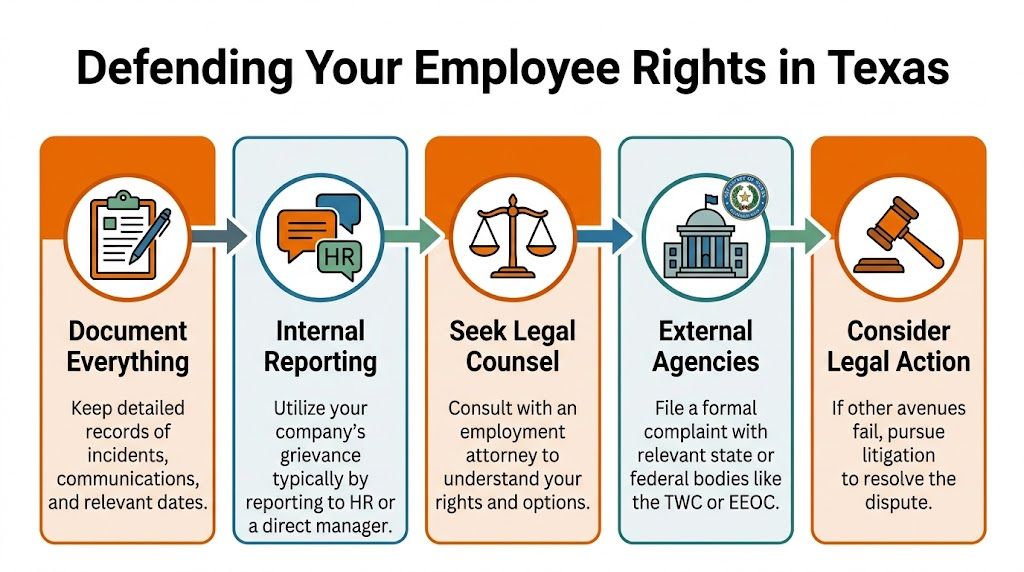
If something is going wrong, document it. Dates. Times. Who said what. What policy was involved. What changed after you raised a concern. Save messages, schedules, pay stubs, and written warnings.
Then use the internal process if it makes sense to do so. Report to HR. Report to the next manager up. Use the complaint channel in the handbook. Not because the company always deserves one more chance, but because internal reporting often creates the evidence trail that matters later.
A simple roadmap
Write it down early
Memory fades fast. Records don't.Report it through the proper channel
Use the handbook process if one exists. If your direct manager is the problem, go around them.Keep copies of everything
Don't rely on access to your work email or workplace apps after a dispute gets serious.Talk to the right outside agency if needed
Wage issues and discrimination issues often go to different places. Match the complaint to the right forum.Get legal advice for termination, retaliation, or significant unpaid wages
If termination, retaliation, or significant unpaid wages are involved, don't wing it.
Deadlines matter more than people think
One of the worst mistakes I see is delay. Employees gather evidence for months and miss filing windows. Employers assume an old complaint is dead and then get hit with a timely agency charge.
If you think the issue might rise to a formal claim, act early. Waiting rarely improves your position.
There are also situations where labor abuse intersects with immigration status and coercion in ugly ways. If you're trying to understand the broader pattern of pressure vulnerable workers can face, this piece on incarcerated immigrants forced to work for little pay gives useful context about how power imbalances can distort labor conditions.
Don't build your case in your head. Build it on paper.
My advice to HR leaders
When a complaint lands on your desk, don't treat it like a personality conflict until proven otherwise. Secure records. Pause retaliation risks. Tell managers to stop freelancing. Most companies make a bad situation worse during the response phase, not the incident phase.
My advice to employees
Be factual. Not dramatic. Agencies and attorneys can work with timelines, names, pay records, and written reports. They can't do much with "everybody knows this place is toxic."
Beyond the Rules Building a Workplace That Works
The law sets the floor. That's all it does.
A workplace that runs only on legal minimums usually feels exactly like that. Barely enough communication. Barely enough clarity. Barely enough trust. People don't stay loyal to a company just because it avoided an obvious violation this month.
The healthier standard is simple. Tell people the rules. Pay them correctly. Train managers to act like adults. Give employees a clear way to ask for time off, report problems, and find the handbook without a scavenger hunt. If you're cleaning up policy access and communication, building an employee handbook people can actually use is a practical start. Tools can help too. Platforms like Pebb give teams one place for policies, chat, scheduling, clock-ins, PTO tracking, and role-based access, which can reduce the usual confusion around shifts, records, and day-to-day communication.
That's what makes employee rights texas worth understanding in plain English. Not because everyone is looking for a lawsuit. Because when people know the rules, work gets calmer, cleaner, and a lot more honest.
If you're trying to turn scattered policies, shift communication, PTO requests, clock-ins, and employee updates into one clear system, take a look at Pebb. It's a practical option for teams that need one place to manage communication, operations, and everyday people processes without bouncing between disconnected tools.
