
Master Exception Reporting: Operational Success in 2026
Get early warnings on operational issues with effective exception reporting. Learn to build a process your team will actually use to stop chasing problems and
Dan Robin

A lot of operational mess starts the same way. Someone notices a small problem, figures they'll deal with it later, and keeps moving.
Then later becomes Friday night.
A shift manager walks the stock room, sees a gap where a fast-moving item should be, and realizes the team has been patching around the same supply issue for weeks. People borrowed from another location, changed the shelf label, and improvised. Nobody logged it in a way leadership could see. Nobody tied it to ordering, staffing, or handoff gaps. What looked minor turned into lost sales, rushed calls, and a weekend spent cleaning up something that was giving warning signs the whole time.
That's why exception reporting matters. Not because organizations need more forms. Because teams need a clean way to say, “Something isn't working the way it should.”
More Than Just a Form to Fill Out
The failure point usually isn't the incident itself. It's the silence around it.
I've seen teams treat exception reporting like admin work. Fill it out if you have time. Maybe attach details. Maybe someone reads it. That mindset misses the point. A good exception report is operational intelligence from the people closest to the work. It tells you where process and reality stopped matching.
The small miss that turns into the big fire
Think about the stock issue in that shift-manager story. The first exception might have been simple. Delivery arrived short. Backroom count was off. A handoff note never reached purchasing. Any one of those could have been logged in minutes if the process was built for real life instead of compliance theater.
Instead, teams often rely on memory, hallway conversations, or group chat fragments. Useful in the moment. Useless a week later.
A missed exception rarely stays small. It usually comes back as rework, blame, or a preventable crisis.
That pattern shows up even in high-stakes settings. A 2018 healthcare study on doctors' exception reporting found that trainees submitted exception reports for only 1.2% of the time they worked beyond scheduled hours. The gap between lived reality and reported reality was enormous. That's what broken reporting looks like. Not bad people. Bad signal.
Why the paperwork framing hurts
Once exception reporting gets framed as “more paperwork,” people do what busy people always do. They skip it unless the issue is dramatic enough that they can't avoid it.
That's backwards. The whole value is in catching the routine deviations early, while they're still cheap to fix. If your process only captures disasters, you don't have an early warning system. You have a postmortem archive.
A lot of teams try to solve this by making the form smarter. More fields. More categories. More required steps. Usually that makes things worse. If the person on the floor has to stop work, find the right system, remember a password, and translate what happened into the language of the form, many reports never get filed.
Digital tools can help, but only if they lower the barrier instead of raising it. That's why practical teams are moving toward simpler digital forms for employees that fit the pace of the job instead of interrupting it.
What exception reporting is really for
At its best, exception reporting does one job well. It gives the organization a steady stream of truth from the edge.
Not polished truth. Not sanitized truth. Just enough structure to show that something went off-plan, why it mattered, and who needs to look at it.
When teams understand that, the conversation changes. The report stops being a chore. It becomes the first step in fixing what keeps getting in the way.
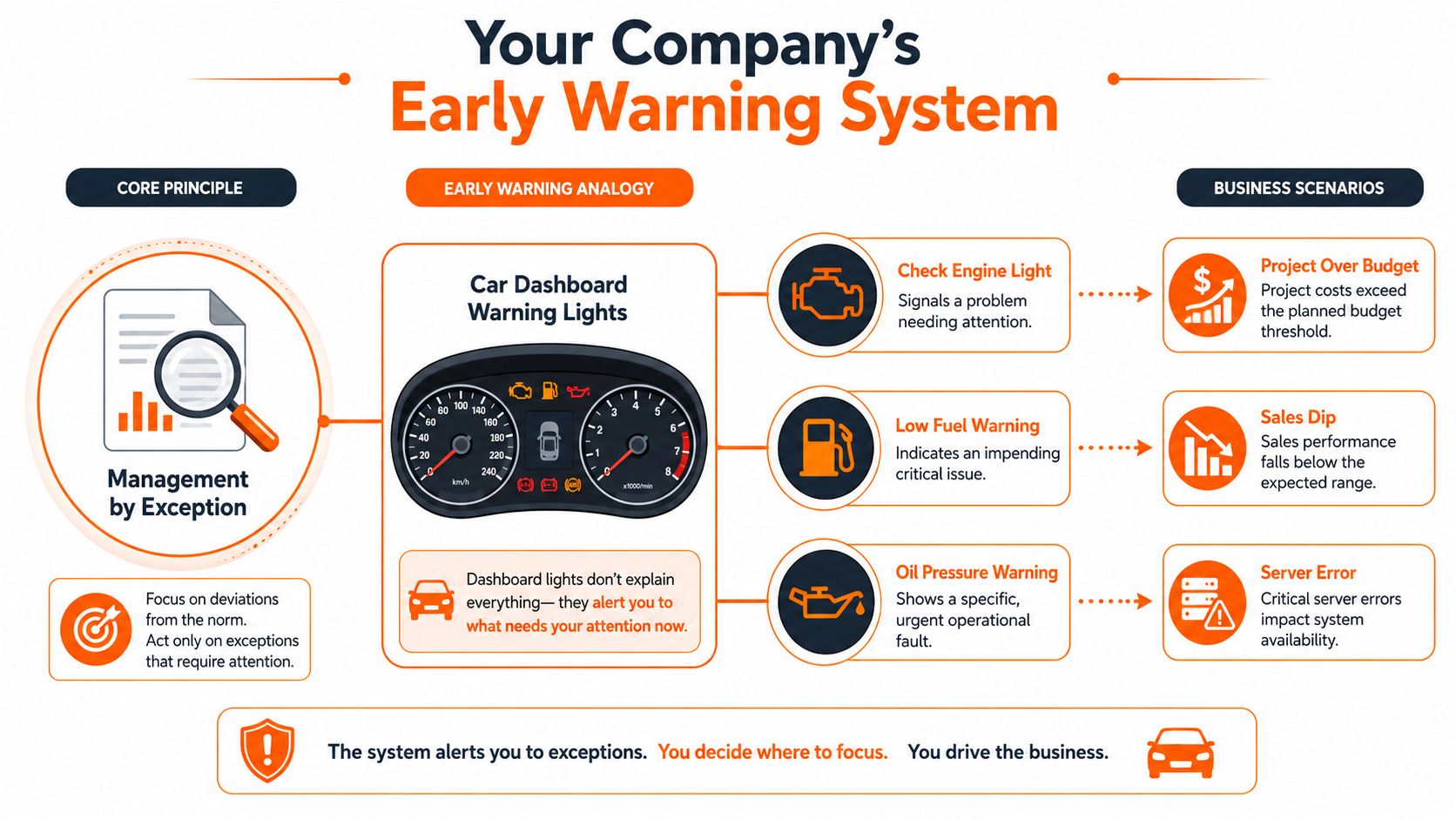
Your Company's Early Warning System
Most companies don't need more status updates saying everything is fine. They need faster visibility when something isn't.
That's the easiest way to understand exception reporting. It works like the warning lights on a car dashboard. You don't ask the dashboard to reassure you every minute that the engine is still working. You ask it to tell you when oil pressure drops, fuel runs low, or the engine starts behaving outside normal limits.
What the signal is supposed to do
In plain English, exception reporting means flagging a deviation from the expected plan, standard, or threshold. A missed shipment. A late handoff. A machine fault. A schedule change that leaves a shift exposed. A discrepancy between what should've happened and what did happen.
That sounds obvious, but many teams still muddy the concept by using exception reports as a discipline tool. The minute people think a report is really a trap, the quality drops. They leave out context, delay submission, or stop reporting altogether.
A better way to think about it is this:
Warning light | Operational equivalent | What managers should ask |
|---|---|---|
Check engine | Process failure or repeated disruption | What broke, and is it recurring? |
Low fuel | Resource shortfall or upcoming capacity issue | What will run out first? |
Oil pressure | Immediate operational risk | Who needs to act now? |
The point isn't to catch people. It's to direct attention.
What it is not
Exception reporting is not a running commentary on normal work. It shouldn't drown managers in noise. In service settings, exception-based reporting for SLAs is useful precisely because it generates reports only when health deviates from the standard or availability falls below the threshold. That filtering is the whole advantage. People can focus on the deviations that carry risk.
Practical rule: If the report can't help someone decide what to investigate, fix, or escalate, it probably doesn't belong in the exception stream.
This is also why old reporting habits fail. Teams dump everything into one inbox, one spreadsheet, or one portal, then wonder why nobody can separate urgent exceptions from ordinary updates. Good reporting creates contrast. It makes the unusual visible.
Why managers should care
Leaders who understand this spend less time chasing general updates and more time resolving the few things that can derail operations. That's the heart of operations management methods that rely on management by exception. You don't monitor every healthy process with the same intensity. You watch for meaningful deviation, then respond with speed and context.
When the system works, people on the floor stop asking, “Is this worth reporting?” They know the answer. If it departs from the standard and affects service, safety, cost, timing, or team capacity, it belongs in the signal path.
That clarity saves time on both sides.
The Silent Killers of Good Reporting
Most underreporting gets blamed on people. They're too busy. They forget. They don't care enough.
That explanation is convenient, and usually wrong.
Friction beats good intentions
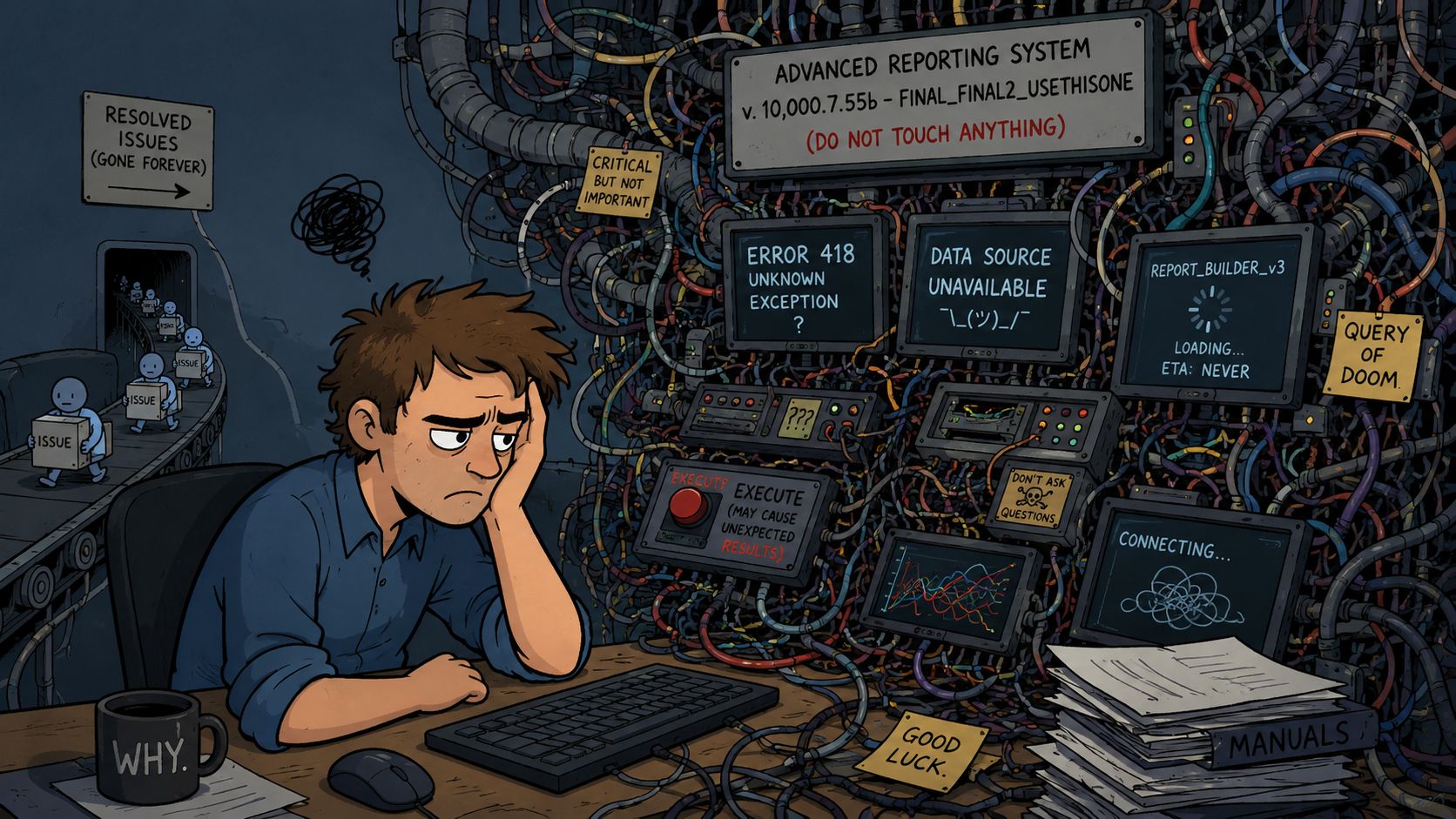
The biggest reporting killer is simple friction. If someone has to leave the floor, find a desktop, open a clunky system, and fill in too many fields to report a straightforward issue, they won't do it consistently. They'll wait until later, and later often never comes.
That isn't a character flaw. It's a design flaw.
Research on unreported workplace risks identifies primary causes: system friction and a lack of visible management action. Complicated systems lead to inaccurate reports, poor descriptions, and weak trend visibility. Once people see that the tool is painful and the outcome is invisible, participation falls fast.
The black hole problem
The second killer is what I call the black hole. Someone submits an exception, then hears nothing. No acknowledgment. No follow-up. No visible change. Just silence.
After a few rounds of that, even conscientious employees stop believing the process matters. They still talk to each other about the issue, but they stop telling the system. Leadership then looks at the low report count and assumes things are stable.
They're not stable. They're hidden.
If people think a report disappears on arrival, you've trained them not to report.
That gap creates a second operational problem. It destroys the data needed to spot patterns. You can't improve what people have learned to keep off the books.
Blame changes the quality of truth
The third killer is blame. The moment exception reporting feels tied to punishment, the reports become defensive. Details get softened. Timelines get fuzzy. Ownership gets blurred. Teams write to protect themselves instead of helping the business learn.
I've seen this happen in environments with strict oversight and in small companies with no formal process at all. Different surface, same result. People calibrate what they say based on what they think will happen next.
Here's where governance matters. Reporting systems need enough structure to be reliable, but not so much that they become intimidating. Good data governance best practices should improve consistency, access, and accountability. They shouldn't turn an urgent operational signal into a paperwork exercise.
What broken systems usually look like
You can spot a weak exception reporting process by the symptoms:
Submission is awkward: Reporting requires a separate login, a separate device, or a long form that doesn't fit the pace of work.
Language is unnatural: The form asks employees to classify issues in terms they'd never use on the floor.
Nothing comes back: People rarely get acknowledgment, resolution notes, or evidence that anyone acted.
Managers improvise: Essential work happens in texts, side conversations, and memory instead of in a shared process.
None of this means teams don't care. It means the system asks too much and gives too little.
Good reporting starts when leaders stop asking, “Why aren't employees using the form?” and start asking, “Why did we make the form harder to use than raising the issue verbally?”
Building a Process People Will Use
The best exception reporting process is usually the one that feels almost too simple.
That makes some leaders nervous. They assume seriousness requires complexity. It doesn't. It requires clarity. If the process is easy to start, safe to use, and visibly worth the effort, people will use it.

Make it easy
Start with the submission path. If reporting an exception competes with the job itself, the job will win.
An effective report doesn't need a dozen fields. According to guidance on what makes an effective exception report, it should document the goof, show a clear timeline, explain the reasons for the deviation, and analyze the impact. These elements offer enough structure to understand the event, not so much that the reporter needs a training manual.
A practical template can be as simple as this:
Field | What it captures | Why it matters |
|---|---|---|
What happened | The deviation or goof | Creates a shared factual starting point |
When it happened | Timeline | Helps connect the event to shift, handoff, or workload conditions |
Why it happened | Known reason or likely cause | Moves the discussion beyond symptoms |
What changed because of it | Impact | Shows why this deserves attention |
Keep the language plain. If someone on a warehouse floor, in a hospital unit, or at a store counter can't complete it quickly, the design still isn't right.
Make it safe
Ease alone won't fix underreporting if people expect pain after they speak up.
Psychological safety in operations doesn't mean lowering standards. It means separating process learning from personal humiliation. If the report says, “I missed this handoff because the shift change was chaotic and the instructions lived in three places,” the right response isn't “Why did you fail?” It's “Why did we design the handoff that way?”
Managers set the tone. A useful exception conversation sounds like diagnosis. A harmful one sounds like prosecution.
The fastest way to kill reporting is to treat every exception like a confession.
Some environments need extra protection. In England's revised reporting rules for doctors, additional-hours exception reports go directly to HR and the Guardian of Safe Working Hours, not to clinical or educational supervisors. That design choice recognizes a hard truth. People report more accurately when conflicts of interest are reduced.
Make it worthwhile
People keep reporting when they can see movement.
That means acknowledgment, ownership, and visible closure. If a reported issue becomes a task, gets assigned, and later comes back with a clear update, the process earns trust. If it vanishes, trust drains out of it.
For frontline teams, this usually works best in one shared operational environment instead of three disconnected tools. The cleanest setup is simple:
Flag the issue where work already happens. A team member reports the exception in the same mobile space they use for daily communication.
Turn the signal into action. A manager assigns follow-up, documents next steps, and tracks ownership.
Close the loop in public. The team sees what changed, whether the fix worked, and what's expected next time.
When those three actions live together, reporting starts to feel less like filing and more like teamwork.
Keep the process alive
Once the basics are in place, don't over-engineer the edges. Add only what improves action.
A few choices help a lot:
Use mobile-first access: If the team works away from desks, the reporting flow should live on phones.
Allow quick entry: Short reports are better than perfect reports that never get written.
Standardize follow-up: Managers should know who responds, how it gets triaged, and where updates are shared.
Review the pattern, not just the event: The report is the start of the conversation, not the end.
A process people use will look modest on paper. That's fine. What matters is whether it captures the truth while there's still time to do something with it.
Turning Exceptions into Intelligence
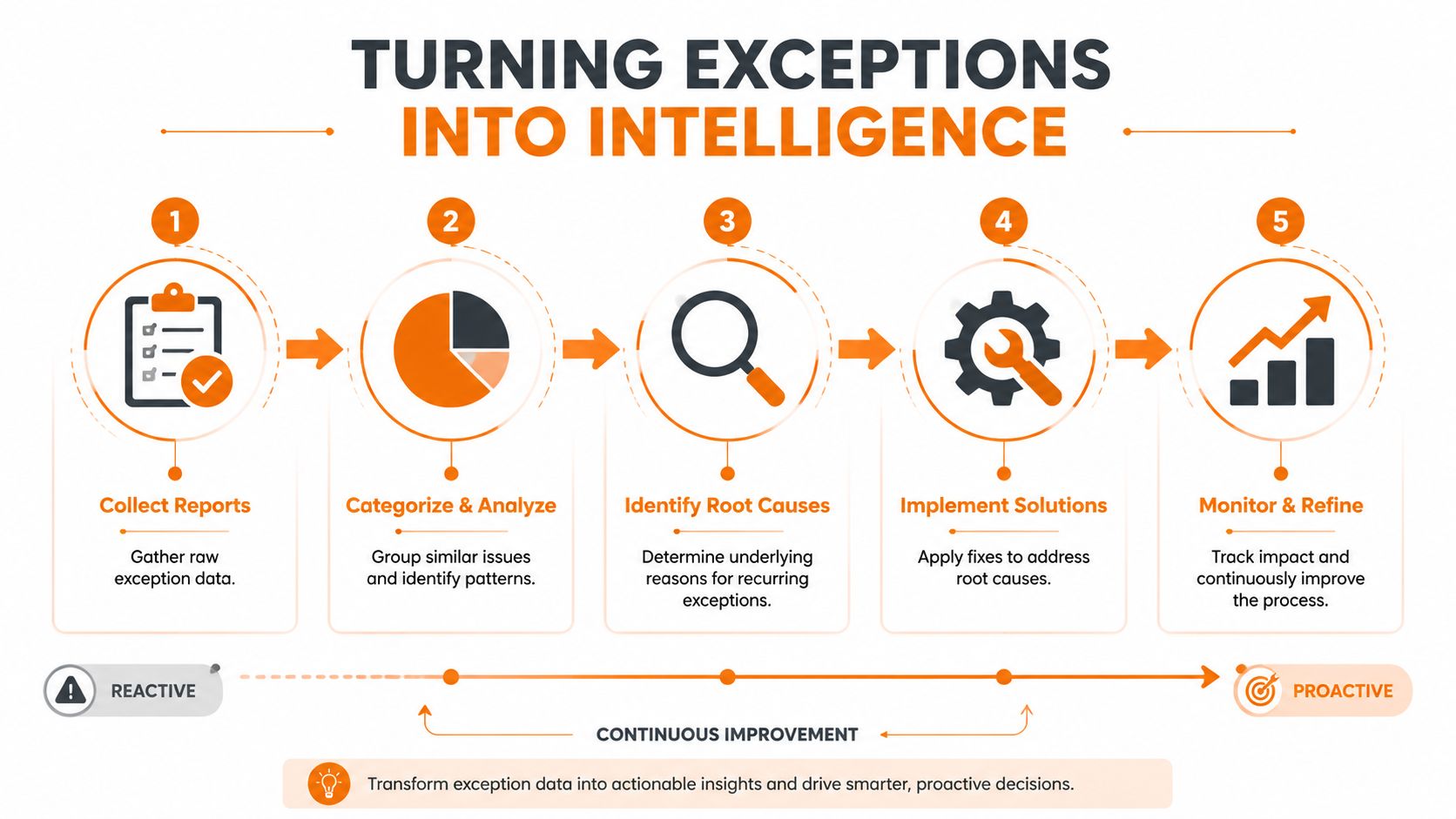
Collecting exception reports is useful. Learning from them is where the value shows up.
Teams often stop too early. They log the issue, resolve the immediate problem, and move on. That keeps the day running, but it doesn't make the system better. If the same exception keeps returning, you don't have a string of isolated incidents. You have a pattern.
When an exception stops being an exception
A late delivery every Friday afternoon isn't random. A recurring stock discrepancy at shift change isn't random. A repeated missed approval on one department's schedule isn't random either.
The missed opportunity, as noted in guidance on exception frequency reporting and root cause analysis, is staying reactive instead of using the data to identify recurring patterns across departments, shifts, or time periods. The point isn't to admire the log. The point is to use it to find what keeps breaking.
A simple review habit helps. At a regular cadence, ask:
What repeats: Same issue type, same team, same time window
What clusters: Different symptoms with one likely shared cause
What escalates: Small exceptions that tend to become major disruptions
What stalls: Reports that sit unresolved or bounce between owners
The questions that uncover root causes
Raw counts don't tell the whole story. What matters is what the reports suggest about the underlying system.
For example, if several exceptions mention delayed handoffs, the underlying problem may be schedule overlap, missing documentation, or unclear role ownership. If multiple reports cite damaged materials, the issue might be receiving, storage, or supplier packaging. Managers need to read across reports, not just down them.
A recurring exception is a process sending you the same message more than once.
That's why I like keeping the review conversation grounded in a few operational questions:
Review question | What it helps uncover |
|---|---|
Where does this happen most often? | Location, shift, or team concentration |
What tends to happen right before it? | Trigger events and upstream failures |
Who has to compensate for it? | Hidden labor and downstream impact |
What changes if we remove the cause? | Priority and likely payoff |
None of this requires fancy analytics to start. A disciplined weekly review can reveal more than a neglected dashboard full of charts.
What to track without drowning in metrics
You only need a handful of measures to make exception reporting useful:
Exception frequency: Are certain issues appearing again and again?
Time to acknowledgment: How quickly does someone respond?
Time to resolution: How long does the issue stay open?
Category concentration: Which kinds of exceptions dominate the log?
Operational spillover: What service, staffing, or quality outcomes tend to move with the exceptions?
That last one matters most. An exception log should eventually connect to the rest of operations. If staffing exceptions rise and customer complaints rise with them, that tells a more complete story than either signal alone.
The goal isn't perfect prediction. It's better judgment. Once teams begin treating exception reporting as a source of intelligence instead of a list of annoyances, they stop asking, “How do we process these faster?” and start asking, “What is our operation trying to tell us?”
That's the better question.
The Real Goal of Exception Reporting
For all the talk about systems, templates, and workflows, exception reporting comes down to one thing. Trust.
People report problems when they believe the organization wants the truth, can handle the truth, and will do something useful with the truth. Remove any one of those, and the process weakens.
Trust is built in the response
A team learns what reporting means by what happens after submission. If leaders respond quickly, ask good questions, and close the loop, reporting starts to feel safe and worthwhile. If responses are slow or dismissive, people get the message.
That speed matters. For same-day shift exceptions, guidance on exception handling procedures says managers should acknowledge reports within 1 to 2 hours whenever possible and communicate a resolution plan within 4 hours. Those response windows aren't just operational targets. They signal respect.
The real KPI isn't volume
A lot of leaders look at report counts and jump to the wrong conclusion. More reports don't always mean a worse operation. Sometimes they mean a healthier culture, one where people trust the process enough to use it openly.
Less reporting doesn't always mean things are calm either. It can mean people have given up.
So the primary question isn't whether your exception reporting process looks tidy on a dashboard. It's whether the people doing the work believe it helps them. Do they think raising a problem leads to clarity, support, and action? Or do they think it creates friction, exposure, and silence?
Systems don't create trust on their own. People do. But the system can make trust easier, or a lot harder.
That's why the strongest exception reporting cultures don't obsess over forms. They obsess over access, response, and follow-through. They make it easy to speak up, safe to be candid, and obvious that someone is listening.
If your current process doesn't do that, the form isn't your main problem.
Your culture is.
If you want one place where teams can communicate, report issues, assign follow-up, and share resolution updates without bouncing between separate tools, Pebb is worth a look. It brings chat, tasks, updates, files, scheduling, and frontline operations into one mobile-first work app, so exception reporting can happen where work already happens.
