
A Guide to Employee PTO We Can Actually Stand Behind
Tired of confusing policies? Our guide to employee PTO helps you build a system that prevents burnout, builds trust, and respects both your team and business.
Dan Robin
Paid Time Off. For most companies, it’s a line item in an HR handbook. A benefit you have to offer, but not something you spend much time thinking about. We think that’s a huge mistake.
Your employee PTO policy isn't just about tracking days. It’s a signal. It tells your team exactly what you think about trust, respect, and the very nature of work itself. Get it wrong, and it becomes a source of quiet frustration. Get it right, and it can be the foundation of a calmer, more productive company. The goal isn’t just to count the days, but to make the days count.
Let's Rethink Employee PTO From the Ground Up
We’ve seen how a thoughtful approach to time off can change a workplace. The real conversation isn’t about the number of days you offer. It’s about the philosophy behind them.
Is time off a grudging obligation, or is it a vital part of a healthy work rhythm? Your answer sends a clear message to your people about what you truly value.
More Than Just a Perk
When you get it right, PTO is an agreement. It’s a shared understanding that helps everyone work better. It’s about building a system where people feel they can genuinely unplug, recharge, and come back ready to do great work. This matters more than ever, especially when the line between work and home has all but disappeared.
A good policy is a direct investment in your team's well-being. And by extension, the health of the business. If your people aren't resting, they're not doing their best work. It’s that simple.
The Real Cost of Unused Time
This isn't just about feelings. There are real financial consequences when people don't take their time off. A staggering number of American workers—nearly half—leave PTO on the table. This adds up to an estimated $52.4 billion in lost benefits. Think about that. It’s deferred salary that employees are handing back to their employers.
If you want to go deeper on the numbers, you can dig into the full time off statistics here.
Let’s be honest. Thinking about time off is really about thinking about productivity, respect, and burnout. When you build your policy, you have to consider its role in fighting widespread issues like workforce burnout.
An employee who feels trusted to rest is an employee who will stick around and contribute their best work.
It’s time to stop seeing PTO as a cost and start seeing it for what it is: a core part of your company’s health. The philosophy you choose has a direct impact on how your team shows up every day.
A Quick Look at PTO Philosophies
Here’s a simple breakdown of the thinking behind common PTO systems and what they lead to in the real world.
Approach | The Core Idea | The Reality |
|---|---|---|
Use-It-Or-Lose-It | Time off is a temporary benefit that expires. | Can create a mad dash to use days at year-end and feels punitive if days are lost. |
Rollover | Earned time is an asset that can be saved. | Supports people saving for big trips, but can lead to large liabilities on your books. |
Unlimited/Flexible | Trust and results matter more than tracked hours. | Fosters a high-trust culture, but often leads to people taking less time off without clear guidelines. |
The right approach depends entirely on the kind of company you want to be and the message you want to send.
Choosing Your PTO Model: Accrual, Lump-Sum, or Unlimited?
The way you handle employee PTO says a lot about your company. Are you about rewarding tenure with a predictable system? Or do you lean toward flexibility and trust? There's no magic bullet. Each model has its own flavor and trade-offs you have to live with.
I've seen so many companies tie themselves in knots trying to design the "perfect" system. Here’s the secret: it doesn't exist. The goal is to pick the model that aligns with how you actually run your business.
The Accrual Method: Earned Over Time
This is the classic approach. For every pay period someone works, they earn a bit of PTO. It feels fair, it's easy to understand, and it rewards people for sticking around. The longer you’re here, the more time off you earn.
But let’s be real—it can be a pain to track. The admin is a constant low-level hum, especially with frontline teams whose hours change weekly. Every pay stub, every question about a balance, every new hire calculation... it all adds up. The accrual model is a reliable workhorse, but it needs a lot of maintenance.
This is a good fit if your business thrives on predictability and you need a structured way to manage financial liabilities for unused time.
The Lump-Sum Approach: Simple and Direct
With a lump-sum model, you just give employees their full bank of PTO for the year on a specific date—usually January 1st or their work anniversary. The biggest win? Simplicity. No more constant calculations. The admin headache shrinks dramatically.
But that simplicity brings its own problems. We've all seen the year-end scramble, where it feels like half the company is trying to burn their remaining days in December. It’s a coverage nightmare. It also gets tricky with new hires. Do you prorate their time, or do they wait until the next grant date? It’s simple on the surface, but the edge cases can get messy.
A lump-sum grant works best for companies that want to keep admin low and trust their teams to plan their time off responsibly.
This simple decision tree shows how a policy choice directly impacts your team's happiness and productivity.
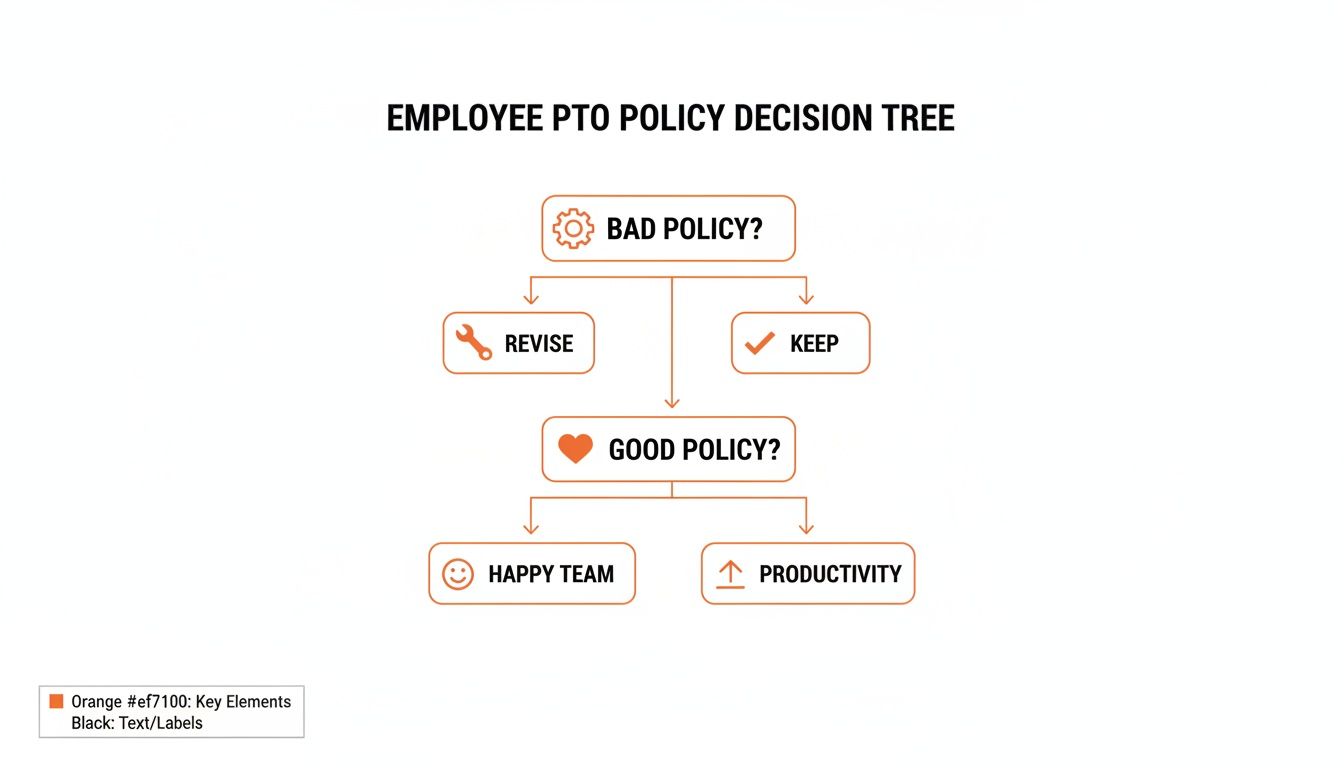
Here's the thing: a good policy isn't just a set of rules. It's a tool for building a sane, healthy work environment.
The Unlimited PTO Experiment
Then you have the model that gets all the press: "unlimited" PTO. It looks great in a job description, doesn't it? It’s meant to signal a culture of high trust and autonomy, where you focus on results, not hours. For the right company, it can be a game-changer.
But "unlimited" is a misnomer. In practice, it often just means "untracked." And if you don't have clear expectations and leaders who model taking time off, it can backfire.
We've seen it time and again: in some companies with unlimited policies, people take less time off. They feel guilty. They aren't sure what's "acceptable." They worry about falling behind. A 2024 study even found that only 11% of U.S. workers have this kind of policy, so it's far from the norm. This approach only works if your entire culture, from the top down, encourages taking real, restorative breaks.
At the end of the day, picking your PTO model isn't a technical decision—it's a cultural one. Think about the relationship you want with your team. The answer to that question will point you down the right path.
Navigating PTO Compliance Without the Headaches
Alright, let's talk about the part of PTO that makes everyone nervous: the legal stuff. It’s easy for your eyes to glaze over when you see words like "compliance" and "regulations." I get it. The temptation is to grab a generic template, plug in your company name, and call it a day.
Believe me, we’ve seen that movie before. It rarely has a happy ending. The hard truth is that employee PTO laws are a confusing jumble of rules that change from state to state, and even city to city. A simple mistake here isn’t just a paperwork hassle. It can lead to expensive problems.
Think of this as a practical field guide, not formal legal advice. It’s here to help you understand the core ideas so you can build a policy that’s fair, clear, and keeps you on the right side of the law.
The Big Compliance Traps to Watch For
Let’s be honest—most compliance headaches pop up in a few predictable places. The biggest tripwire is figuring out what to do with unused time when someone leaves the company.
For example, some states like California consider accrued vacation time to be earned wages. That means it must be paid out when an employee's job ends. But in other states, there's no such rule. This is where a "one-size-fits-all" policy can blow up in your face, especially with a remote team. What works for your developer in Texas could land you in legal trouble with your sales rep in Massachusetts. You have to know the rules for every location where you have an employee. For a deeper look, check out our guide on how to calculate PTO payout correctly.
Mandatory sick leave is another hot spot. A growing number of cities and states now require employers to offer a specific amount of paid sick time. You can't just throw all time off into one big PTO bucket and assume you're covered. Your policy has to meet (or beat) those local minimums and follow their rules for using that time.
The goal isn’t to become a legal expert overnight. It’s to understand that local laws set the minimum standards, and your policy must be built on that foundation.
One Policy to Rule Them All? Probably Not.
For companies with a global team, the complexity gets even worse. Paid time off rules are all over the map. For example, Yemen mandates 30 days of annual leave plus 16 public holidays, while many European countries like Poland (26 days) and Sweden (25 days) are also quite generous. This is a world away from the U.S., where there's no federal requirement, and the average is somewhere around 10-20 days.
Trying to create a single global policy is nearly impossible. You’d either short-change employees in some countries or create a program that’s too expensive to maintain. You can learn more about the global differences in paid time off policies to see just how wide the gap is.
So, what's the answer? Most companies use a hybrid approach. They create a core company philosophy around time off, but build regional addendums to stay compliant. You might have a baseline U.S. policy that accounts for state variations, with separate policies for your teams in Europe or Asia.
Compliance isn't about being scared of getting sued. It’s about building a fair and clear system. When you put in the effort to understand the rules, you aren't just protecting the business—you're creating a structure your people can trust. That’s a foundation worth building.
How to Write a Simple Employee PTO Policy
Let's be honest. Most employee PTO policies read like they were written by a lawyer paid by the word. They’re dense, confusing, and feel more like a trap than a guide.
That’s a mistake. Your PTO policy shouldn't feel like a legal contract. It should be a simple, clear guide that anyone on your team can read and understand in five minutes. It’s a document that reflects your company’s values, not just its legal obligations.
Start with Why, Not What
Before you even think about accrual rates or request procedures, start with a simple statement of philosophy. Why does your company offer paid time off in the first place? Do you genuinely believe rest is essential for great work?
A short, honest paragraph that sets the tone can make all the difference. It turns a dry rulebook into a shared agreement. For example: "We believe great work comes from rested, happy people. This policy is our commitment to helping you take the time you need to recharge, so you can bring your best self to work."
That simple framing changes everything.
The Essential Components of a Clear Policy
Once you’ve set the tone, you can get into the details. But keep it simple. Use plain English. Avoid corporate jargon. Every policy needs to cover a few key areas to prevent confusion.
Here’s what we’ve found are the non-negotiables:
Eligibility: Who gets PTO and when does it start? Be clear about how it applies to full-time, part-time, and new hires.
How Time is Earned: Explain your model—accrual, lump-sum, or unlimited—in a way anyone can grasp.
Requesting Time Off: How far in advance do people need to ask? Who gives approval? What tool should they use?
Payouts at Separation: State clearly what happens to unused time when someone leaves, making sure it aligns with all state laws.
A well-written policy can live inside a larger document. If you're building one from scratch, our guide on how to create an employee handbook can give you a solid framework.
The Sections Most Policies Forget
This is where you go from a decent policy to a great one. Most templates stop at the basics, but the real-world issues are often more nuanced. Think about adding sections that address the unwritten rules.
This is where culture is built. You can include guidelines on:
Communication When Out: What’s the expectation for an out-of-office message?
Scheduling During Busy Times: Are there blackout periods? How does the team coordinate to ensure coverage?
The Right to Unplug: Explicitly state that when someone is on PTO, they are not expected to check email. This is huge.
The U.S. has a famously fragmented approach to time off. Research shows that 42% of workers accrue it based on hours worked, while others get fixed days or have unlimited plans. This variety makes clear, written expectations even more critical. You can discover more insights about PTO statistics to see just how different the landscape is.
A great policy anticipates questions and answers them with clarity and empathy. It’s a tool for building trust, not for enforcing rules.
Your employee PTO policy is one of the most tangible expressions of your company’s culture. Does it feel generous and trusting, or stingy and suspicious? The words you choose will give you the answer. Make them count.
Managing PTO Requests Without the Chaos
Let's be real. You can have the best PTO policy in the world, but if managing it is a mess, it's not doing anyone any good. We've all been there—the overflowing inbox, the spreadsheet from hell, the lost sticky note. A simple request for a day off spirals into a chaotic back-and-forth.
This headache gets even bigger for frontline teams in places like retail or healthcare. Suddenly, questions are flying. Who’s covering the shift? Did anyone approve this? Does payroll even know? It's a perfect recipe for burnout and frustration.
Honestly, the old manual methods just don't cut it anymore. This is where the right tool can completely change the game.
Beyond the Digital Request Form
Moving to a modern system isn't just about swapping a paper form for a digital one. The real magic happens when you plug the entire PTO process into everything else your team is doing.
Think about it: when a time-off request is approved, it shouldn't just vanish into an HR file. It should automatically kick off a chain of events. The team schedule needs to update instantly. Coworkers should get a heads-up. That information has to sync with payroll without anyone touching it.
This is what a connected workflow is all about.
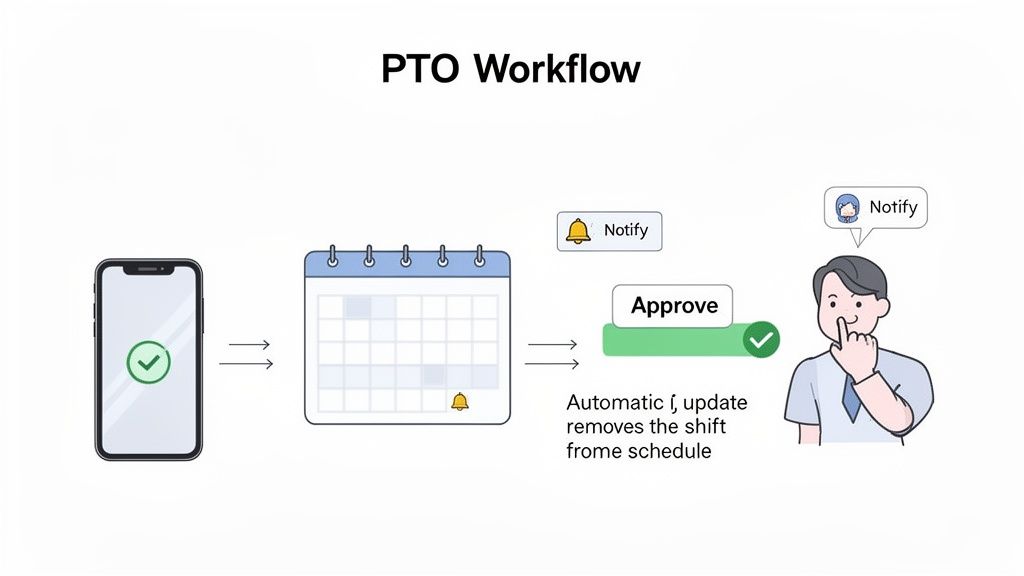
What you’re seeing here is a system that actually works for people, not against them. It cuts out the guesswork and kills the admin busywork, freeing up managers to actually manage.
Creating a Seamless Experience
From what we’ve seen, the goal is to make asking for and approving time off feel effortless. An employee should be able to open an app, see their balance, pick their dates, and hit send in under a minute. No friction. No confusion.
On the other side, a manager gets a notification with all the context they need. Who else is off that week? Is the shift covered? They can approve or deny with a single tap, and the system does the rest. That’s how you build a process people don’t dread.
A great PTO management tool isn't just a feature; it's the foundation for a calmer, more organized workplace. It respects everyone's time by making the simple things simple.
This is crucial for hourly and shift-based teams, where one approved request has an immediate domino effect on the schedule. A system that doesn't tie PTO directly to scheduling is only solving half the problem. If you're looking for a tool that gets this, we've put together some thoughts on what makes for the best employee PTO tracker app.
The right tool eliminates chaos, slashes errors, and gives everyone—from the frontline employee to the HR director—a clear, real-time picture of who’s out and when. It’s not just about efficiency. It’s about building a more transparent culture where the process just works.
Using PTO Data to Build a Healthier Culture
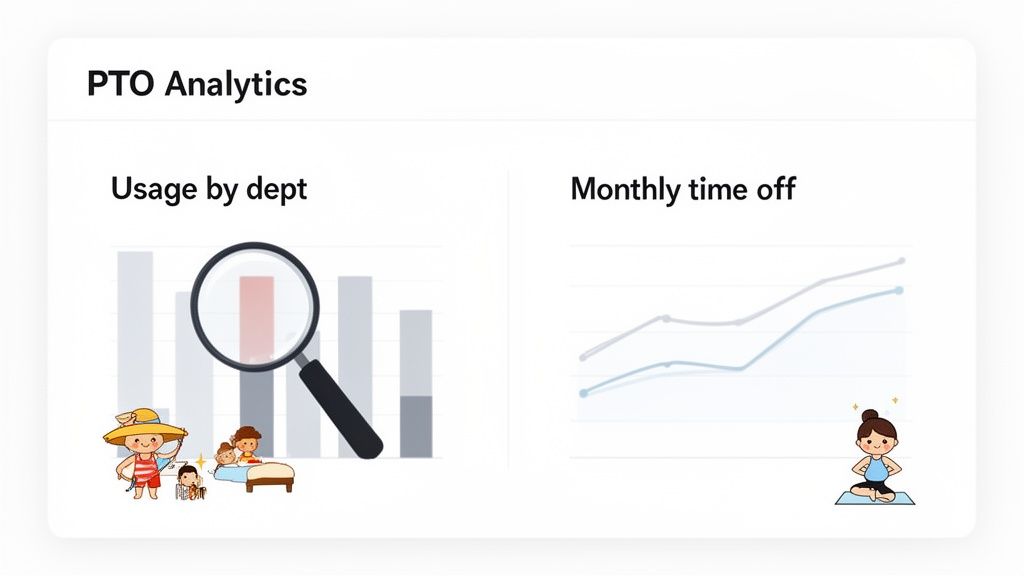
Let’s be honest. Most companies don't look at their employee PTO data beyond checking if shifts are covered. It's treated as a logistical headache, not a source of insight.
But that’s a massive missed opportunity. Your PTO data is a goldmine. It’s a quiet, honest signal about the health of your organization. It tells you stories you might not hear otherwise.
Reading the Signals in Your PTO Data
Numbers on a dashboard don't mean much until you start asking why. Are certain teams barely taking any time off? That's not a sign of dedication; it's a flashing red light for burnout. It could point to a manager who subtly discourages breaks or a workload that’s simply out of control.
What if you see a spike in sick days right after a massive project deadline? That tells a story, too. It’s a clear sign that your team pushed too hard and is now paying the price.
Your PTO analytics aren't just numbers; they are human patterns. They reveal the friction points in your culture long before they show up in an engagement survey.
Understanding these patterns lets you get ahead of problems before they fester. It’s about being proactive, not just reactive. It’s about building a workplace where rest is seen as a prerequisite for great work, not just a reward.
Key Trends to Watch For
You don't need to be a data scientist to find meaningful trends. Start by looking for outliers and patterns in a few key areas. These simple checks can reveal a ton about how your teams are really doing.
Usage Rates by Team: Compare how different teams use their time off. A department with consistently low PTO usage might be under-resourced or led by a manager who needs coaching on the importance of rest.
Patterns of Unplanned Absences: Is one team constantly plagued by last-minute sick calls? This can signal low morale, chaotic scheduling, or even underlying health issues that need compassionate attention.
Time Off Clustering: Do people only seem to take vacations around major holidays or at the end of the year? This could mean your day-to-day work pace is too intense, leaving no room for breaks during "normal" times.
From Data to Action
Here’s the thing: insights are useless without action. Noticing a trend is the first step. The real work is using that information to have honest conversations and make changes.
If you spot a team that isn't taking breaks, sit down with their manager. Ask questions. Is the workload too heavy? Do they feel supported? Sometimes, they just need to hear from leadership that it’s not just okay to unplug—it’s expected.
When you start treating your PTO data as a tool for cultural health, you shift the entire conversation. It’s no longer just about tracking a benefit. It becomes a way to actively care for your people, spot burnout before it happens, and build a truly resilient organization.
Common Questions About Employee PTO
Even with the clearest PTO policy, questions will pop up. That's a good thing. It means your team is actually reading it. Over the years, we’ve seen the same handful of questions come up again and again.
Let's walk through some of them. The idea isn't to create a legal encyclopedia, but to give you a calm, confident way to handle the common stuff that will land in your inbox.
What Happens to Unused PTO When Someone Leaves?
This is probably the #1 question. The answer depends almost entirely on one thing: your employee's location.
Some states, like California, treat accrued PTO as earned wages. That means you must pay out any unused balance when an employee leaves. But in other states, it's entirely up to your company policy. A "use-it-or-lose-it" approach might be perfectly fine in one state but land you in legal hot water one state over.
The main takeaway: your policy has to be built on a solid foundation of local and state law. Never assume a single rule applies to your whole team, especially if you have remote employees.
Can We Deny a PTO Request?
In short, yes. But it’s all about the why. A manager can, and sometimes should, deny a request if it creates a genuine hardship for the business—like leaving a critical shift unstaffed or having half the sales team out during the year's biggest conference.
The trick is to be consistent, fair, and transparent. Denials should be the exception, not the rule, and they should always come with a clear explanation. If you find yourself constantly denying requests, you don't have a PTO problem. You have a staffing or planning problem.
A PTO request isn't a negotiation; it's a conversation about balancing individual needs with team responsibilities. A healthy culture makes that conversation easy.
Sick Time vs. Vacation: What Is the Difference?
This distinction is getting more important as mandatory paid sick leave laws spread across the country. Even if you offer a single, unified PTO bank, your policy still has to meet the minimum legal requirements for sick time where you operate.
Here’s a simple way to think about it:
Sick leave is for unplanned, necessary absences when someone is unwell (and yes, that includes mental health days).
Vacation is for planned, restorative time away from work.
Your policy needs to make it clear that employees can use their PTO for either purpose without pushback. This is especially critical for complying with specific sick leave rules, like those in Connecticut that protect the first five days of leave. It's about making sure your flexible policy still checks all the necessary legal boxes.
Ultimately, these questions are just conversations waiting to happen. Answering them with clarity and empathy is how you turn a policy on paper into a culture people actually trust.
Ready to stop the chaos of spreadsheets and email chains? Pebb brings your communication, scheduling, and PTO management into one simple, modern app for your entire team. See how it works.
