
Employee Performance Evaluation Software: Unlock Potential
Stop the annual review circus. Discover modern employee performance evaluation software, its benefits for frontline teams, & how to pick the right tool.
Dan Robin
Most advice about employee performance evaluation software starts in the wrong place. It starts with forms, workflows, rating scales, and approval chains. It assumes the problem is that reviews are messy, so we should make them neat.
That’s backwards.
A core issue is that many teams still treat performance like a document instead of a relationship. Then they buy software that turns that mistake into a cleaner-looking mistake. The result is familiar. Managers postpone feedback until review season. Employees hear about problems too late to fix them. Frontline staff ignore the tool because it lives in a system they never open. HR gets completion reports, but the company fails to improve.
I’ve seen this play out enough times to stop blaming people for “not adopting the process.” In most cases, the process never fit the work. That matters even more for hourly, mobile, and distributed teams, where performance shows up in shifts, handoffs, service moments, safety habits, and daily coordination. If your software can’t live there, it won’t help much.
The Annual Review Is a Ritual Nobody Likes
The annual review survives mostly because it’s familiar. Not because it works.
Managers dread it because they have to summarize a year of work from memory, old notes, and whatever fires happened most recently. Employees dread it because the conversation often feels loaded. By the time they hear the feedback, it’s stale, vague, or impossible to act on. Everyone performs the ritual. Few people leave energized by it.
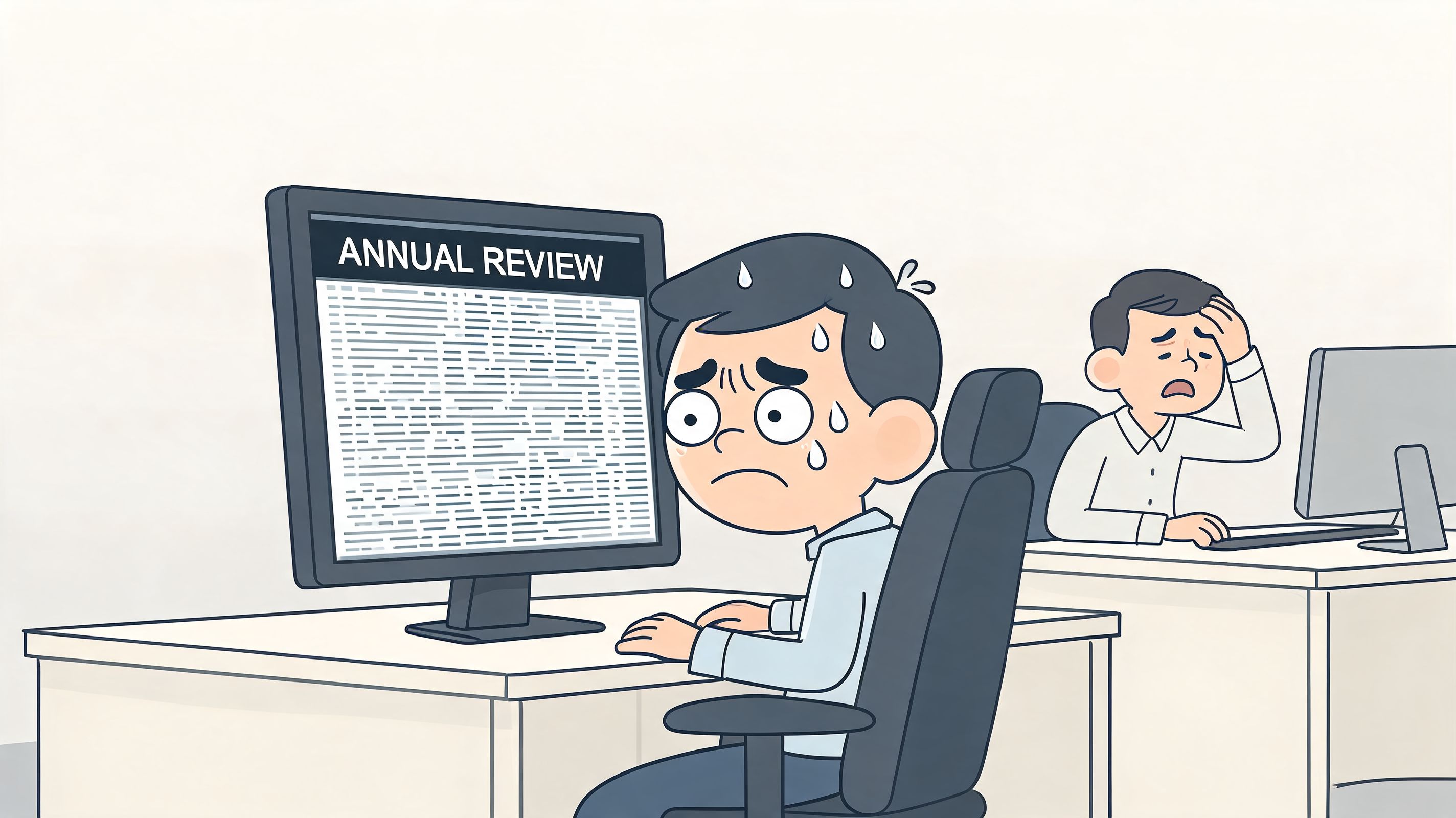
A lot of software digitized that ritual. Same awkward process, nicer interface. Same annual anxiety, fewer paper forms. That’s not progress. It’s administration.
Automation doesn’t fix a bad habit
If the only thing your employee performance evaluation software does is make annual reviews easier to file, you’ve bought recordkeeping, not performance management. That may satisfy policy. It won’t help a supervisor coach better on Tuesday afternoon, when someone needs direction.
That gap is why companies keep looking for a better approach. The employee performance management software market projection from MarketsandMarkets estimates growth from USD 3.52 billion in 2025 to USD 6.33 billion by 2030, with a 12.4% CAGR. I don’t read that as excitement about forms. I read it as a widespread search for something less biased, less clumsy, and more useful.
The review meeting usually isn’t the real problem. The months of silence before it are.
Plenty of teams still need a formal review moment. That’s fine. A structured summary can be useful for compensation, promotion decisions, and documentation. If you want a practical example of how teams still organize those conversations, Steingard Financial's 2026 guide is a good reference point, especially if you’re trying to make a formal review less chaotic. We’ve also found that a simple annual performance review template can help managers prepare without turning the meeting into a script.
The ritual breaks down faster on frontline teams
The annual model is especially weak when work happens in shifts, across locations, and on mobile devices. A store lead, nurse manager, warehouse supervisor, or restaurant operator doesn’t have the luxury of waiting months to correct a habit or recognize a win. The work moves too fast. The context changes too often.
That’s why the most popular advice about this topic misses the point. It tells companies to make reviews more efficient. What they often need is to make feedback more human, more frequent, and closer to the work itself.
What Performance Evaluation Is Supposed to Do
Performance evaluation got buried under too much HR theater. Strip that away, and the job is simple. Help people understand what good work looks like, how they’re doing, and what to do next.
That’s it.
A strong evaluation process doesn’t exist to “score” people like a final exam. It exists to create clarity. When people know what matters, get useful feedback, and see a path to improve, they usually respond well. When they get a surprise rating in a portal they barely use, they don’t.
Think coach, not judge
The old model treats the manager like a judge delivering a verdict. The healthier model treats the manager more like a coach. A coach doesn’t wait until the season ends to mention the footwork is off. They say it early, clearly, and in time for the athlete to adjust.
That same logic applies at work.
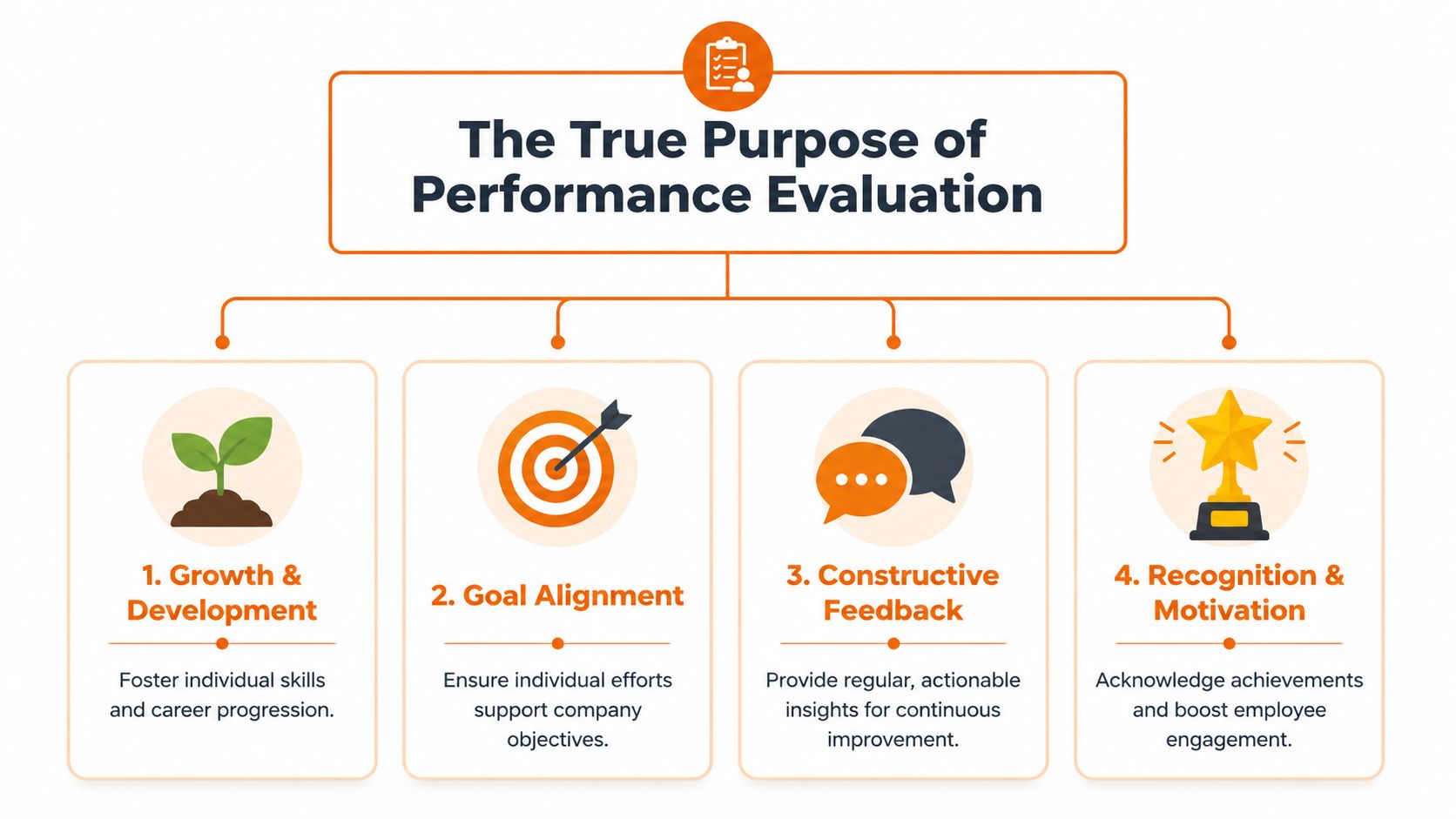
A useful performance conversation usually covers four things:
Growth and development. What skill needs work, and how will the person build it?
Goal alignment. Does the employee understand what matters most right now?
Constructive feedback. What should they keep doing, stop doing, or try differently?
Recognition and motivation. What’s going well that deserves to be named?
If a process misses those four, it may still create paperwork. It won’t create much progress.
Good evaluation is continuous and specific
Many buyers get distracted by feature lists. Before you compare tools, decide what standard you want the tool to support. In a healthy system, feedback is timely. Goals are visible. Recognition is normal. Concerns are raised early. Progress is discussed in plain language.
That’s the frame I use when evaluating any performance management system. Not “Does it have lots of settings?” but “Does it help managers and employees talk about real work while it’s still fresh?”
Practical rule: If feedback arrives too late to change behavior, it’s history, not management.
The strongest teams I’ve worked with didn’t turn every week into a formal review. They did something simpler. They made performance part of the rhythm of work. A quick conversation after a customer incident. A note after a clean handoff. A short check-in when priorities changed. Small corrections. Small wins. Less drama.
The purpose should feel human
People can tell the difference between a system built for compliance and one built for growth. Compliance asks, “Was the form completed?” Growth asks, “Did the person leave clearer than before?”
That distinction changes everything. It changes how managers prepare. It changes what employees expect. And it changes what kind of employee performance evaluation software is worth buying.
Core Features of Modern Performance Software
The best modern tools don’t feel like a special event. They feel like a light layer around the work people are already doing.
Think about a supervisor managing a mixed team. One person is new and needs more direction. Another is steady but wants to grow. A third is struggling in ways that don’t show up in a basic rating. In an old system, all three get pushed through the same review form. In a better system, the software supports an ongoing picture.
Continuous feedback in the flow of work
The first useful feature is continuous feedback. Not endless commentary. Just timely, practical input while the context is still alive.
A manager notices a great customer recovery after a bad handoff and leaves a quick note. A team lead flags a recurring issue with accuracy before it becomes a pattern. An employee asks for feedback after finishing a difficult shift or project. In these scenarios, modern software proves its worth. It makes these moments easy to capture without making them feel ceremonial.
What doesn’t work is forcing people into a separate portal with too many fields and too much friction. If giving feedback feels like filing an expense report, people will avoid it.
Goals that stay visible
The next feature is lightweight goal setting. Some teams use OKRs. Others keep it simpler. The framework matters less than the visibility.
Good software keeps goals current, easy to update, and tied to the person’s actual role. A frontline supervisor should be able to connect feedback to attendance reliability, service quality, safety habits, training progress, or team support. A knowledge worker may tie it to project delivery, collaboration, and outcomes. Different work needs different context.
A rigid system usually misses that. It asks everyone the same canned questions and calls it fairness.
A fuller picture with 360 feedback
Manager-only reviews often reflect one angle, one memory, and one bias. 360-degree feedback helps by pulling in perspective from peers, direct reports, and self-reflection where appropriate. According to NEOGOV’s review software overview, modern software using 360-degree feedback can reduce subjective error by 25% to 35% compared with manager-only reviews.
That matters because performance is social. A person may manage up well and still create friction for peers. Another may be too hard on themselves while everyone around them trusts their judgment. A broader view catches things a single manager might miss.
Still, 360 feedback needs restraint. Too many raters, too many forms, or no guidance on how to give useful input, and the process becomes noisy fast.
AI should support judgment, not replace it
AI gets oversold in this category. It should not be a robot judge. It is more useful as a pattern finder.
The strongest use I’ve seen is when AI helps surface trends that humans would struggle to spot consistently across time, projects, and feedback. The same NEOGOV source notes that AI-driven analytics can process project outcomes and peer feedback to forecast performance trends and improve talent retention predictions by up to 30%. Used well, that helps managers ask better questions earlier.
Here’s where AI helps:
Spotting patterns in repeated feedback themes
Flagging drift when goals and day-to-day behavior stop matching
Summarizing context across projects or review periods
Prompting consistency so one manager’s review style doesn’t differ wildly from another’s
What it should not do is hand down final truth. Managers still need judgment. Context still matters. A rough month after a schedule change, a staffing shortage, or a difficult territory assignment can distort the data if nobody applies common sense.
Use AI as a flashlight, not a gavel.
The software works when these features reinforce each other. Feedback creates the raw material. Goals provide direction. 360 input rounds out the picture. AI helps surface patterns. Then a manager uses that information to have a better conversation.
That’s modern employee performance evaluation software at its best. Not more process. Better signal.
The Real Benefits Beyond a Checkmark
When companies get this right, the change is visible long before review season. Managers stop storing up grievances. Employees stop bracing for surprises. Feedback gets shorter, calmer, and more useful.
The business impact is not abstract, either. It shows up where leaders already care. Retention. Turnover. Time. Focus. Confidence in decisions.
Regular feedback changes the temperature of a team
There’s a simple reason continuous feedback works. People don’t like ambiguity. They want to know whether they’re on track, whether their effort is noticed, and whether they should adjust course.
The 2025 State of Performance Management report from eLeaP found that organizations using continuous feedback systems see 44% better talent retention and 14.9% lower turnover rates. It also reports an average ROI of 180% to 340% within the first 18 months of implementation.
Those numbers are strong, but the logic behind them is even more important. Frequent feedback reduces uncertainty. Reduced uncertainty builds trust. Trust makes people more likely to stay, ask for help, and improve.
Better process creates better management
Software doesn’t create a healthy culture on its own. It can, however, remove excuses.
When feedback is easy to leave, goals are easy to revisit, and review prep doesn’t require digging through old emails, managers are more likely to manage well. Not perfectly. Just better, more consistently. That matters.
I’ve seen teams move from defensive review meetings to ordinary working conversations because the system stopped treating performance as a once-a-year event. Instead of one heavy discussion, they had many lighter ones. That lowered the emotional stakes and raised the quality of the conversation.
A few signs that the process is working:
Employees aren’t surprised by formal reviews because nothing important is brand new.
Managers have examples instead of vague impressions.
Recognition becomes normal rather than saved for special occasions.
Course correction happens early when there’s still time to fix the issue.
The payoff is operational, not just cultural
Skeptics sometimes roll their eyes and call performance work “soft.” It isn’t. Poor feedback creates avoidable exits, weak handoffs, uneven standards, and too many bad decisions made too late.
A healthier system doesn’t just make HR’s dashboard look cleaner. It helps supervisors lead. It helps employees improve. It helps organizations keep more of the people they’ve already trained.
That’s the key benefit. Less ceremony. More clarity.
Why Most Software Fails Your Frontline and Distributed Teams
Most performance software was designed for a worker who sits at a laptop, checks email all day, and can log into yet another HR portal without much hassle. That worker exists. They’re just not the whole workforce.
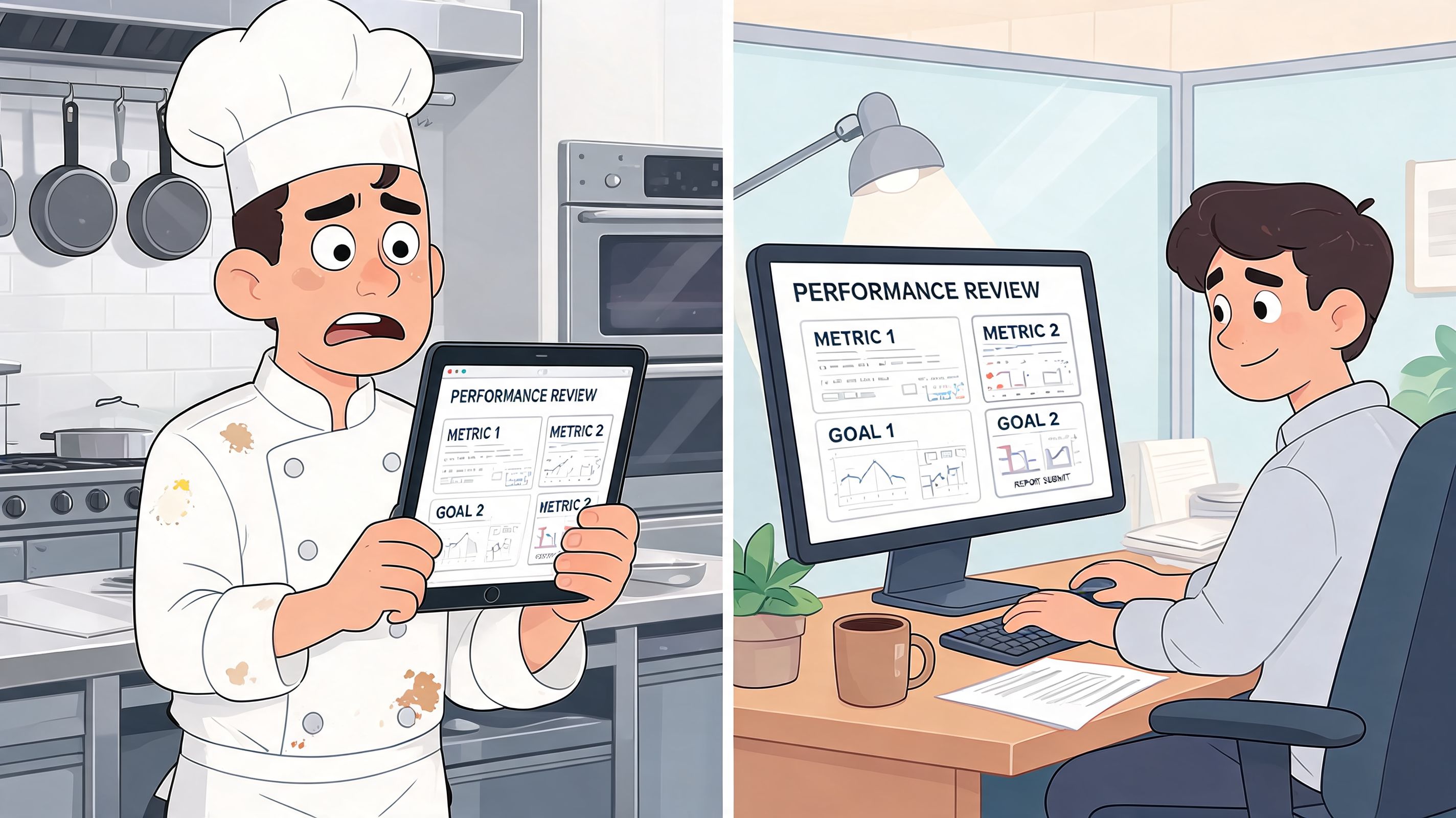
In retail, hospitality, healthcare, logistics, field services, and manufacturing, work happens on the move. People swap shifts, cover locations, jump between tasks, and use their phones far more than desktops. Yet many employee performance evaluation software products still assume long forms, scheduled portal visits, and formal review cycles that have little to do with the pace of the job.
Low adoption is usually a design problem
When frontline teams ignore the review tool, leaders often blame training or engagement. Usually, the simpler answer is that the software doesn’t fit the work.
The PeopleGoal write-up on performance evaluation software makes this gap plain. The vast majority of the global workforce is frontline, yet traditional tools ignore mobile-only and shift-based needs. It notes that only 25% of frontline evaluation tools support native mobile features relevant to that environment.
That number explains a lot.
If someone starts work on a loading dock at dawn, manages tables during a rush, covers patients across a unit, or moves between sites all day, they are not going to open a clunky review module later and reconstruct what happened. The useful moment has passed.
Separate systems create sterile feedback
This is the part many vendors still don’t want to admit. Performance software fails when it lives too far away from the work itself.
For frontline and distributed teams, performance is wrapped up in everyday signals:
Did the shift handoff go smoothly
Was the safety step followed
Did the new hire ask for help at the right time
Did the supervisor recognize a strong recovery with a customer
Did someone repeatedly miss the small details that matter
Those moments belong inside daily communication and operational tools. Not in a detached HR system that appears once or twice a year. If feedback, tasks, shifts, and team communication all live in different places, people stop connecting them. The process becomes sterile. Then it becomes optional in practice, even if it remains mandatory on paper.
Frontline teams don’t need more software categories. They need fewer gaps between them.
The office bias is built into the process
A lot of standard review design reflects office assumptions. Long narrative forms. Quarterly prompts sent by email. desktop-heavy dashboards. Broad competency language that sounds polished but doesn’t match the job. That bias shows up in the software because it showed up in the thinking first.
For distributed teams, the better model is simpler. Short feedback. Mobile-first access. Notes integrated with ongoing work. Visibility across locations. A manager can comment between tasks. An employee can respond without needing a laptop. The process works because it respects the environment people operate within.
That’s why I’m skeptical of any tool that describes itself as flexible but still feels like a desk product in disguise. If it can’t support a shift lead on a phone in a noisy real-world setting, it’s not built for the whole team.
Choosing the Right Tool for Your Whole Team
Most buying guides tell you to compare features. That’s useful up to a point. But feature checklists hide the practical questions that decide whether the tool will work after launch.
I’d start somewhere less glamorous. Ask how the tool feels in the hands of your busiest manager on their worst day. If they can’t leave feedback quickly, find the right person, understand the context, and move on, the process will decay.
Start with fit, not volume
More settings do not mean better performance management. Usually they mean a longer implementation and lower use.
Look for signs that the tool fits the daily rhythm of your teams:
Phone-first experience. If your frontline staff live on mobile, the review process must work cleanly on mobile too.
Fast manager actions. A supervisor should be able to leave a useful note between live tasks, not at the end of the month.
Context from real work. Feedback should connect to shifts, tasks, goals, or team interactions.
Clear permissions. Sensitive feedback needs role-based access and obvious boundaries.
If your performance tool also depends on strong training and coaching support, it’s worth reviewing options alongside broader enablement systems. Zanfia’s guide to top learning management systems is a practical companion if you’re thinking about how feedback, training, and development should connect.
Watch the hidden legal and bias risks
Multi-rater systems can improve quality, but they can also create new exposure if the data is poorly handled or the scoring logic is unfair. The HR365 overview of appraisal software risks cites a 2025 SHRM study finding that 45% of firms using multi-rater tools face legal issues from biased feedback aggregation. It also notes that AI calibration can reduce that risk by 28%, yet only 15% of SMB-focused software offers it.
That should change the buying conversation.
Don’t just ask, “Does it have 360 feedback?” Ask these instead:
How are managers trained to interpret multi-source input
What controls exist to reduce unfair aggregation
Can the vendor explain how calibration works in plain language
Who can see what, and how is confidentiality handled
What audit trail exists if a rating is challenged
Buying performance software without asking about bias controls is like buying payroll software without asking about permissions.
Choosing your approach
Criteria | Traditional Approach | Modern Approach |
|---|---|---|
Daily use | Separate HR event | Part of normal work rhythm |
Access | Desktop-heavy portal | Mobile-friendly and easy in the field |
Feedback timing | Delayed and periodic | Ongoing and timely |
Manager effort | High admin burden | Lightweight actions in context |
View of performance | Mostly top-down | Multi-source with human oversight |
Data governance | Basic storage mindset | Clear permissions, calibration, and auditability |
Employee experience | Formal and distant | Clear, practical, and relevant |
One tool worth considering in this category is Pebb, because it combines communication, operations, and engagement in one app and supports reviews, goals, and feedback in the same environment teams already use for chats, tasks, shifts, and updates. That integrated model makes more sense to me than bolting performance onto a disconnected system.
A good tool should feel calm. Not impressive in a demo and exhausting in real life. If it asks your team to leave their work to talk about their work, it’s already creating friction.
Performance Is a Conversation Not a Report
The shift that matters most is philosophical. Performance is not a report you generate. It’s a conversation you maintain.
That sounds small, but it changes what kind of software you choose and how your managers behave inside it. If performance is a report, you optimize for forms, approval chains, and summary screens. If performance is a conversation, you optimize for timing, context, trust, and follow-through.
The right environment matters
This is why separate performance tools often feel cold. They appear only when someone needs to be rated. They don’t hold the daily signals that make feedback credible. They miss the chat where a peer stepped in to help, the update that shows progress, the task completion that reveals reliability, or the quick note after a tough shift.
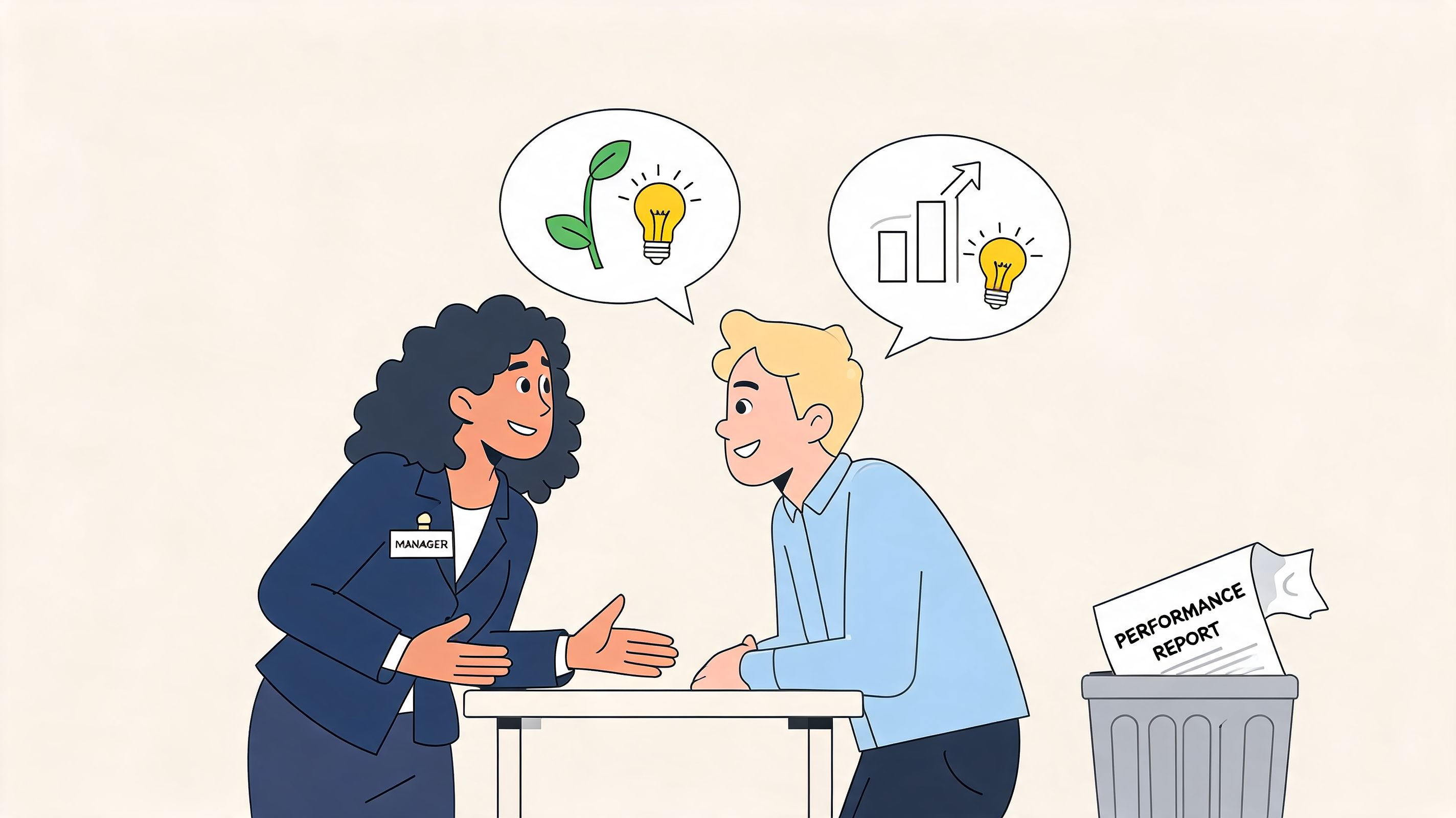
In a healthier setup, feedback can happen where work already happens. A manager comments on a completed task. A teammate recognizes someone in a group space. A lead records a short note after observing a real customer interaction. Later, a formal review can pull from that history instead of pretending memory is enough.
That approach also gives employees a fairer shot. They’re not being judged by the mood of one meeting. They’re being understood through a trail of actual work, conversations, and progress over time.
Formal reviews still have a place
I’m not arguing for chaos. Companies still need structure. They need documentation, consistency, and moments of reflection. Self-assessment can be part of that. A simple employee self evaluation form can help employees prepare thoughtful input before a formal discussion.
Coaching matters too. If your managers need help learning how to give better feedback, a dedicated coaching platform can be useful alongside your internal process. Software can prompt better habits, but managers still need to learn how to listen, ask follow-up questions, and say hard things clearly.
Good performance systems don’t remove humanity. They make room for more of it.
The teams that handle this well usually stop obsessing over the review event itself. They focus on whether people know where they stand, whether they can improve, and whether managers have enough context to be fair. Once those pieces are in place, the software becomes quieter. That’s a good sign.
The best employee performance evaluation software doesn’t feel like another compliance destination. It feels like part of the workplace. That’s especially true for frontline and distributed teams, who’ve been asked for too long to fit office-shaped systems that were never built for them.
If your current setup produces reports but not better conversations, it’s telling you something.
If you want a simpler way to bring feedback, goals, communication, and day-to-day work into one place, take a look at Pebb. It gives teams a shared environment for chats, tasks, updates, shifts, and performance conversations, so reviews don’t have to live in a disconnected system that people only visit out of obligation.
