
Employee Engagement Software for Healthcare: A Human Guide
Ditch the disconnected apps. See how modern employee engagement software for healthcare unifies teams, simplifies ops, and improves patient care. A clear guide.
Dan Robin
Most healthcare leaders don't need another lecture about engagement. They need fewer workarounds before 8 a.m.
The usual scene is familiar. A manager is filling a call-out, texting one nurse, calling another, checking a paper note for a policy update, and hoping the float pool got the latest message. Someone missed the change in protocol because it lived in email. Someone else never saw the message because they were already on the floor. By lunch, people say the team feels disengaged.
It often isn't disengagement first. It's friction first. Then fatigue. Then disengagement.
That's why employee engagement software for healthcare matters. Not as a culture toy. Not as a survey layer on top of a broken day. As infrastructure for how clinical teams work.
The Morning Scramble Is a Symptom Not the Disease
The morning scramble is easy to dismiss as “just healthcare.” Fast handoffs, staffing gaps, last-minute changes, missing information. People adapt because they always have. But when teams live in that state every day, it stops being resilience and starts becoming drag on the whole system.
A nurse manager doesn't experience “engagement” as an abstract score. They experience it when the right person gets the right update at the right time. They experience it when a float nurse can find the current protocol without asking three people. They experience it when they aren't piecing together staffing and communication across text threads, paper notes, email, and a portal nobody opens.
Friction becomes culture
When work is clunky, people feel it in very ordinary ways.
Information arrives late: Staff hear about important updates after shift start.
Coverage gets harder: Open shifts and time-off questions bounce between systems.
Recognition disappears: Good work happens, but nobody has a simple place to acknowledge it.
Feedback gets lost: Leaders hear from the loudest people, not the whole team.
That accumulation matters more than most software demos admit.
A large 2026 benchmark from Perceptyx found that healthcare engagement fell 2.9 points, from 71.5% to 68.6%, across 4.02 million respondents in 557 healthcare systems, and intent to stay dropped 3.0 points at the same time, according to Perceptyx's healthcare benchmark. That scale matters because it tells us this isn't one loud unit or one rough quarter. It's a system problem.
Burnout rarely shows up all at once. It shows up as constant overload, low control, and the feeling that work keeps spilling past the edges of a normal day.
That's also why it helps leaders to keep a broader mental health perspective on burnout in view. Burnout isn't only about long hours. It's also about chronic fragmentation.
What the scramble is really telling you
The daily mess is useful data if you're willing to read it accurately. It usually means your communication tools, staffing workflows, and employee listening tools live in different places. Staff spend energy translating between systems instead of caring for patients or supporting each other.
A strong healthcare team communication approach doesn't start with nicer announcements. It starts with removing the gap between operational work and human experience.
That's the point many teams miss. Employee engagement software for healthcare isn't there to decorate the employee experience. It's there to reduce the operational friction that keeps wearing people down.
Beyond Surveys What This Software Actually Is
A lot of buyers hear “engagement software” and think surveys. Pulse checks. Sentiment dashboards. Maybe a recognition feed nobody uses after the launch week.
That definition is too small for healthcare.
Employee engagement software for healthcare should work like a digital staff room. One place where people get updates, ask questions, manage work, find policies, complete onboarding, and give feedback without hopping between disconnected tools. In a hospital or clinic, communication, operations, and engagement aren't separate categories. They collide all day.
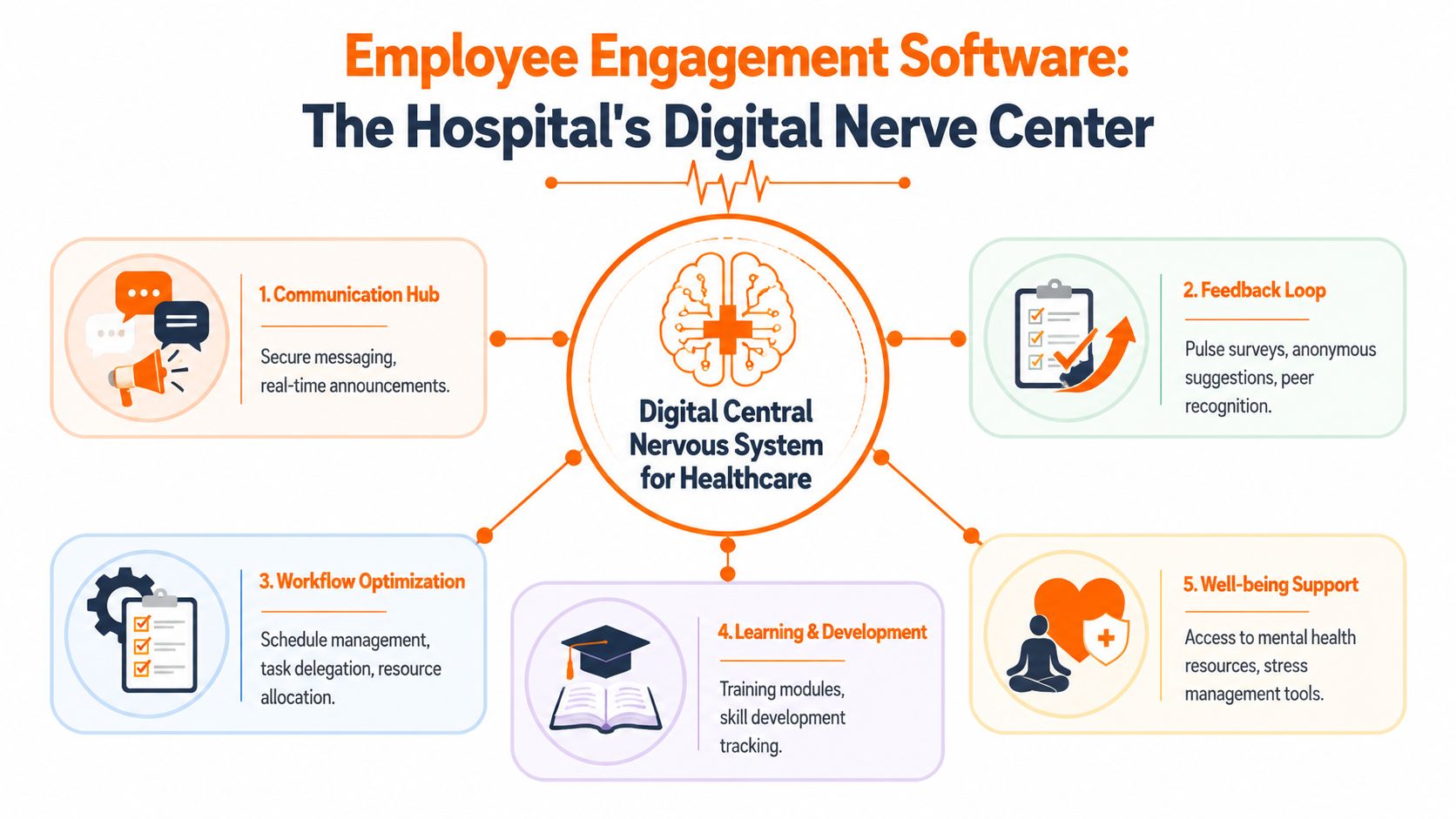
A central system beats a pile of apps
When teams use email for updates, a messaging app for side conversations, a separate intranet for policies, and another tool for recognition or surveys, the result isn't flexibility. It's drift. People stop knowing where the truth lives.
Industry guidance for healthcare points in a clearer direction. Platforms work better when they combine listening, recognition, onboarding, and analytics in one system, so leaders can connect interventions to outcomes like burnout and retention, as discussed in this healthcare engagement platform guidance.
That unified model matters because each part strengthens the others:
Function | What it does in practice |
|---|---|
Communication | Sends updates people can actually find and act on |
Listening | Captures feedback before frustration hardens |
Onboarding | Gives new staff one place to learn how work happens |
Recognition | Makes good work visible across shifts and roles |
Analytics | Shows where adoption, trust, or attention is weak |
What it should replace
If a platform is doing its job, it should retire some bad habits.
Random group texts for urgent operational updates
Lost PDFs buried on an intranet
One-off survey tools that measure frustration without fixing the source
Manual onboarding packets that depend on someone remembering where the latest file lives
Practical rule: If staff still need three tools and two favors from coworkers to get through a shift, you don't have an engagement platform. You have software debt.
I've seen teams buy a survey product and call it a strategy. That's like installing a thermometer and saying you've improved the building's heating system. Useful signal, wrong fix.
In healthcare, the software has to support the work itself. Otherwise it becomes one more icon on a phone, one more login, one more thing people ignore.
The Non-Negotiables for Healthcare Teams
Healthcare isn't a generic workplace with scrubs. It has shift handoffs, floating staff, compliance pressure, mobile work, and almost no patience for clumsy software. That changes what “good enough” means.
A tool can look polished in a demo and still fail on a unit in two days.
Broadcasts are lazy. Clinical communication can't be.
One of the biggest mistakes is sending the same message to everyone and calling it communication. In healthcare, that creates noise. Nurses on nights don't need the same timing as day shift. A float pool needs different instructions than a fixed unit. Environmental services, lab, and front desk teams do not live in the same workflow.
Healthcare engagement software works best when communication is role-, location-, and shift-specific, because staff often work across units and schedules. Segmenting messages by shift or care setting reduces overload and improves the chance that people receive the updates relevant to their work, as explained in this overview of healthcare engagement software communication needs.
That's not a nice detail. It's the difference between clarity and clutter.
The floor-level requirements
When I look at a tool for healthcare, I'm not asking whether it has a recognition badge or a pretty dashboard first. I'm asking whether it can survive the ground truth of a clinical day.
Here's what I'd treat as table stakes:
Secure communication: Staff need one approved place for team messaging and updates. If people fall back to consumer chat apps, governance already failed.
Scheduling in the same environment: Open shifts, swaps, clock-ins, and PTO requests should not live in a separate universe from team communication.
Policy access on mobile: A nurse or tech should be able to pull the right document on a phone without hunting through folders.
Task visibility: Unit checklists, onboarding steps, and operational follow-ups need owners and deadlines.
Read confirmation and admin controls: Leaders should know whether a critical update was seen, and by which groups.
Role-based permissions: Different teams need different access. Healthcare can't run on all-or-nothing visibility.
For teams comparing platforms, this broader view of workforce management software for healthcare usually helps. The strongest setups don't split workforce operations from engagement. They connect them.
What usually fails
Generic employee apps often break in the same places:
Tool behavior | What happens on the floor |
|---|---|
Everyone gets every message | Staff mute notifications or ignore updates |
Desktop-first design | Frontline teams stop using it |
Separate scheduling product | Managers do duplicate work |
Weak permissions | Sensitive information spreads too widely |
Survey-heavy, action-light | Staff stop believing feedback matters |
Pebb is one example of a unified tool in this category. It combines chat, updates, spaces, tasks, knowledge access, scheduling, clock-ins, PTO tracking, directory features, and analytics in one app. That kind of structure fits healthcare better than stacking separate tools and hoping employees stitch the workflow together themselves.
Good healthcare software respects interruption, mobility, and limited attention. Bad healthcare software assumes people have spare time and a desk.
That's the dividing line.
A Simple Checklist for Choosing Your Tool
Most buying mistakes happen because teams evaluate software in a conference room instead of against a real shift.
The vendor walks through features. The admin panel looks clean. The roadmap sounds promising. None of that answers the core question. Will this tool hold up at 6:40 a.m. when a unit is short, the schedule changed, and staff need one clear place to check what matters?
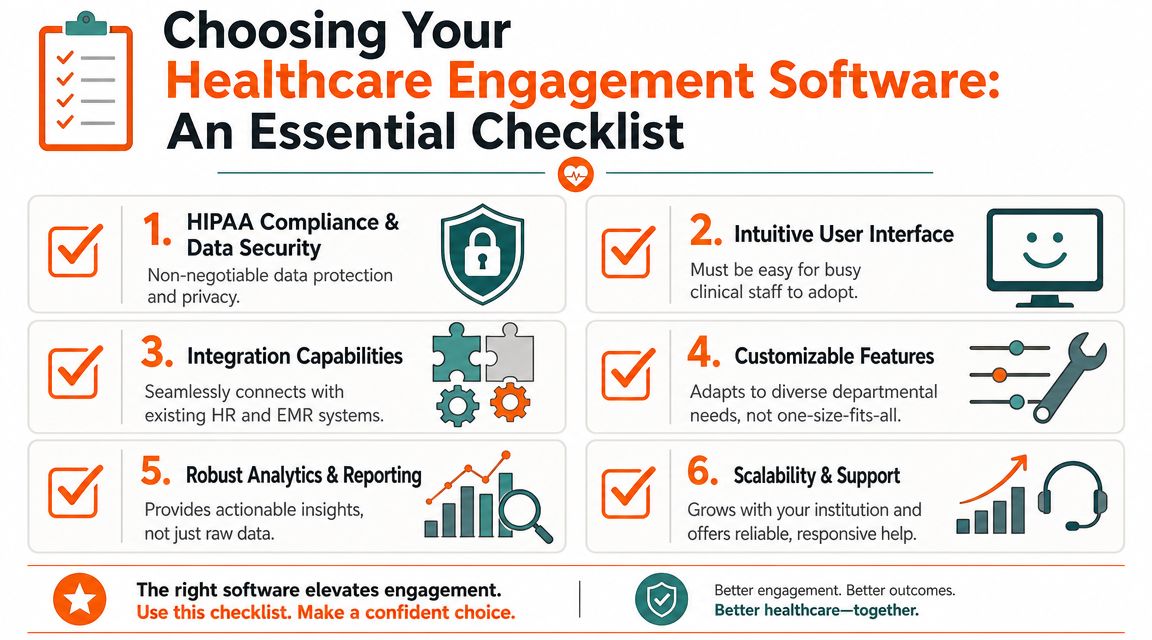
The questions I'd actually ask
Forget the polished script for a minute. Put the product under pressure.
Can a frontline employee use it without training?
If basic tasks take explanation, adoption will stall. Busy clinicians won't babysit software.Can staff find what they need on mobile, fast?
A policy, phone number, update, or shift change should be easy to reach during active work.Does it reduce tool sprawl?
If you still need separate apps for announcements, schedules, files, tasks, and feedback, you're buying another layer, not solving a problem.Can managers target communication cleanly?
Units, locations, roles, and shifts should not all see the same feed by default.Does it fit your governance reality?
Permissions, admin control, and clear ownership matter more in healthcare than in many other sectors.What happens when staff don't live in the app? Consequently, a lot of evaluations get lazy.
App-only is sometimes a fantasy
A hard truth. Some healthcare teams overestimate app adoption because leaders themselves sit at desks more often than the frontline does. Staff may carry a phone, but that doesn't mean they are checking an employee app consistently between med passes, transport requests, patient questions, and charting.
That's why delivery channel matters as much as feature set. For many hospitals and care settings, engagement software fails because the channel doesn't match shift reality. Dialog Health data cited in this healthcare engagement software roundup says SMS reaches the 80% of healthcare workers who lack regular computer access, with a 98% open rate and average response times of 90 seconds versus 90 minutes for email.
You don't need to turn everything into text messaging. But you do need to know when app-based communication is enough and when a multi-channel model is the only realistic way to reach people.
If the message is urgent and the tool assumes people will eventually open the app, the problem isn't adoption. The problem is design.
A fast comparison mindset
Here's the simplest way I know to compare options:
A survey-first tool tells you people are frustrated.
A recognition-first tool helps celebrate wins.
A communication-first tool pushes updates.
A unified operational tool does those things while also reducing the friction causing the frustration.
That last category is usually what healthcare teams actually need.
Rolling It Out Without Causing a Revolt
Buying software is the easy part. Getting a tired clinical team to trust it is harder.
By the time most hospitals start a rollout, staff have already sat through enough “new system” announcements to become skeptical on reflex. They've seen tools arrive with fanfare and then turn out to make work more complicated. If you want adoption, you have to earn it fast.
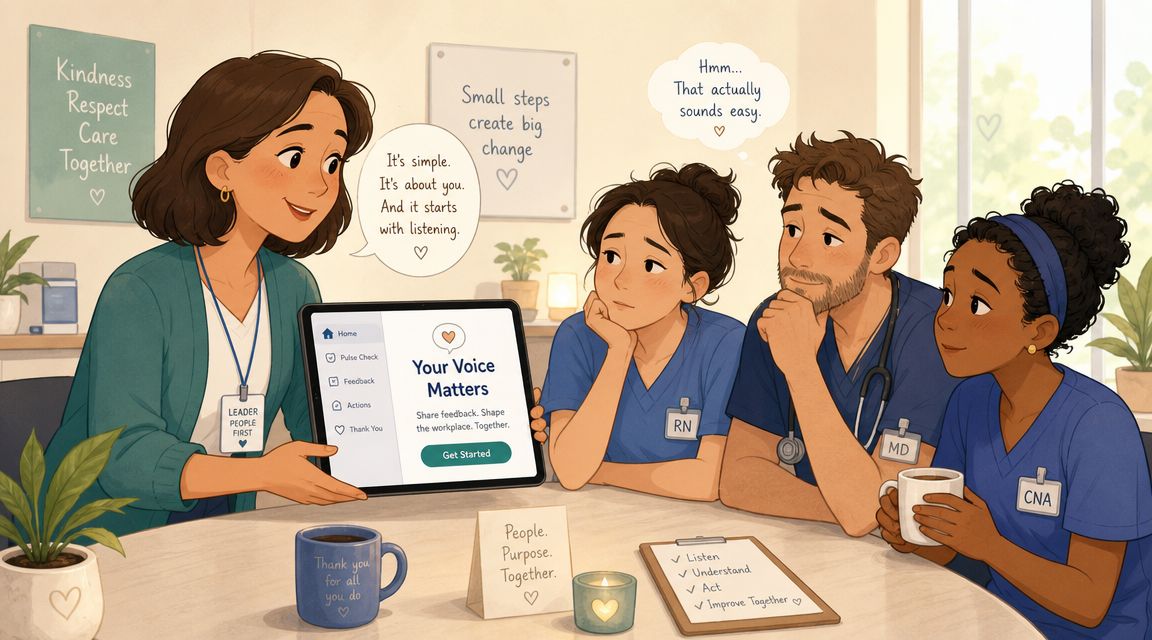
Start where people are open, not where politics are loudest
The best rollouts usually begin with a pilot unit that already has decent local leadership and a practical problem to solve. Maybe they need faster shift communication. Maybe new staff can't find current protocols. Maybe managers are drowning in scheduling back-and-forth.
Pick one pain point. Solve that first.
When staff see one thing get easier, trust starts moving. Not because they attended training. Because the tool saved them time.
Find the clinical champion people already trust
Every good rollout has a translator. Usually it's not the formal project lead.
It's the charge nurse people ask for help. The unit coordinator who knows where everything is. The respiratory therapist who everyone trusts because they are calm and practical. Give that person early access, ask what's clumsy, and let them shape the workflow before the broad launch.
That person does more for adoption than any all-staff email ever will.
One useful test: if your rollout plan depends mostly on leadership reminders, it's too top-down.
Measure uneven adoption early
This part matters because healthcare performance is rarely uniform. A Press Ganey benchmark found employee engagement in U.S. hospitals and health systems increased slightly from 4.02 to 4.04 out of 5 between 2022 and 2023, with 69% of employees classified as engaged or highly engaged in 2023, but nearly half of healthcare roles improved while 20% stayed stable and about one-third declined, according to Press Ganey's engagement trends in healthcare.
That unevenness is exactly why rollout tracking matters. One unit may love the new system. Another may ignore it. One role may use recognition features while another only touches scheduling. You need visibility by team, not just an overall adoption number.
Keep the promise small and real
I'd keep the rollout language simple:
Show one daily habit that gets easier
Move one important workflow into the system
Retire one old workaround
Listen fast and fix obvious friction
Don't promise transformation. Promise relief.
The teams that stick with a new platform are usually the ones who feel, within the first week, that it removed a hassle instead of adding one.
Is It Working The Real Signs of Success
The wrong way to judge employee engagement software for healthcare is by staring at login counts and calling it progress.
The better way is to ask whether the day feels less chaotic. Are managers spending less time chasing people down? Are new hires finding what they need without three side conversations? Are important updates landing with the right teams faster and more clearly? That's where the value shows up first.
Look for operational calm
You'll know the tool is working when old friction starts disappearing.
Fewer staffing scrambles
Faster onboarding
More visible follow-through on feedback
Less confusion about policies and updates
Stronger trust that leaders can reach the right people at the right time
That kind of progress is easier to understand when you're using a clear employee engagement measurement approach tied to daily work, not just annual sentiment.
The real outcome isn't a prettier dashboard
The point isn't to make engagement look measurable. The point is to make work feel more connected, more predictable, and less draining.
When the software is right, staff don't talk about the software much. They just stop saying things like “I never saw that,” “I didn't know where to find it,” or “nobody told our shift.”
That's a real change.
And it raises a useful question for any healthcare leader looking at their current patchwork of tools. If your people weren't spending so much energy fighting the system around the work, what would they have left to give to the work itself?
If you're trying to replace scattered tools with one place for communication, scheduling, knowledge, tasks, and engagement, Pebb is worth a look. It gives healthcare and frontline teams a single app for daily operations and employee communication, which is often the missing piece when engagement efforts stall.
