
Your Employee Communication Policy: A No-Nonsense Guide
Tired of communication chaos? Learn to create an employee communication policy people actually follow. A simple, practical guide for modern teams.
Dan Robin

Teams often don't have a communication problem. They have six of them, piled on top of each other.
A schedule change goes out in WhatsApp. The updated process lives in a Google Doc no one can find. A manager mentions an important deadline in a Zoom call, then assumes everyone heard it. Payroll sends an email. Operations posts in Slack. Frontline staff see none of it until someone screenshots the message and forwards it three hours later.
I've seen this kind of mess up close. Nobody wakes up trying to create chaos. It happens because the company grows, tools multiply, habits form, and no one stops to answer a simple question: how do we talk to each other here?
That's what an employee communication policy is for. Not a stiff document written to impress Legal. Not a dusty PDF sitting in a folder. A real one is a working agreement. It tells people where to look, what to expect, how to raise concerns, and what counts as urgent. It replaces guesswork with clarity.
And clarity is kinder than chaos.
The Sound of Communication Chaos
You can hear communication chaos before you can describe it.
It sounds like, “I thought that was posted already.” It sounds like, “Nobody told the night shift.” It sounds like, “I sent it in the team chat,” followed by, “Which team chat?” It sounds like a manager repeating the same answer five times because the original update went to the wrong place.
This usually gets framed as a people problem. Someone forgot. Someone didn't read. Someone failed to share the memo. I don't buy that. Most of the time, the system failed first.
When teams don't have a clear employee communication policy, they invent one on the fly. Email becomes the place for some official things, but not all official things. Chat becomes both casual and critical. Meetings become the backup plan for bad writing. Text messages become the emergency lane because nobody trusts the normal lanes.
That's how anxiety enters the workday. People start checking everything because they don't know where the official answer lives.
What chaos looks like in practice
A chaotic setup usually has a few familiar traits:
Too many channels: Important news is spread across email, chat, text, calls, and word of mouth.
No channel rules: Urgent issues and casual updates land in the same place.
Manager interpretation: Each manager passes information along in their own style, on their own schedule.
Invisible employees: Frontline and non-desk teams miss updates because the system assumes everyone sits at a laptop.
A bad communication system trains people to become scavengers.
The fix isn't more messaging. It's less noise and better agreements. A good employee communication policy creates relief. People know where announcements go. They know what deserves a call. They know when a reply is expected and when it isn't. The policy doesn't tighten the screws. It gives everyone room to work without constantly hunting for the truth.
Why a Policy Is About Trust Not Rules
When leaders hear “policy,” they often picture restriction. More approvals. More rules. More process. That's the wrong frame.
A useful employee communication policy is a trust document. It says we respect your time enough not to scatter critical updates across random tools. It says we won't make you guess where urgent information lives. It says your voice has a path back to leadership, not just a one-way stream coming down from the top.
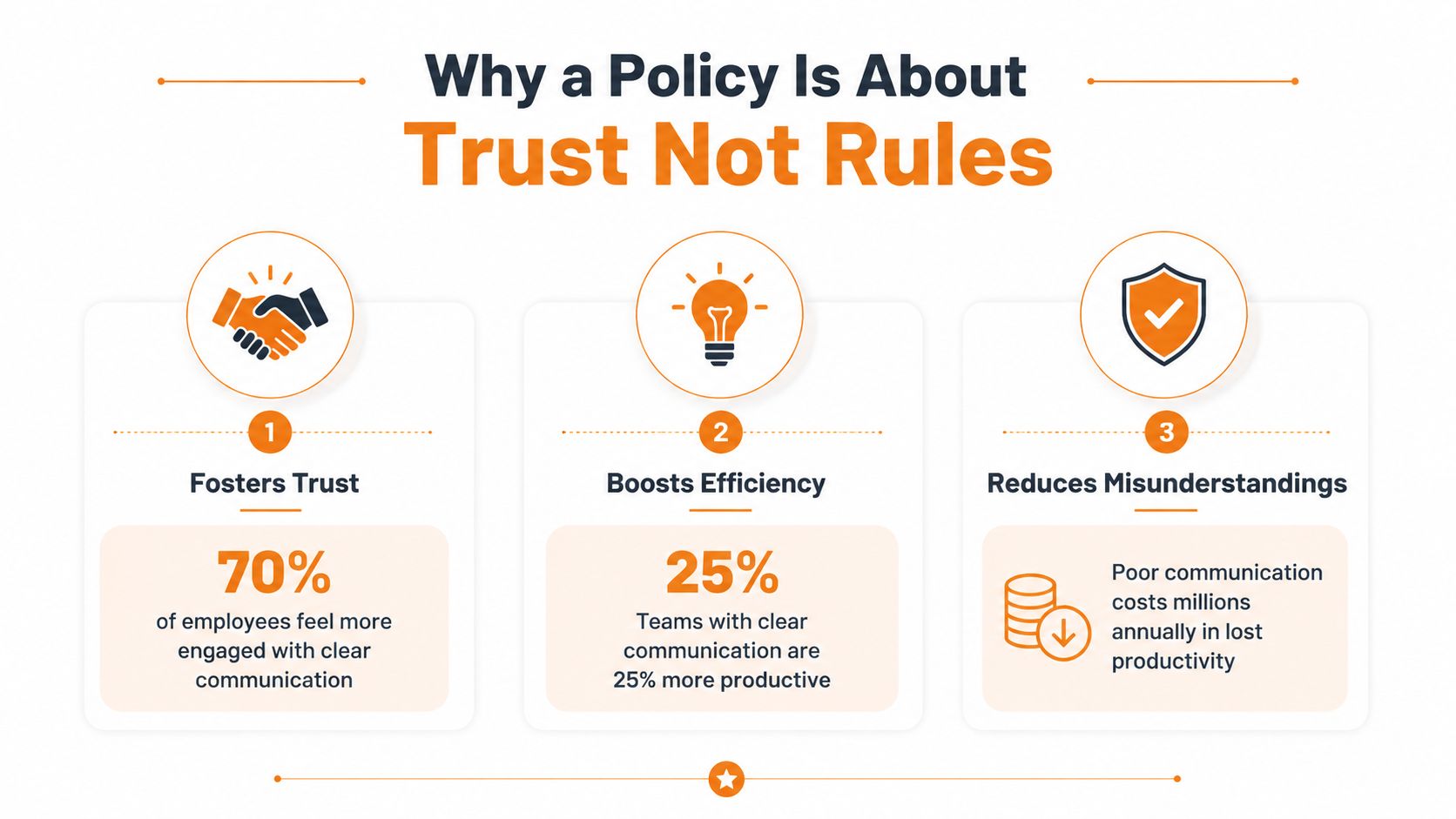
The business case is blunt. The Pumble roundup of communication statistics cites a cost of poor communication estimated at $1.2 trillion per year for U.S. businesses alone, with losses of up to $37,440 per employee annually. The same source says organizations with effective communication strategies see a 4.5-fold increase in employee retention and a 25% boost in productivity.
That matters, of course. But the cultural cost usually shows up first. Work slows down because people don't trust what they're hearing. Teams create side channels. Managers hoard context. Employees stop asking questions because they assume the answer will be vague, late, or inconsistent.
Trust shows up in small habits
Trust doesn't come from a mission statement. It comes from repeatable behaviors.
A strong policy tells people things like this:
Situation | What trust looks like |
|---|---|
Major company update | It appears in one official place, not five |
Urgent operational issue | People know which channel interrupts the day |
Policy change | Employees can ask questions, not just receive orders |
Sensitive information | Staff know what stays private and why |
Those details may seem small. They aren't. They tell employees whether the company communicates with care or just broadcasts and hopes for the best.
Rules can help, but only if they serve people
The point isn't to police tone or force everyone into a script. The point is to create shared expectations that reduce friction.
Practical rule: If a communication rule makes work heavier without making clarity better, throw it out.
The best policies are simple enough to remember. They don't try to control every sentence. They establish a few reliable norms, then let adults use judgment. That's what makes them durable. People follow systems that make their day easier. They ignore systems that feel ornamental.
An employee communication policy earns trust when it reduces uncertainty. That's the standard I'd use for every line in it.
The Anatomy of a Simple Communication Policy
Most communication policies fail because they read like compliance manuals. Dense language, vague expectations, no connection to actual work. People skim them once, then go back to doing whatever they were doing before.
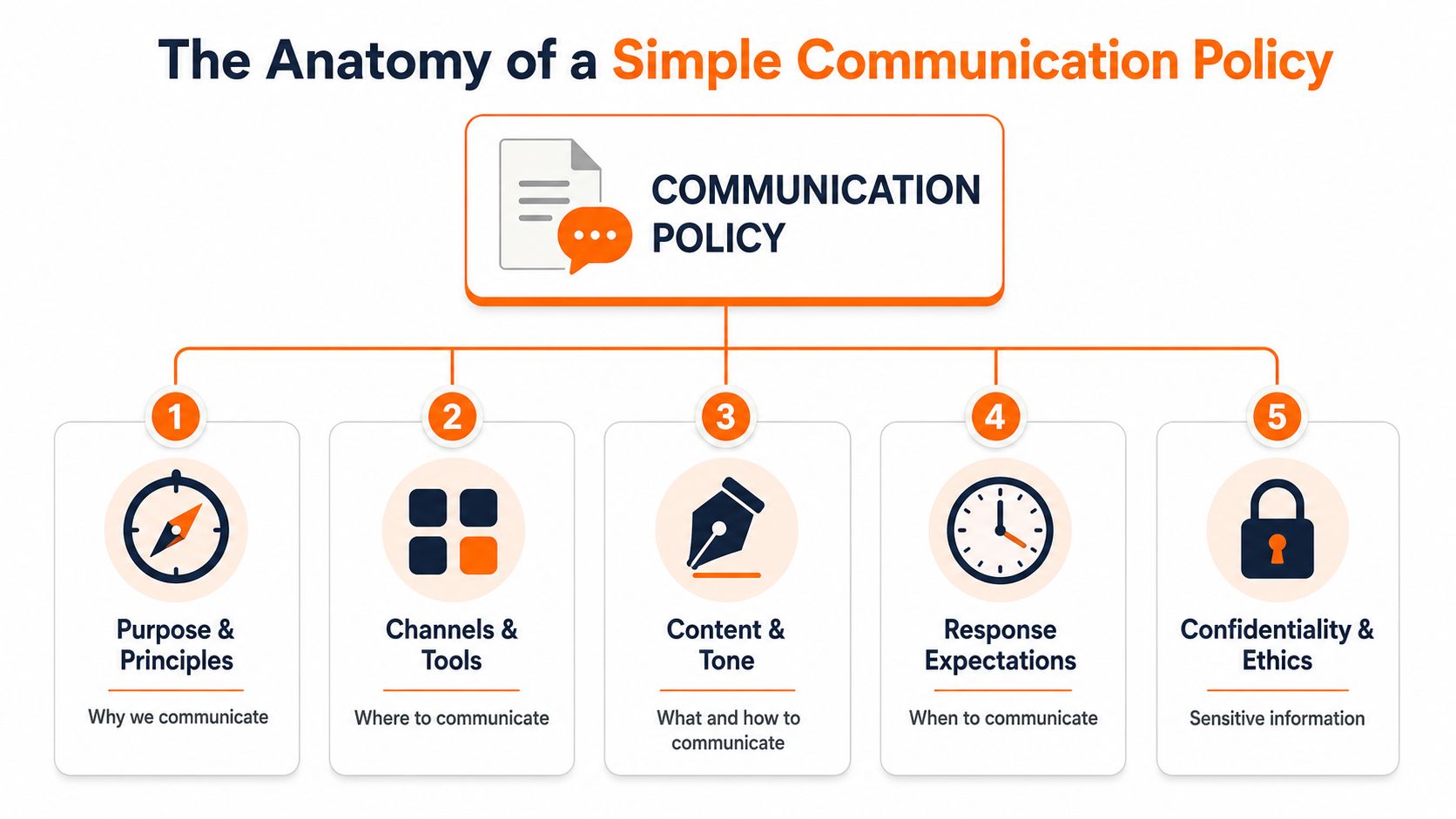
A good employee communication policy answers plain questions in plain language.
Where do we talk
Start with channels. Not every tool deserves equal status.
You need a channel map that says where official announcements live, where team discussion happens, where urgent issues go, and where documents are stored. If people can't answer that quickly, the system is too loose. The guidance on audience segmentation from Itacit is useful here because it pushes leaders to stop broadcasting the same message to everyone. Shop floor workers, remote staff, field teams, and office employees don't need identical delivery.
That means your policy should spell out not just the channel, but the audience. A benefits update may belong in a company-wide announcement space. A location-specific safety issue probably doesn't.
Who sends what, and who owns the follow-through
Policies get fuzzy when everyone is “responsible” and nobody actually is.
Decide who can issue official communications. Decide who updates operating procedures. Decide who closes the loop when employees ask questions. If HR owns policy updates but line managers explain local impact, say that. If operations owns shift alerts, say that too.
A broader policy and procedure manual helps. Communication shouldn't sit off to the side as its own universe. It should connect cleanly to how your company documents decisions, responsibilities, and standards.
How we sound
Tone matters more than many leaders think. A policy can define voice without turning everyone into a robot.
I like a few simple standards:
Be direct: Say what changed, who it affects, and when it starts.
Be human: Write like you're talking to coworkers, not drafting legal theater.
Be complete: Don't hide the hard part in paragraph six.
Be calm: Urgency should come from the situation, not from all caps.
If employees need a translator for internal updates, the company has a writing problem.
Can everyone actually access the message
Many policies fall short. They assume access that doesn't exist.
The Staffbase employee communication impact study notes that only 29% of non-desk and frontline employees report high satisfaction with internal communication. That's not a formatting issue. It's a design issue. Policies need to require mobile-first delivery, captioned videos, and formats that work for shift-based teams who aren't sitting in front of email all day.
Accessibility belongs here too. If your communication depends on long memos, tiny text, or desktop-only tools, some employees are excluded before the message even starts.
What stays private, and what gets escalated
Every policy needs a confidentiality line. Employees should know what can be shared broadly, what belongs within a team, and what must move through formal channels because it involves people data, legal risk, or safety.
It also needs an escalation path. If a message concerns a safety issue, harassment concern, payroll error, or operational disruption, where does it go next? Good policy removes hesitation at the moment hesitation is most dangerous.
Keep this section short. Clear beats exhaustive every time.
Sample Policy Language You Can Steal
Starting from a blank page is miserable. Teams often delay writing an employee communication policy because they think they need polished language from day one. They don't. They need sentences that are usable.
Below is the kind of language I'd start with. It's plain on purpose. You can tighten it later.
Channel rules
Use something simple and specific:
Official company announcements will be shared through the designated company announcement channel only. Team chat is for discussion and quick coordination, not for posting policy changes, deadline changes, or company-wide decisions.
Then add the hierarchy. The PandaDoc guidance on internal communication policy recommends a strict channel hierarchy, reserving phone calls for urgent matters, using video for team meetings, and keeping group messaging for quick updates. It also points to the Brief, Logical, One-Take (BLOT) format because employee reading behavior drops sharply after 111 words.
That last part is worth baking into the policy itself:
Urgent matters: Use a phone call.
Team discussion and live alignment: Use video meetings.
Quick updates: Use group messaging, and keep them short.
Formal decisions and lasting reference: Post them where people can find them later.
Response expectations
Teams often either over-specify this or avoid it entirely. Try this instead:
Employees are expected to acknowledge urgent operational messages as soon as reasonably possible during working time. Non-urgent messages do not require an immediate response unless the sender states a deadline.
That gives people guidance without turning the workday into a stopwatch.
Voice and tone
A short paragraph is enough:
Internal communication should be clear, respectful, and direct. Write for understanding, not performance. Avoid vague language, unnecessary jargon, and long blocks of text. State the action required, the owner, and the timeline.
Confidentiality
Keep it practical:
Do not share employee personal information, confidential business information, or sensitive customer data in public or informal channels. If you are unsure whether information is confidential, pause and ask your manager or the appropriate internal owner before posting or forwarding it.
The best policy language sounds like your best manager on a calm day.
Feedback and questions
The document starts feeling alive instead of rigid here:
Employees should have a clear path to ask questions, raise concerns, and request clarification on company communications. Managers are responsible for answering local questions or routing them to the right owner when needed.
You don't need perfect language. You need honest language that your team will actively use.
Turning a Document Into a Daily Habit
Most policies fade away. They get announced once, filed somewhere, and ignored. Then six months later someone says, “We have a policy for that,” and everyone nods without changing anything.
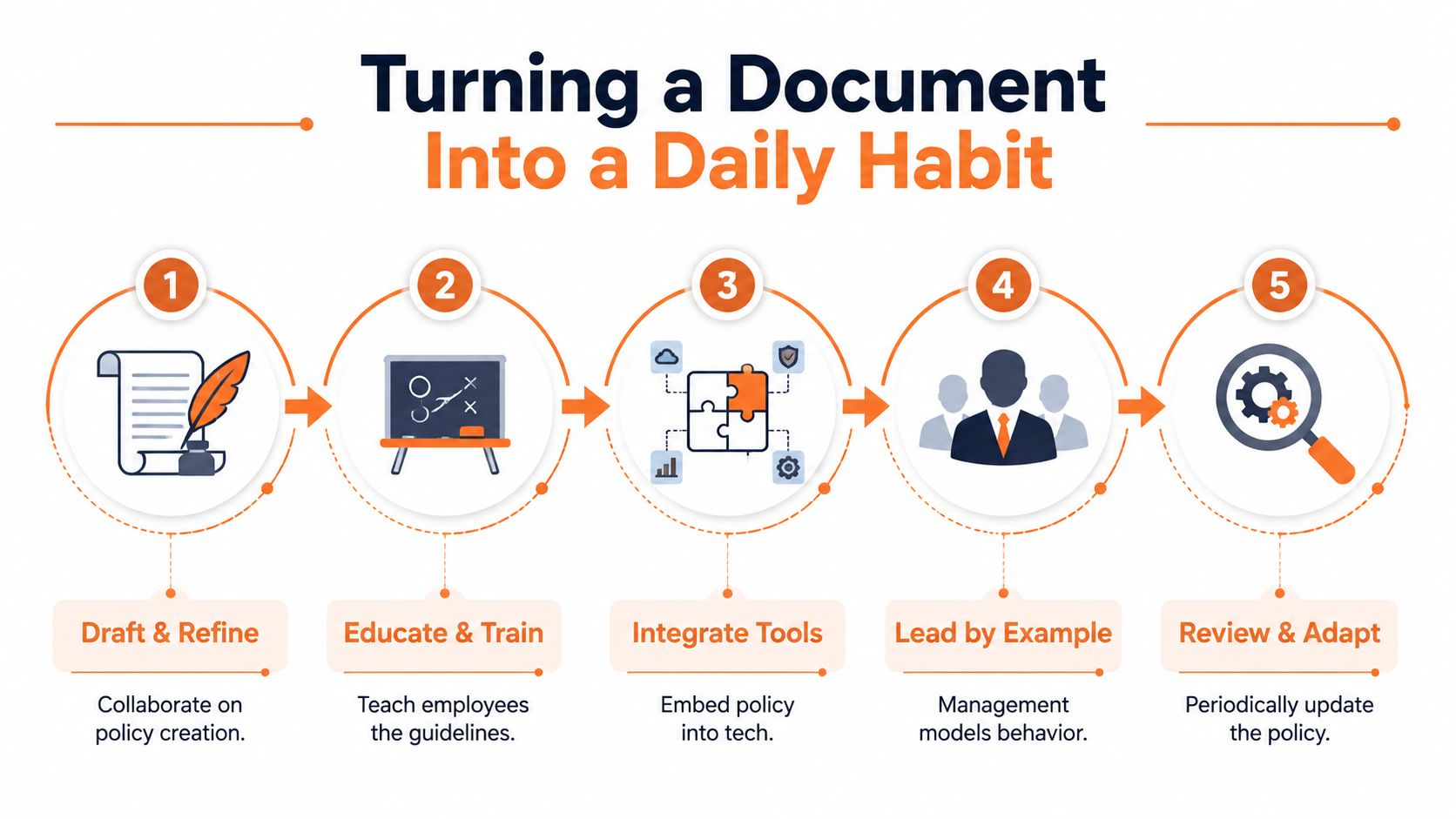
If you want your employee communication policy to stick, treat rollout as behavior design, not document distribution.
Start small enough to learn
Don't launch with a grand speech and a 20-page guide. Start with a pilot team, a few channel rules, and one or two manager groups who are willing to model the change.
You'll learn quickly where the policy is too vague, too idealistic, or at odds with the actual pace of work. That learning matters more than a polished debut.
A practical rollout often looks like this:
Draft with operators in the room: Include managers, frontline supervisors, and a few skeptical employees.
Test the rules in real work: See where people still default to text messages, side chats, or verbal relays.
Tighten the language: Rewrite based on friction, not preference.
Train through examples: Use real scenarios, not generic slides.
Review after a short cycle: Adjust quickly while people still remember what felt clumsy.
Make training feel like work, not school
The worst training on communication is abstract. The best training starts with actual moments of confusion.
Take a few common scenarios. A location closes early. A shift changes. A policy changes. Someone reports a safety concern. Ask managers and employees, “Where does this go first? Who owns the message? Where does the final answer live?” If the room can't answer consistently, the policy needs work.
The Axios HQ guidance on internal communication best practices makes an important point here. Communication mandates need two-way mechanisms, including Q&A sessions and regular pulse surveys, so employees can respond, clarify, and flag issues before they harden into frustration.
People support what they help shape.
That's why I'd also recommend reading a practical guide on how to communicate policy changes to employees. The rollout matters almost as much as the content. If the launch feels imposed, employees treat the policy like another executive hobby.
Watch behavior, not just compliance
Don't measure success by whether employees signed off on reading the policy. Watch whether confusion drops. Watch whether managers stop duplicating messages across five channels. Watch whether employees know where to find the official answer.
A few useful review questions can help:
Question | What you're looking for |
|---|---|
Are urgent issues reaching the right people fast enough | Clear escalation without channel confusion |
Are employees asking fewer “where was this posted” questions | Better information findability |
Are managers repeating less manual follow-up | Cleaner system design |
Are employees using feedback routes | Trust in the process |
A living policy changes when the work changes. That's a strength, not a weakness.
How a Unified App Makes Your Policy Real
A policy can say “use the right channel for the right message,” but that falls apart when the company runs on scattered tools. Email for one team, chat for another, text messages for urgent issues, shared drives for files, and a separate app nobody opens for announcements. At that point the policy isn't guidance. It's wishful thinking.
That's why consolidation matters. The EveryoneSocial roundup of internal communications statistics says 74% of workers report missing critical company news due to poor internal communication systems. The same source says centralizing communications can increase employee job satisfaction by up to 12 times compared to fragmented environments.

One place changes behavior
This is the practical advantage of a unified employee app. Your channel hierarchy stops being a theory and becomes part of the tool itself.
A team space can hold discussion. An updates feed can hold official announcements. A knowledge library can store the current policy and the latest operating procedures. Files, tasks, chat, and people search can sit in the same place instead of sending employees on a scavenger hunt across apps.
That matters most for frontline teams. If someone is on a warehouse floor, in a hospital unit, in a restaurant, or moving between sites, communication has to work on a phone, quickly, without making them decode where the “real” update was posted.
The right way has to be the easy way
This is the rule many leadership teams miss. People don't ignore policy because they're rebellious. They ignore policy because the approved path is slower than the messy one.
If your communication system asks employees to remember five tools and interpret unwritten norms, they'll create shortcuts. If the system gives them one reliable home, they're far more likely to follow it.
For teams comparing options, it helps to review what strong employee communication platforms need to support: clear spaces, mobile access, searchable knowledge, secure permissions, and room for both announcements and conversation.
A policy starts on paper. It becomes real in the product people open every day.
Communication Is the Work
The interesting thing about communication is that everyone says it matters, then treats it like background noise. Something adjacent to actual work. Something soft. Something HR can tidy up later.
That's backward.
Work moves at the speed of understanding. A missed update changes a shift. A vague note delays a launch. A buried decision creates rework. A manager who can't answer “where should this live?” creates confusion for ten other people. Communication isn't sitting next to the work. It's running through all of it.
A useful employee communication policy won't make your company perfect. People will still over-explain, under-share, hit send too early, and forget the agreed channel now and then. That's normal. The win is that your team now has a common language for fixing it.
So keep it human. Keep it short. Keep it current. If a rule doesn't help people do better work together, cut it. If a gap keeps creating friction, write it down and agree on a better way.
You don't need a masterpiece. You need a calmer Monday.
If you're trying to turn communication from scattered messages into one clear system, Pebb is worth a look. It gives frontline and office teams one digital home for chat, updates, knowledge, tasks, files, and day-to-day coordination, so your employee communication policy can live where work happens.
