
Employee Communication Platforms Are Company Headquarters Now
Discover how employee communication platforms streamline collaboration, boost transparency, and foster real company culture.
Dan Robin
Let’s be honest. For years, “internal communication” has been a mess. It’s the buried email everyone missed, the ancient intranet nobody uses, and the constant feeling that your frontline teams are on a completely different planet. We’ve all lived it.
It's a familiar story of frustration. Critical updates get lost in noisy group chats. Frontline workers, if they’re lucky, might see a memo tacked to a bulletin board. It’s chaos disguised as work.
But here’s the thing: patching this broken system isn’t the answer. Juggling a dozen different apps is exhausting. A recent report found that 60% of professionals struggle to focus because of the non-stop digital noise. When information is everywhere and nowhere at the same time, it just creates confusion.
This isn't about finding a better way to broadcast top-down announcements. Great companies don't run on one-way streets. Real connection is built on conversation, not dictation. People need a space to ask questions, share feedback, and connect with colleagues they’ve never met.
That’s what an employee communication platform is really for. It’s not just another tool. It’s the digital headquarters for your entire company—the one place where work gets done and culture comes to life, side-by-side.
In this guide, we’ll cut through the noise. We'll explore why these platforms matter and how to find one that feels less like a corporate mandate and more like a tool people actually want to use. It’s time for a calmer, smarter way to work.
What a Real Communication Platform Does
The phrase “employee communication platform” gets thrown around so much it’s almost lost its meaning. Most people hear it and think, “Oh, another chat app.” If that’s all you see, you’re missing the point entirely.
A true platform is much more than a digital megaphone or a glorified group chat. Think of it as your company's digital town square—the one place everyone trusts for the real story. It's the pulse of the organization.
From our experience building these tools, a great platform has to do three things exceptionally well: connect everyone, no matter their role or location; organize work, cutting through the daily chaos; and build culture, making people feel like they’re part of something bigger.
It's More Than Just Sending Messages
Look, direct messages are table stakes. The real work is creating a single source of truth. A company news feed that people actually read, where critical updates don’t get drowned out by memes.
It's also about weaving the tools people use every day right into the conversation. Why should task management or shift scheduling live in separate, walled-off apps? When you bring operational tools into your communication hub, work just flows. It becomes simpler for everyone.
This is what it looks like to move from a mess of disconnected tools to a single, focused hub.
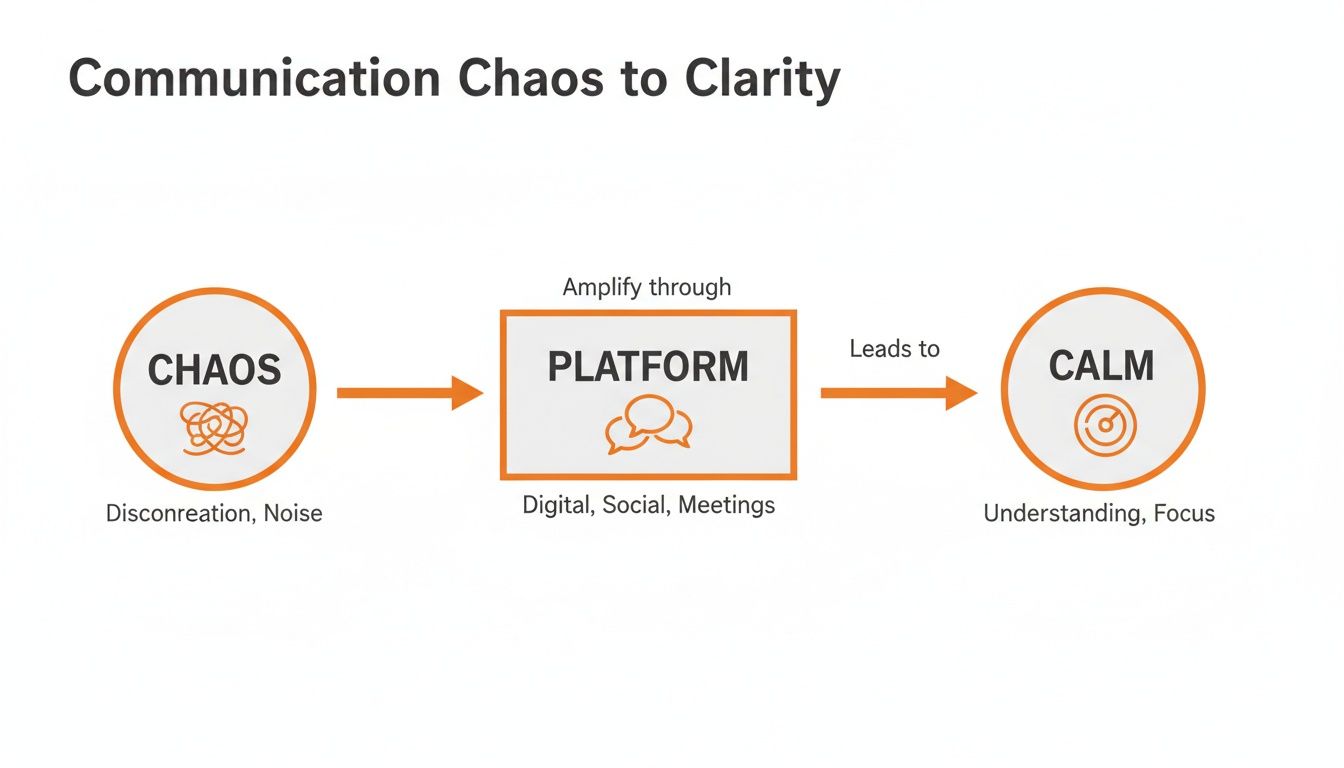
The picture tells the story. A unified platform cuts through the noise of a dozen apps and delivers a clear signal to everyone. The old way creates friction. The modern way brings everything under one roof. The difference is night and day. One path leads to silos and frustration; the other fosters alignment and genuine connection.
The Foundation for a More Human Workplace
At the end of the day, this is about people. It’s about creating a space where colleagues can build real relationships that aren’t defined by an org chart. When people feel seen and connected, they work better together. It’s that simple.
A great platform is an investment in simplicity and sanity. It’s not just another piece of software; it's a commitment to making work feel more human.
There's a reason the market for these tools is exploding. It's on track to hit $2,550.5 million by 2031. This isn't hype. It’s a massive shift to cloud-based tools that offer flexibility and big cost savings—often 30-50% less than clunky, on-premise systems. As Research Dive points out, businesses are realizing they can connect their teams without a huge upfront investment.
The goal isn't just to send messages faster. It’s to build the company you’ve always wanted to lead.
Why Your Frontline Teams Deserve Better Tools
For too long, the people building business software have had a massive blind spot. They’ve designed tools for people like themselves—people who sit at desks. But that’s only a tiny slice of the real world.
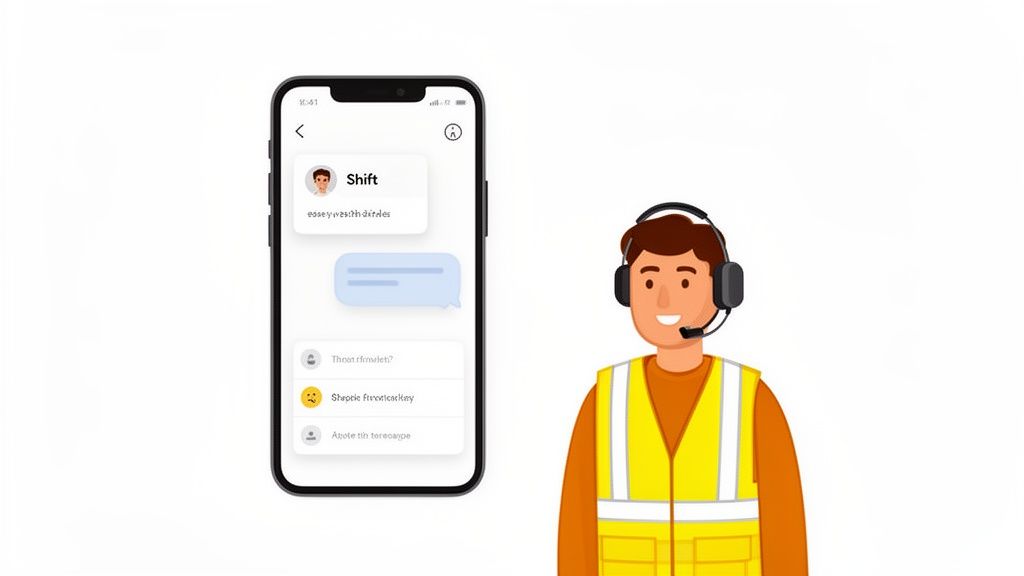
Here’s the thing: most of the global workforce doesn't sit behind a computer. They’re on their feet. Stocking shelves, caring for patients, operating machinery. They are the face of your business, yet they’re almost always the last to get decent tools.
The Disconnect Is Costing You
We’ve seen it firsthand. Companies spend fortunes on software for headquarters while frontline teams manage with paper schedules, garbled walkie-talkie messages, and word-of-mouth updates. It’s not just inefficient; it’s a recipe for disengagement and costly mistakes.
When your most vital team members are cut off, you end up with missed shifts, confused customers, and a feeling that nobody knows what’s going on. It sends a clear message: their work is somehow less important.
The truth is, employee communication platforms must be built for people who are rarely at a desk. The focus has to be mobile-first.
A tool is only useful if it fits the work. For frontline teams, that means simple enough to use in the middle of a busy shift, with instant access to schedules, tasks, and a direct line to managers.
This isn’t about giving them a stripped-down version of an office chat app. It's about giving them something purpose-built for their world. Something that makes their demanding jobs a little bit easier.
Mobile-First Isn't a Buzzword, It's a Necessity
Let’s be honest. Asking a retail associate to check their email for an urgent update is absurd. Their work doesn’t happen in an inbox. It happens on the move.
The numbers tell the story. Non-desk workers make up a staggering 80% of the global workforce—that's 2.7 billion people largely ignored by corporate tech. While office email open rates struggle to hit 30%, mobile-first employee communication platforms see engagement rates soar to 70% or higher.
Why? Because a good mobile platform provides a single, reliable hub for everything they need: instant updates, accessible schedules, clear tasks, and a direct connection to their team without exchanging personal phone numbers.
More Than a Tool, It's a Message of Value
When you finally give your frontline teams the same quality of tools your office staff has enjoyed for years, you’re not just improving operations. You’re showing them they are a valued, integral part of the company. As we've seen time and again, figuring out how to make communication work with frontline employees is one of the most powerful investments a company can make.
It closes the gap between headquarters and the front line. And that connection is what builds a stronger, more resilient business from the ground up.
The Features That Genuinely Matter
The feature lists for employee communication platforms can feel endless. Demos often become a dizzying tour of bells and whistles, from AI-powered analytics to complex workflow automations. But after years of building these tools and watching real teams use them, I’ve learned a hard truth: most of that stuff is just noise.
Only a handful of features truly move the needle. The rest? It’s just feature bloat—complexity that gets in the way of the one thing that actually counts: adoption. If your team can't pick up the tool and feel at home within minutes, the fanciest features in the world are worthless.
The Unshakeable Core
Let’s cut right to it. A great platform needs to do a few simple things exceptionally well.
First, clean, intuitive chat. This is the foundation. People must be able to have one-on-one and group conversations without friction. A well-designed employee team chat app is the engine of daily connection.
Next, a central feed for company updates that’s actually engaging. Not a digital bulletin board where announcements go to die, but a living space where news is shared and discussed. This is how you create alignment.
Finally, dedicated spaces where teams can organize their work. A home base for each department, project, or location to have focused conversations, share files, and manage tasks. It brings order to the chaos of a workday.
Simplicity Is the Ultimate Feature
It’s easy to get seduced by the promise of “advanced” features. But they often create more problems than they solve. Companies get tangled in complicated integrations that break or “gamification” elements that feel like a chore.
Think about how the most effective gamification examples in education rely on simple, intrinsic motivators, not convoluted badge systems. The same principle applies here. The best features are the ones that feel invisible, quietly making work easier.
A searchable people directory, for instance, seems basic. But it’s a profoundly human feature. It turns a list of names into a community, helping people find colleagues beyond their immediate circle. That’s the kind of simple, powerful utility you should look for.
The Real Return on Investment
This push for better communication isn't just a trend. The market for these tools is expected to hit $3.5 billion by 2033 for a simple reason: connection drives results.
The numbers don't lie. Employees who feel engaged are 21% more productive and 17% more likely to stay. When you consider that replacing one employee can cost an average of $15,000, the investment pays for itself almost immediately. You can discover more about the impact of these platforms from Strategic Revenue Insights.
So as you sift through the options, ignore the marketing hype. Ask yourself one question: will this make my team’s day calmer, clearer, and more connected? If the answer is yes, you’re on the right track.
How to Choose the Right Platform for Your Team
Picking a new platform feels like a monumental decision, because it is. The market is flooded with options, and every salesperson will promise you the moon. It’s easy to get lost in a blur of demos and feature-comparison spreadsheets.
But it doesn't have to be a nightmare. Let’s be real: the best tool is the one your team will actually use. If it’s clunky or complicated, it’s destined to become expensive shelfware. Adoption is everything.
So, forget the shiny feature lists for a moment. Start with one, brutally honest question: What is our biggest communication pain point right now?
Start With Your Core Problem
Is your frontline team completely cut off from HQ? Is critical information lost in a dozen different apps? Are you struggling to build a shared culture across different locations?
Let the answer to that question be your guide. Your goal isn't to find a platform with the most bells and whistles; it’s to find one that solves your core problem with elegance and simplicity. If your frontline is disconnected, you need a world-class mobile experience. If information is siloed, you need a single, searchable hub.
Don’t get distracted by what a platform could do for you someday. Focus on what it will do for you on day one. Solving your most pressing problem is the only thing that matters at the start.
This single-minded approach is your best defense against the noise. It helps you filter out the "nice-to-haves" and zero in on the "must-haves."
Key Evaluation Questions to Ask
Once you’ve nailed down your core problem, you can start looking at vendors with a much clearer lens. Instead of asking what their platform does, ask how it will fit into the daily rhythm of your organization. A great platform should feel like a natural extension of your team.
We’ve put together a detailed guide on what to look for in an employee communication platform that goes even deeper. But to get you started, here are a few critical questions to keep you grounded.
Evaluation Area | Key Question to Ask | Why It Matters |
|---|---|---|
User Experience | Is this tool genuinely easy for our least tech-savvy person to use? | If it’s not intuitive, people won’t use it. Period. Adoption is the only metric that matters. |
Mobile-First Design | Does the mobile app feel as powerful and simple as the desktop version? | For frontline teams, the mobile app isn't an accessory; it's the entire product. It has to be flawless. |
Total Cost | Does this tool replace other apps and reduce our overall software spend? | A platform that consolidates five tools isn't just another expense; it's an investment in sanity and savings. |
Onboarding | Can we get our entire team set up and running in a single afternoon? | A long, complicated rollout kills momentum. Simplicity wins. |
Ultimately, choosing a platform is less about the technology and more about your people. Find a tool that respects their time, simplifies their work, and makes them feel more connected to the company's mission—and to each other. That’s the real win.
Building a Calmer, More Connected Company
When you peel back all the layers, this conversation about employee communication platforms isn’t really about the tech. It’s about people. It’s about creating a workplace where information flows freely, everyone feels seen, and teamwork just happens.
For too long, we've accepted the chaos of a dozen different apps as the cost of doing business. It doesn't have to be that way.

Stepping away from that frantic reality is more than an operational upgrade—it's a cultural one. It’s a conscious decision to build a company where every single person, no matter their role, truly feels like they belong.
More Than Just a Tool
Let’s be honest. The constant app-switching is exhausting. A 2024 report from Grammarly found that a staggering 60% of professionals can't focus because of the endless stream of notifications. This digital noise doesn’t just kill productivity; it slowly erodes morale.
A unified platform is the antidote. It brings order to the day. When everything has its place—from company announcements to team tasks—people can finally breathe. They can focus on the work that matters instead of hunting for information.
The right platform doesn't just pass messages along; it helps you build the company you've always wanted to be. It creates space for a more thoughtful, intentional way of working.
A Commitment to Your People
Picture what a truly connected company looks like. It’s a place where a frontline worker in one city can share a brilliant idea that helps a team in another. It’s where a new hire feels welcomed from day one. It’s where a leader can get a genuine pulse on how the team is actually doing.
This isn't some far-off dream. It's what happens when you give your people a single, reliable place to connect. You’re not just buying software. You’re making a commitment—to clarity, to transparency, and to the simple idea that people do their best work when they feel like part of a team.
That’s the goal. Not to find a perfect “solution,” but to build a calmer, more connected company, one conversation at a time. The technology is just the starting point.
Frequently Asked Questions
We talk to a lot of people trying to make sense of employee communication platforms. It’s a big decision, and it's easy to get lost. Here are a few common questions, along with our straight answers.
How Is This Different from Slack or Microsoft Teams?
This is the big one. We love tools like Slack and Microsoft Teams for real-time chat, especially for people at a desk. But a dedicated employee communication platform plays a different, much bigger role. It’s built to be the single source of truth for the entire company.
Think of it this way: chat is for the "right now," but a platform is for everything else. It includes official announcements, essential tools like schedules and task lists, and a permanent, searchable knowledge base. Most importantly, it's built from the ground up for mobile, so it actually works for your frontline teams. It’s about connecting everyone, not just the people already in front of a computer.
How Hard Is Onboarding for Frontline Workers?
This is a make-or-break question. Any tool that requires complicated setup or long training for your frontline staff is doomed. They’re busy. They don’t have time for a webinar or a user manual. The platform has to be as easy to use as the social media apps on their phones.
The onboarding process has to be ridiculously simple. We're talking about getting your entire team active in minutes, using a single invite link or a QR code. No corporate email needed. If it's more complicated than that, it wasn't built for them.
The goal is instant adoption. If an employee can't open the app and immediately understand what it’s for, they'll just delete it. Simplicity isn't a feature; it's the whole game.
Can We Measure the ROI of a Communication Platform?
Absolutely. While the biggest wins—like a stronger culture—are harder to put on a spreadsheet, many benefits have a clear impact on the bottom line.
For starters, look at employee turnover. Better communication and connection are proven to reduce churn, especially in frontline roles. It's not out of the question to see a 15-20% drop in voluntary turnover when companies get this right.
Then there's productivity. How much time do your people waste tracking down information? A central platform gives all that time back. Finally, you can see direct cost savings by consolidating your tech. If you can replace three or four different apps with one, the math speaks for itself. Plus, modern platforms give you real data—like post views and read receipts—so you can see what’s working instead of just guessing.
Ready to bring calm to your company’s communication? Pebb is the all-in-one work app that unifies communication, operations, and engagement for every single employee. See how it works.
