
Digital Workplace Transformation: A Practical Field Guide
Stop chasing buzzwords. Our guide to digital workplace transformation shows you how to unite your entire workforce, from the office to the frontline.
Dan Robin

On day one, a new store associate asked where to check next week's shifts. The answer was six apps, two passwords she didn't have, and a manager's screenshot in a group chat.
That's not a digital workplace. That's a scavenger hunt.
The Mess We've Made
Most companies didn't design this mess. They accumulated it.
A chat tool arrived because email was too slow. A scheduling app showed up because spreadsheets kept breaking. Training moved into a separate system. HR picked one platform. Operations picked another. Internal comms kept the intranet alive long after everyone stopped visiting it. Bit by bit, work got split across too many places.
For desk workers, that's annoying. For frontline teams, it's brutal.
A nurse on a busy floor can't stop and hunt for a policy PDF buried in an old portal. A warehouse supervisor won't open three systems just to confirm a shift change and post a safety update. A hotel housekeeper doesn't have time for a webinar about “navigating the employee experience ecosystem.” They need one place that works on a phone, fast.
Friction is not a small problem
Gartner's framing is useful here. It describes digital friction as the unnecessary effort people spend using data or technology, and it warns about a digital dexterity gap when companies roll out tools faster than employees can adapt. The fix isn't generic training. It's identifying friction in real employee journeys and addressing it with targeted support, nudges, rewards, and trusted business technologists, as outlined in Gartner's digital workplace guidance.
That lines up with what operators see every day. People don't resist change in the abstract. They resist clumsy work.
Practical rule: If an employee needs a manager, a sticky note, and a password reset just to get basic information, your system is broken.
The quiet cost is bigger than most leaders admit. Confusion slows onboarding. Missed updates create rework. Fragmented tools split culture into little islands. The head office thinks communication went out because they posted it. The field thinks nobody tells them anything because they never saw it.
Simpler work feels more human
The goal isn't to “digitize the workplace.” The goal is to make work less scattered.
That means fewer logins, fewer dead ends, fewer places to check. It means the cashier, dispatcher, nurse, technician, and finance manager all have a shared digital home instead of a patchwork of half-connected tools. When people can find what they need and act on it quickly, work gets calmer. That matters more than any launch deck ever will.
What Digital Workplace Transformation Really Is
Digital workplace transformation gets sold as a technology program. That's the first mistake.
It isn't about buying a shinier app stack. It's about creating a single, usable environment where people can communicate, find information, complete work, and stay connected to the company without fighting the tools every day. If you want a basic definition, this explanation of what a digital workplace is gets to the core idea cleanly.
It's a work design problem
When people say they're “doing transformation,” they often mean one of three things:
They're replacing old software
They're moving systems to the cloud
They're launching another communication channel
Those things can help. None of them, on their own, are transformation.
Real digital workplace transformation changes the shape of work. It reduces handoffs. It shortens the distance between a question and an answer. It gives people one reliable place to go. It connects communication, operations, and culture instead of treating them as separate projects owned by separate teams.
That's why so many programs stall. The money is there. The intent is there. The design is wrong.
According to Statista's digital transformation coverage, over 90% of organizations worldwide had implemented cloud technologies as of 2023, 91% of companies have active digital transformation initiatives underway, and global spending on digital transformation is projected to reach $3.9 trillion by 2027. Yet success remains uneven. Only 35% of companies worldwide achieved their digital transformation goals in 2021, up from 30% in 2020.
That gap tells the story. Adoption and spending are not the same as useful change.
The real outcome is operational clarity
A good digital workplace does three plain things well.
Focus | What it means in practice |
|---|---|
Communication | The right people see updates without digging |
Operations | Tasks, schedules, files, and workflows are part of daily work |
Culture | Frontline and office teams feel like they belong to the same company |
When those three live in separate systems, people feel the seams. When they come together, the company moves faster with less noise.
You can't fix a fragmented workplace by adding one more place to click.
There's also a market signal here. The global digital workplace market is projected to grow from $59.4 billion in 2025 to $323.5 billion by 2033, at a 23.8% CAGR from 2026 to 2033, according to Grand View Research's market analysis. The growth matters, but not because markets are exciting. It matters because companies have learned the old patchwork no longer holds under hybrid, distributed, and mobile-first work.
The useful question isn't “How digital are we?” It's simpler.
Can people do their jobs without fighting the system?
A Roadmap That Actually Works
Most transformation plans fail before rollout because they start with procurement. Someone sits through vendor demos, picks a platform, and then asks the business to reshape itself around the tool. That's backward.
The durable path is simpler. Start with the work, then the habits, then the tool.

Discover and define
Go watch how work happens.
Sit with a store opener at 6 a.m. Follow a charge nurse through shift handoff. Ask a warehouse lead where urgent updates live. Don't ask executives what they think the pain points are until you've seen the work yourself. Blockers are usually small, repetitive, and expensive. Missing files. Duplicate entry. Confusing approvals. News that never reaches the night shift.
This first phase is about naming the mess clearly. Not in corporate language. In plain terms people recognize.
Where do employees lose time
What information arrives late
Which teams are excluded by design
What still depends on memory, paper, or screenshots
If you skip this step, you'll build for an imagined company instead of your real one.
Design around people and process
A strong architecture balances people, processes, and technology, and when one pillar gets ignored the result doesn't last. That's the central point in RemoteDesk's overview of workforce digital transformation. It also points out that individual factors like technology acceptance and skills training matter just as much as leadership if you want broad participation.
That's exactly right. Before choosing software, decide what should change in behavior and workflow.
Maybe shift swaps should stop living in text messages. Maybe safety updates need a formal channel with read confirmation. Maybe onboarding should happen in the flow of work instead of through scattered emails and PDFs. Process decisions come first. Tool selection should support them, not invent them.
If your process is vague, your software will make the vagueness faster.
Select tools that reduce moving parts
Teams usually overcomplicate things. They chase feature depth and forget daily usability.
A better filter is boring in the best way. Can one tool replace three? Can a new hire understand it without a manual? Can a supervisor use it in the middle of a shift? In restaurants, this matters even more because scheduling, communication, and training collide in real time. I like 10Seat's insights on restaurant tech because they stay close to operational reality instead of drifting into abstract tech talk.
If you're weighing options, these digital transformation best practices are a useful gut check. Simplicity beats breadth more often than software sales teams would like to admit.
Implement, then keep trimming
Launch is not the finish line. It's the first honest test.
Use a phased rollout. Start with one group that has visible friction and enough local leadership to give clear feedback. Watch what people ignore. Watch where they still revert to side channels. Remove steps. Rename things. Archive what nobody uses. Tighten permissions. Clarify ownership.
The best rollouts feel almost plain. People know where to go, what to do, and why it helps. That's enough.
Why Your Plan Fails Without The Frontline
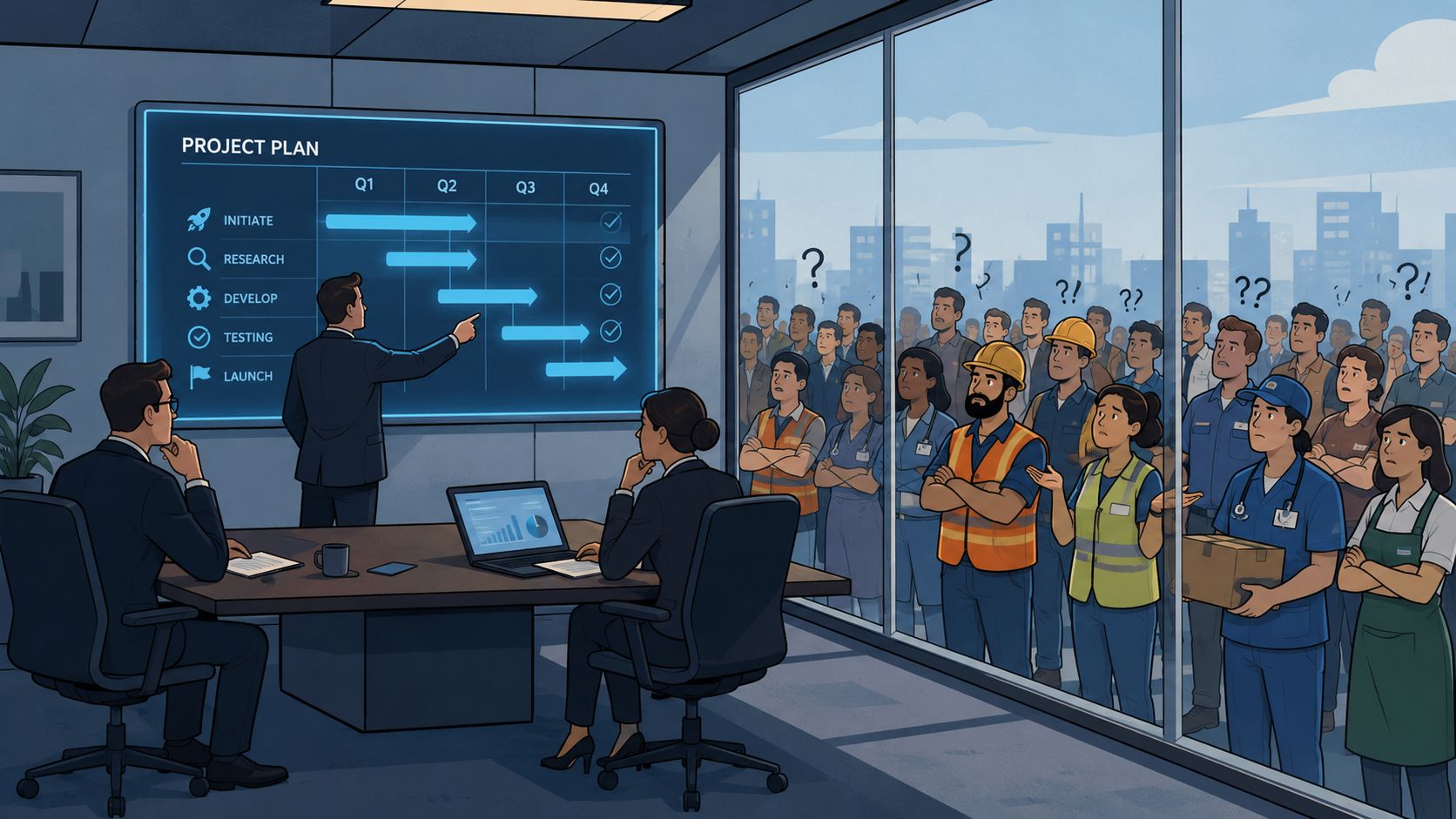
Most digital workplace plans are built by people who sit at desks, for people who sit at desks. That blind spot wrecks the whole effort.
A lot of leadership teams still talk about “employees” as if everyone starts the day with a laptop, an inbox, and a calendar invite. That's not how retail, healthcare, logistics, hospitality, or field operations work. Many employees start on their feet, in motion, with shared devices, noisy environments, tight staffing, and almost no patience for clumsy software.
Office logic breaks in frontline settings
The standard playbook assumes constant connectivity and uninterrupted attention. Frontline work offers neither.
A cashier checks updates between customers. A technician glances at instructions from a parking lot. A nurse may have seconds, not minutes. If your system requires a desktop login, a long training session, or a maze of menus, people won't use it consistently. That isn't laziness. It's basic survival in a busy operation.
Cerkl highlights this gap clearly in its piece on digital workplace transformation for frontline teams. It notes that the frontline angle is widely underserved and that organizations with significant frontline populations report 35% lower digital adoption rates among shift workers compared to office staff.
That number shouldn't surprise anyone who has spent time in real operations. Most systems weren't built for shift life.
One company needs one digital home
The fix is not a “frontline version” bolted onto the office version. That just creates a two-tier company.
A better model is one digital home with different permissions, workflows, and experiences based on role. Mobile first for people in motion. Clear channels for official updates. Tasks and scheduling close to communication. Search that works. Language that sounds like the business, not the software vendor.
If you're trying to understand what that looks like in practice, frontline team communication patterns here are worth reviewing.
The frontline doesn't need a stripped-down workplace. It needs a workplace designed for actual work.
What leaders often miss
Frontline inclusion changes more than adoption. It changes culture.
When desk teams get polished tools and field teams get posters in the break room, people notice. They read that difference correctly. It says whose time matters and whose doesn't. A company that wants one culture can't communicate in two classes.
If your digital workplace works for headquarters but not for shifts, stores, wards, routes, and sites, then the transformation didn't fail at the edges. It failed at the center.
What Success Looks Like In The Real World
Success isn't “higher engagement” on a dashboard no one trusts. Success is operational.
A hospital knows things are better when staff can swap shifts quickly, find updated protocols on a phone, and stop chasing paper or hallway answers. A retailer feels it when store managers push updates once and every location gets the same version. A field team sees it when work orders, safety notes, and team communication stop bouncing across texts and email threads.

Start with operational proof
The common mistake is measuring sentiment before function. Engagement matters, but it's downstream. First, prove the system is helping the work itself.
Track things leaders can tie to real money, real risk, or real throughput:
Task completion trends that show whether critical work is getting done
Operational bottlenecks that reveal where handoffs slow down
Time to fill open shifts because unfilled work creates service strain fast
Onboarding progress so managers can see whether new hires are ready
Policy access and acknowledgement for compliance-heavy environments
Avoidable turnover signals when confusion and disconnection drive exits
That's the direction smart teams are moving. According to BTOES Insights on workplace digital transformation ROI, only 12% of enterprises have a clear, quantified ROI framework for digital workplace initiatives. The same analysis notes that teams are shifting toward analytics that track task completion and operational bottlenecks, then translate them into finance-ready measures tied to revenue, cost avoidance, or risk reduction.
That's a better conversation with a CFO than “people seem happier.”
Soft metrics still matter, but they come second
I'm not dismissing engagement, satisfaction, or sentiment. They're useful. They just shouldn't carry the whole business case.
A sharper scorecard looks like this:
Area | Strong signal |
|---|---|
Labor | Faster shift coverage, smoother onboarding, lower churn pressure |
Execution | Fewer missed tasks, fewer duplicate updates, less manager chasing |
Risk | Better visibility into policy distribution, training completion, and urgent comms |
Service | Faster response on the floor, in the ward, or in the field |
There's a broader payoff too. Among companies that undertook digital transformation over the last two years, 63% reported improved performance, and the majority said technology investments boosted profits or performance by over 10% in 2023, according to KPMG data cited in Mooncamp's roundup of digital transformation statistics.
That doesn't mean every workplace app creates value. It means well-run transformation can.
Good measurement answers a hard question plainly: what got easier, what got cheaper, and what got less risky?
When teams can answer that, the initiative stops sounding like an HR project or an IT modernization effort. It becomes what it should've been from the start. An operations decision.
Choosing Tech That Unites Not Divides
The market is crowded because the need is real. The global digital workplace market is projected to grow from $74.55 billion in 2026 to $388.68 billion by 2034, with a 22.93% CAGR, according to Fortune Business Insights on the digital workplace market. That growth reflects a bigger shift toward unified, cloud-based work environments. It also means buyers face too many options and too much noise.
The wrong response is building a Franken-stack.
Many tools or one home
Point tools look attractive in demos. One app handles chat. Another does scheduling. A third manages files. A fourth runs training. A fifth hosts the intranet nobody visits. Individually, each one seems reasonable. Together, they recreate the original mess on a larger budget.
A unified platform usually wins for one simple reason. Employees don't experience work by software category. They experience it as one day.
What to look for
The shortlist should be practical, not aspirational.
Mobile-first design that feels obvious on a phone, especially for shift-based teams
Communication layers for both quick chat and official announcements
Operational tools like tasks, scheduling, files, policies, and team spaces in the same environment
Admin controls that let leaders manage permissions, structure, and governance cleanly
Analytics that show usage and activity in ways operators can act on
Fast onboarding so rollout doesn't become its own project
Learning is one area where companies often split the stack too early. If training is central to your rollout, it helps to understand the key features of enterprise LMS before deciding what belongs inside your main workplace platform and what should stay specialized.
One example in this category is Pebb, which combines chat, news feeds, tasks, file sharing, people directory, shifts, clock-in, and PTO tracking in one work app for frontline and office teams. Whether you use that or another platform, the standard should be the same. Fewer seams. Less switching. Clear ownership.
A simple test
Ask one question during evaluation.
Can a new hire, a supervisor, and a head office manager all use this tool for their real work without needing three separate explanations?
If the answer is no, keep looking. Division often enters through software long before it shows up in culture.
The Work Is Never Really Done
Leaders like projects with finish lines. Digital workplace transformation doesn't work that way.
You can launch a platform. You can complete a migration. You can retire old systems. But the true job starts after that, when people begin using the thing you built in ways you expected and ways you didn't. That's where the truth comes out.
The better mindset is maintenance
A good digital workplace is more like a well-run store or a healthy garden than a capital project. It needs attention. Someone has to prune what's cluttered, fix what's confusing, and notice when habits drift back into side channels and workarounds.
That's not a sign of failure. It's normal.
Listen for complaints that sound small. “I can't find it.” “I didn't know.” “We still use WhatsApp for that.” Small complaints usually point to structural problems.
The companies that get this right stay curious. They watch where adoption is shallow. They ask frontline managers what still feels awkward. They simplify ruthlessly. They don't confuse a high login count with a healthy workplace.
The real transformation is cultural
Tools matter. Design matters. Governance matters.
But the lasting shift is a belief that everyone deserves the same clarity, whether they work at headquarters, on a ward, in a store, on a route, or on a factory floor. One company. One place to work. One standard for simplicity.
That standard is harder to maintain than to announce. It's also the only one worth building around.
If you're trying to bring communication, operations, and culture into one place, Pebb is worth a look. It gives frontline and office teams a shared work app for chat, updates, tasks, files, shifts, and people directory, with mobile and web access in the same system. For teams replacing scattered tools with something simpler, that's a practical place to start.
