
The Myth of Cross-Department Collaboration
Discover how to master cross department collaboration. Our guide breaks down the real barriers and offers practical steps to build unified, effective teams.
Dan Robin

We've all been sold a lie about cross-department collaboration. The lie is that it’s a thing you do—a project you manage, a meeting you schedule, an initiative you launch. We’re told to "synergize" and "break down silos," as if a few buzzwords and a team-building exercise can fix a broken system.
But it’s not a thing you do. It’s a byproduct. It's what happens naturally when you get the foundations right.
Real collaboration is the quiet hum of a company where information flows freely. It’s when your marketing team knows what sales is hearing from customers without needing a meeting. It’s when the product team sees a spike in support tickets and knows exactly what to fix next, almost instinctively.
It’s about creating an environment where working together is simply the most logical way to get things done. Anything else is just theater.
The Quiet Tax on Everything
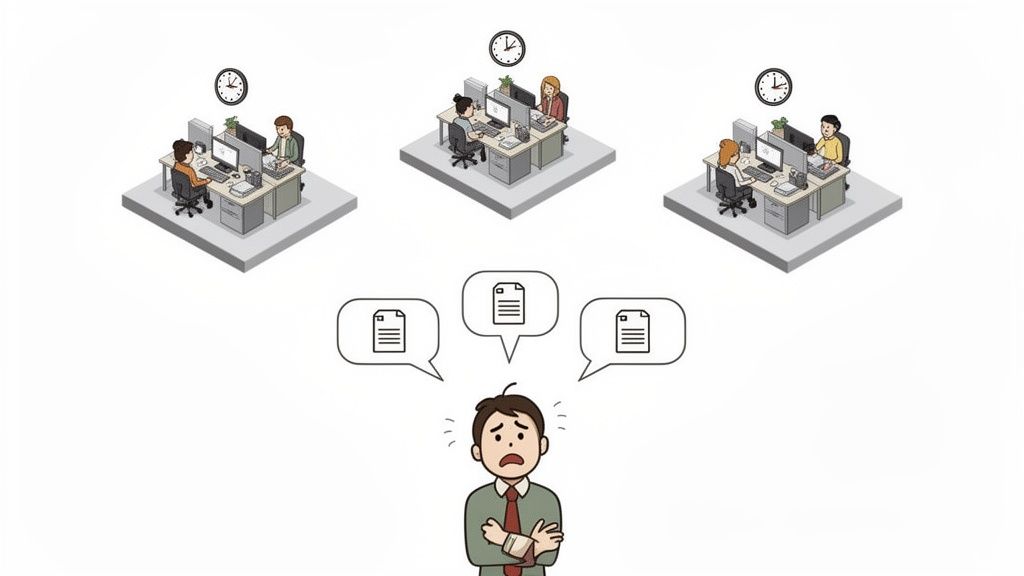
Let’s be honest. We’ve all felt the friction. Marketing launches a campaign, but forgets to tell the sales team. So when a customer calls with a question, sales is caught completely flat-footed. Or operations changes a process, and the support team finds out from an angry customer.
These aren't just mix-ups. They're symptoms of a disconnected company. It’s the sound of duplicated work, blown deadlines, and frustrated customers who get three different answers from three different people. It’s a silent tax that drains energy and morale from your business every single day.
And here’s the thing: it’s rarely anyone’s fault. People aren’t trying to make life harder for their coworkers. The real problem is the system they're working in. When teams operate in separate worlds with their own tools, goals, and languages, these gaps are inevitable.
Why Good People Don't Talk to Each Other
The problem isn't a lack of effort. Research shows that a massive 67% of collaboration failures come from organizational silos, not from people who don't want to work together.
When each department has its own playbook and its own scoreboard, everyone’s focus turns inward. You measure success by hitting your team's targets, not by moving the whole company forward. Sharing information starts to feel like an extra chore instead of a core part of the job. The result? A staggering 28% of all missed deadlines are caused by simple miscommunication between teams. We've written more about the cost of these communication silos and how to overcome them in our guide.
The biggest tragedy in business is smart, motivated people working hard on the wrong things because they weren't in the same conversation.
The Human Cost
This isn't just about spreadsheets and efficiency. There's a real human toll. When a support agent has to apologize for a marketing promise they never heard, it crushes their confidence. When an engineer spends weeks building a feature based on old customer feedback from another team, it's just demoralizing.
This daily friction grinds people down. It makes work feel like swimming upstream. Over time, it creates an "us vs. them" mindset, where other departments feel like obstacles, not partners.
This is the real price of poor cross-department collaboration. It's not an abstract concept from a business book. It's the frustration and wasted effort people feel every day. And seeing that cost clearly is the first step toward finally fixing it.
What Real Collaboration Feels Like

The term "cross-department collaboration" has been beaten into a meaningless corporate buzzword. It brings to mind awkward team-building exercises and endless meetings about having fewer meetings.
That’s not what we’re talking about. Not even close.
Real collaboration isn't scheduled. It's a shared consciousness that develops across a company.
Think of a film crew. The director, cinematographer, and sound engineer aren't constantly huddling to "synergize." They just flow. Each knows what the others need, almost intuitively, because they’re all obsessed with one clear goal: telling a great story.
That’s what genuine cross-department collaboration feels like. It’s the quiet confidence that everyone is rowing in the same direction, guided by the same star.
How It Actually Happens
In a business, this shared consciousness doesn't appear by magic. It’s the direct result of how you structure your work and—more importantly—your information.
It’s your product team having such a clear, real-time view of support tickets that they instinctively know which bug fix will make the biggest difference. They don't need a quarterly report; the data is just there, part of their daily landscape.
It’s your warehouse team seeing the marketing calendar and staffing up for a big sale—without anyone sending a panicked email. The system itself created the awareness.
Collaboration is the byproduct of a transparent, shared environment. You can't force it with meetings, but you can design a system where it becomes the natural way to work.
This is the opposite of superficial teamwork. It’s not about adding another Slack channel or a weekly check-in. It’s about tearing down the information walls that make those things necessary in the first place.
When everyone sees the same information and aims for the same goal, collaboration just happens.
The Tell-Tale Signs
So how do you know if you have the real thing? It’s less about what people are doing and more about what they’ve stopped doing.
You spend less time "catching up." Information flows so freely that meetings are for making decisions, not just sharing updates.
"That's not my job" vanishes. When people see how their work connects to the whole, they start caring about the entire process, not just their piece of it.
Problems get solved faster, and weirdly. A marketing manager spots a supply chain issue. An engineer suggests a brilliant sales angle. Why? Because they finally have the context to connect the dots.
Getting here requires a real commitment to transparency. When you build your team, a cultural fit assessment can help find people who are wired to work this way from the start. It’s about finding people who default to sharing.
In the end, great cross-department collaboration is almost invisible. It’s the quiet hum of a well-oiled machine, where every part moves in sync—not because it’s told to, but because it was designed to.
The Traps That Keep Us Divided
If everyone agrees collaboration is so great, why is it so rare? Because most companies fall into the same predictable traps. These aren't complex strategic failures. They're simple, human disconnects that create massive divides.
Let's start with a problem we all know: tool chaos. Engineering lives in Jira. Marketing runs on Asana. Sales is glued to its CRM. Each tool is its own digital island. Work gets done on the islands, but context and visibility die the moment a project has to travel between them. This isn't just a tech problem; it's a visibility problem. If you can’t see what other teams are doing, you can’t possibly work with them.
Competing With Your Own Team
But even the best tools won't help if your incentives are broken. The goals you set dictate behavior far more than any motivational poster.
Think about it. The sales team gets a bonus for closing deals, fast. The support team is measured on how quickly they resolve tickets. On paper, both teams are winning. But their goals are secretly at war. Sales promises a custom feature to land a big client, creating a six-month headache for engineering and a support team left to deal with an angry customer. No one is the villain here; they’re just playing the game they were paid to win.
Your company's real priorities aren't in your mission statement. They're in what you measure and reward.
When department goals aren’t tied to a bigger, shared outcome, you're basically paying your teams to compete with each other. This breeds a "not my problem" attitude, which is the quiet killer of collaboration.
The Fear of Looking Dumb
The last trap is more subtle: a culture where information is power and asking a "dumb question" feels risky. When people are afraid to admit they don’t have an answer, they just stop talking.
This creates information hoarding. It’s rarely malicious. People are just trying to protect their turf or avoid looking incompetent. A recent Forbes Advisor survey found that for a shocking 42% of people, a simple lack of communication was the main reason projects failed.
When there's no psychological safety—no deep-seated trust that you can speak up without being shot down—people default to silence. They won’t challenge a bad idea from another department or offer a creative suggestion outside their job description.
They just keep their heads down. And that’s where collaboration goes to die.
These barriers aren't just frustrating. They carry real costs that drag down your entire company.
Common Barriers and Their Real Costs
The Barrier | What It Looks Like | The Real Cost |
|---|---|---|
Tool & Data Silos | Teams using different apps that don't talk. Information is trapped in spreadsheets, inboxes, or department-specific software. | Wasted Time: People spend hours just looking for information. Bad Decisions: Leaders make calls with half the story. |
Misaligned Goals | Marketing is bonused on lead quantity, Sales on lead quality. Engineering is rewarded for shipping features, Support for fixing bugs. | Internal Friction: Teams see each other as obstacles. Wasted Money: Departments work on projects that cancel each other out. |
Lack of Visibility | "I had no idea the product team was working on that." "If only we'd known finance was changing that process." | Duplicated Work: Two teams solve the same problem twice. Missed Opportunities: Great ideas die because the right people never connect. |
No Psychological Safety | People are afraid to ask questions, admit mistakes, or challenge ideas in meetings. | Zero Innovation: The best ideas are never spoken. Groupthink: Bad projects move forward because no one feels safe enough to raise a flag. |
These traps aren't signs of a bad company. They're signs of a company running on default settings. To fix them, you have to be intentional.
How to Build Bridges Instead of Walls
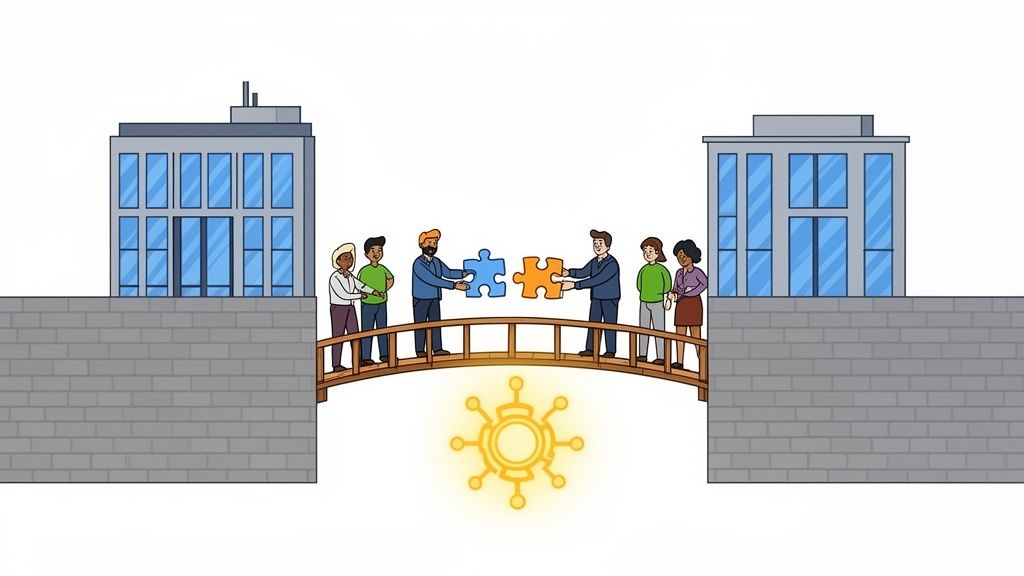
Alright, we know the problems. The traps are real. So what’s the fix? How do we stop building taller walls and start building stronger bridges?
It starts with creating common ground. Not in a fluffy, corporate-retreat kind of way. But in a practical, nuts-and-bolts rewiring of how work gets done.
The most powerful first step is to establish a single source of truth. Think of it as a digital town square for your company—one central place where every team can see project status, find key documents, and talk to each other.
Create One Place for Everything
Imagine a retail manager seeing the exact same marketing brief as the brand team that created it, inside the same tool. When the manager has a question, they don't fire an email into the void. They comment directly on the brief, and the right person gets notified instantly.
That one change can stop a thousand misunderstandings. Suddenly, the frontline isn't just receiving orders; they're part of the conversation. This move alone helps destroy the information hierarchy that keeps companies stuck.
But a shared space is only half the puzzle. You also have to give people a reason to cross the bridge.
You don’t get collaboration by asking people to collaborate. You get it by giving them a shared problem to solve and a shared scoreboard to watch.
This is where shared goals come in.
Change the Scoreboard
For decades, we’ve been taught to manage by department. Marketing has a lead goal, sales has a quota, support has a ticket time target. Then we act surprised when they don't work together.
Let’s be honest. We’re rewarding siloed behavior.
What if we changed the game? Instead of only rewarding a department for its individual work, what if we also created incentives around a bigger, shared success? For example:
A "Product Launch" Bonus: Marketing, sales, product, and support are all rewarded based on the product’s first-quarter adoption rate and customer satisfaction. Suddenly, marketing cares about lead quality. Sales focuses on setting the right expectations. And support has a direct line to product to fix early issues.
A "Customer Experience" Metric: Every department is measured on a company-wide Net Promoter Score (NPS). When everyone owns the customer experience, they naturally start working together to improve it.
This shift changes the entire mindset of a company. It forces teams to look beyond their own to-do lists and see the bigger picture. When everyone’s success is tangled together, cross-department collaboration becomes a necessity, not a choice. Our guide on building trust in cross-functional teams explores how these shared goals become the bedrock for real connection.
Look at What Works
This isn't just theory. Look at the pharmaceutical industry, where alignment between R&D, medical, and sales is critical. Studies show that 60% of underperforming sales teams blame poor collaboration for their failures. Meanwhile, the top teams align their functions from day one and consistently blow past their targets. They build bridges from the start.
These are concrete changes that fix the root cause of disconnected work. A single source of truth gives people a place to gather. Shared goals give them a reason to work together once they get there.
This is how you turn a collection of departments into a single team.
Your Digital HQ: The Foundation for Everything
Let’s be real. Collaboration dies from a thousand tiny cuts. If your team has to juggle five different apps to chat, share a file, and update a task, they won’t bother. It’s too much work. People will always take the path of least resistance, which usually means staying in their silo.
This is why having a single, unified work platform isn't just a nice-to-have—it’s the whole game. We’re not talking about fewer browser tabs. We’re talking about creating a true digital headquarters for your entire company. One shared space where work actually happens.
From Chaos to Cohesion
Think about a new product launch. Right now, that’s probably a mess of email threads, a dozen Slack channels, and files buried in a shared drive nobody can find.
Now, imagine a dedicated 'Space' for that launch instead. In one spot, your marketing, sales, and operations teams can chat, share mockups, and track every task together.
When the marketing lead posts the final ad, the sales team sees it and can give feedback instantly. When operations flags a shipping delay, everyone involved knows at the same time. The entire conversation, every file, and every task lives in one place, wrapped in context. That’s real alignment.
Here’s a glimpse of what that kind of hub looks like, pulling everything into one clean view.
This central dashboard brings chats, tasks, and company news into what we call a "single pane of glass." It's the foundation of a digital HQ. You stop wasting time hunting for information and start getting work done.
Connecting Every Corner
But this has to include your frontline teams. For them, a unified platform is even more critical.
Think about a retail employee. They can clock in, see the day’s new promotions, and pull up a training guide—all in the same app on their phone. If they have a question for their manager, they can send a quick chat without leaving the sales floor.
A unified platform doesn't just make work easier; it makes collaboration the default. When the right people and the right information are in the same place, working together becomes the most logical thing to do.
This consolidation does one powerful thing: it dissolves friction. It knocks down the invisible walls that technology so often builds. And when you remove the friction, you remove the excuses. If you want to get into the details, check out our guide on how to set up your company’s digital HQ.
The goal isn't just to add another tool. It's to build a shared home for work where collaboration isn't something you schedule—it's just how things get done. It's about making connection so effortless that any other way of working starts to feel insane. That’s when you know you've built something that will last.
Where to Start on Monday
It’s easy to get excited by big ideas. It’s also easy to get overwhelmed. The thought of redesigning how your entire company works can make you want to close this tab and go back to your inbox.
So let’s make it simple. Forget about a massive transformation. That’s not how real change happens anyway.
Let's talk about what you can do on Monday morning.
Find One Broken Thing
Your first step isn’t a huge company-wide project. It's to pick one, high-impact process that’s broken because of poor cross-department collaboration. Don't boil the ocean. Just find one painful, universally-known problem.
Maybe it’s how you onboard new hires. HR handles paperwork, IT sets up the laptop, and the hiring manager sends a welcome email—but since no one talks to each other, the new person spends their first week completely lost.
Or maybe it’s how customer feedback gets from support to product. Your support team hears brilliant ideas every day, but they die in a ticketing system, never reaching the people who could actually use them.
Pick one. Just one.
The goal isn't to fix everything. It's to prove that a better way of working is not only possible, but easier for everyone.
Run a Small Experiment
Once you have your broken process, pull together a small team. Grab one person from each department involved—the people who actually do the work. Then, give them two things: a clear, shared goal and a single place to work.
For the onboarding example, the goal might be: "Create a 'first week' experience so great that 95% of new hires feel fully equipped and welcomed." For the feedback problem, it could be: "Make sure every piece of high-priority customer feedback is reviewed by the product team within 48 hours."
That "single place to work" is key. Give them a dedicated project space—a central hub where they can chat, share files, and track progress together. This removes the friction of endless email chains and scattered files. It makes collaboration the path of least resistance.
This is what that flow looks like when you move from scattered tools into one workspace.
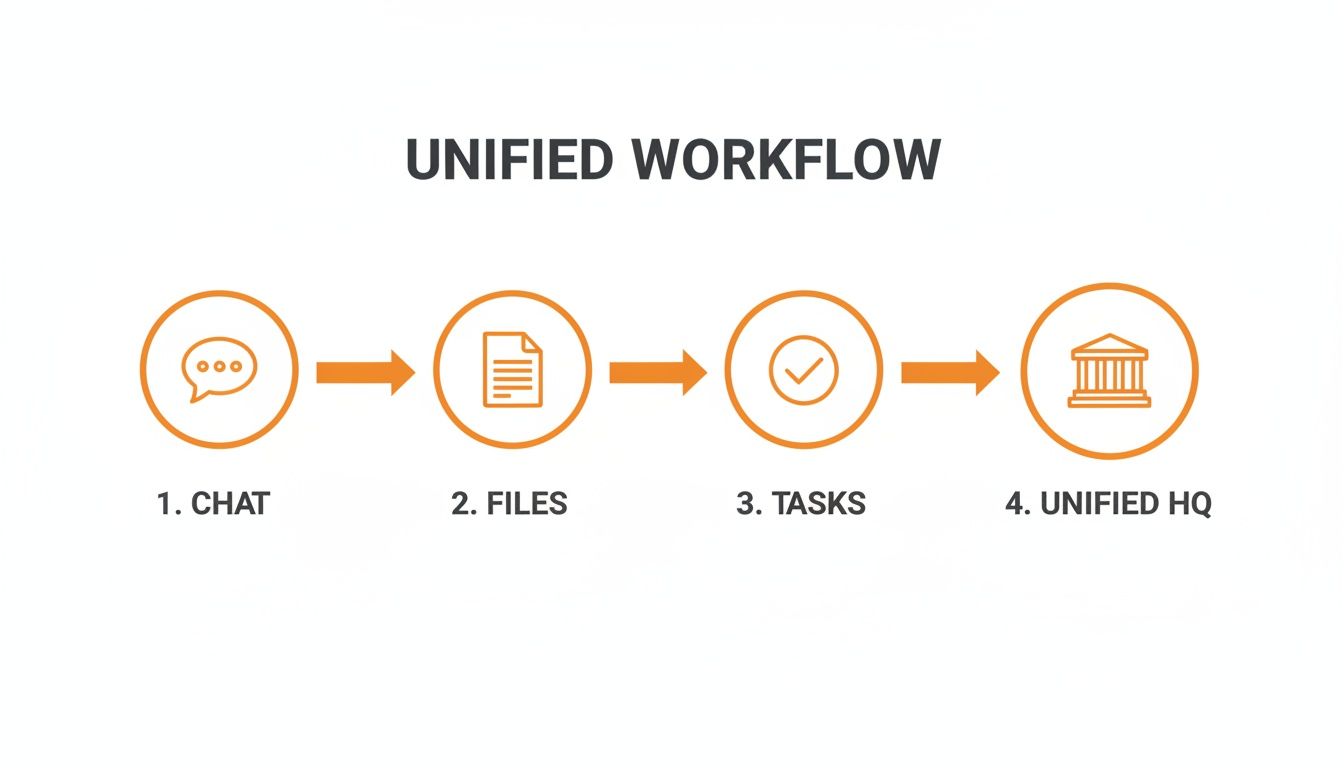
Here, you can see how separate actions like chats, files, and tasks all flow into a single, unified headquarters.
This isn't about a corporate mandate. It's about planting a seed. By getting a small, quick win, you create a story that spreads on its own. Other teams will see the success and get curious. They’ll want to know how you did it.
And that’s how real change begins. Not with a big announcement, but with a small group of people who decided to try a better way.
In the end, collaboration isn’t a project. It's a practice. It’s a daily choice to build bridges, seek connection, and solve problems together instead of alone. And it starts with a single step.
Ready to take that step? Pebb brings your frontline and office teams together in one digital HQ, making cross-department collaboration simple and seamless. Start building your connected workplace today.
