
A Better Way of Managing Employees Performance
Tired of the performance review circus? Discover a real-world, human-centered approach to managing employees performance that actually fosters growth and trust.
Dan Robin
Let’s be honest. Managing your team's performance isn't about some once-a-year administrative chore. It’s about building a system of clear expectations, continuous conversation, and mutual trust. Think of it as a daily practice of coaching and support, all designed to help your people do their best work.
The Performance Review Is Broken, So Let's Start Over
The annual performance review is a corporate ritual almost everyone dreads. It’s a backward-looking exercise in paperwork and awkward conversations, completely disconnected from the real, day-to-day work.
We’ve all been there. You’re trying to recall a project detail from nine months ago while your manager, just as uncomfortable as you are, reads from a script. It’s a fundamentally flawed process.
This old model fails spectacularly for frontline and distributed teams. These folks need guidance in the moment, not a report card once a year. When your work is fast-paced and hands-on, feedback that's delayed is feedback denied.
Why Do We Cling to a Flawed System?
So if it's so bad, why does this system stick around? Mostly, it's just familiar. It feels official, and it generates a paper trail that gives HR a sense of security. But let's be real—it rarely achieves its main goal of actually improving performance.
The truth is, most companies are well aware that their review process is ineffective. Research shows that while 95% of companies have performance management systems, less than 20% believe they provide quality feedback or boost performance. In fact, a staggering 80% have tried to overhaul their systems in the last few years, all searching for a better way.
This flowchart perfectly captures the simple but profound shift from the old way of thinking to a more human-centered approach.
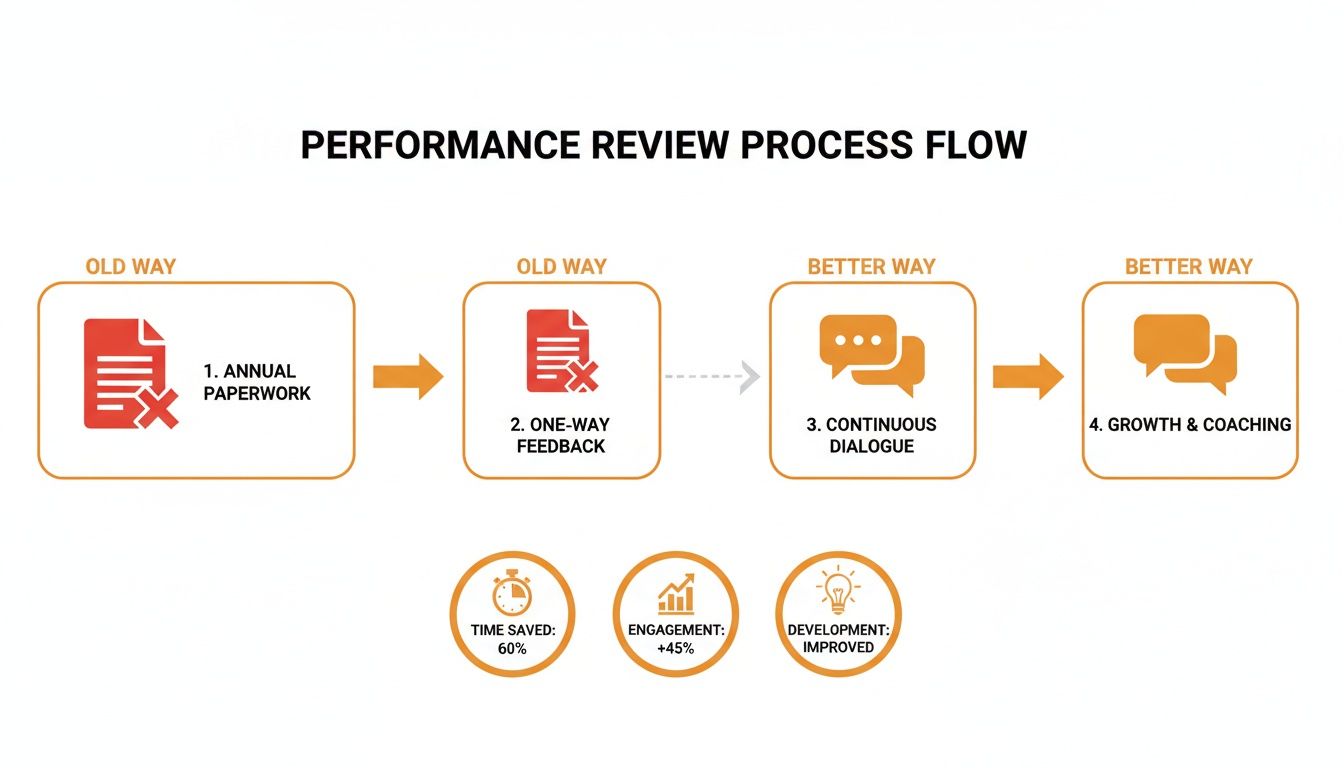
As you can see, moving from a static, yearly event to a dynamic, ongoing conversation not only saves time but also fosters a genuine connection between managers and their teams.
A Calmer, More Human Approach
My goal here isn't just to complain about what's broken. It's to set the stage for a calmer, more human way of managing employee performance—one built on daily conversation and trust, not yearly judgment.
The big idea is simple: performance is a continuous dialogue, not an annual event. This shift is the foundation for everything we’ll discuss. It moves the focus from rating past actions to shaping future success.
Here's a quick comparison to make it crystal clear.
The Old Way vs A Better Way
Principle | The Old Way (Annual Review) | A Better Way (Continuous Dialogue) |
|---|---|---|
Frequency | Once a year, maybe twice. | Ongoing, lightweight check-ins. |
Focus | Backward-looking, focused on rating past events. | Forward-looking, focused on development and growth. |
Tone | Formal, often stressful and administrative. | Informal, conversational, and supportive. |
Goal | Documentation and justification for pay/promotion. | Coaching, alignment, and removing roadblocks. |
Outcome | Surprise ratings, disengagement, and anxiety. | Clarity, trust, and improved performance. |
This table really highlights the fundamental difference in philosophy. It's a move from judging to coaching.
This isn't about throwing accountability out the window. It’s about building it in a way that feels supportive, not punitive. It’s about creating a system where people know exactly where they stand every single day. If you want to dive deeper into this concept, you might be interested in our guide on what is continuous performance management.
To truly start over, it's crucial to understand what makes for an effective conversation. That means learning about the best questions to ask in a performance review.
This philosophy is the starting point for the rest of this guide. So, let's forget the old ceremonies and spreadsheets for a moment. Let's talk about how to actually help people succeed.
Clarity Is the Foundation of Performance
Most performance issues don't stem from a lack of effort. They come from a lack of clarity. We ask people to hit a target they can't see, then we wonder why they miss.
We’ve all seen it happen. We get lost in corporate jargon, fuzzy acronyms, and lofty goals like “increase customer delight.” What does that actually mean for a retail associate on a Tuesday afternoon? Not much. It's just noise.
The bedrock of great performance management isn't a complex spreadsheet or a rigid goal-setting framework. It comes down to one simple, powerful idea: defining what a great job looks like in plain English.
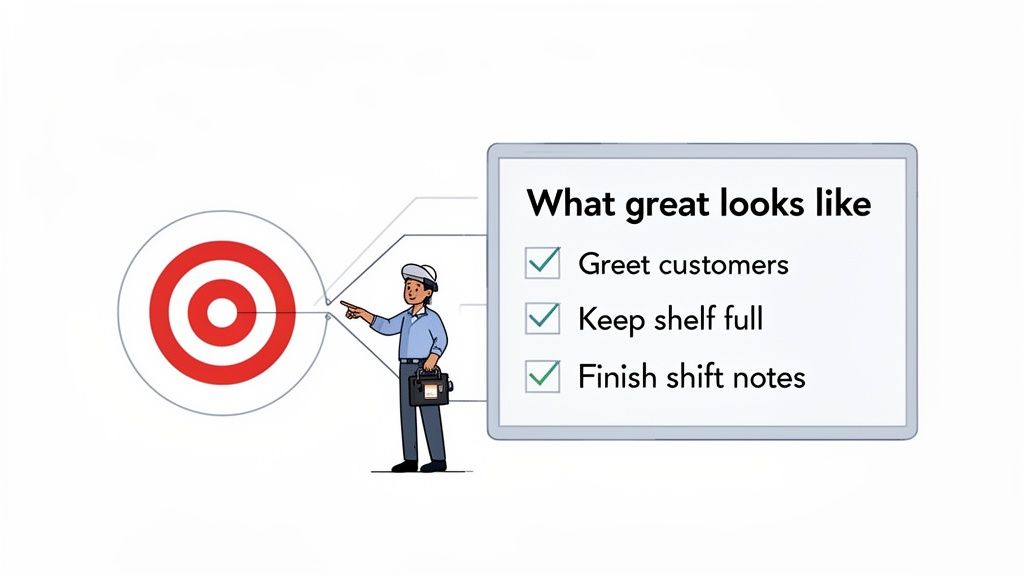
From Vague Goals to Clear Actions
As a manager, a huge part of your job is being a translator. You take a high-level company objective and break it down into a concrete, daily task that someone can actually get their hands on.
This is exactly where most performance management systems fall flat. We hand people ambiguous goals and then get frustrated when the results aren't what we wanted. That’s not just ineffective; it's unfair.
Think about it this way. A company goal might be to “improve inventory accuracy.” For a logistics operator on the warehouse floor, what does that translate to?
The Unclear Way: "Be more careful when scanning packages."
The Crystal Clear Way: "Double-scan every outgoing pallet to ensure the item count matches the shipping manifest. Our team's goal is to slash scanning errors to below 1% this month."
The second one is real. It’s an instruction someone can understand, practice, and be measured against. It gives them a tangible mission for their shift, not just a vague hope.
Here’s a simple test: Can your employee explain, without using a single buzzword, what they need to do today to be successful? If the answer is no, the expectations aren't clear enough.
This isn’t about micromanaging. It’s about clearing the path so your team can run. When people know the rules of the game, they can actually play to win.
Making Expectations Visible and Alive
Here’s the thing about expectations—if they only live in a dusty document from an onboarding session, they’re already dead. They need to be a visible, breathing part of the daily workflow.
This is especially critical for frontline and distributed teams who are always on the move. They don't have time to dig through old emails or a clunky corporate intranet to remember their priorities.
A simple trick is to use a shared digital space, like a team chat or an updates channel in Pebb, to pin team goals and key responsibilities. This turns them into a daily reference point, not a forgotten document. When the week’s focus is always front-and-center, it naturally guides everyone’s work.
But that’s only half the battle. It's not just about telling people what to do. It’s about helping them understand why their work truly matters.
Connect the Dots to the Bigger Picture
People are wired to find meaning in their work. They want to feel like they're contributing to something larger than a simple to-do list. That logistics operator isn't just scanning boxes; they are the final checkpoint ensuring a customer gets the right order, on time. That’s a mission-critical role.
When you set expectations, take an extra 30 seconds to connect the dots.
“When we keep the store displays clean and organized (the what), it makes it easier for customers to find what they need. They have a better experience and are way more likely to come back (the why).”
“By accurately tagging every support ticket (the what), you help us spot trends in customer issues. That allows the product team to fix the root problems for good (the why).”
This context doesn’t need to be some grand, motivational speech. A single sentence is often all it takes. But that sentence transforms a mundane task into a meaningful contribution and builds a powerful sense of ownership.
At the end of the day, clarity is an act of respect. It respects your employees' time, their intelligence, and their genuine desire to do great work. It's the essential first step in building a performance culture that feels supportive, not stressful.
Turn Feedback into an Everyday Conversation
If you’re saving all your feedback for a formal, sit-down review, you’ve already missed the boat. The real work of performance management doesn't happen in scheduled meetings; it happens in the small, ongoing moments that make up the day.
This is all about getting good at continuous coaching. It's about learning to give feedback that’s specific and timely without sounding like you’re reading from an HR script. The whole idea is to make these conversations so normal that nobody even flinches when they happen.
The Two Types of Everyday Feedback
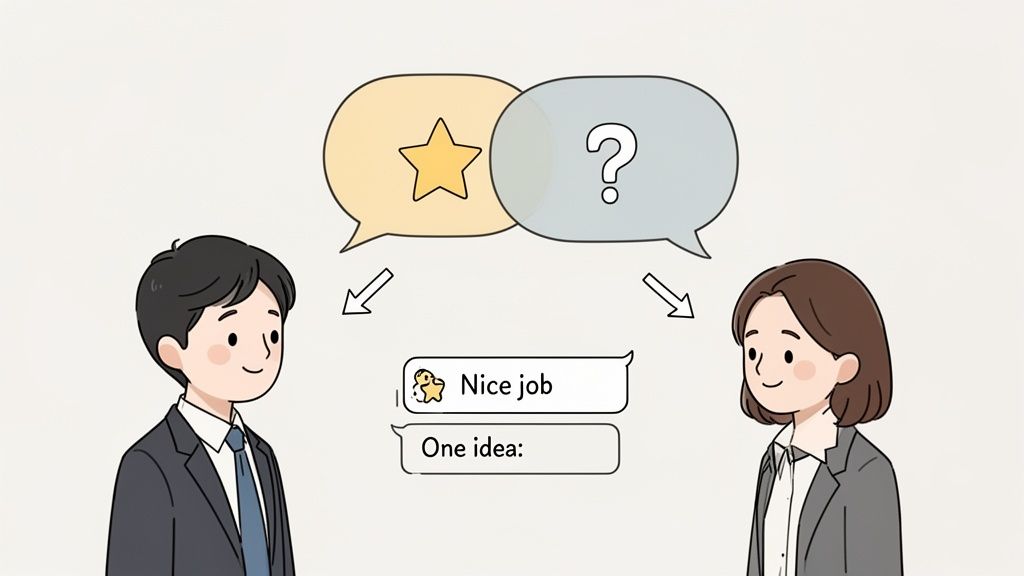
So, how do you actually do this? You don’t need some complicated system. It really boils down to mastering two simple kinds of conversations.
First up, public praise. Think about how you’d shout someone out in a team chat. The trick is to be super specific. Instead of a generic "Great job, Alex!" try something like, "Alex, that summary you posted saved the rest of us an hour of reading. Huge help." It’s a tiny shift, but it highlights exactly what you want to see more of without making anyone else feel awkward.
Second, there’s private redirection. When someone makes a mistake, the goal isn't to create a big, dramatic moment. It's just to correct the course, quickly and quietly. A simple direct message like, "Hey, can we sync up for five minutes about that client email? I have a quick thought," is all it takes to kick things off. The conversation itself should be just as direct and focused on what to do next, not on placing blame.
The goal is to lower the stakes. Feedback should feel as normal as asking, “Did you get my last message?” It’s just another part of the workflow.
When you master these small interactions, you completely drain the fear out of the feedback process. It becomes just another tool for getting things done, which is exactly what it should be.
Feedback Is a Two-Way Street
But that’s only half the story. Giving feedback is one thing, but creating an environment where you can get it back is just as crucial. The best managers I know don't just talk; they ask incredible questions.
They make it their business to find out what’s really going on. Instead of the classic “How’s it going?” they ask things like:
“What’s getting in your way right now?”
“Is there anything I can do to clear the path for you on this project?”
“What’s one thing that’s slowing you down this week?”
Questions like these do something really powerful. They flip the script from "Here's what you need to fix" to "How can we solve this together?" It shows your team that you see their performance as a shared responsibility, not just their problem to figure out alone.
Make It a Habit, Not an Event
This whole approach turns coaching into a natural extension of the workday. A quick chat to follow up on a task becomes a coaching opportunity. A question in a team channel becomes a chance to clarify expectations.
And this isn't just a hunch; it’s what people are asking for. Especially in distributed teams, 43% of remote employees prefer to have one-on-one meetings every single week. The payoff is massive: 51% of organizations that nail performance management see a direct boost in employee engagement, a stark contrast to the 15% of companies stuck in the old ways. You can read more about these performance management findings to get the full picture.
Making this shift isn’t about cramming more meetings onto your calendar. It's about changing the very texture of your conversations. It’s about building a culture where feedback is simply how we work—not something we have to brace ourselves for. If you're looking for more ideas to make this a reality, you might want to check out our ultimate guide to employee feedback strategies.
How to Run Check-Ins That People Actually Value
Even if you’re giving feedback all the time, a dedicated check-in still has its place. But its purpose shifts entirely. This isn't a top-down verdict; it's a calm, collaborative conversation about what’s next.
So many of these meetings end up feeling like a one-sided judgment, where a manager reads from a list of critiques while the employee just sits there and nods. That's a monologue, not a discussion. We can do a lot better.
The real goal here is to have a low-stress, high-value conversation that leaves both of you feeling aligned and energized for the road ahead. Think of it as a milestone on an ongoing journey, not the final destination.
Prepare by Briefly Looking Back
The best way to get ready for a check-in? Do almost nothing. Seriously. The real prep work has been happening all along, in every small conversation, every piece of praise, and every tiny course correction you've already had.
There should be zero surprises. If you're bringing up a performance issue for the very first time in a check-in, you’ve waited way too long.
Your only task before the meeting is to quickly scan the ongoing dialogue. Look through your team's shared space or chat history. What themes keep popping up? What wins have you celebrated together? What small hurdles did you overcome? This isn't about building a case against someone; it's just about refreshing your memory on the story so far.
A great check-in is 80% about the future and only 20% about the past. The past is just context for a much more important conversation about where to go from here.
This simple shift in focus is the secret to performance conversations that feel constructive, not critical.
The Right Questions Make All the Difference
Keep the structure of the meeting simple and human. The easiest way to guide it is with open, honest questions. Ditch the corporate jargon and just talk to the person sitting across from you.
Your main job is to listen more than you speak. Kick things off with questions that invite them to reflect and take ownership.
Here are a few conversation starters I’ve found work wonders:
“Looking back over the last few months, what are you most proud of?”
“What’s one thing you feel like you’ve really leveled up on?”
“Where did you feel stuck, or where could you have used more support from me?”
“Thinking about what's next, what’s one new skill you’re excited to develop?”
“What part of your job are you most fired up about right now?”
These questions do something powerful: they put your team member in the driver’s seat of their own development. The conversation immediately becomes about their growth and aspirations, which is way more motivating than just ticking boxes on a checklist of your expectations.
Documenting What Matters (and Only What Matters)
The check-in should end with clarity, not a mountain of paperwork. The outcome isn’t a score or a rating. It’s a simple, shared summary of the key takeaways and a rough plan for the next quarter.
This doesn't need to be some formal, signed-off document. It can be as simple as a short, shared note that captures the big-picture goals you both landed on.
For instance, a quick summary might look like this:
Key Takeaways & Next Steps
Focus: Keep owning the process for complex customer escalations—you're becoming the go-to expert here.
Growth Goal: Take the lead on creating the training module for the new software rollout.
Support Needed: I’ll set up a 30-minute chat with Sarah from engineering to get your questions answered before you start.
That’s it. It’s clear, actionable, and lives somewhere you can both easily find it again—like a pinned post in a dedicated space within a tool like Pebb. This turns the conversation into a living reference point that actually guides the work ahead, making the whole process feel like a true partnership.
What to Do When Someone Is Struggling
Look, even with the best system in place—crystal clear goals, regular check-ins, and ongoing coaching—sometimes a team member just won’t be hitting the mark. It’s one of the toughest and most awkward parts of being a manager. This is the moment when most companies wheel out the dreaded Performance Improvement Plan (PIP).
Let's just call it what it is: the PIP has a terrible reputation. Most people see it as a bureaucratic formality, the last stop on the way out the door. It feels less like a plan to improve and more like a paper trail for HR.
But what if we flipped that script? What if a PIP could be a genuine, good-faith effort to help someone turn things around?
This isn’t about being soft; it’s about being incredibly clear, honest, and supportive. It’s about giving someone a legitimate, fighting chance to get back on track. When you reframe a PIP as an act of support instead of a threat, the entire dynamic changes.
A Better, More Human Way to Handle Improvement Plans
A supportive improvement plan doesn't need to be some complicated, formal document. At its core, it's just a transparent agreement between you and your employee. It’s a structured conversation that gives them the clarity they desperately need to succeed.
Here’s how you can structure that conversation:
Pinpoint the Gap with Specifics: Vague feedback like "you need to show more initiative" is useless. Get specific. Try this instead: "Over the last month, the morning checklist wasn't finished by 9 AM on three separate occasions. That put the rest of the team behind schedule. The standard we all need to hit is having it done by 8:45 AM every single day."
Set Achievable Goals—Together: This has to be a collaboration, not a top-down mandate. Ask them directly, "What do you think is a realistic goal for us to work on over the next 30 days?" Work with them to define a few measurable targets.
Define Your Support: This is the most important part. You have to show you're in it with them. Ask, "What do you need from me to make this happen?" Their answer might be more frequent one-on-ones, some extra coaching on a specific skill, or even being paired with a mentor on the team. Your commitment has to be just as clear as the expectations you have for them.
Lock in Follow-Up Times: Don't leave things vague. Get a recurring 15-minute check-in on the calendar every week for the duration of the plan. This creates a predictable rhythm of accountability for both of you.
The key is to document everything and share it, not to build a case against them, but to create a shared roadmap you can both follow. These are never easy conversations, but approaching them this way makes a world of difference. For a deeper dive, check out our guide on how to manage underperforming employees for more on-the-ground tips.
Why This Approach Matters Now More Than Ever
Let's be honest, this kind of hands-on, supportive leadership is exactly what the modern workplace needs. The old-school model of saving all feedback for a once-a-year review just doesn't cut it anymore. Problems are left to fester for months, and by the time they're addressed, it's often too late. The data on this is overwhelming.
A recent study found that a whopping 89% of HR managers agree that continuous feedback is far more effective than traditional annual reviews. On top of that, 80% of employees say they actually prefer getting feedback right away. This massive shift is causing 81% of HR leaders to completely overhaul their old systems, because they know that ineffective reviews can cost companies millions in lost productivity. You can see more of these performance management statistics and understand the full picture.
When you tackle performance issues head-on with directness and genuine support, you're doing more than just trying to solve a single problem. You're sending a powerful message to your entire team: that you are invested in their success, even when the going gets tough. You're showing them that you're a manager who coaches, not just a boss who judges.
And that kind of trust? It's priceless.
Common Questions About Performance Management
Once you decide to ditch the old, rigid way of managing employee performance, a ton of practical questions start to surface. That’s actually a great sign. It means you’re thinking through the nitty-gritty of how this works in the real world.
We get these questions all the time from managers making this exact shift. Here are some of the most common ones we hear, along with some straight-up, honest answers.
How Do I Manage Performance for a Remote Team?
Managing a team you can’t see every day really boils down to one word: intentionality. You can’t just rely on physical presence or those casual chats in the hallway anymore. You have to be much more deliberate about setting clear expectations and maintaining a steady rhythm of communication.
The core principles are exactly the same—clarity and continuous dialogue—but the execution requires more conscious effort. Your focus has to shift from tracking hours logged to celebrating outcomes achieved. It’s a subtle change in mindset, but it makes all the difference.
Here are a few things that actually work:
Create a single source of truth. Use a shared digital space to document team priorities, key goals, and weekly focus areas. This ensures everyone is rowing in the same direction, even if they’re scattered across different time zones.
Embrace asynchronous updates. A quick daily or weekly post where everyone shares what they’re working on and where they’re stuck can be more valuable than a dozen meetings. It keeps everyone in the loop without a ton of ceremony.
Protect your one-on-one time. For remote teams, one-on-ones are sacred. This is your primary channel for coaching, uncovering roadblocks, and just connecting on a human level. Don’t let them get canceled.
At the end of the day, trust is the currency of remote management. You have to trust your team to do their work, and they have to trust you to have their back. A huge part of that is acknowledging the unique challenges of remote work, like isolation, and making well-being a core part of your performance conversations.
What Are the Right Metrics to Track for Performance?
The best performance metrics are simple, directly tied to a business outcome, and mostly within the employee’s control. It's so easy to get lost in a sea of data, so the key is to fight the urge to track absolutely everything.
The question I always come back to is this: “If this number gets better, does the business get better?” If the answer isn’t a clear and immediate “yes,” then you’re probably looking at a vanity metric.
Let’s get specific.
For someone in customer support, you might track their Customer Satisfaction (CSAT) score or average first-response time. These numbers directly reflect the customer experience.
For a warehouse team member, it could be their order accuracy rate or the number of units picked per hour. These are tied directly to operational efficiency.
For a designer, think about project milestones met on time and the satisfaction scores from internal stakeholders who use their work.
The real magic isn’t in the numbers themselves. The data is just there to spark a conversation. It helps you spot trends, but it’s the dialogue that uncovers the “why” behind the numbers.
Track a few meaningful indicators, not a dozen, and talk about them as part of your regular check-ins. A metric is just a starting point for a conversation, not the final verdict on someone’s performance.
How Do I Give Tough Feedback Without Crushing Morale?
This is the one that keeps most managers up at night. Let’s be real: no one enjoys these conversations. But tough feedback, delivered with care, is one of the most supportive things you can do for someone on your team.
The feedback lands so much better when it comes from a place of genuine trust and support. If you’ve been having regular, low-stakes conversations all along, you’ve already built the foundation you need for the tough stuff.
First, deliver it privately and soon after the event. The longer you wait, the bigger the issue becomes in everyone’s mind. When you do talk, be incredibly specific about the action or behavior, not the person.
For example, don’t say, “You were careless with that report.”
Instead, try something like this: “When the report was sent to the client with those errors, it created a bottleneck for the next team and made us look disorganized. Can you walk me through your process for double-checking the data before you hit send?”
Notice the structure here:
State the specific action: "The report was sent... with errors."
Explain the impact: "It created a bottleneck..."
Ask a curious question: "Can you walk me through your process...?"
This approach does a few crucial things. It separates the mistake from the person’s identity, it clarifies why it matters, and it immediately shifts the conversation into a collaborative, problem-solving mode.
The goal is to correct the issue while preserving the person’s dignity. Always end the conversation with a clear path forward and a quiet expression of your confidence in their ability to improve. When formalizing the process of addressing poor performance, understanding how to implement effective Performance Improvement Plans can provide a clear and structured way to offer this support.
Managing employee performance doesn't have to be a bureaucratic nightmare. By unifying communication, operations, and engagement in one place, Pebb helps you turn feedback into an everyday conversation. Create a culture of clarity and support where everyone knows what a great job looks like. See how Pebb can help your team do their best work at https://pebb.io.
