
A Confidentiality Agreement That Actually Builds Trust
Get a clear, ready-to-use confidentiality agreement template for employees, plus our practical advice on introducing it without the drama.
Dan Robin
Here's an employee confidentiality agreement template you can use. But let's be honest, a template is just a starting point. The real work is creating a document that builds trust, not fear—and that’s where most of them fail.
Why Most Confidentiality Agreements Create Fear, Not Trust
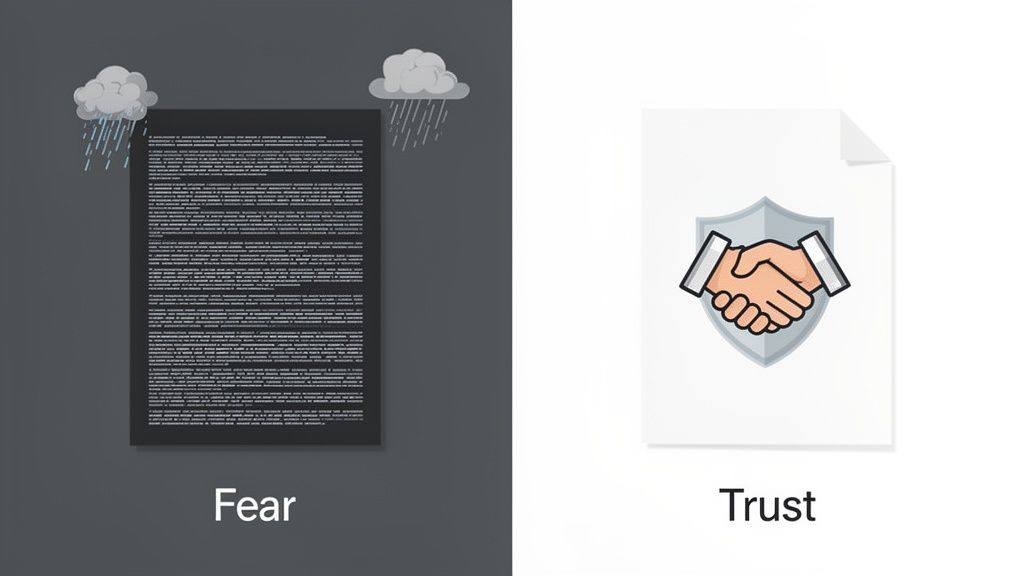
Think about the last time you signed one. It was probably a dense, intimidating wall of text. Full of legalese. Most of us just skim it on our first day, sign, and hope for the best.
But what good is a document no one reads or understands? An agreement loaded with jargon and printed in tiny font doesn't scream "partnership." It screams "we don't trust you." As a recent California Supreme Court case highlighted, intentionally hard-to-read agreements are often viewed with more suspicion because they can hide unfair terms. They create anxiety, not clarity.
The Problem with Boilerplate Fear
I still remember the first confidentiality agreement I signed. It was a multi-page beast that felt completely disconnected from the job I was so excited to start. It vaguely mentioned protecting "all proprietary information" but offered zero context. It was a classic legal CYA move, not a real attempt to communicate.
The goal shouldn't be to get a signature. It should be to build a shared understanding of why protecting information matters. It's about laying a foundation of respect, not just rattling off rules.
The old way is broken because it starts from a place of mistrust. It assumes the worst in people. It operates on the flawed idea that a scary legal document is the only thing keeping someone from spilling company secrets.
A better agreement flips this. It serves its legal purpose quietly while focusing on something more powerful: shared responsibility. It's an educational tool that explains, in simple terms, what's sensitive and why protecting it helps the whole team succeed.
This shift—from a rigid legal obligation to a shared purpose—is everything. It's the difference between an employee who's terrified of making a mistake and one who's motivated to do the right thing. One is driven by fear, the other by trust. We’ll choose trust every single time.
Our Annotated Confidentiality Agreement Template
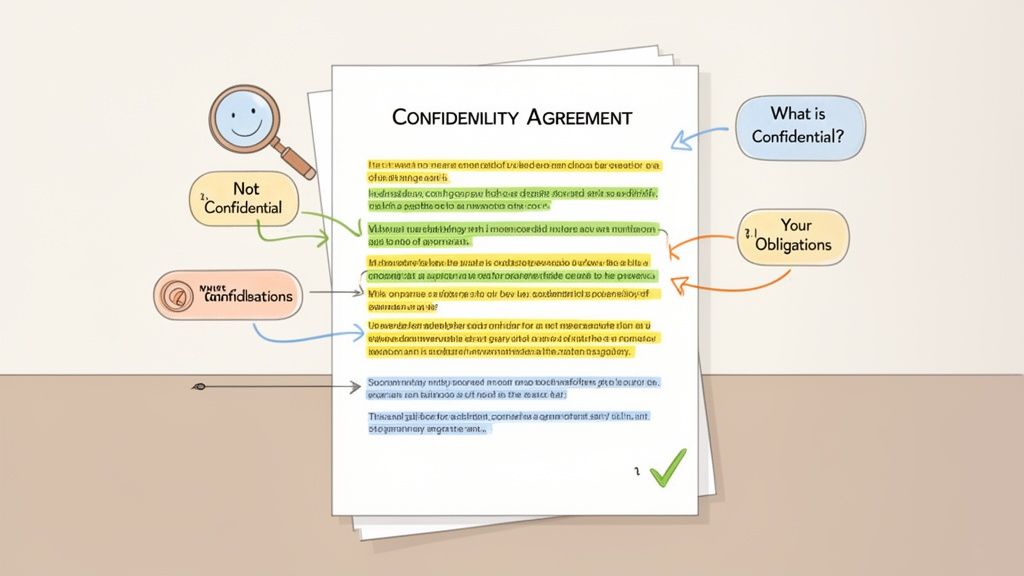
Let's get into it. What follows isn't another copy-paste template. It’s the result of years of refinement—an agreement that’s clear, fair, and actually works. I’ve found that overly aggressive legal documents just put people on edge. The goal here is mutual understanding, not intimidation.
Instead of just handing you a wall of text, I’m going to walk you through it, section by section. I'll explain the why behind each part, what it means in practice, and how it protects both your company and your team.
By the end, you won't just have a solid document. You'll understand the thinking behind it, so you can adapt it to your own business with confidence.
The Foundation: A Simple Preamble
Most agreements kick off with dense legalese about parties and dates. I prefer to start with a simple statement that sets the right tone.
This agreement outlines our shared commitment to protecting the company's confidential information. We trust you, and this document is here to provide clarity on what that means for everyone.
This little paragraph isn't a legal necessity, but it’s powerful. It immediately frames the agreement as a tool for shared understanding, not a threat. It says, "We're on the same team, and this is how we look out for each other."
1. What Is Confidential Information?
This is the core of the agreement. If you’re vague here, the whole thing falls apart. You can't just declare "all company information" confidential. That's a rookie mistake that’s both unenforceable and unfair. People need to know exactly what they can and can’t share.
I've found the best way to do this is with clear, specific categories.
Confidential Information includes, but is not limited to:
Financial Information: Internal revenue numbers, pricing models, budgets, and investor decks.
Product Information: Unreleased features, source code, product roadmaps, and proprietary designs.
Customer Information: Customer lists, contact details, and any non-public data shared by your clients.
Marketing & Sales Information: Upcoming campaigns, internal market research, and sales playbooks.
Business Operations: Internal processes, vendor contracts, and long-term strategic plans.
Why this works: Listing categories makes an abstract idea like "confidentiality" tangible. It gives your team concrete examples they can connect to their work. It's the difference between telling someone to "drive carefully" and telling them to "watch out for that patch of ice on the bridge." One is helpful; the other is just noise.
2. What Is Not Confidential Information?
This section is just as important as the last one. It’s a sign of good faith. It shows you're being reasonable and not trying to lay claim to your employees' general knowledge or skills.
Here’s how we frame it.
This agreement does not apply to information that:
Is or becomes publicly known through no fault of your own.
You already knew before joining us, which you can show with your own records.
You developed on your own time, without using any of our confidential information.
Is shared with you by another party who isn't bound by a confidentiality duty to us.
Including this is a huge trust-builder. It signals that you respect your team's prior experience and their right to use public knowledge. It also shows a court you’re not overreaching, which matters.
3. Your Obligations: Protecting Our Information
Now we get to the employee's responsibilities. Again, the key is direct language focused on actions, not abstract legal duties.
You agree to:
Keep it Secret: Do not share, publish, or disclose any confidential information to anyone outside the company without our express written permission.
Use it for Work: Only use confidential information to do your job for the company.
Protect it: Take reasonable steps to keep confidential information secure, just as you would with your own sensitive personal data.
See how simple that is? We aren't asking them to build a digital Fort Knox. We're asking for common sense. That phrase “take reasonable steps” is important—it sets a standard that is high enough to be meaningful but flexible enough to be achievable. It shows you trust their judgment.
For some businesses, like law firms or healthcare providers, this definition needs to be even more specific to meet industry rules. If you’re in a specialized field, you might want to start with a more detailed document. You can download a complete and Word-friendly employee confidentiality agreement template to see a good example.
4. When You Leave The Company
People move on. It’s a normal part of business. This section makes it clear that the duty to protect sensitive information doesn't end when they hand in their laptop.
Your responsibility to protect our confidential information continues even after your employment with us ends. When you leave, you agree to return all company property, including any documents or devices containing confidential information.
This is a standard clause, but it’s critical. It ensures a clean separation and reinforces that the information they accessed was a tool for their role, not a personal asset. It’s a simple, non-confrontational reminder of a professional duty that lasts.
5. The Important Legal Details
Finally, every good agreement needs a few boilerplate clauses to make it legally sound. But even these can be written in plain English. We group them at the end.
Entire Agreement: This document is our whole agreement on this subject.
Governing Law: This agreement will be interpreted under the laws of [Your State/Country].
Severability: If a court finds one part of this agreement is unenforceable, the rest of it still stands.
That last point on severability is more important than ever. Laws are always changing—think of recent rules like Alabama's "Trey's Law," which impacts confidentiality clauses around sexual abuse claims. A severability clause is your safety net, ensuring your entire agreement isn’t tossed out because one part becomes invalid.
This whole approach is built on one belief: clarity inspires confidence. An employee who understands their responsibilities is far more likely to honor them than one who's just trying to avoid a legal minefield. This is about more than protection; it's about building a culture of trust from day one.
A great template is a starting point, not the finish line. We gave you our plain-English template because it’s a solid foundation. But your business is unique, and your agreement needs to reflect that.
I've seen so many companies make the same mistake: they copy-paste a generic agreement and call it a day. The result? A document that feels disconnected from their actual work. It’s confusing for employees and harder to enforce in court. This isn't about more legalese; it's about making it crystal clear.
How to Customize the Template for Your Business
Let's walk through how to take this template and make it truly yours.
Define What Is Actually Confidential
First, get specific about what "confidential information" means for your business. Vague terms like "proprietary data" are meaningless without context.
Seriously, sit down with your team. Pinpoint the exact information that gives you a competitive edge.
Run a restaurant with a secret recipe for your famous sauce? Name it.
Built a software company around a unique algorithm? That goes in.
Have a marketing agency with a hand-curated list of industry contacts? That's your gold.
The goal is to bridge the gap between abstract legal concepts and the reality of someone's job. When a new hire reads the agreement, they should immediately connect the words on the page to the work they'll be doing.
This level of detail makes an agreement stick. A court is far more likely to protect "customer sales data from the last 24 months" than a vague claim on "all business information."
To help you get specific, think about what's critical in your sector. Every industry has its own "secret sauce."
Key Customization Points by Industry
Industry | Examples of Confidential Information | Key Considerations |
|---|---|---|
Tech/SaaS | Source code, product roadmaps, user data, server architecture, unreleased features. | The pace of innovation is fast. Be clear about what's a trade secret vs. general industry skill. |
Healthcare | Patient records (PHI), billing practices, research data, pharmaceutical formulas. | Compliance with regulations like HIPAA is non-negotiable and must be explicitly referenced. |
Retail/E-commerce | Supplier lists, pricing strategies, customer purchase history, inventory levels, sales data. | Customer lists and purchasing behavior are often the most valuable assets to protect. |
Professional Services | Client lists, project proposals, billing rates, proprietary methodologies, marketing plans. | Protecting client confidentiality is just as important as protecting your own business secrets. |
Manufacturing | Proprietary manufacturing processes, schematics and designs, supply chain logistics, cost structures. | Focus on the unique "how" of your operation that competitors can't easily replicate. |
Getting this part right is 80% of the battle. It ensures everyone is on the same page from day one.
Tailor the Agreement to Different Roles
Not all employees handle the same information, so why would they all sign the same agreement? A one-size-fits-all approach might seem simple, but it’s not smart.
Think about it: the sensitive information a frontline cashier needs to protect is worlds away from what your CFO has access to. A cashier's world revolves around customer credit card details and daily sales totals. Your finance chief is dealing with long-term financial projections, potential acquisitions, and sensitive investor communications.
Creating different versions of your agreement based on roles or departments adds a powerful layer of relevance.
For your sales team: Zero in on the confidentiality of client lists, pricing models, and the sales pipeline.
For your engineering team: The focus should be on source code, product roadmaps, and unreleased features.
For your marketing team: Highlight campaign strategies, market research, and brand messaging that hasn't gone public yet.
This doesn't mean you need dozens of unique documents. You can have a core agreement and then use simple addendums or tweaked versions for teams with access to the most sensitive data. Taking this extra step shows your team you’ve put real thought into the process. That builds respect.
If you're wondering how to keep all these versions straight, our guide on document management best practices has some practical tips for keeping everything organized.
Give It a Final Sanity Check
Before you roll out your new agreement, run through a quick checklist. Asking these questions now can save you a world of headaches later.
Definition Check: Is our definition of "confidential" full of specific examples from our industry (e.g., patient records in healthcare, supplier lists in manufacturing)? Have we been clear about what sets our business apart?
Role-Fit Check: Does this agreement actually match the information this employee will see? Is it too broad for a junior role or too generic for an executive?
Exclusions Check: Did we clearly state what is not confidential? This is crucial for fairness and includes public knowledge, skills the employee already had, and anything they create on their own time without using company resources.
Time & Scope Check: Are any time-based restrictions reasonable? While the core duty of confidentiality is ongoing, some clauses might have time limits that need to make sense in a legal context.
Once you’ve refined the language, getting a second opinion is always a good move. For a final polish, specialized tools offering AI contract review can be surprisingly helpful for spotting potential issues.
Ultimately, a customized agreement sends a powerful message. It tells your team you see them as individuals and that you’ve taken the time to create a document that is fair, specific, and respectful. It’s a document born from consideration, not just compliance.
How to Introduce the Agreement Without Sparking Panic
Let’s be honest. Even the most carefully written agreement is worthless if you botch the delivery. An email with the subject line, “Action Required: Sign Confidentiality Agreement,” is guaranteed to trigger anxiety and a storm of nervous Slack DMs.
I’ve seen it happen. A company has the best intentions, but the rollout feels cold and transactional. It puts everyone on the defensive.
There’s a much better way.
Lead With the ‘Why,’ Not the ‘What’
The secret to introducing any new policy is simple: start by explaining why before you get into what. This isn’t just about checking a legal box; it’s about reinforcing trust. The whole conversation needs to be framed around shared responsibility.
You're not dropping a new rule from on high. You're gathering the team to protect something valuable you've all built together. Whether that’s your product, your customer list, or your internal workflows, that information is the result of everyone’s hard work.
So, when you roll out the agreement, start a real conversation. Explain what it protects and why that protection benefits everyone. It ensures a level playing field and protects the company's future—which protects everyone's jobs.
This simple shift changes the vibe from a corporate mandate to a collaborative pact. It’s an invitation to be a guardian of the business, not just an employee.
A Rollout Plan Built for People
Once you’ve set the stage with the "why," the actual "how" needs to be painless. Chasing signatures and dealing with stacks of paper is a headache. It's 2024. We can do better.
A simple, organized process makes all the difference. The goal is to make it easy for employees to review, understand, and acknowledge the agreement without it feeling like a disruption. This starts with how you prepare the document itself, which usually falls into three phases.
Here’s a look at that customization workflow.
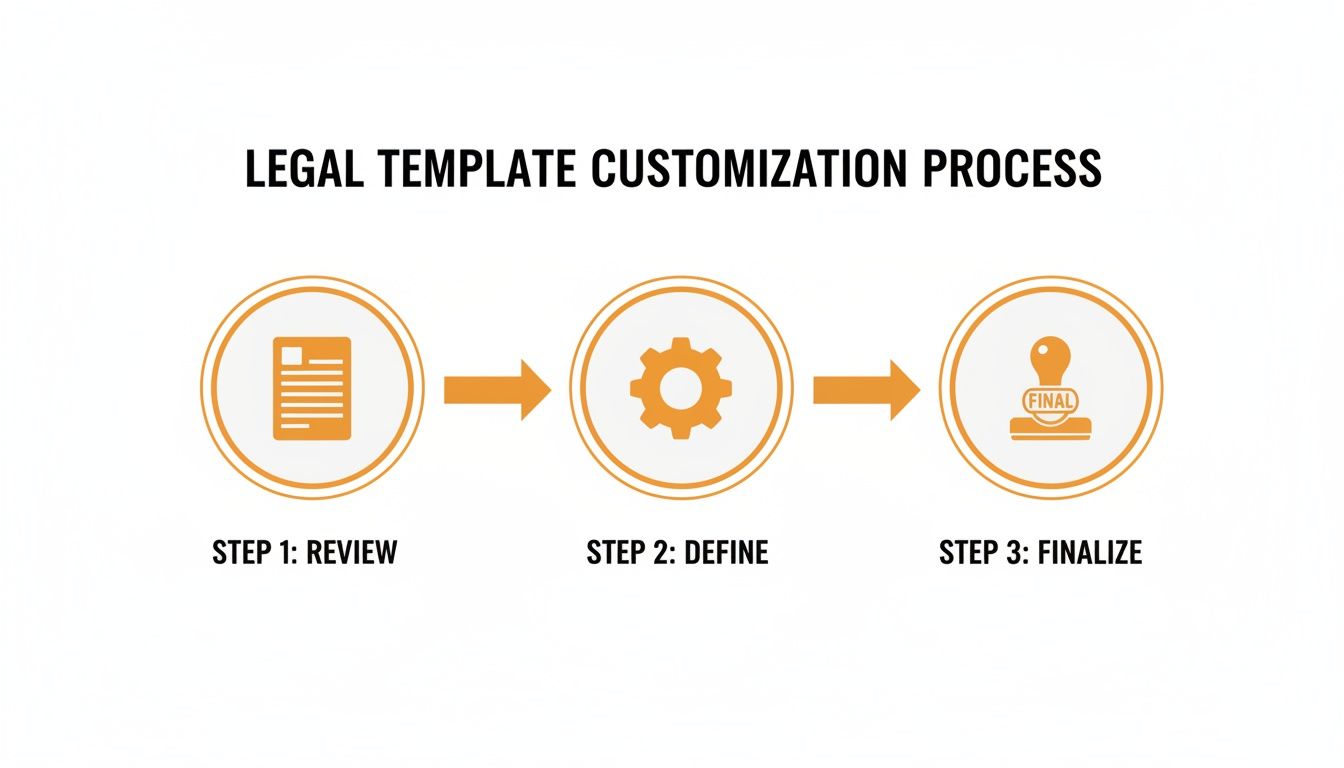
Following this flow—Review, Define, and Finalize—ensures your document is thoughtfully prepared long before your team ever sees it. That prep work is the real foundation of a smooth rollout.
Your rollout isn't just an admin task. It’s a tangible demonstration of your company culture. A respectful, transparent process says more about your values than any mission statement ever could.
A modern approach uses tools that show you respect people's time. Imagine sending the agreement as a company-wide Update in an app like Pebb. Your team gets a notification, reads the friendly explanation you’ve written, and can review and acknowledge the document right from their phones. No printing, no scanning, no stress.
This is the kind of thoughtful process that builds confidence. If you're looking for more tips on setting up these foundational documents, our guide on how to create an employee handbook people actually want to read is a great place to start.
Making Acknowledgment Effortless
The last piece is getting confirmation without creating more busywork. The beauty of a digital rollout is that the admin side takes care of itself.
When an employee acknowledges the agreement, their confirmation is logged automatically. This creates an organized, easy-to-search record you can reference anytime. No more digging through filing cabinets. It’s all right there.
The agreement doesn’t have to be a document that’s signed once and forgotten. By storing it in a central place like Pebb's Knowledge Library, it becomes a living resource that's always available.
This simple step turns a static legal document into an active tool for reinforcing your culture of trust.
Ultimately, how you introduce your agreement says a lot about how you see your team. Treat it as a conversation, not a command. Make the process simple and respectful. When you do that, you’re not just getting a signature—you’re earning trust. And that’s infinitely more valuable.
Living Your Commitment to Confidentiality
Okay, everyone has signed the agreement. Box checked, right? Not even close. Getting the signatures is just the starting line.
The real challenge—where most companies stumble—is making the document mean something in the day-to-day grind. A signed agreement nobody thinks about again is worthless. It’s about building a culture where protecting information is second nature, not an afterthought.
So, how do you make it stick? Not by sending stern, all-caps emails or creating a culture of fear. It’s about making confidentiality a shared responsibility people actually care about.
From Compliance to Culture
The goal is to shift everyone’s thinking from "I have to do this" to "I get why this is important." This isn't something you achieve with a single meeting. It’s built through small, consistent actions over time.
Here's what I've found works:
Make it ridiculously easy to find. Your confidentiality policy shouldn't be a secret document buried five folders deep. We use Pebb’s Knowledge Library to keep ours front and center. When someone asks about sharing project info with a freelancer, anyone can link them to the exact clause. It becomes a helpful guide, not a dusty rulebook.
Treat questions as opportunities. When an employee asks, "Is it okay if I share this?"—that's a huge win. Resist the urge to give a simple yes or no. Instead, walk them through the thinking. "Great question. Let's look at it. Because this involves unreleased financial data, it falls under section 3.2. Here's why that's protected..." These little moments do more to reinforce the policy than any memo ever could.
This approach breathes life into the agreement. It stops being a static PDF and starts being a practical tool for daily decision-making. If you're looking for more ideas on how to organize your company's important documents, our guide on building a policy and procedure manual has some great tips.
Reinforcing Trust in Daily Work
True confidentiality isn't a task on your to-do list. It’s woven into how you run meetings, manage projects, and talk with partners. It’s a collective habit.
One of the biggest hurdles is the fear of making a mistake. When your team members feel like they're walking on eggshells, they can’t do their best work. Your job is to give them clear guardrails so they can move forward with confidence.
When your team believes you trust them to make the right call, they almost always will. The agreement simply becomes a written reflection of that trust, clearly defining the guardrails so everyone feels safe and confident.
I’ve learned to handle questions with curiosity, not suspicion. When someone pauses and thinks before sharing a file, that's a sign of a healthy culture. It shows they're actively considering their responsibility.
Ultimately, that piece of paper is just the beginning. The daily conversations, the easy access to clear guidelines, and the trust you place in your people are what will truly protect your most valuable information. When your team feels a sense of ownership, the agreement isn't a set of rules they have to follow. It’s a shared commitment they’re proud to uphold.
Frequently Asked Questions
Even the best confidentiality agreement will spark questions. That’s a good thing. It means your team is taking it seriously. We've heard just about every question in the book, so we’ve put together some straightforward answers to the ones that come up most often.
What Makes a Confidentiality Agreement Legally Enforceable?
When it comes to enforceability, courts usually boil it down to one word: reasonableness. A judge wants to see if the agreement serves a legitimate business purpose—like protecting actual trade secrets—rather than just being a heavy-handed attempt to stop someone from finding another job.
This is exactly why overly broad agreements often backfire. An agreement that tries to label everything as confidential is legally weaker than one that is clear and specific. The scope has to be reasonable in three key areas:
Time: How long does the obligation to keep information secret last?
Geography: Does it apply globally or only in a specific market?
Information: What specific types of information are covered?
That’s why our template uses plain language and focuses on clearly defining what’s confidential (and what isn’t). But laws vary from state to state. A final check-in with a local legal expert is always a smart move.
Do We Need a New Agreement for Existing Employees?
This is a great question. The short answer is yes. When you introduce a new or updated confidentiality agreement, it's best to have everyone sign it—new hires and current team members alike. This creates consistency across the company.
For new hires, it’s just part of their onboarding. For your existing employees, you need to be mindful of a legal concept called "consideration." In simple terms, it means you have to provide something of value in exchange for their new signature.
"Consideration" doesn't always mean a cash bonus. In many places, the person's continued employment is considered enough.
The most important part is communication. Explain why you’re updating the agreement, frame it as a way to ensure fairness and clarity for everyone, and give people time to review it. A human-first approach makes the process go much more smoothly.
How Is This Different From a Non-Compete Agreement?
This is a critical distinction. Think of it this way:
A confidentiality agreement protects your company’s information. A non-compete agreement attempts to control an employee’s future career.
A confidentiality agreement (or NDA) is purely focused on preventing an employee from sharing your private data—client lists, financial projections, or proprietary code. It’s about protecting what’s yours.
A non-compete, on the other hand, restricts an employee from working for a competitor for a set period after they leave. These agreements are facing major legal challenges and have been banned in some states because they can unfairly limit a person's ability to earn a living. Confidentiality agreements are far more common and almost universally seen as a standard and reasonable way to protect a business.
What Happens if an Employee Refuses to Sign?
It’s rare, but it happens. If it does, your first move should be to de-escalate. A refusal usually comes from a place of confusion or fear, not defiance.
Start by sitting down with them for a one-on-one conversation. Walk through the agreement, explain the "why" behind each clause, and answer their questions openly. Reassure them that this is about creating mutual trust and clear expectations for everyone. More often than not, a calm, respectful conversation is all it takes.
If they still refuse, things get complex and depend heavily on local employment laws. For a new hire, you might withdraw the offer. For a current employee, it’s a much more delicate situation that could lead to termination, but this path is a legal minefield.
Before you even consider taking such a drastic step, you absolutely must consult with legal counsel to understand your risks and obligations.
Managing company policies, getting acknowledgements, and keeping everything organized shouldn’t be a source of stress. Pebb brings all your team communication and company knowledge into one simple, modern app that everyone loves to use. See how you can build a more connected culture and streamline your operations at https://pebb.io.
