
Untangling the Wires: A Guide to Calmer Communication at Work
Discover the types communication channels your team actually needs and build a calm, efficient system that reduces chaos.
Dan Robin
Let’s be honest. The way most companies talk is a mess. We’re drowning in a flood of Slack pings, endless email threads, and back-to-back video calls. Important information gets lost, context evaporates, and our frontline teams often feel like they’re on a different planet from the main office.
This isn't a new problem. I’ve lived it. I've watched good teams with good intentions get dragged down because their communication "tools" were actually making work harder. The answer isn’t another app. It’s a moment of clarity. We need to step back, understand the different types of communication channels, and start using them with intention.
The Mess We Made
This chaos started with good intentions. We adopted new tools to be faster, more connected. But instead, we created a state of constant, low-grade anxiety. One study found that the average employee toggles between apps over 1,200 times a day. That’s not productivity. It's digital whiplash. All those pings and alerts create the illusion of work while destroying our ability to actually think.
Here's the thing: our tools are working against us because they’re siloed. Think about how we split everything up:
Urgent questions go in a chat.
Formal announcements live in email.
Project updates get buried in a project management tool.
Team bonding happens in yet another channel.
This forces everyone—especially folks on the front lines who aren’t at a desk—to become digital detectives. Was that schedule change in an email? A chat? A task comment? The hunt is exhausting and pointless.
To fix this, we need to understand the rationale behind new communication platforms and the core problems they’re trying to solve. The answer isn't more channels. It’s smarter, more unified ones.
The problem isn't a lack of tools. It's a lack of a coherent system. We've optimized for speed at the cost of calm.
It's time for a simpler approach. One that serves everyone, from the front desk to the corner office. We need a single source of truth—a calmer, more organized space where work and talk can finally happen in one place.
The Single Biggest Factor: Speed
If you want to fix your team's communication, you need to grasp one thing: the difference between synchronous and asynchronous communication. This isn't jargon. It's the fundamental choice that dictates your company’s entire rhythm. Getting this right changes everything.
Synchronous is real-time. It’s the meeting, the video call, the tap on the shoulder. Everyone has to be there, at the same moment, paying attention. It’s a live phone call—it demands your immediate focus.
Asynchronous, on the other hand, is communication that doesn't need an instant reply. You send a message, and the other person responds when they’re ready. It’s an email, a project update, a post in a shared feed. It’s like sending a letter—the message waits for the recipient.
The Tyranny of the Urgent Ping
Most businesses today make a huge mistake: they treat everything like it’s urgent. We’ve become addicted to instant replies, defaulting to synchronous pings for things that should have been thoughtful, asynchronous messages.
This culture of interruption demolishes deep work. Research shows it can take over 23 minutes to get back on track after just one distraction. When your day is a series of pings, you aren't really working. You're just playing reactionary whack-a-mole.
For frontline teams, this isn't just an annoyance; it's operational chaos. A manager can’t hold a real-time meeting with people across three different shifts. But firing off endless texts just creates noise. An async-first approach isn't a luxury here; it's essential for a calm, functional workplace.
This simple decision tree can help you see where your own process might be breaking down.
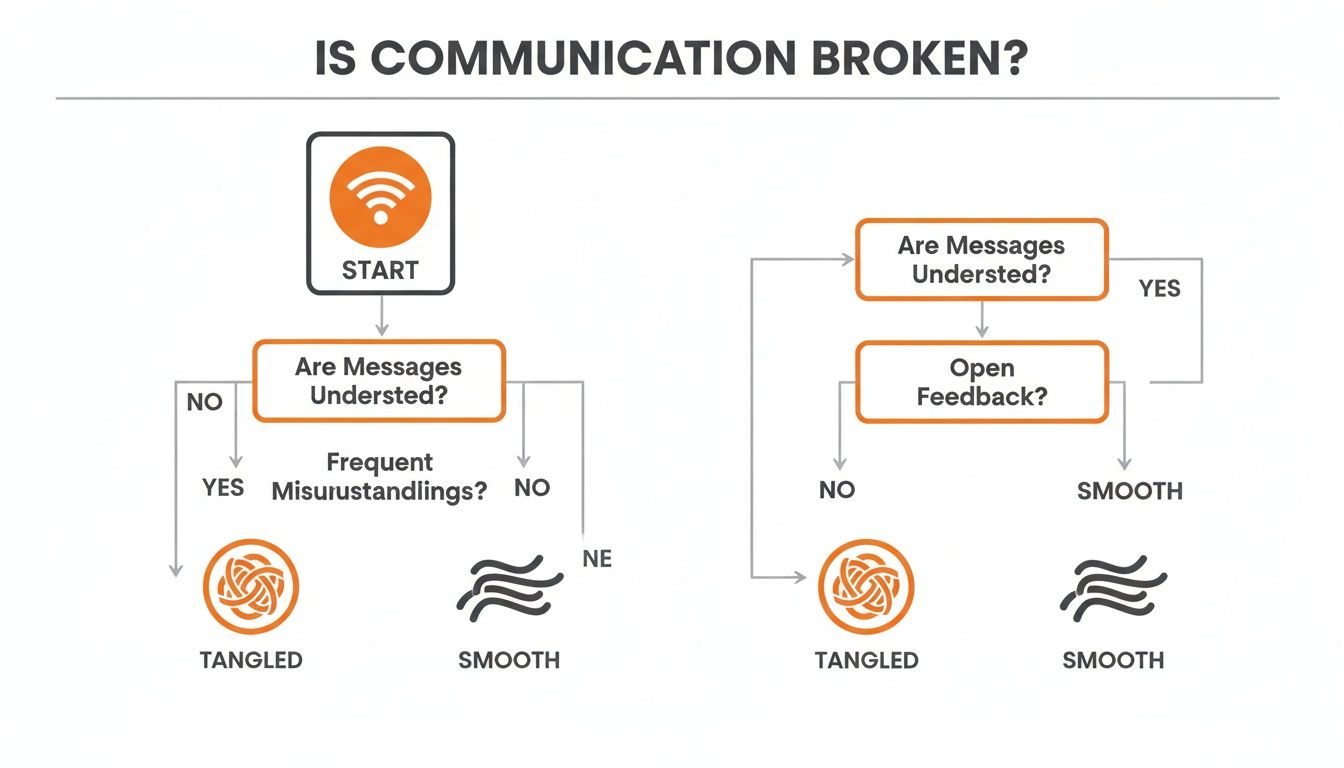
As the flowchart shows, when communication feels tangled, it's usually because the channel's speed doesn't match the message's true urgency.
How to Choose Your Speed
Deciding between a live chat and a documented post can be tricky. Here’s a simple guide to match the task to the right channel speed.
Task | Best Channel Type | Why It Works |
|---|---|---|
Brainstorming a new, complex idea | Synchronous | The rapid exchange of a live conversation sparks creativity and allows for immediate feedback. |
Announcing a company policy update | Asynchronous | It gives everyone time to read, digest, and ask thoughtful questions on their own schedule. |
Handling a true crisis (e.g., system outage) | Synchronous | You need immediate coordination and decision-making from everyone involved. Period. |
Sharing weekly progress reports | Asynchronous | It creates a documented record people can reference without interrupting their day for a meeting. |
One-on-one feedback and coaching | Synchronous | The nuance of tone and body language is critical for sensitive, personal conversations. |
Requesting feedback on a draft | Asynchronous | It respects the other person's focus, helping them provide higher-quality feedback when they're ready. |
By defaulting to asynchronous channels for anything that isn't on fire, you give your team the gift of uninterrupted time.
Embracing an Async-First Mindset
Let's be clear: this isn’t an anti-meeting crusade. It’s about making real-time collaboration a thoughtful choice, not a knee-jerk habit.
An async-first culture prioritizes clear, written communication that people can access on their own time. It builds trust and helps individuals manage their own focus. For a deeper look, check out this guide on unlocking the power of internal asynchronous communications.
An async-first culture isn't about being slow; it's about being thoughtful. It’s a commitment to protecting focus for the work that actually matters.
Shifting your team’s mindset is powerful. It replaces the anxiety of the green "active now" dot with the calm confidence that important information is documented and waiting for you. It’s not just about different tools; it’s about building a better way to work together.
The Four Fundamental Ways We Talk
It’s easy to get lost in all the apps and platforms. But if you strip away the tech, you find every interaction is built on just four fundamental methods. Understanding these isn't just theory—it's the key to making our digital tools feel human again.
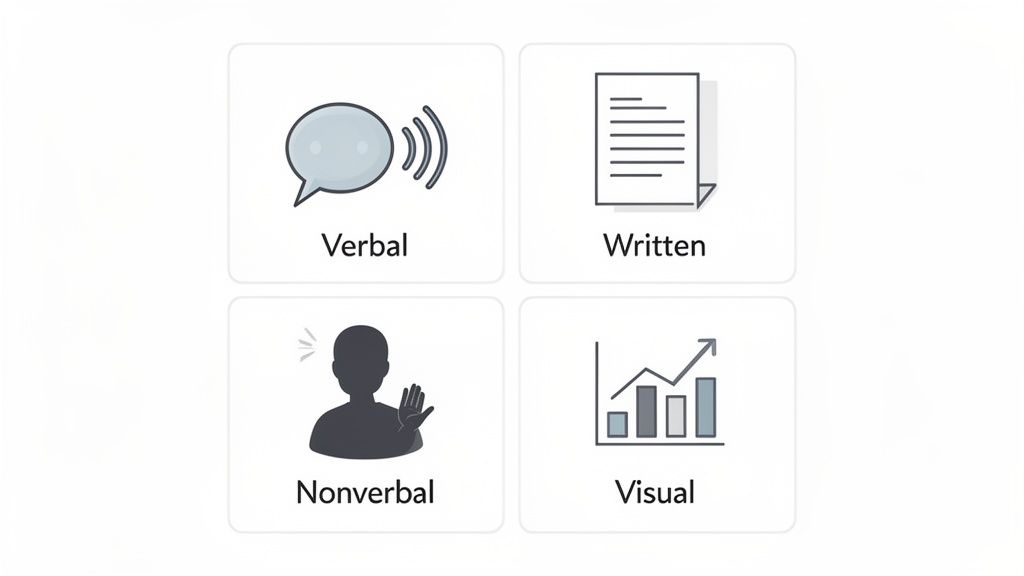
Think of these as the primary ingredients for every conversation, whether in a conference room or a chat window.
Verbal and Written Communication
Let's start with the two we know best. Verbal communication is the spoken word. It’s the phone call, the team huddle, the sensitive one-on-one. Its magic is in its immediacy and ability to convey tone and emotion. It's perfect for building relationships and working through tough problems.
Then there's written communication. This covers everything from a formal report to a quick chat message. Its superpower is creating a clear, permanent record. It gives people time to absorb information and craft a thoughtful response, which is why it’s the backbone of so much of our work.
The trap is relying only on written text. A quick message can’t convey a reassuring tone, and a long email will never capture the energy of a live brainstorm. But that's only half the story.
Nonverbal and Visual Communication
This is the stuff lost between the lines. Nonverbal communication is the whole world of body language, facial expressions, and gestures. It's the encouraging nod during a presentation or the visible excitement when a project succeeds. These cues often tell us more than the words themselves.
In fact, experts agree that a huge chunk of any message's impact comes from these nonverbal signals. Ignoring them is like trying to understand a movie with the sound off.
We often forget that what isn't said is just as important as what is. Trust is built on more than just words; it’s built on seen and felt understanding.
Finally, we have visual communication—charts, photos, diagrams, and videos. A simple graph can explain a complex trend far better than a five-page report. A quick video walkthrough can show a new hire how to use a tool more effectively than a dense manual. You can explore how the three core forms of communication work together to create richer messages.
The real skill is learning to blend them. A video message combines verbal words with nonverbal expressions. A project update with a chart uses both written and visual communication. When we're intentional about mixing these fundamental channels, we create a system that reflects how people actually connect. Work starts to feel natural again.
Formal vs. Informal: Finding the Balance
Every company I’ve ever seen operates on two tracks at once. First, you have the official broadcast layer—your formal communication channels. This is where the must-know information lives: policy changes, project plans, performance reviews. These channels carry authority and create a paper trail.
But that’s not where the real work of culture happens. Beneath that surface layer is a whole other world: the informal communication channels. This is the company’s lifeblood. It’s the team group chat where inside jokes are born, the quick DMs to check on a coworker, and the social threads where people connect as people, not just job titles.
The Mistake of Crushing Culture
Too many leaders see this informal chatter as a distraction. They try to stamp it out to "boost productivity," forcing every conversation into a rigid box. This is a massive mistake. You don't build trust or connection in a formal memo; you build it in the spontaneous spaces between the official work.
A 2024 McKinsey study highlighted that employees with a strong sense of community are drastically more engaged and likely to stick around. You can't manufacture community with top-down announcements. You grow it by giving people space to be themselves.
The secret isn’t to squash informal talk. It's to intentionally design a system that supports both. You need one place for official business and a separate, equally important space for human connection.
Designing for Both
This isn't about letting chaos take over. It’s about being deliberate. You absolutely need a dedicated, official channel for critical information that cannot be missed. Think of it as the town square—it's clear, authoritative, and for everyone. For frontline teams, this is non-negotiable for things like schedule updates or safety protocols.
At the same time, you need to carve out casual spaces where your team can breathe. This is your digital neighborhood cafe—a spot for conversation, celebrating wins, and just being together. Even the evolution of modern Voice Solutions reflects this, offering tools for both structured calls and quick, informal check-ins.
Here’s a simple way to think about separating them:
Formal Channels: Use these for anything that needs a permanent record or has to be seen by a specific audience. Examples include policy updates, project kick-offs, and final reports. These are often asynchronous to allow for careful review. Our guide on finding an alternative to email is a great place to start rethinking official messages.
Informal Channels: Keep these spaces for team bonding, quick questions, and creative spitballing. This is where your culture comes to life. A busy chat channel isn't a sign of distraction; it's the sign of a healthy, connected team.
By creating distinct homes for both types of communication channels, you bring clarity to everyone's day. Critical updates no longer get buried under memes, and your team's culture gets the room it needs to flourish. It’s a balance, but getting it right makes a company feel less like a machine and more like a community.
How to Unify Your Channels Without Losing Your Mind
So, you’ve got formal announcements, casual chats, and endless project updates. How do you keep it all from turning into a nightmare of pings and lost information?
The trap is thinking another tool is the answer. But adding more apps is what created the mess in the first place. The real fix is to stop scattering your work across different platforms and bring everything into a single, organized home. This is exactly why we built Pebb.
From Silos to a Single Source of Truth
Instead of chat in one app, announcements in another, and tasks in a third, you bring them all together. We created something called Spaces to do this. A Space is just a dedicated digital HQ for a specific team, project, or even a physical location.
Inside that one Space, your team gets everything they need:
An informal chat for quick questions and daily banter.
A dedicated place for formal posts that won’t get buried.
A shared file library for crucial documents and guides.
A task manager to see who’s doing what.
A team calendar for shifts, meetings, and important dates.
This isn’t about cramming more features on a screen. It’s about bringing back context. When conversations and the work itself live in the same place, everything is suddenly easier to find. Everyone, from the frontline crew to the leadership team, is finally on the same page.
For instance, a project team’s Space can hold their chat, files, and task board, keeping every single thing related to that project in one neat hub.
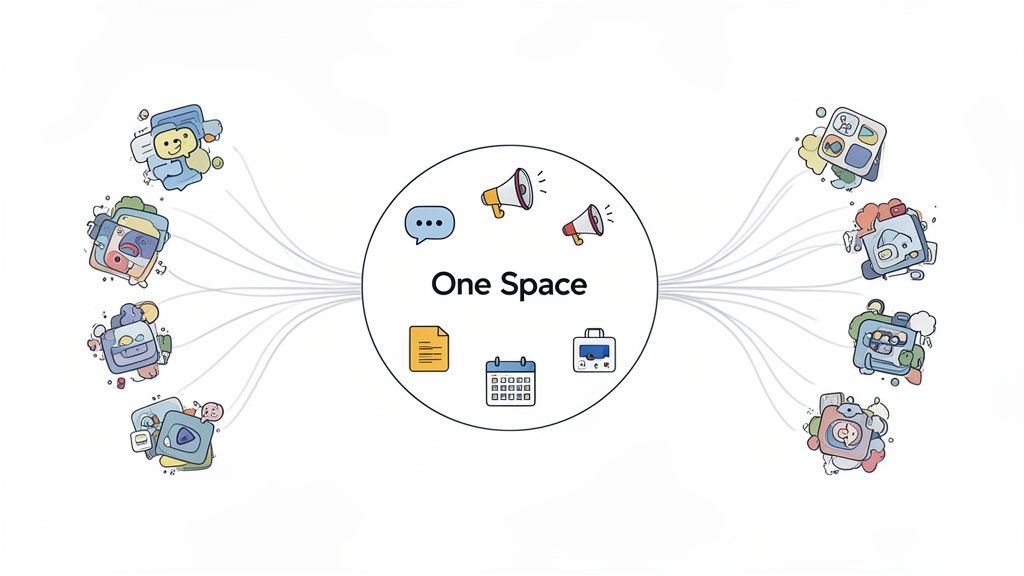
A single Space can house multiple tools—like Chat, Posts, and Tasks—to create that single source of truth everyone talks about. You’re no longer digging through three different apps to find a file someone mentioned in a chat. It’s all right where you’d expect it to be.
The goal is to make context effortless. When a conversation about a task happens right next to the task itself, you eliminate the confusion that comes from jumping between fragmented tools.
Unifying the different types of communication channels isn't about making everyone talk the same way. It's about creating a predictable, organized environment where every kind of communication has its own logical place. It’s a simple shift, but it’s the key to a calmer, more productive way to work.
Building a Calmer Way to Work
Let’s be real. Getting your communication right isn’t just about boosting productivity metrics. It’s about sanity. It’s about building a system that respects people’s time and fiercely protects their focus.
For your frontline teams—the ones not glued to a computer—a solid communication system means getting critical information without being chained to a device. It means they can trust that important news will find them, so they don’t have to waste energy hunting it down.
This Is a Cultural Decision
When you get this right, you see the results almost immediately. Fewer interruptions. Fewer pointless meetings. More long stretches of deep, focused work—the kind that actually moves the needle. When you cut through the noise, you get clarity.
Choosing the right communication channels isn't just a technical decision; it's a cultural one. It's a clear statement about what your company values—be it focus, respect, or transparency.
Being intentional about how your team connects is so much bigger than just streamlining operations. You aren't just shuffling information around more efficiently. You're building a fundamentally better, more humane place to work.
More Than Just Operations
Think of it as designing an environment, not just a process. When you create spaces where both focused work and real human connection can thrive, you build a resilient, engaged team. A company where people feel seen, respected, and trusted is a company where they want to stay.
By deliberately choosing how your team communicates, you're laying the groundwork for a workplace that feels less like a frantic sprint and more like a steady, purposeful journey. That’s a calmer way to work. And frankly, we all deserve that.
A Few Common Questions
We get it. Changing how an entire company communicates is a big deal. It's not just swapping software; it's changing habits. Let's walk through a few common questions we hear.
What’s the biggest mistake companies make?
Hands down, it's relying on synchronous channels—pings and meetings—for everything. This creates a culture of constant interruption where no one has space for deep work. It’s no wonder a staggering 73% of employees feel pressured to reply to messages instantly, no matter what they're doing.
The fix? Shift your team's default to "async-first." Make posts, comments, and tasks your go-to for daily work. Save real-time chat for things that are truly urgent or complex.
How can I convince my team to use fewer tools?
You can't force it. You have to show them a better way. The goal isn't to take tools away; it's to replace a handful of clunky apps with one unified platform that makes their day easier.
My advice? Start small. Pick one pilot team and move their essential workflows into a single, shared space. Once they feel the relief of not juggling three apps to get one thing done, their success story will be your most convincing argument.
People don't resist change; they resist ambiguity and inconvenience. Show them a clear, simple path forward, and they’ll walk it with you.
Are formal or informal channels more important?
It's a trick question. You absolutely need both. They play different but equally crucial roles.
Formal channels provide a single source of truth. But informal channels are where culture is born. It's where trust, camaraderie, and real relationships are built. A great company has dedicated spaces for both. If you ignore the informal, your company feels cold. If you let informal chaos take over, no one knows what's important. The best tools give you distinct spaces for each, all under one roof.
Ready to build a calmer, more organized way to work? See how Pebb unifies all your communication channels into one simple app. Learn more at Pebb.io.
