
Author: Ron Daniel
Employee Training for Incident Reporting Compliance
Train employees on incident reporting with clear roles, what to report, documentation steps, practice drills, and tools to meet OSHA and state requirements.
Have you ever seen a minor workplace mishap that could’ve been prevented if someone had spoken up? I remember a story from one of our warehouse teams. A loose cable caused a near trip, but no one reported it. A week later, someone did trip, leading to an injury and downtime for the entire crew. The irony? That cable could’ve been secured in minutes if it had been flagged earlier. This wasn’t just about the injury - it was about missed opportunities to prevent it.
Here’s the reality: incident reporting isn’t just about avoiding fines or meeting legal deadlines (though we all know OSHA doesn’t mess around). It’s about creating a system where employees feel confident stepping up and sharing what they see. Without that, companies risk not only repeated mistakes but also losing the trust of their teams.
At Pebb, we’ve learned that the key to effective incident reporting is education and simplicity. When employees know exactly what to report, how to report it, and feel safe doing so, compliance stops being a chore and starts being second nature. In this article, I’ll share how we’ve built a reporting culture that works - from clarifying roles to using tools that make the process easy for everyone. Let’s dive in.
Legal Requirements for Incident Reporting
OSHA and Federal Reporting Rules
If your company has 10 or more employees, you're required to follow 29 CFR Part 1904, which lays out OSHA's rules for recording workplace injuries and illnesses. Some low-risk industries are exempt, but for most, the documentation isn't optional - and the deadlines are strict.
Here’s the deal: you’ll use three main forms to stay compliant. OSHA Form 300 (the Log) is where you track all recordable incidents throughout the year. Then there’s Form 301, which dives into the details of each individual case. Finally, Form 300A (the Summary) needs to be certified by a company executive and publicly posted from February 1 to April 30 every year. These records aren’t just for show; they must be retained for five years, and many employers are also required to electronically submit their data to OSHA’s Injury Tracking Application between January 2 and March 2 annually.
But what counts as a recordable incident? It must be work-related and result in one of the following: death, days away from work, restricted duties, a job transfer, medical treatment beyond first aid, loss of consciousness, or a significant diagnosis. First aid doesn’t count - think bandages or over-the-counter meds at regular strength. Anything beyond that? It’s recordable.
OSHA also emphasizes that reporting procedures must be fair and encourage honesty. As they put it:
"A procedure is not reasonable if it would deter or discourage a reasonable employee from accurately reporting a workplace injury or illness." – OSHA
Make sure your reporting system is retaliation-free. Employees have the right to report incidents without fear and can even request access to the OSHA 300 Log, which you’re legally required to provide by the next business day.
State-Specific Reporting Laws
On top of federal OSHA rules, states often have their own reporting requirements. If you’re operating in a state with an OSHA-approved State Plan, you may face stricter rules. These could cover everything from reporting fatalities and catastrophes to additional recordkeeping obligations.
For example, Texas, California, and Washington each have their own spin on these regulations. Managing teams across multiple states? That’s where things can get complicated. Each location might have unique forms, deadlines, or thresholds for reporting incidents. To stay ahead, audit your compliance for each state and create a reference guide that outlines the specific rules for every location where your employees work.
When training your team, don’t stop at the federal requirements. Make sure supervisors and safety coordinators are crystal clear on the local rules that apply to their sites. It’s not just about avoiding fines - it’s about keeping everyone safe and informed.
How to Build an Incident Reporting Training Program
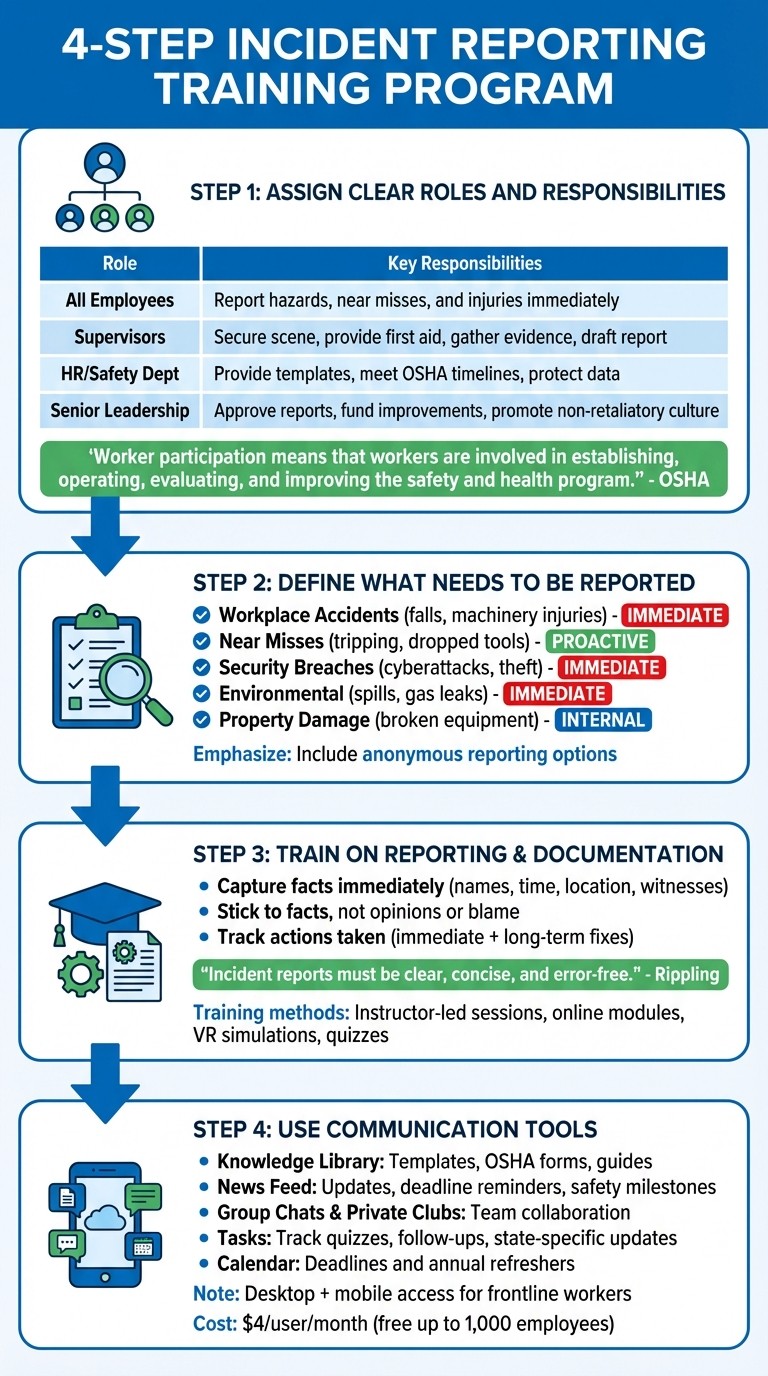
4-Step Employee Incident Reporting Training Program Implementation Guide
Let me share how we at Pebb took incident reporting from a compliance headache to a seamless part of our daily operations. It's all about structure, clarity, and making it easy for everyone to play their part. Here's how we got there.
Step 1: Assign Clear Roles and Responsibilities
The first step? Make sure everyone knows exactly what they’re supposed to do. When roles are fuzzy, things fall apart. Here’s how we break it down:
The Reporter: This could be anyone - employees, contractors, or temps - who sees or becomes aware of an incident. As the SafeDE Consult Team wisely says:
"Any person who first witnessed or became aware of a workplace incident should fill out an incident report. Those who discover a problem are generally in the best position to provide the most accurate, timely details." – SafeDE Consult Team
These folks are the front line, spotting issues before they escalate.
Supervisors and Managers: They’re the first responders. Their job? Receive reports, secure the area, provide immediate help (like first aid), and kick off the investigation.
Safety Officers and HR: They step in with tools and templates, manage records, and ensure deadlines (like OSHA’s) don’t slip through the cracks.
Senior Management: They review reports, approve budgets for safety measures, and - most importantly - create a culture where reporting feels safe and encouraged.
Here’s a quick snapshot of how it all comes together:
Role | Primary Responsibility | Key Action Items |
|---|---|---|
All Employees | Identification & Reporting | Report hazards, near misses, and injuries immediately; provide factual details. |
Supervisors | Initial Response & Investigation | Secure the scene; provide first aid; gather evidence; draft the report. |
HR / Safety Dept | Compliance & Record-keeping | Provide templates; meet OSHA timelines; protect sensitive data. |
Senior Leadership | Oversight & Resources | Approve reports; fund safety improvements; promote a non-retaliatory culture. |
If you have unions or safety committees, bring them into the fold. As OSHA points out:
"Worker participation means that workers are involved in establishing, operating, evaluating, and improving the safety and health program." – OSHA
When people feel included in shaping the system, they’re far more likely to use it.
Step 2: Define What Needs to Be Reported
Clarity is king here. If people aren’t sure what counts as reportable, incidents will slip through the cracks. We break things into clear categories:
Workplace Accidents: Falls, machinery injuries, or worse.
Near Misses: Close calls that didn’t cause harm but could’ve - like tripping over a cord or a tool falling just short of hitting someone.
Property Damage: Equipment breakdowns or damage to facilities.
Environmental Incidents: Spills, leaks, or exposure to hazardous substances.
Security Breaches: Cyberattacks, stolen devices, or unauthorized access.
We emphasize near misses because they’re like early warning signs. For instance, if someone nearly trips over a loose cable, fixing it could prevent a serious fall later.
Tailor examples to your industry. Healthcare teams might focus on patient safety and HIPAA, while manufacturing teams zero in on equipment issues. For tech companies, data breaches are a top concern. Real-world scenarios make training relatable and actionable.
Here’s a handy table we use during training:
Incident Category | Examples | Reporting Priority |
|---|---|---|
Workplace Accidents | Falls, machinery injuries | Immediate (Regulatory) |
Near Misses | Tripping, dropped tools | Internal / Proactive |
Security Breaches | Cyberattacks, theft | Immediate (Legal/IT) |
Environmental | Spills, gas leaks | Immediate (Regulatory) |
Property Damage | Broken equipment, collisions | Internal / Insurance |
We also offer anonymous reporting options to eliminate fear of retaliation. And we’re careful with incentives like “zero accident” awards - they can discourage people from being honest.
Step 3: Train on Reporting and Documentation Procedures
Once roles and definitions are clear, it’s time to teach the nuts and bolts of reporting. The goal? Make it second nature.
Capture Facts Immediately: Train employees to jot down key details while they’re fresh - names, time, location, witness accounts, and environmental factors. For example, one of our warehouse supervisors documented everything right after a slip-and-fall incident, ensuring nothing was missed.
Stick to Facts: Reports should focus on what happened, not opinions or blame. As Vanessa Kahkesh from Rippling explains:
"Incident reports are formal documents typically kept on file for future reference. They must be clear, concise, and error-free." – Vanessa Kahkesh, Content Marketing Manager at Rippling
Track Actions Taken: Include both immediate responses (like first aid) and long-term fixes (like replacing faulty equipment). Confidentiality is key - employees also need to know how to handle sensitive information, especially under regulations like HIPAA.
We provide templates for every type of incident - whether it’s a near miss, injury, or security breach - so nothing gets overlooked. To keep training engaging, we mix it up with instructor-led sessions, quick online modules, and even VR simulations. Quizzes and interactive exercises help us measure how much people are learning and where they might need extra help.
Step 4: Use Communication Tools to Support Training
Here’s where the magic happens - keeping the process alive with the right tools. At Pebb, we use our platform to make training and resources easy to access:
The Knowledge Library stores templates, OSHA forms, and guides.
The News Feed shares updates, like reminders about reporting deadlines or celebrating safety milestones.
Work Chat and Teams & Branches help teams collaborate, whether it’s supervisors or the safety committee.
The Tasks feature tracks pre-training quizzes, post-training follow-ups, and even state-specific updates.
The Calendar ensures no one misses deadlines or annual refreshers.
What’s great is that Pebb works across both desktop and mobile, so even our frontline workers can stay connected. And at just $4 per user per month (or free for up to 15 employees), it’s an all-in-one employee app for communication and operations that simplifies compliance while building a stronger safety culture.
Making Training More Effective Through Practice
Practice is the backbone of effective incident reporting training. Let’s be honest - lectures alone don’t cut it. You can talk about procedures all day, but it’s hands-on practice that transforms those lessons into real-world skills. At Pebb, we’ve seen firsthand how practice turns compliance training from a checkbox activity into something employees genuinely feel prepared for. Let me share how we’ve made it work.
Practice with Sample Reporting Forms
One of the simplest yet most impactful things we do is run workshops where employees fill out sample incident report forms. We don’t just hand out generic templates; we create realistic scenarios. Picture this: a warehouse worker has a slip-and-fall, or someone receives a phishing email. Employees then document the situation step-by-step - who was involved, what happened, when it occurred, and what actions followed.
This isn’t just busywork. It’s about building confidence. As Safeguarding Matters puts it:
"Regular practice turns good procedures into excellent protection." – Safeguarding Matters
When employees practice in a calm environment, they’re more composed and precise when something actually happens. We’ve noticed faster response times and more thorough reports because people already know what information matters. Plus, these sessions often uncover gaps in knowledge - like not knowing how to handle a near-miss or escalate a security breach. And that’s the beauty of practice: it highlights what we need to work on before it’s too late.
Use Role-Playing for Incident Response
Role-playing takes training to the next level. Here’s how it works: we create lifelike scenarios, assign roles, and let employees act out their responses. For example, one person might play a witness, another a supervisor, and someone else handles documentation. The scenarios could be anything - a chemical spill in the break room or a suspicious visitor at the front desk. The goal? Practice under pressure.
Why does this work so well? It closes the gap between knowing what to do and actually doing it when the stakes are high. As Hook Security explains:
"Simulations are another effective training format that enables employees to practice responding to real-life scenarios in a safe and controlled environment." – Hook Security Blog
We don’t limit this to safety teams. Our front desk staff practices spotting security threats, HR teams run through HIPAA scenarios, and finance teams tackle fraud detection. Each role-playing session ends with employees completing an incident report, reinforcing the importance of proper documentation. We also test communication channels - who gets called, how fast information flows, and whether the right people are looped in. These drills build confidence and muscle memory, so when a real incident happens, no one freezes.
Keep Employees Engaged with Digital Tools
Role-playing is great, but keeping skills sharp between sessions is just as important. That’s where digital tools come in. Our platform at Pebb is designed to make ongoing training easy and engaging. For starters, we’ve got a centralized Knowledge Library, a real-time News Feed, interactive Tasks, Digital forms, and Calendar events that work across all devices.
For frontline workers, mobile access is a game-changer. Imagine this: someone spots damaged equipment on the floor. They can pull up the reporting form on their phone, snap a photo, and submit everything right then and there. No delays, no hassle.
We’ve also created Spaces where safety committees can swap tips and discuss anonymized incidents. Push notifications keep everyone in the loop about training updates or new practice scenarios. The best part? It doesn’t feel like nagging. And with a cost of just $4 per user per month - or free for teams of up to 15 - Pebb makes it easy to keep everyone engaged without blowing the budget.
Tracking Results and Improving Over Time
At Pebb, we've discovered that tracking results isn't just about ticking off boxes - it's about creating a system that constantly feeds back into itself, making your program better every step of the way. Training doesn't stop after the initial sessions; it evolves through active measurement and continuous updates. Let me walk you through how we approach this.
Monitor Incident Reporting Data
Every number in your incident reports tells a story, and those stories hold the key to improving safety. At Pebb, we keep a close eye on both leading indicators - like near-miss reports, training completion rates, and safety suggestions - and lagging indicators, such as injury counts, workers' comp claims, and severity rates. The beauty of leading indicators? They let you catch potential issues before they escalate into real problems.
For instance, tracking near-miss reports helps us gauge whether employees feel comfortable reporting incidents. If we notice delays in responses or a drop in reporting, it’s often a sign of deeper issues, like unclear processes or fear of repercussions.
As OSHA advises:
"Employers should periodically, and at least annually, step back and assess what is working and what is not, and whether the program is on track to achieve its goals." – Occupational Safety and Health Administration
We use Pebb's Analytics feature to pull real-time reports, which means we can spot trends and act on them immediately. Whether it’s tweaking a process or addressing a gap in training, these insights keep us proactive.
Schedule Regular Training Updates
Once you've gathered data and feedback, the next step is keeping your training up-to-date. Regulations shift, equipment gets upgraded, and new risks pop up - it’s a moving target. That’s why we review our training program at least annually, and we make immediate updates whenever there’s a big change, like new machinery or a serious incident.
Annual refreshers do wonders for keeping safety protocols top-of-mind. We mix things up by rotating scenarios, adding updated case studies, and even using anonymized real incidents to make the training feel relevant. Our News Feed and Knowledge Library on Pebb help us roll out quick updates in between formal training sessions. For example, if OSHA introduces a new rule, we can post it instantly. Changed a reporting form? Share it right away.
Collect Feedback and Make Changes
Here’s the thing: your employees are your best resource for figuring out what’s working and what’s not. Continuous feedback not only highlights wins but also pinpoints areas that need fixing. We actively involve our team in reviewing incident reports, setting goals, and identifying gaps in our processes. Safety climate surveys are a goldmine - they reveal whether people feel safe enough to report issues without fear of backlash.
OSHA couldn’t have said it better:
"A procedure is not reasonable if it would deter or discourage a reasonable employee from accurately reporting a workplace injury or illness." – Occupational Safety and Health Administration
If employees tell us a process is too complex or causes delays, we simplify it. Pebb's Tasks feature has been a game-changer for assigning follow-ups and tracking completion times, ensuring nothing gets overlooked. And when we make changes based on feedback, we always acknowledge and celebrate those improvements. It’s a small step that goes a long way in keeping everyone engaged and motivated.
Conclusion
Let me tell you, training employees for incident reporting compliance isn’t just a box you check once and forget about - it’s an ongoing effort that truly pays off. Safer workplaces, fewer fines, and a team that feels confident speaking up - those are the real rewards. By clearly explaining the difference between recordkeeping and mandatory reporting, and staying on top of OSHA’s strict deadlines (8 hours for fatalities, 24 hours for severe injuries), you’re setting up a system that protects both your people and your organization.
Here’s the thing: even the best program can fall apart if employees don’t know what to report or when to report it. That’s why we designed Pebb to make training materials and updates easy to access at any time. Our platform pulls everything together - training resources in the Knowledge Library, instant updates through the News Feed, and follow-ups managed via Tasks. We’ve seen how this kind of integration eliminates confusion, keeps teams aligned, and takes incident management to the next level.
It all comes back to building a culture where reporting is second nature. As OSHA puts it:
"Worker participation is vital to the success of safety and health programs." – OSHA
When you pair solid training with user-friendly digital tools, you’re not just ticking compliance boxes - you’re creating a workplace where safety becomes part of the everyday rhythm. That’s what we’re aiming for at Pebb. And we’re making it easier, more effective, and affordable - starting at just $4 per user - to manage everything in one place.
FAQs
How can I create an effective training program for incident reporting compliance?
Creating an effective incident reporting training program doesn’t have to feel like climbing a mountain. The first step? Pinpoint exactly what your team needs to know. This could include identifying which incidents require reporting, understanding legal obligations, and learning how to fill out reports accurately. The key is to make the training stick - think role-playing scenarios, quick quizzes, and real-life examples that bring the process to life.
Here’s where Pebb comes in to make things seamless. You can upload all your training materials into the knowledge library, keep communication open with group chats, and set up a simple, no-fuss "Report Incident" form. Plus, tracking participation and gathering feedback becomes a breeze, helping you fine-tune the program over time.
With Pebb, staying compliant and empowering your team to report with confidence isn’t just possible - it’s easy. And the kicker? You can start for free for up to 15 employees, with Premium plans at just $4 per user per month.
How can companies create a safe and retaliation-free process for reporting incidents?
The secret to creating a reporting process free from retaliation lies in three pillars: transparency, consistency, and trust. It starts with making sure every employee knows that reporting incidents - whether it’s an injury, a safety issue, or even a near-miss - is not just encouraged but protected. A simple, step-by-step guide can make all the difference. Share it during onboarding, post it prominently in break rooms or other common areas, and keep it accessible online. This sends a clear message: every report is taken seriously, and no one will face backlash for speaking up.
Managers are the linchpin in making this work. They need to act fast - acknowledging reports within 24 hours is a great rule of thumb. Thorough investigations and open communication about outcomes (without pointing fingers) show employees that their concerns are being addressed. Even better? Recognize and celebrate employees who step forward. Tracking trends, like whether disciplinary actions follow reports, can also help spot and stop retaliation before it becomes a bigger problem. And let’s not forget: when leadership leads by example, it sets the tone for everyone else.
At Pebb, we’ve made embedding these principles into your workplace a breeze. Our platform lets employees report incidents confidentially, upload photos or videos, and even remain anonymous if they choose. Managers can monitor progress in real-time, assign tasks, and close the loop with clear resolutions - all in one place. Plus, our analytics tools are designed to catch potential retaliation patterns early. We’ve even added features like group shout-outs to celebrate employees who raise concerns. And here’s the kicker: all of this comes at just $4 per user per month. Because building a safe, supportive culture shouldn’t come with a hefty price tag.
How can we improve incident reporting compliance while keeping employees engaged?
Improving how employees report incidents while keeping them engaged starts with having the right tools and strategies in place. A solid incident-management system is a game-changer - it ensures every report is captured, tracked, and resolved without unnecessary delays. Pair this with OSHA-compliant training, and you’ve got a recipe for empowering your team to spot hazards and document incidents confidently.
Here’s where it gets even better: integrating compliance into daily workflows doesn’t have to feel like a chore. Tools like Pebb make it simple. With features like real-time chat, group feeds, task management, digital forms, calendar events, and voice/video calls, Pebb streamlines communication and operations. It’s easier than ever for employees to stay in the loop, report incidents, and complete their safety training - all in one place. And the best part? It’s budget-friendly, starting at just $4 per user per month.
When you combine a dependable incident-management system, practical training, and an intuitive communication platform like Pebb, you create a process that not only keeps compliance on track but also keeps your team engaged and motivated.
